Walking Beats Lifting for a Longer Life
You run. You lift. You do yoga. You have read every headline about high-intensity interval training.
Then a Harvard team followed 110,000 people for more than 30 years, compared every common exercise, and the longevity champion turned out to be… walking.
Not running. Not lifting. Walking — the thing you do to get from the car to the store.
Walking Is Officially the Longevity Champion
The study, published in a BMJ journal in 2026, compared how much each sport lowered the risk of dying from any cause over the follow-up. The person who exercised the most versus the person who never exercised:
| Activity | All-cause mortality reduction |
|---|---|
| Walking | −17% |
| Tennis, squash | −15% |
| Rowing, aerobics | −14% |
| Running, weightlifting | −13% |
| Jogging | −11% |
| Climbing stairs | −10% |
| Cycling | −4% |
Walking cut all-cause mortality by 17 percent. Tennis and squash: 15. Rowing and aerobics: 14. Running and weightlifting: 13. Jogging: 11. Climbing stairs: 10. Cycling: 4.
Think about what this means. The cheapest, least intimidating exercise on the planet out-performed the ones that require equipment, courts, and gym memberships.
No machines. No booking a lane. No warm-up sets. You step out the front door and you are doing it.
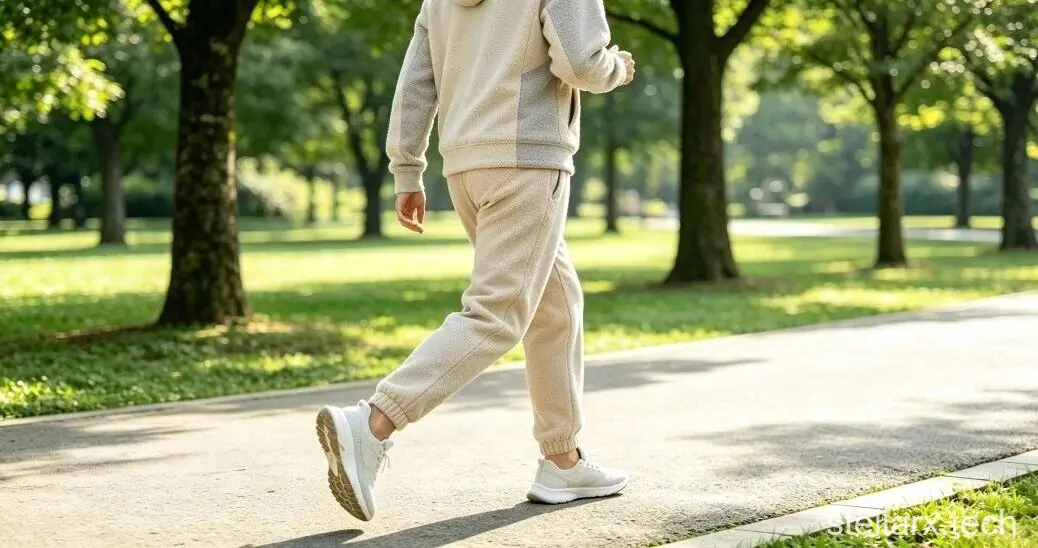
But here is the part nobody tells you: more walking is not automatically better.
The Sweet Spot Is 8,763 Steps — Not 10,000
You have heard the magic number a thousand times: 10,000 steps a day. Walk 10,000 steps and you have done your duty.
The number was never science. It came from a Japanese pedometer company's marketing campaign in the 1960s, timed to the 1964 Tokyo Olympics. A device called the manpo-kei — "10,000 steps meter" — and the slogan stuck for sixty years.
Science finally went looking for the real number. In an analysis published in the Journal of the American College of Cardiology, researchers mapped step counts against risk:
| Daily steps | What the data shows |
|---|---|
| ~2,600 | All-cause mortality risk starts to drop significantly |
| ~2,800 | Cardiovascular risk starts to drop significantly |
| 8,763 | Lowest all-cause mortality risk (optimal) |
| 7,126 | Lowest cardiovascular risk (optimal) |
| 7,000–8,000 | "Best turning point" for health benefits (Lancet Public Health 2025); beyond it, gains fade |
| ~8,000 | Ideal dose for knee-osteoarthritis prevention (Ann Rheum Dis 2025); a threshold, not a ceiling |
| Moderate-to-brisk pace | Extra survival benefit, independent of step count |
At roughly 2,600 steps a day, all-cause mortality risk starts dropping significantly. Around 2,800 steps, cardiovascular risk follows. The sweet spot — the point where risk is lowest — lands at 8,763 steps for all-cause death and 7,126 steps for cardiovascular disease.
Beyond that, the benefit stops growing. You do not get extra years for extra thousands.
And pace matters more than people think. Compared with slow strolling, a moderate-to-brisk walking pace delivered an extra survival benefit — independent of the step count. Swap your shuffle for a stride, and mortality risk drops further, no matter how many steps you took.
It was never about 10,000. It is about rhythm.
Worried About Your Knees? 6,000–8,000 Is the Safe Zone
The most common excuse to skip walking is the knees. "Walking hurts my joints." "Walking will wear out my knees."
The research says the opposite — up to a point.
In 2025, orthopedic researchers from Xiangya Hospital's key laboratory of geriatric bone and joint disease prevention, writing in Annals of the Rheumatic Diseases, found that about 8,000 purposeful steps a day is the most ideal dose for preventing knee osteoarthritis. That intensity builds muscle strength, improves joint stability, and unloads the joint.
But 8,000 steps is also a threshold. Above it, the knee benefit plateaus — the reduction in knee osteoarthritis risk stops improving.
There is even a catch the other way. Meandering steps taken at under 60 steps per minute — shuffling around the house, say — when accumulated in excess and for too long, may actually harm the joint.
A 2025 Lancet Public Health analysis of daily steps and health found the same shape of curve: the "best turning point" sits around 7,000 to 8,000 steps. Beyond it, the risk reduction for several diseases fades.
For a normal adult, 6,000 to 8,000 steps is the golden zone: enough longevity benefit, and friendly to the knees.
Three Step Targets, Three Kinds of People
The 6,000–8,000 zone is for the average adult. Your age, your health, and your waistline change the math.
| Who you are | Target steps per day |
|---|---|
| Adults 60+, chronic disease, post-surgery recovery | 4,000–6,000 |
| Healthy adults | 6,000–8,000 (golden zone, knee-friendly) |
| Overweight / sedentary | 8,000–10,000 |
Professor Gou Bo of the Xi'an Physical Education University sports medicine department puts it plainly: the "best step count" is personal.
Adults over 60, people with chronic disease, and anyone in post-surgery recovery should aim for 4,000–6,000 steps — gentle start, long-term consistency beats a heroic week.
Healthy adults: 6,000–8,000 is the universal golden range — the best cost-performance zone for health, and the knee-friendly safety zone.
Overweight and sedentary people can push to 8,000–10,000 steps.
How to Walk "Scientifically"
Once the target is set, the details decide whether it helps or hurts.
Duration. The day's total can be done in one go or split into sessions. Older adults and chronic patients do best with three 20-minute walks — kinder to the joints and to digestion. Younger people chasing fat loss and cardio can do one continuous 30+ minute brisk walk to the point of slight breathlessness.
Posture. Walk tall. Ears, shoulders, and hips in one vertical line. Let the heel hit the ground first — knee slightly bent, foot landing lightly — roll through to the forefoot, and push off. No knocked knees, no duck feet.
Stride length. A casual stride runs about 35 percent of your height — roughly 60 centimeters — and spares the knees. A brisk stride stretches to 65–70 centimeters, which builds cardio and burns fat. Deliberately overstriding beyond 45 percent of height is where knees and pelvis get hurt.
Timing. Morning or evening both work for healthy people — but wait 30–60 minutes after meals. People with cardiovascular disease should walk in the late afternoon or early evening, when blood pressure is more stable and the risk of an exercise-related event is lower.
One study after another, the pattern is the same: more steps help, faster steps help more, and there is a number where the body says "enough."
The champion exercise of the 30-year study does not need a gym. It needs a sidewalk and a pair of shoes.
More steps help. Faster steps help more. The walk is the workout.
Ever wondered what actually cushions your knee with every step? WWAI gives you real microscopy specimens to explore at multiple magnifications — including an elastic cartilage specimen where the chondrocytes and elastic fiber network that absorb impact in your joints are clearly visible — with AI answers about what you are seeing. Search "WWAI" in your app store and download it now.

Related reading
Related reading

VILPA: One Minute of Exercise Cuts Mortality

ACL Tear: Why Viral Dance Moves Injure Knees

Why a 10-Second Balance Test May Predict Disability and Death Risk
References
[1] Harvard-led cohort study of 110,000 adults followed for over 30 years, BMJ journal, 2026 — comparison of common sports on all-cause mortality reduction (walking −17%).
[2] Step-count and mortality analysis, Journal of the American College of Cardiology, 2023 — risk thresholds at 2,600/2,800 steps, optimal 8,763 (all-cause) and 7,126 (cardiovascular) steps.
[3] Purposeful daily steps and knee osteoarthritis, Xiangya Hospital / Ministry of Education Key Laboratory of Geriatric Bone and Joint Disease Prevention, Annals of the Rheumatic Diseases, 2025 — ~8,000 steps most ideal for knee-joint disease prevention.
[4] Daily step counts and health outcomes, Lancet Public Health, 2025 — best turning point at 7,000–8,000 steps.
- Can a Bunny Conquer the Jianghu? AI Animation Sparks Zootopia Debate
- 當「兔小卯」遇上江湖夢:AIGC動畫《劍兔江湖》掀起萌寵武俠熱潮
- Love Across Distance: Netizens Rally Against Heartbreak in AI Short Drama
- 熱戀隔天就分離?AI短劇《別躲》引發「防刀」焦慮與純愛呼喚
- AI Reimagining of ‘Pet Shop of Horrors’ Sparks Debate: Fans Demand Restoration of Count D’s Iconic Androgyny
- AI重現《恐怖寵物店》引熱議:D伯爵形象崩壞?極樂鳥悲劇喚醒人性反思
- AI-Generated K-Drama Short Series Sparks Debate Over Identity and Aesthetics
- AI短劇爆紅?「韓系穿越」語言混亂與臉孔崩壞引發全網熱議
- Ancient Drama’s Fertility Twist Sparks Debate on Marriage and Modern Storytelling
- 古裝短劇「前夫不孕我另嫁」爆紅:是女性覺醒爽文,還是生育焦慮的市場試探?

全部评论