Your Child Cannot Sit Straight, It Might Be Their Spine
Your kid slouches at the dinner table, leans sideways while doing homework, and five seconds after you say "sit up straight" they are curled over the desk again.
Most parents figure it is just a bad habit. Adults slouch on the sofa too. Children are wiggly, and posture is something they will grow out of.
And most of the time, that is true. Occasional slouching, leaning, and standing crooked are nothing to worry about.
But sometimes — when a child keeps leaning to the same side no matter how many times you remind them, when their shoulders stay uneven even when they try to stand tall — it is not a habit. It is a signal from their spine.
Two Kinds of Slouching
There is an important difference between the two.
The kind that gets better with a reminder. You tap your child on the back, they adjust, and for a little while their shoulders are level and their spine is straight. After a rest or a change of position, they naturally sit up again. This is usually a functional or postural issue — weak core muscles, a desk that does not fit, or simply fatigue. It is common in school-age children and usually improves with better habits and environment.
The kind that does not. Your child genuinely tries to straighten up. They adjust their shoulders, their waist, their whole torso — and they still lean to the same side. One shoulder stays higher. One shoulder blade sticks out. The waistline is uneven. This can be a structural curve: the vertebrae themselves have rotated or shifted away from the midline. The child may not even realize they are crooked. Only a doctor can rule out a skeletal development issue.
Watch for whether the asymmetry is always on the same side, whether it gets worse over time, and whether it survives a genuine attempt to stand straight. If it does, it is time for the next step.
[I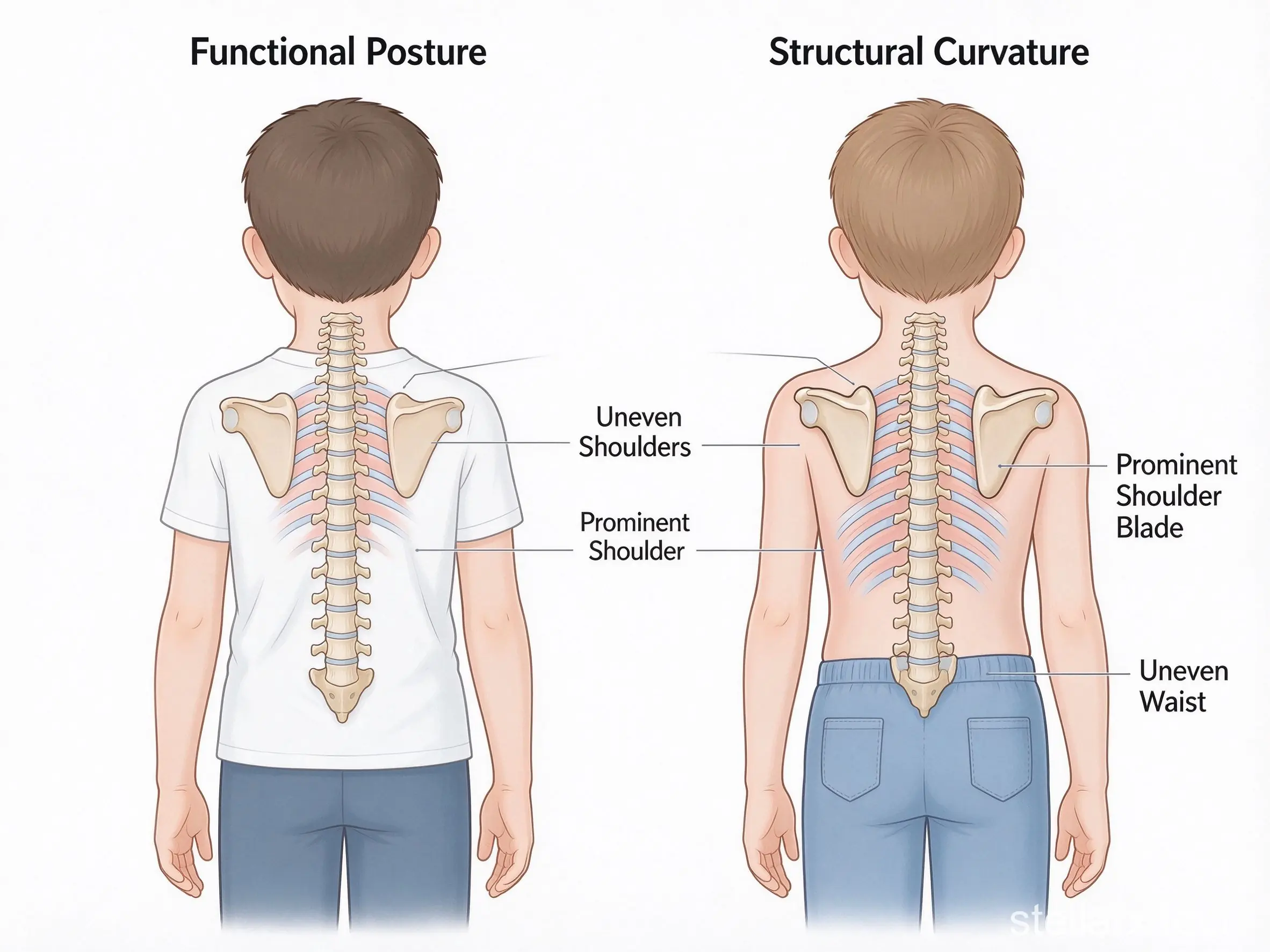
Check at Home in Two Steps
You do not need any equipment. Bath time, getting dressed, or before swimming are good moments to look at your child's back.
Pick a well-lit room. Have your child stand naturally with feet flat, arms relaxed at their sides. Do not tell them to "stand up straight" — you want to see their natural posture.
Step 1: The "four horizontals and one vertical" check
Look at five things:
Shoulders: are they level? Is the head centered?
Shoulder blades: are the bottom corners at the same height?
Waist: are the indentations on both sides symmetrical? Does one side of the waist bulge out more?
Hips: are the hip bones level? Is the pelvis tilted?
Spine: does it run in a straight line from neck to lower back?
Step 2: The forward bending test
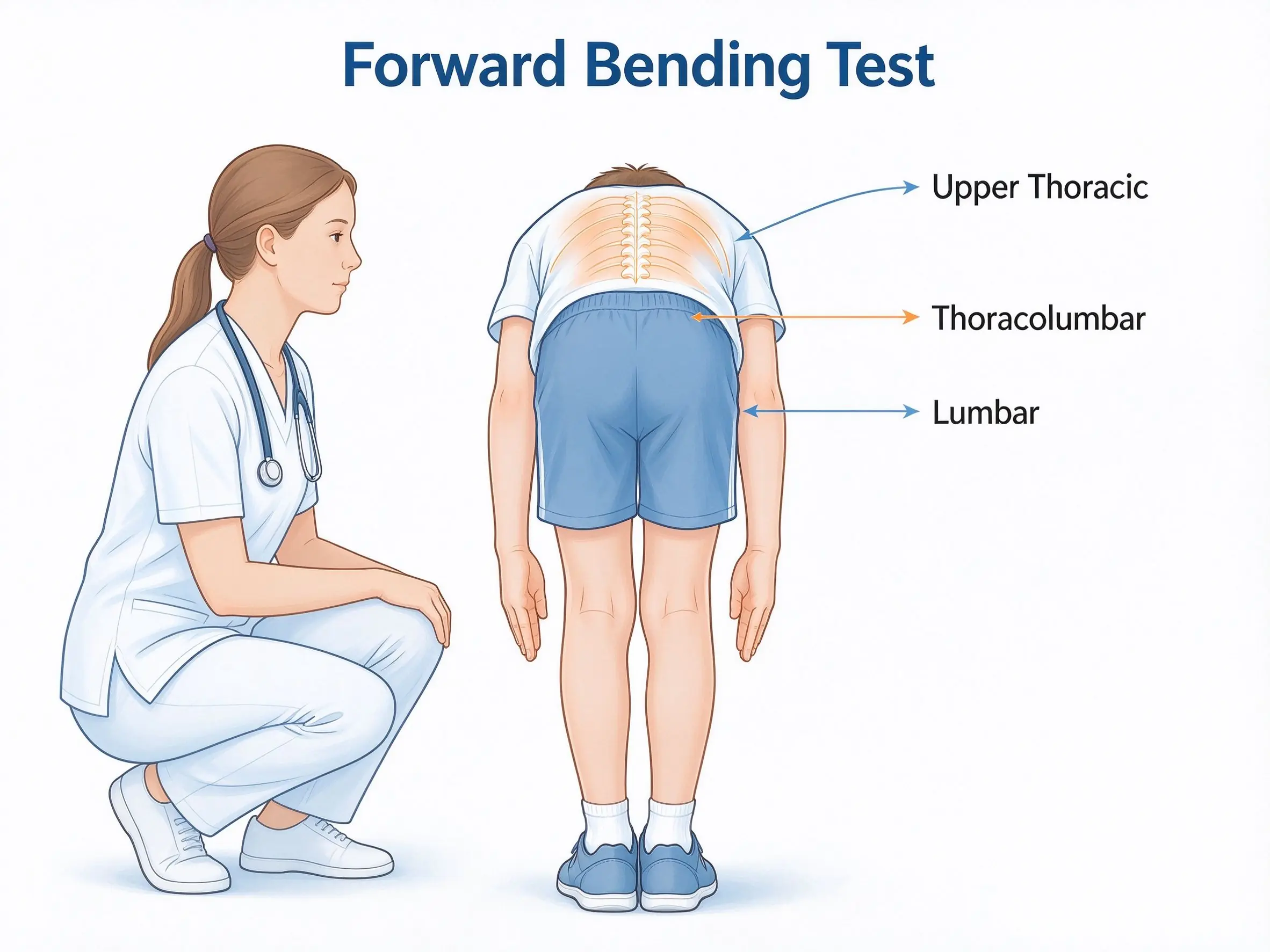
Have your child face away from you. Feet together, knees straight, arms hanging loosely with palms pressed together. Then have them slowly bend forward until their back is roughly horizontal.
Get down so your eyes are level with their back. Look from the head down to the lower back. Are both sides of the back the same height? Or does one side — upper back, mid-back, or lower back — rise higher than the other?
If you see something that looks off, do not panic. Have your child relax, move around, and try again. If the asymmetry is still there, if they cannot correct it themselves, or if it seems to be getting worse, it is time to see a doctor.
A home check is not a diagnosis. Do not rush out to buy a posture brace or corrector. Do not try to massage, crack, or "fix" the spine yourself. None of that replaces a proper evaluation — and some of it can delay the follow-up that actually matters.
The right move is a specialist: pediatric orthopedics or spine surgery. The doctor will take a history, do a physical exam, and if needed order a standing spinal X-ray to measure the Cobb angle and assess bone maturity.
Four Ways to Protect a Growing Spine
Protecting your child's spine does not mean forcing them to sit at attention from morning to night. It means helping them sit well and move often.
Get the desk and chair height right. When your child sits, both feet should rest flat on the floor or a footrest. The hips and thighs should be supported. Forearms should rest naturally on the desk. Books and screens should be at a comfortable viewing height. A desk that is too high makes them shrug; one that is too low makes them crane forward. And if they keep tilting their head or leaning in to read, get their eyes checked.
Break up long sitting sessions. You do not need your child to sit perfectly still while doing homework. What matters is getting up every 20 to 30 minutes to move — stretch the neck, shoulders, back, and limbs. Adjust the timing to your child's age, the task, and what feels comfortable.
Use a backpack that fits — and lighten it. A properly fitted two-strap backpack, adjusted so it sits close to the back, is the way to go. Take out what they do not need. The evidence does not support backpacks causing adolescent idiopathic scoliosis, but a heavy bag does cause fatigue and discomfort. A good rule of thumb: keep the backpack under 10% of your child's body weight. If they lean forward to carry it, or complain of pain, numbness, or stiffness, lighten it and find out why.
Keep them moving. Encourage whatever sport or activity they will stick with — running, ball games, swimming, cycling, jumping rope. Swimming is especially kind to the spine: buoyancy takes the load off the muscles while the back gets a balanced, symmetrical workout. And do not worry that ping-pong, badminton, or tennis — all one-sided sports — will "bend" a healthy child's spine. They will not.
The spine grows fastest during childhood and adolescence. What you do during those years matters — but it does not have to be complicated. Good posture is not about rigidity. It is about a body that can move, rest, and grow without being stuck in one position.
Want to see the tissue that makes the spine work, up close? WWAI lets you explore real biological specimens, including a human hyaline cartilage specimen — the smooth, glassy tissue that caps the vertebrae and cushions every movement of the spine. Search "WWAI" in your app store and download it now.

Related reading

Firefly Glow: A Cold Light Humans Learned to Copy

Why Letting Kids Sleep In Is a Health Move
References
[1] Mihaylova M, Ruseva Z, Filkova S. Diagnostic algorithm for detection of functional and structural spinal deformities in children. General Medicine. 2024;26(6):47-51.
[2] Zhao Y, Zhao Y, Lu S, et al. Guideline for adolescent scoliosis screening in China (public version 2024). Journal of Orthopaedic Translation. 2025;50:364-372.
[3] 中华医学会物理医学与康复学分会. 青少年特发性脊柱侧凸康复诊疗指南(2024版). 中华医学杂志. 2024;104(39):3647-3660.
[4] 国家卫生健康委疾控局. 儿童青少年脊柱弯曲异常防控技术指南.
[5] U.S. Preventive Services Task Force. Adolescent Idiopathic Scoliosis: Screening. 2018.
- Why Heartburn Comes Back After You Stop a PPI
- 胃酸反彈:停用抑酸藥反而更燒心
- 根本沒有「薄肌」這種肌肉——而這正是重點
- There Is No Such Thing as Lean Muscle — Here Is Why
- That Half-Finished Bottle on Your Desk Is Growing Bacteria
- 你桌上那瓶喝了一半的飲料,正在長細菌
- Your Child Cannot Sit Straight, It Might Be Their Spine
- 孩子坐不直,可能是脊柱發出的訊號
- Why Your Phone in the Dark Is Damaging Your Eyes
- 關燈玩手機如何傷害你的眼睛

全部评论