Why Your Phone in the Dark Is Damaging Your Eyes
It is the last ritual of the day. The lights go out, you roll onto your side, and the phone comes out. The screen is the only thing between you and sleep — and somehow it is always more interesting than it was at nine in the morning.
That comfort comes at a price your eyes pay in real time. When you look at a bright screen in a dark room, you are not just staying up late. You are putting your eye through a sequence of stresses that, repeated night after night, adds up.
The Light-Dark Contrast That Strains Your Retina
In darkness, your pupil dilates to let in more light. In brightness, it constricts to keep light out. A glowing phone screen in a pitch-black room forces the pupil into a constant cycle of dilation and constriction — over and over, as the content on screen shifts from dark to bright and back.
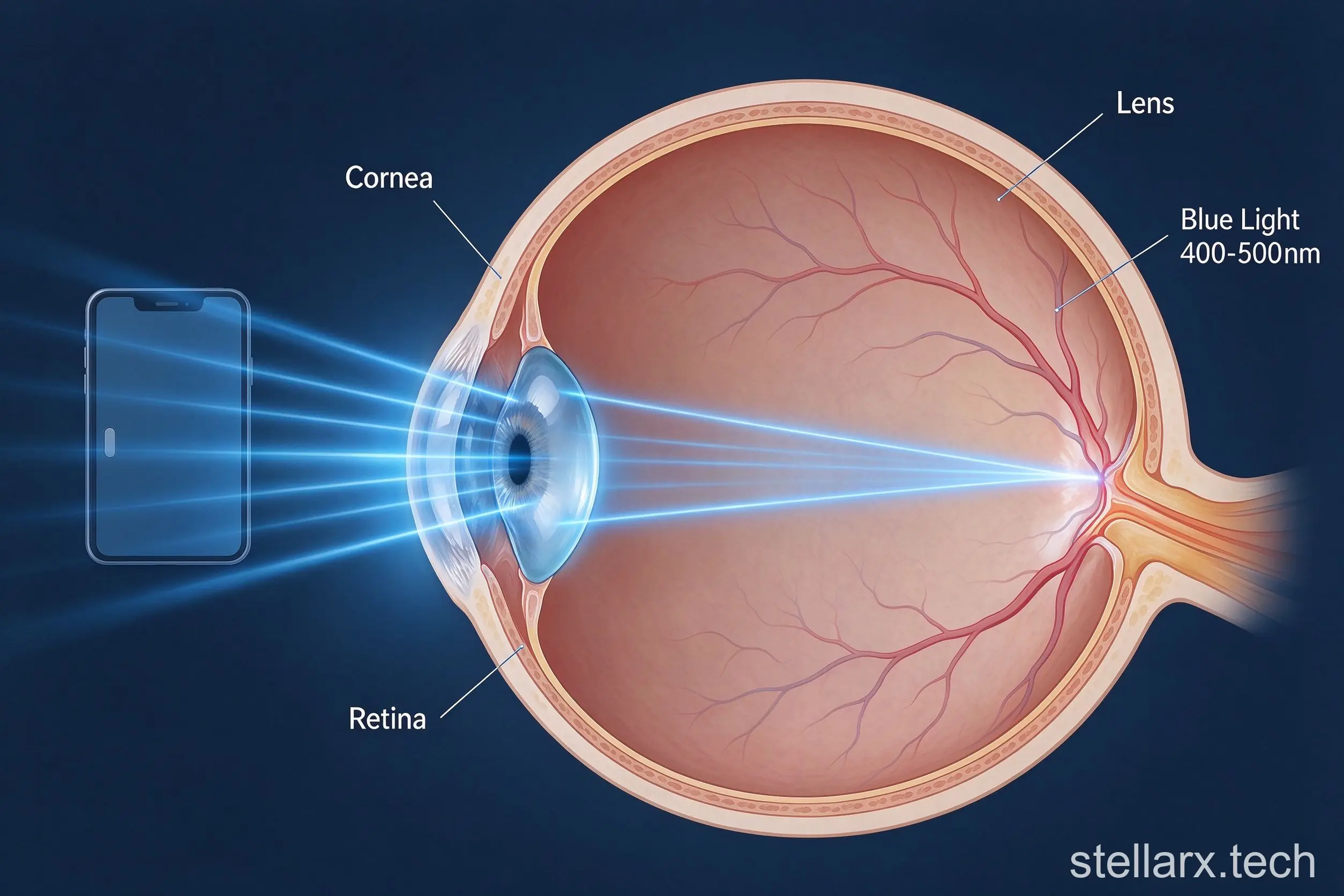
The light itself matters too. Phone screens emit blue light in the 400 to 500 nanometer range — short wavelength, high energy. Unlike longer wavelengths, blue light penetrates the cornea and lens and reaches the retina directly. Chronic exposure has been linked to macular degeneration, the progressive and irreversible loss of central vision.
The Chinese Medical Journal reported a case of suspected macular light damage in a patient who used a smartphone for six to eight hours every night, in bed, with the lights off. In people already prone to glaucoma, the dilated pupil and increased lens convexity in darkness can raise intraocular pressure — and in rare cases, trigger an acute attack. The New England Journal of Medicine has even documented two cases of transient blindness after prolonged phone use in the dark.
Your Blink Rate Drops by 57 Percent
Dry eye sounds minor. It is not. In its late stages, it means constant foreign-body sensation, inability to tolerate light, and a quality of life that is genuinely hard to treat.
A normal blink rate is about 20.8 times per minute. In an experiment with 36 healthy participants, the moment they started looking at a phone, that number dropped to 8.9 — a 57 percent fall that persisted for a full hour. In the dark, attention narrows further. You forget to blink. The tear film evaporates, the ocular surface dries, and the cycle repeats.
China alone has more than 360 million people with dry eye disease. According to the 2024 Chinese Expert Consensus on Clinical Diagnosis and Treatment of Dry Eye, the prevalence sits between 21 and 52.4 percent — roughly one in every four people.
Too Close for Comfort
During the day, you might hold your phone at arm's length. In bed, at night, the distance collapses. Studies link screen viewing distances under 33 centimeters to higher rates of myopia. Many people in bed are well under 20.
Myopia is not only a childhood problem. In adults, sustained near work can still drive axial elongation — the lengthening of the eyeball that produces true, irreversible nearsightedness, especially above 600 degrees. The ciliary muscle, which controls the lens, stays clamped in a near-focus contraction. Over time it loses elasticity, and the blur becomes permanent.
Side-Lying: One Eye Pays the Price
Lying on your side means the two eyes are no longer the same distance from the screen. The lower eye is closer, works harder, and fatigues faster. Its prescription drifts upward while the other eye stays put.
In medicine this is called anisometropia — a difference in refractive power between the two eyes. It causes more fatigue, more headaches, and poorer depth perception for tasks that rely on spatial judgment. Long term, the disrupted coordination can even shift eye alignment toward strabismus.
If You Can't Put It Down
Few people can quit the bedtime phone cold turkey. These steps reduce the damage: keep the screen at or slightly below eye level rather than craning sideways; blink consciously and often; turn on a small night lamp so the room is not pitch black; use dark or night mode; and keep screen brightness at 0 to 30 percent, matched to the ambient light.
None of this makes late-night scrolling harmless. It makes it less harmful — which, for a habit you are not going to break, is the realistic goal.
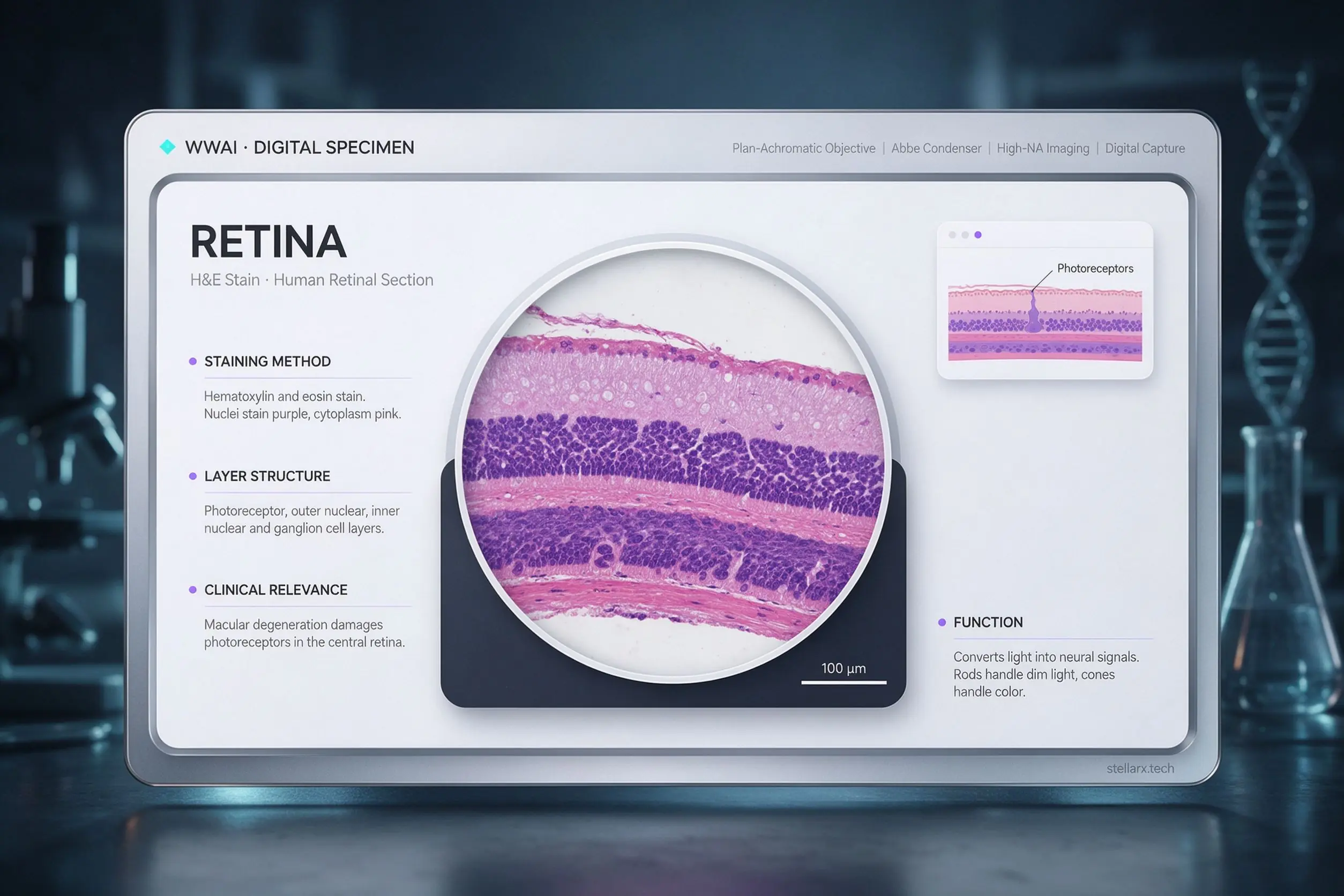
Want to see the tissue at the center of all this up close? WWAI lets you explore real biological specimens under a digital microscope — including a Euglena specimen where the light-sensitive eyespot that guides single-celled organisms toward light is clearly visible. Ask AI anything about how eyes work, then switch to 4X, 10X, 40X or 100X and look for yourself. Search WWAI in your app store to download.

Related reading

Phone in Bed: Scrolling Hurts Your Eyes

Dry Eyes? The Problem Is Oil, Not Water

Glowing Algae: A Lockdown Story of Luck
References
[1] Hui YN. New concepts of age-related macular degeneration: definition and pathogenesis. Chinese Journal of Ocular Fundus Diseases. 2024;40(3):171-174.
[2] Advances in drug research for retinal diseases. Chinese Journal of New Drugs. 2020;29(9):1001-1006.
[3] Huang XD, Gao X, Gao L, Ma G, Zhang J. Suspected macular light damage caused by excessive use of smartphone. Chinese Medical Journal. 2019;132(16):2013-2014.
[4] Hanyuda A, Sawada N, Uchino M, et al. Visual display terminal use and risk factors for dry eye disease.
[5] Chinese Expert Consensus on Clinical Diagnosis and Treatment of Dry Eye. 2024.
[6] Association between near viewing distance and myopia prevalence in children and adults.
- Why Heartburn Comes Back After You Stop a PPI
- 胃酸反彈:停用抑酸藥反而更燒心
- 根本沒有「薄肌」這種肌肉——而這正是重點
- There Is No Such Thing as Lean Muscle — Here Is Why
- That Half-Finished Bottle on Your Desk Is Growing Bacteria
- 你桌上那瓶喝了一半的飲料,正在長細菌
- Your Child Cannot Sit Straight, It Might Be Their Spine
- 孩子坐不直,可能是脊柱發出的訊號
- Why Your Phone in the Dark Is Damaging Your Eyes
- 關燈玩手機如何傷害你的眼睛

全部评论