Why Heartburn Comes Back After You Stop a PPI
You took omeprazole for two months. The burning settled. Then you stopped — and within days, the heartburn was back. For some people, it is worse than before they ever started.
The obvious conclusion: the disease was never cured, and the pill was the only thing holding it together.
That conclusion is tempting, and it is mostly wrong. A good share of the acid that shows up in the weeks after stopping was left behind by the acid-suppressing treatment itself. While the drug was on, the stomach quietly changed how much acid it could make. When the drug came off, production overshot the old baseline for a while. Gastroenterologists call this rebound acid hypersecretion.
Why this matters is not comfort. It decides two things: whether the weeks after stopping count as a relapse, and whether you should go back to the old dose and stay there for good.
The Acid Factory Rewires Itself While the Drug Is On
Start with the production line.
Acid is made by parietal cells in the stomach lining. The machine doing the pumping is the proton pump on their surface — the H⁺/K⁺-ATPase that pushes hydrogen ions into the stomach cavity. Proton pump inhibitors work exactly here: they bind irreversibly to active pumps and switch them off. A parietal cell cannot reactivate a blocked pump; it has to wait for a freshly built one. That is why a single daily dose can keep stomach acidity suppressed for a full day.
Now the regulator. Cells in the stomach antrum — G cells — release gastrin into the blood, and gastrin travels back to the body of the stomach to urge parietal cells on. This throttle has a brake: when acidity is high, D cells release somatostatin, which suppresses G cells, and gastrin falls. Acid high, gastrin low. Gastrin low, acid low. One ring holding the other in check.
An acid-suppressing drug removes the acid, so the brake lets go. The antrum no longer senses enough acid. G cells keep getting the green light, and blood gastrin stays elevated for the entire course of treatment.
Here is the part most people miss: gastrin is not just a signal to make acid. It is a growth signal for the stomach lining. Enterochromaffin-like cells — ECL cells — multiply and become more active under gastrin's push. They release histamine, which stimulates neighboring parietal cells. The parietal cells themselves enlarge under prolonged gastrin exposure.
So during the months on the drug, the acid factory keeps expanding its production line — only the exit is blocked, so no acid is measured in the stomach. Stop the drug, and newly synthesized proton pumps come online within days. The expanded line runs at full capacity, and total acid output overshoots what it was before the treatment. It does not return straight to baseline.
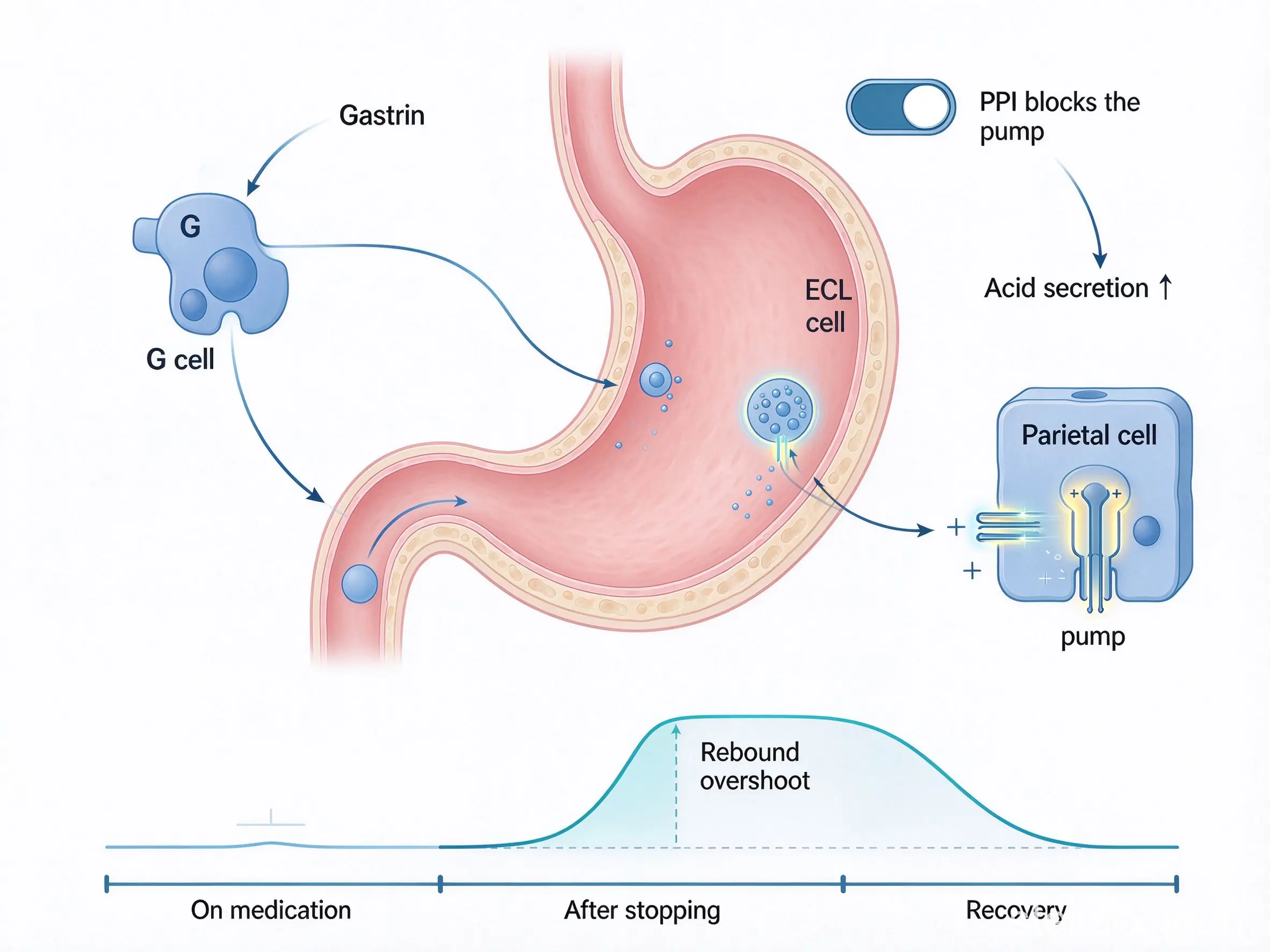
A Norwegian study caught this directly. Researchers followed patients who had taken long-term acid suppression, then stopped after anti-reflux surgery. Acid output measured at four and eight weeks after stopping was higher than at twenty-six weeks. Biopsies counted histidine-decarboxylase-positive cells — the ECL cells — and at twenty-six weeks they were down sixty percent from before surgery. Cells rose first, fell later; acid followed the same curve. The rebound involved not just parietal cells but the ECL layer underneath them.
How Much Extra Acid, and for How Long
A Glasgow study put numbers on the overshoot. Twelve H. pylori-negative volunteers took omeprazole 40 mg daily for eight weeks. Fifteen days after stopping, basal acid output was 82 percent higher than before treatment. Maximal acid output was 28 percent higher.
Eighty-two percent sounds alarming. Put it back in context. Basal acid output is the acid the stomach makes on its own, empty and unstimulated — a small number by nature. Even doubled, it stays inside physiological range, but it lines up exactly with the acid-reflux feeling people get at night and on an empty stomach. Maximal acid output is the ceiling of what the stomach can produce, and that ceiling rose only 28 percent. The extra acid in this window is mostly resting-state acid, not a stomach that suddenly gained double the pumping capacity.
The same study showed the rebound tracks how deeply the drug suppressed acid: people whose gastric pH stayed above 4 while on the drug saw maximal acid output rise 48.0 percent; those below 4, only 21.0 percent. People with fasting gastrin above 25 ng/L rose 49.2 percent; below 25, 19.8 percent. The more completely the acid was suppressed and the higher gastrin climbed, the sharper the rebound. Dose and duration are not bystanders.
Duration matters too. In the Norwegian study, long-term users stayed above baseline for more than eight weeks but less than twenty-six; at twenty-six weeks the numbers had fallen back. Short courses rebound for less time — usually two to four weeks.
Even Healthy People Get Heartburn After Stopping
Measuring acid is one thing. Whether the extra acid actually hurts is another question, and a Danish trial answered it with the cleanest possible design: healthy people with no stomach disease at all.
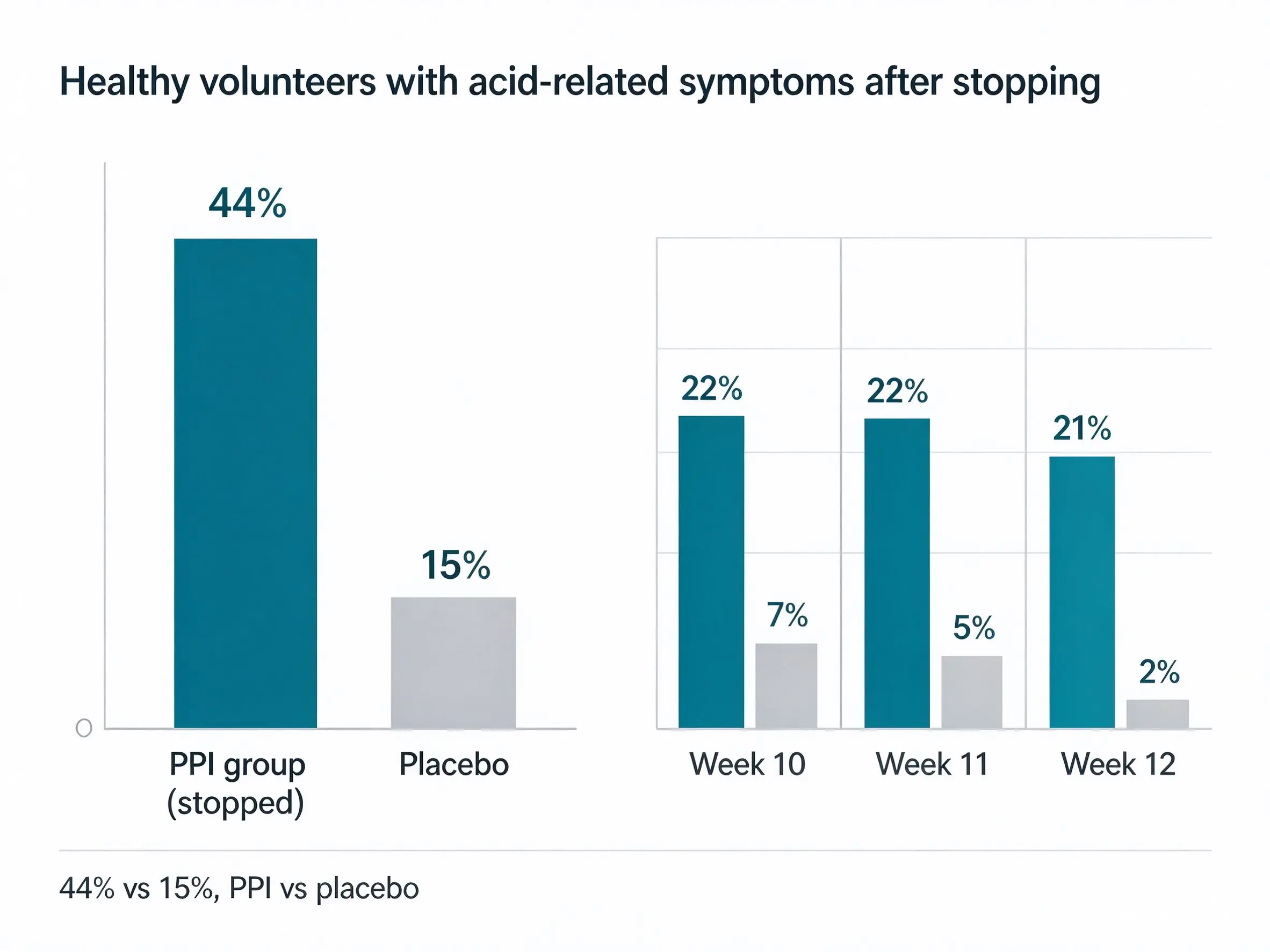
The study took 120 healthy volunteers and randomized them. One group took esomeprazole 40 mg daily for eight weeks, then placebo for four. The other took placebo for all twelve weeks. Both groups scored their gastrointestinal symptoms weekly on the same scale — heartburn, acid regurgitation, and dyspepsia counted as a clinically meaningful acid-related symptom when any item scored above 2.
In weeks 9 to 12 — the four weeks after the drug group stopped — 44 percent of the esomeprazole group (26 of 59) reported at least one acid-related symptom, versus 15 percent of the placebo group (9 of 59). Week by week, the drug group ran 22, 22, and 21 percent in weeks 10, 11, and 12, while placebo ran 7, 5, and 2 percent.
The weight of these numbers is in the volunteers. No reflux disease. No ulcers. Identical symptom scores at entry. The only difference was whether they had swallowed a PPI for eight weeks. In other words: the acid-reflux feeling after stopping can be manufactured entirely by the drug, with no underlying disease required.
Bring that back to the clinic. A person takes eight weeks of acid suppression for upper-abdominal discomfort, stops, and the symptoms return. It could be the original problem never resolved, or it could be rebound. Symptoms alone cannot tell the two apart — and the two call for completely different handling.
Why Some People Feel Nothing at All
The same Glasgow study included nine H. pylori-positive volunteers, and their rebound was inconsistent — some showed raised acid, others stayed suppressed. Chronic H. pylori infection inflames the stomach body, and that inflammation itself suppresses acid production. The ongoing suppression masks the rebound.
That explains the clinic. Some people stop and feel nothing: their suppression was shallow and gastrin never climbed; or their stomach lining already produced less acid; or their symptom threshold is high and the same acid load does not register. Rebound is conditional — a matter of degree — not something everyone who stops necessarily suffers.
When Stopping Is the Wrong Move
None of this is an argument to stop. Some people need long-term acid suppression, and for them the risk of stopping outweighs weeks of heartburn. The American Gastroenterological Association's 2022 clinical practice update on deprescribing proton pump inhibitors lists the cases plainly:
Complex gastroesophageal reflux disease with a history of severe erosive esophagitis, esophageal ulcers, or strictures — generally do not attempt withdrawal.
Confirmed Barrett's esophagus, eosinophilic esophagitis, or idiopathic pulmonary fibrosis — generally do not attempt to taper.
People at high risk of upper GI bleeding should not attempt withdrawal; assess bleeding risk with a validated method first.
The update carries one easily missed warning: the reason to stop should be that there is no longer an indication for the drug — not concern about the harms of long-term use. Having already experienced a PPI-related adverse event, or carrying risk factors for one, does not by itself justify stopping. Restated: stop because the drug no longer has an indication, not because it might be harmful.
For anyone on long-term acid suppression who wants off, the first step is not lowering the dose. It is going back to confirm why the drug was prescribed in the first place and whether that reason still holds. That step needs the original workup and diagnosis — a doctor's eyes, not the medicine cabinet's.
How to Get Through the Transition
The 2022 update offers two practical moves.
One: people stopping long-term acid suppression should be told in advance that transient upper-GI symptoms may appear, because of rebound acid hypersecretion. Knowing those weeks are coming — versus fighting them blind — changes the clinical outcome. A symptom that looks like a relapse and immediately pulls the patient back to the original dose is the common path to staying on the drug forever. That is exactly the concern the Danish authors raised.
Two: taper or stop outright, since the update names neither method superior. People on twice-daily dosing who still need treatment can usually step down to once daily first.
Some situations are not for self-management — see a doctor: difficulty or pain swallowing, vomiting blood or black stools, unexplained weight loss, or new upper-abdominal pain that does not settle. These are not rebound. They are alarm symptoms that need a workup, and tinkering with doses while waiting will only delay it.
Back to the opening judgment. Heartburn a few days after stopping does not prove the disease never went away, and it does not prove it is cured. It looks most like a transition phase left behind by drug withdrawal. The real move is to revisit why the drug was started and whether that reason still stands — a question for a doctor and the original evaluation, not for guessing from symptoms.
Want to see the stomach lining that runs this whole production line up close? WWAI lets you explore real biological specimens, including a smooth muscle specimen — the layered wall of the stomach that stretches and churns as the acid does its work. Search "WWAI" in your app store and download it now.

Related reading

Heartburn or GERD: The Valve That Gives Up
Why Stomach Acid Can't Kill Parasite Eggs
References
[1] Reimer C, Søndergaard B, Hilsted L, Bytzer P. Proton-pump inhibitor therapy induces acid-related symptoms in healthy volunteers after withdrawal of therapy. Gastroenterology. 2009;137(1):80-87.
[2] Gillen D, Wirz AA, Ardill JE, McColl KE. Rebound hypersecretion after omeprazole and its relation to on-treatment acid suppression and Helicobacter pylori status. Gastroenterology. 1999;116(2):239-247.
[3] Fossmark R, Johnsen G, Johanessen E, Waldum HL. Rebound hypersecretion after long-term inhibition of gastric acid secretion. Aliment Pharmacol Ther. 2005;21(2):149-154.
[4] Targownik LE, Fisher DA, Saini SD. AGA Clinical Practice Update on De-Prescribing of Proton Pump Inhibitors: Expert Review. Gastroenterology. 2022;162(4):1334-1342.
- Why Heartburn Comes Back After You Stop a PPI
- 胃酸反彈:停用抑酸藥反而更燒心
- 根本沒有「薄肌」這種肌肉——而這正是重點
- There Is No Such Thing as Lean Muscle — Here Is Why
- That Half-Finished Bottle on Your Desk Is Growing Bacteria
- 你桌上那瓶喝了一半的飲料,正在長細菌
- Your Child Cannot Sit Straight, It Might Be Their Spine
- 孩子坐不直,可能是脊柱發出的訊號
- Why Your Phone in the Dark Is Damaging Your Eyes
- 關燈玩手機如何傷害你的眼睛
全部评论