Incomplete Blink: The Hidden Cause of Screen Dry Eyes
The air dries out when the weather turns cold, and the first thing to feel it is an office worker's eyes. A few minutes at the screen and they burn, tight, as if a grain of sand got in. The letters blur. Step into a cold wind and the tears come without warning.
The usual "aggressive eye care" routine: buy eye drops, stay off the phone, even wear blue-light-blocking glasses that the American Academy of Ophthalmology says most people don't need. [4]
But the most basic protective action you own — blinking — is probably the one you're doing wrong.
Blinking is your eye's built-in moisturizer. Modern life makes you do less of it.
Your eyeball is covered by a thin film of water, medically called the tear film. Everything you rely on — comfort, sharp vision — depends on it.
Each blink is your eye quietly maintaining itself.
Think of the eyelid as a windshield wiper: open, shut, and the lid spreads a fresh layer of tears evenly across the eyeball. One basic round of watering.
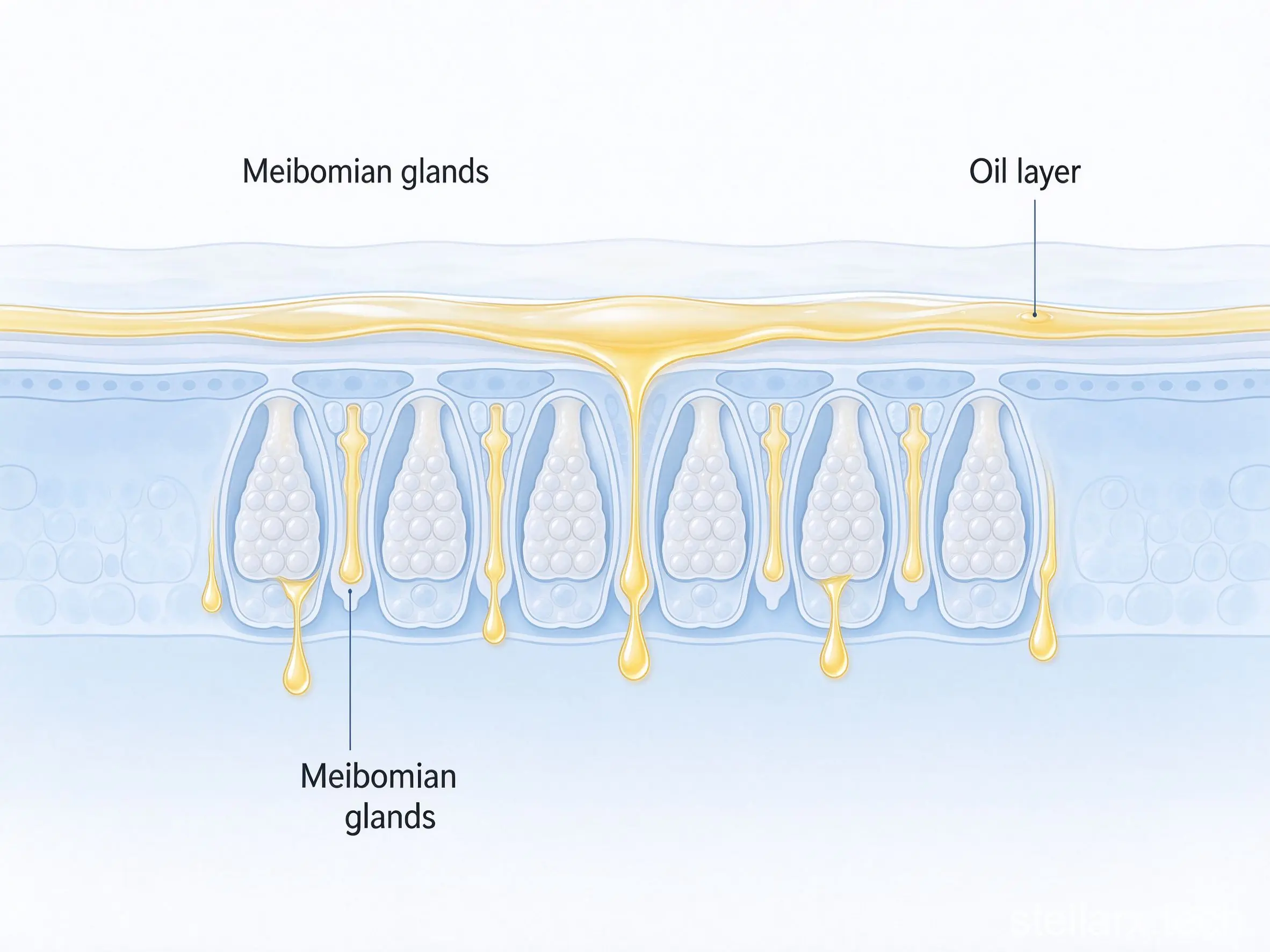
The clever part: a blink also seals the water in with a layer of oil (lipid). Inside both eyelids sits a row of tiny glands called meibomian glands, built to squeeze out oil. When you blink completely, eyelid muscles compress them, push the oil out, and it floats to the top of the tear film.
That thin lipid coat is the eye's own "moisturizing cream" — it caps the water and stops it evaporating.
A real blink is never just "closing the lid for a moment." It is one operation that adds water and presses the oil. Two steps, both required.
This factory setting, however, is affected by what you're doing.
Reading, crafting, and above all staring at a screen to finish a deck, watch a video, or play a game: focus narrows, and your blink rate quietly falls.
The longer the gap between blinks, the longer the tear film goes unrenewed — and the drier, grittier your eyes feel.
| Phase of a blink | What the eyelid does | Tear film & lipid layer |
|---|---|---|
| Between blinks | Lid at rest | Tear film flattens, evaporates and breaks up |
| Closing | Lid moves down quickly | Lipid layer moves slowly |
| Closing-to-opening moment | Lid stops moving | A trough forms in the tear film |
| Opening | Lid moves up quickly | Tear film keeps flowing upward and spreading |
Researchers measured it directly: in 36 children aged 6 to 15, switching from ordinary conversation to playing a mobile game dropped their average blink rate from 20.8 blinks per minute to 8.9 — a reduction of about 57%. [1]
The change appeared in the first minute of gaming and lasted the entire one-hour session. 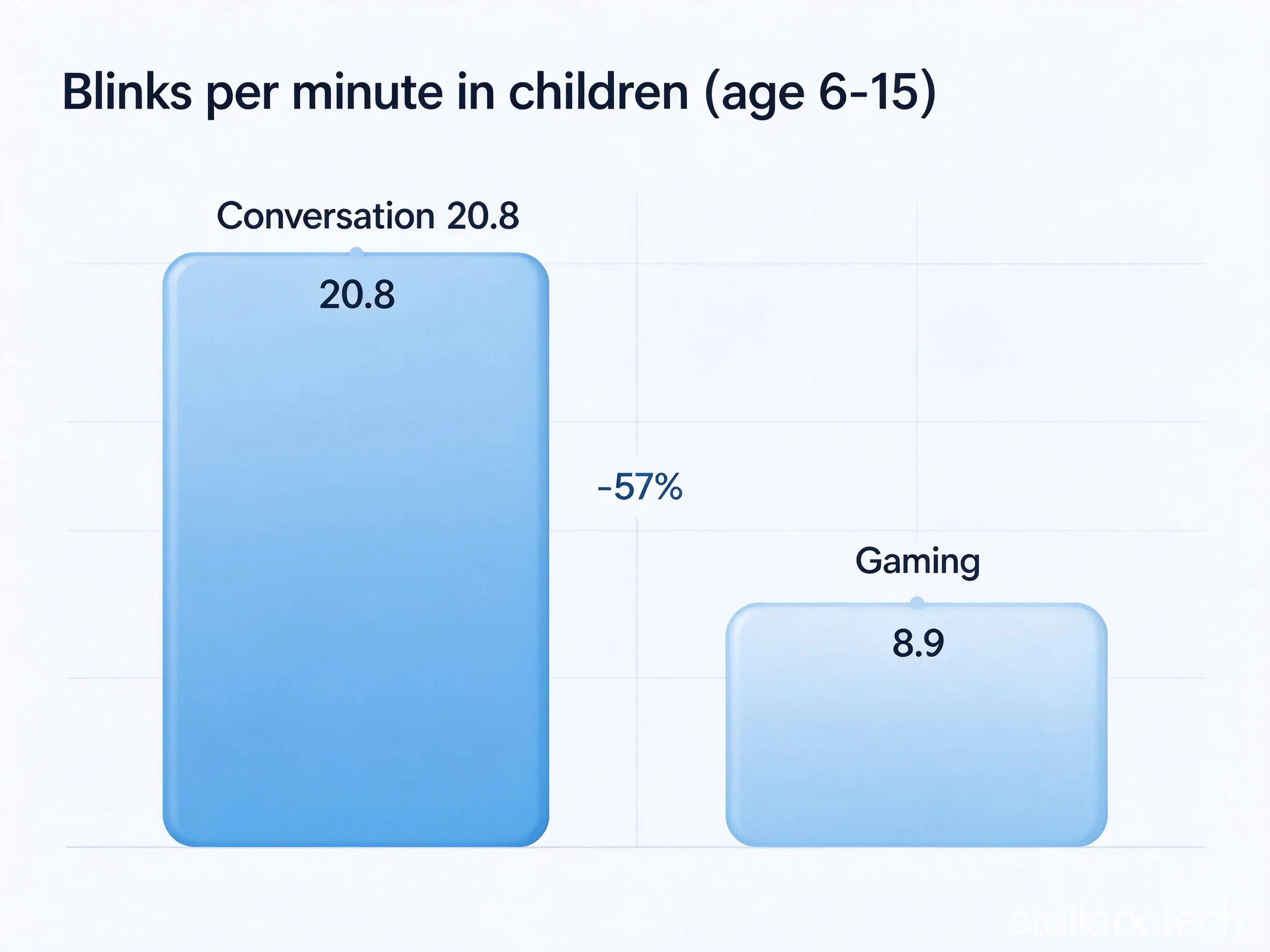
But there's a quieter problem, easier to miss than blinking less.
You might be blinking without really blinking.
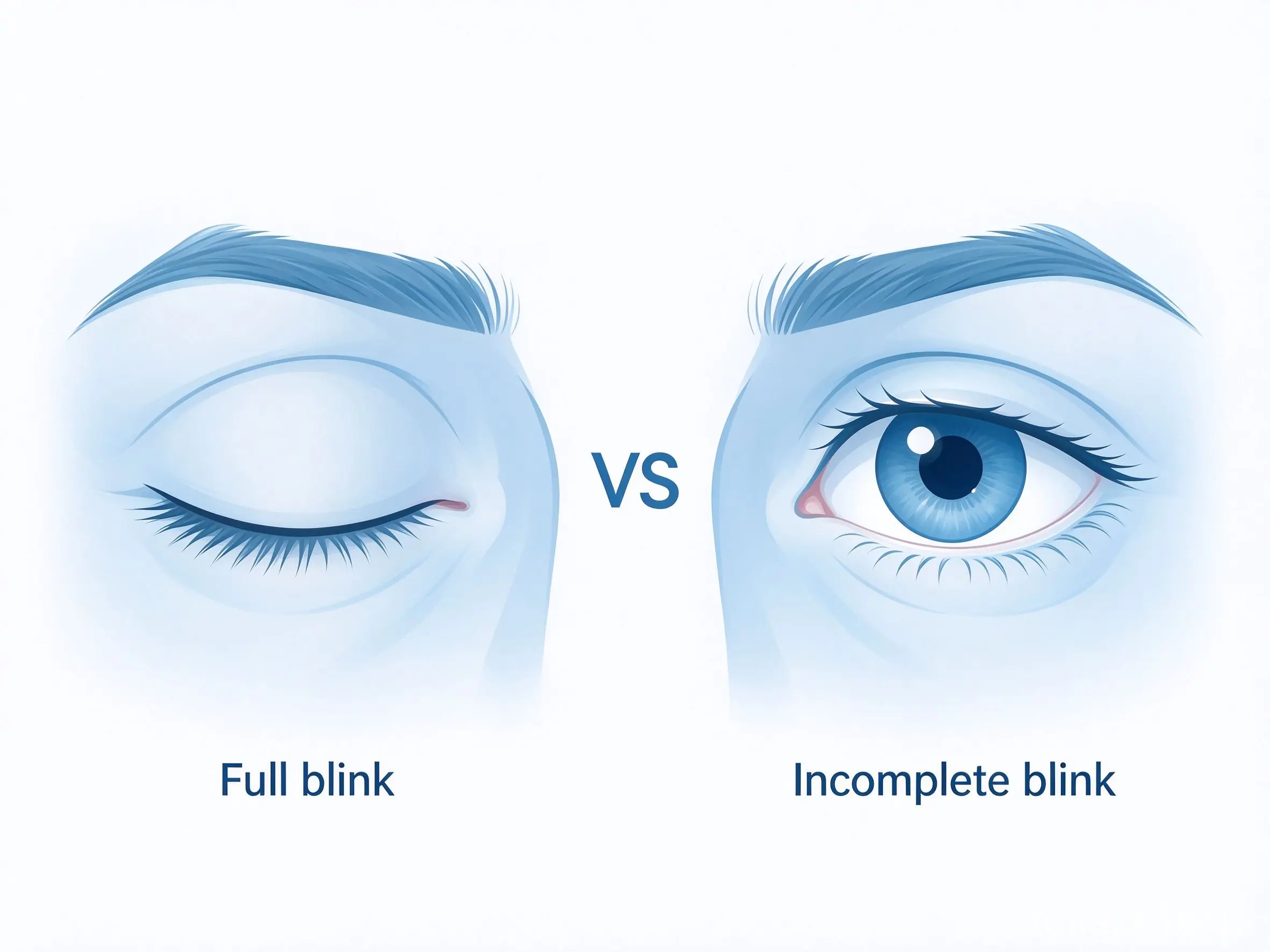
Check yourself: when you stare at a screen, does your upper lid only drift halfway down — never touching the lower lid, sometimes not even covering the pupil — before snapping back up?
The motion lasts a few milliseconds — too fast to notice. In eye medicine it has a name: incomplete blink — the eyelid fires a blank.
| A full blink | An incomplete blink |
|---|---|
| Upper lid falls fully and meets the lower lid | Upper lid falls only partway; a gap stays open |
| Effect: the lids meeting fully spreads the tear film evenly over the eye | Effect: the lids never meet, so parts of the surface stay under-moistened |
Why does a half-done blink matter? Back to the wiper:
The wiper only covers half the windshield. It should sweep top to bottom; instead it retreats halfway, so the lower part of the glass never gets cleaned — a permanent "missed zone" of moisture.
The oil pump can't press. The squeeze that forces oil out of the meibomian glands only happens when the lids fully meet. A shallow lid flick doesn't tighten the muscles, no oil is released, and the tear film — with nothing to cap the water — evaporates faster.
Blinking less means the gap between moisturizing rounds is too long. Blinking incompletely means every round is a half-measure. Put both together with dry autumn air and an office heater blowing on your face, and dry, red eyes are nearly guaranteed — the exact picture today's dry-eye management guidelines were built around. [2]
Try one real, complete blink right now.
Close your eyes gently and fully. Let the lids meet completely, hold for one second, then slowly open. No need to frown — just feel that unfamiliar sensation of a properly moistened eye surface.
It looks trivial, but it works. In a study of people with dry eye, after four weeks of blink training, symptom scores improved clearly and the proportion of incomplete blinks fell sharply. [3]
During work, give yourself fixed anchors: every time you finish typing a paragraph, while a file loads, or right after you hang up a call, look away and do two slow, complete blinks.

Eye care that costs nothing: give your eyes a micro-vacation.
A few small daily habits make the screen time far more comfortable — the National Eye Institute lists dry, gritty, burning eyes among the classic signs of dry eye to watch for. [5]
You don't need an expensive gadget to protect your eyes. The most effective habits are free.
| Tip | What to do |
|---|---|
| Keep the screen slightly below eye level | Adjust screen height so your eyes look gently downward; the drooping upper lid covers more eye surface and slows water evaporation |
| Look into the distance during long sessions | Use the 20-20-20 rule: every ~20 minutes, look at something about 6 m away for at least 20 seconds — and add a few slow, complete blinks |
| Put the phone down when resting | Switching from computer to phone keeps your eyes in near work; use the break to go screen-free instead of waiting until your eyes feel dry |
| Avoid direct airflow; manage dryness sensibly | Keep air conditioning, heating or fans off your face and humidify dry air. For dry eyes, use artificial tears as needed; if you need them often, ask a doctor or pharmacist about preservative-free options |
| If eyes stay dry, red, or clearly itchy, see an ophthalmologist — don't self-treat with antibiotic or steroid drops. | |
The next time you're lost in the screen, stop and remind yourself:
Blink. And make this blink complete.
The tear film, the meibomian glands, the surface cells of your eye — these quiet machines are a world of their own under a virtual microscope. Want to see the same protective system that keeps your eyes working all day, up close? Just search "WWAI" in your app store and observe the biological specimen online — ask its AI anything while you look. Including an oral epithelium specimen where layered epithelial cells with clearly visible nuclei line up the way they do on the eye's surface.

Related reading

Phone in Bed: Scrolling Hurts Your Eyes

Dry Eyes? The Problem Is Oil, Not Water

Woodpecker Concussion Myth: Real Brain Damage
References
1. Chidi-Egboka NC, Jalbert I, Golebiowski B. Smartphone gaming induces dry eye symptoms and reduces blinking in school-aged children. Eye (Lond). 2023;37(7):1342–1349. doi:10.1038/s41433-022-02122-2.
2. Jones L, Craig JP, Markoulli M, et al. TFOS DEWS III: Management and Therapy. American Journal of Ophthalmology. 2025.
3. Kim AD, Muntz A, Lee J, Wang MTM, Craig JP. Therapeutic benefits of blinking exercises in dry eye disease. Contact Lens and Anterior Eye. 2021;44(3):101329. doi:10.1016/j.clae.2020.04.014.
4. American Academy of Ophthalmology. Are Blue Light-Blocking Glasses Worth It?
5. National Eye Institute. Dry Eye. Updated August 6, 2025.
- 捏住老虎後頸,牠會像貓咪一樣乖巧順從嗎?
- How to Tell If an Adrenal Nodule Makes Hormones
- 腎上腺結節功能檢查:抽血判斷,不是看 CT 大小
- Pacific Oyster Invasion: The Edible Ecosystem Engineer
- 牡蠣:入侵歐洲的海洋工程師,也是桌上美食
- Incomplete Blink: The Hidden Cause of Screen Dry Eyes
- Silence Speaks Volumes: The Rise of Immersive “Cool Girl” Makeup Tutorials
- 無聲勝有聲:沉浸式「冷感御姐妝」引發全網仿效與容貌焦慮辯證
- 不完全眨眼:螢幕前眼睛乾澀的真正原因
- Winter Wardrobe Rebellion: The Rise of 'Disgusting' Comfort

全部评论