How to Tell If an Adrenal Nodule Makes Hormones
A CT scan finds an adrenal nodule nobody asked for. The report says it is 2.4 centimeters, well-defined, and probably benign. Everyone exhales. Then the question nobody can answer from the image alone: is this thing actually making hormones? The size of the nodule — 1 centimeter or 3 — has no fixed relationship to whether it secretes. The scan measures density, borders, and dimensions. Hormones go straight into the blood and leave no mark on the image. To judge function, you test the blood.
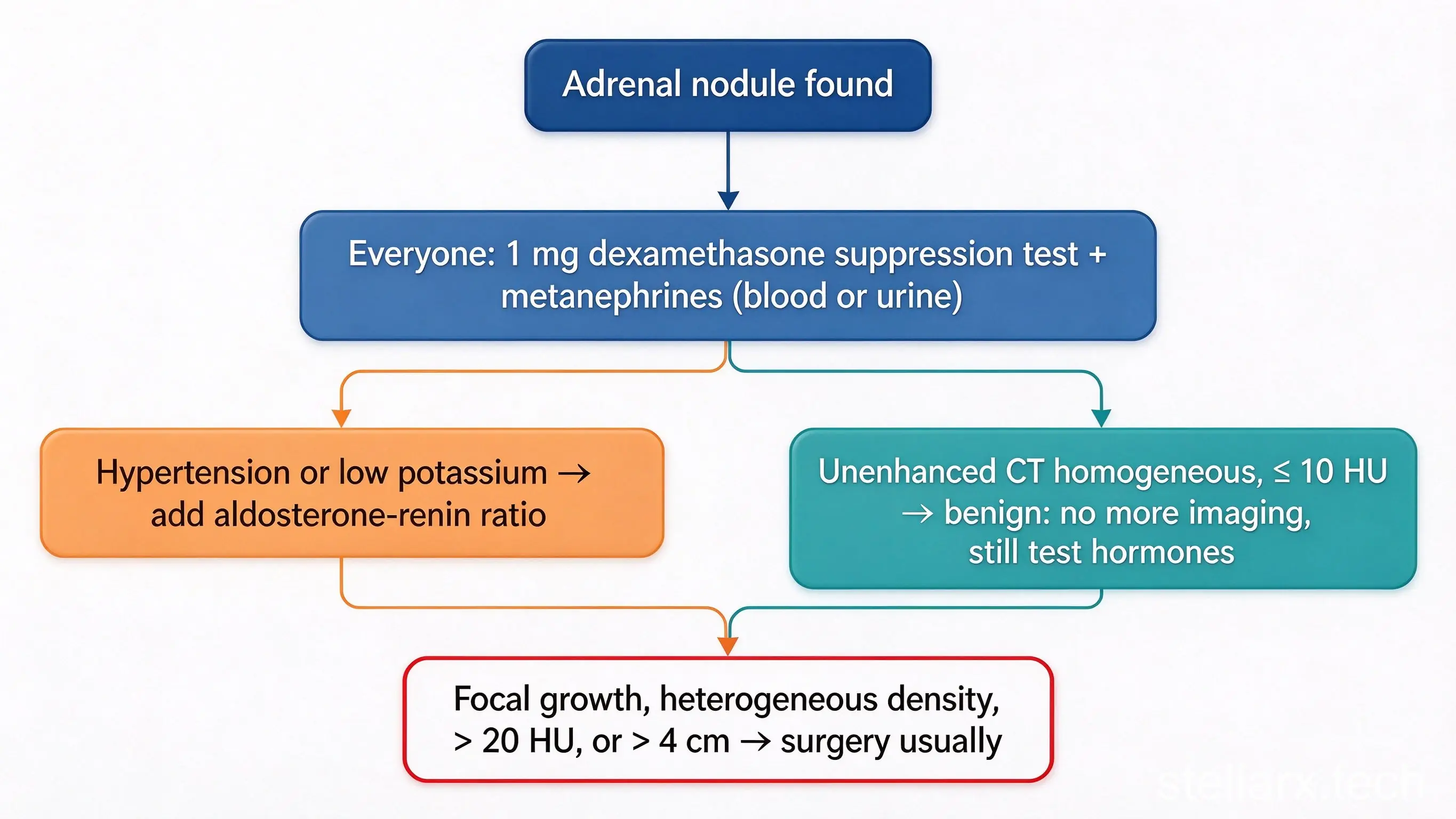
The European Society of Endocrinology's 2023 guideline on adrenal incidentalomas is blunt: every incidentally discovered adrenal nodule gets two hormone checks — an overnight 1-milligram dexamethasone suppression test, plus metanephrines in blood or urine. If the person has high blood pressure or low potassium, add the aldosterone-to-renin ratio.
Functional nodules are not rare. A Chongqing screening center ran adrenal CT on 25,356 routine physical-exam adults: 351 had adrenal tumors, a prevalence of 1.4 percent — 0.2 percent in the 18-to-25 group, rising to 3.2 percent above age 65. Of the 212 adenomas that completed endocrine workup, 69.3 percent secreted nothing, 18.9 percent showed autonomous cortisol secretion, 11.8 percent were primary aldosteronism, and not one was a pheochromocytoma. Roughly 3 of every 10 people who got the blood tests came back functionally abnormal.
| Function of the adenoma (n=212) | Share | ≈ people |
|---|---|---|
| Nonfunctioning | 69.3% | 147 |
| Autonomous cortisol secretion | 18.9% | 40 |
| Primary aldosteronism | 11.8% | 25 |
| Pheochromocytoma | 0% | 0 |
| Source: 212 adenomas with completed endocrine workup, Chongqing screening population (Jing Y, et al. Ann Intern Med 2022). | ||
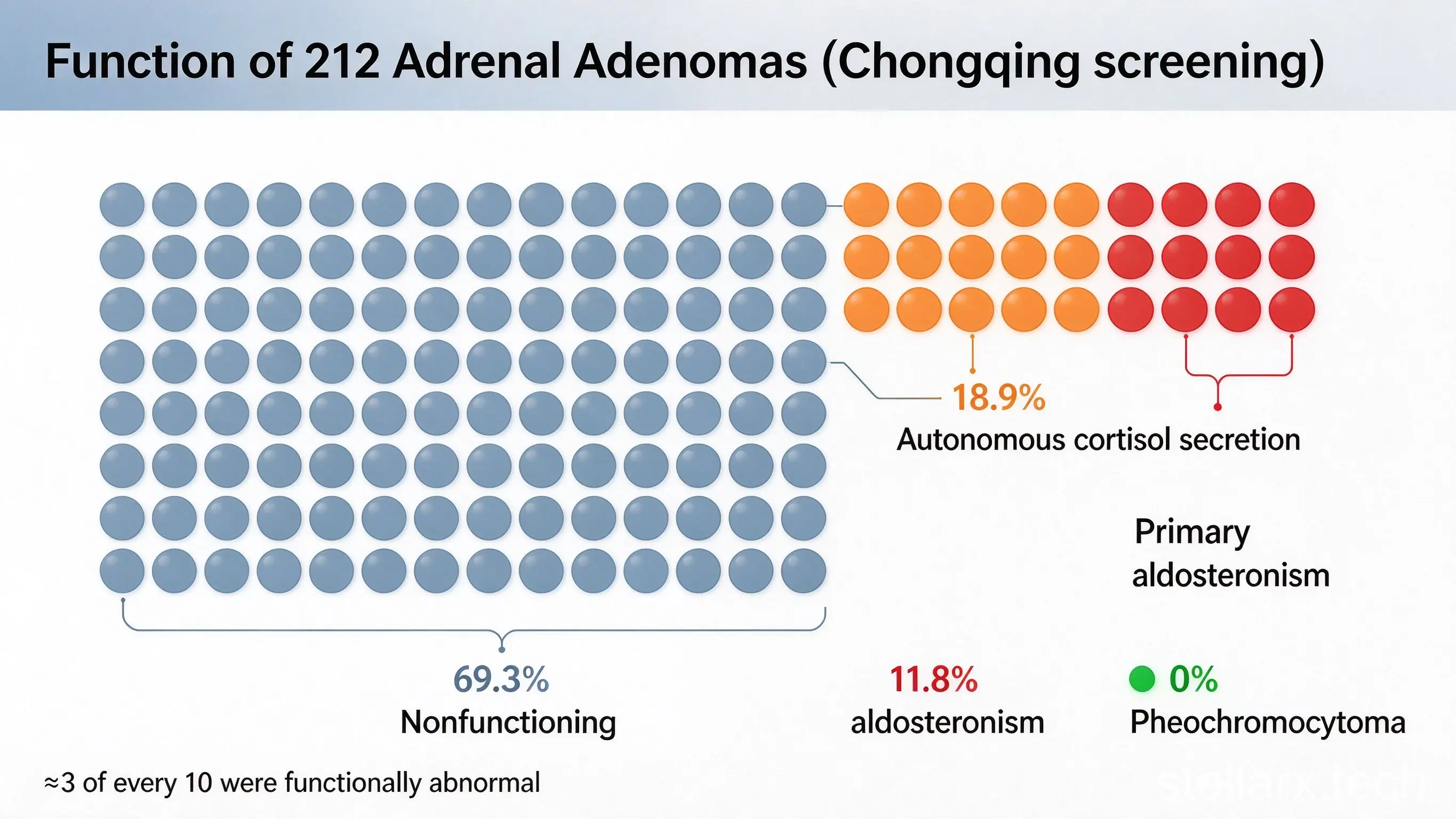
Why the image can't answer the question: hormones leave no footprint. The real question is whether a cluster of cells has broken out of the normal command chain and started secreting on its own. Only the hormones — or their metabolites — in the blood tell you that.
Cortisol: the overnight 1-mg dexamethasone suppression test
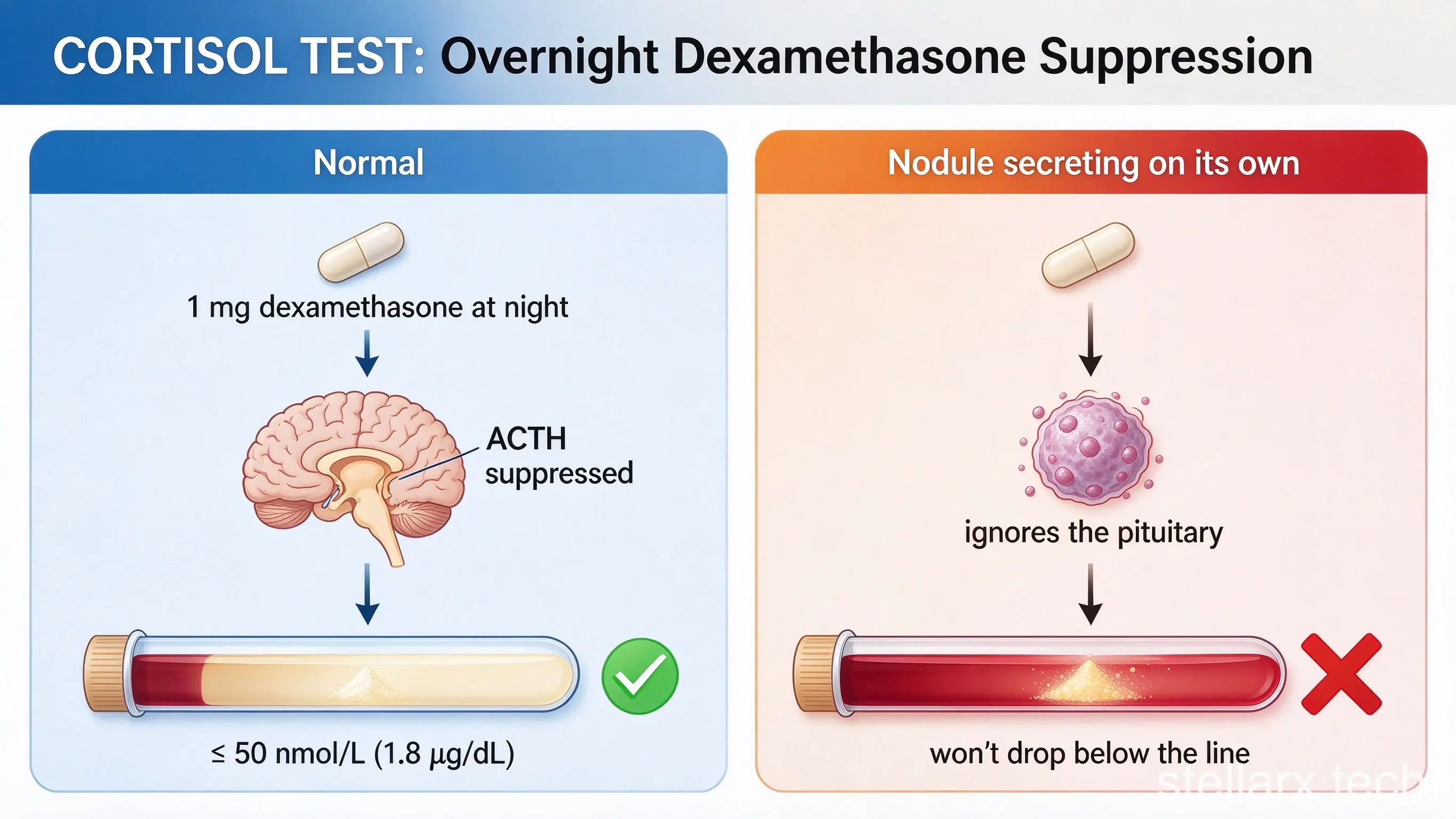
Dexamethasone is a potent artificial glucocorticoid. Take 1 milligram at night, and a normal pituitary assumes the body has enough steroid, suppresses ACTH, and the morning blood cortisol should be low. The guideline cut-off is serum cortisol ≤50 nmol/L (1.8 µg/dL).
If it will not suppress, the nodule is secreting on its own and ignoring the pituitary. The guideline calls cortisol that won't drop below the line — without Cushing's appearance — mild autonomous cortisol secretion, and flags these people for higher risk of hypertension and type 2 diabetes. Find it, and treat those diseases properly.
Catecholamines: metanephrines in blood or urine
Pheochromocytomas are rare in screening populations — zero in that Chongqing set of 212. The guideline still orders the test for everyone, because the cost of a miss is high: these tumors release bursts of catecholamines, and anesthesia, surgery, or certain drugs can trigger a dangerous spike in blood pressure. Being caught unaware is what you don't want. The test measures metanephrines, the catecholamine metabolites — stable in blood, so a quiet moment during the blood draw does not hide them.
Aldosterone: add it when blood pressure is high or potassium is low
Aldosterone tells the kidney to hold sodium and dump potassium. Too much of it drives blood pressure up and potassium down, which is why the guideline targets the screening at people with hypertension and hypokalemia, using the aldosterone-to-renin ratio. In the Chongqing data, primary aldosteronism made up a large share of functioning adenomas — anyone with poorly controlled blood pressure should not shrug this off.
What the CT numbers actually answer
On unenhanced CT, a homogeneous nodule with density ≤10 Hounsfield units is benign; no further imaging is needed regardless of size. Only above 4 centimeters — combined with heterogeneous density or >20 HU — does malignancy risk get high enough to usually warrant surgery. This rule grades benign versus malignant. Function is a separate question: imaging for the nature of the thing, blood tests for whether it is working.
What to do with a report that says "adrenal nodule"
Four practical lines from the guideline:
An adrenal nodule on a report means hormones first, not a repeat CT in three months. Book the endocrine or urology workup.
High blood pressure, low potassium, or recent changes in weight and blood sugar — say so at the visit. The doctor uses it to decide whether to add aldosterone testing.
A homogeneous ≤10 HU nodule on unenhanced CT is reassuring on malignancy. The hormone tests still need to be done.
A nonfunctioning adenoma with typical imaging usually does not need surgery. Watch it with the doctors.
The division of labor is clean: CT asks what this lump is, the blood asks whether it is doing anything. Only when both are answered has the nodule been truly sized up. The same curiosity that makes you want to see what those cells actually look like — under a microscope, a blood vessel specimen shows the wall that all this pressure strains against: smooth muscle and elastic fiber layers holding the line at normal blood pressure, the very tissue that aldosterone and catecholamines push on. A functioning adrenal adenoma, meanwhile, shows zona fasciculata cells stuffed with lipid vacuoles, the machinery of cortisol production sitting right there in the tissue.
Related reading

Waking at 3 AM? The Clock Is the Problem

Your Gut Makes Most of Your Happy Hormone

How the Kidney Filters 180 Liters of Plasma a Day
References
* Jing Y, et al. Prevalence and Characteristics of Adrenal Tumors in an Unselected Screening Population: A Cross-Sectional Study. Ann Intern Med 2022;175:1383-1391. doi:10.7326/M22-1619
* Fassnacht M, et al. European Society of Endocrinology clinical practice guidelines on the management of adrenal incidentalomas, in collaboration with the European Network for the Study of Adrenal Tumors. Eur J Endocrinol 2023;189:G1-G42. doi:10.1093/ejendo/lvad066
* Funder JW, et al. The Management of Primary Aldosteronism: Case Detection, Diagnosis, and Treatment: An Endocrine Society Clinical Practice Guideline. J Clin Endocrinol Metab 2016;101:1889-1916. doi:10.1210/jc.2015-4061
- Why Do Humans Mate in Private? Ask a Desert Bird
- 為什麼人類交配要私密?沙漠裡的一隻鳥給出答案
- Why Do Cats Go Limp When Scruffed? Tigers Won't
- 捏住老虎後頸,牠會像貓咪一樣乖巧順從嗎?
- How to Tell If an Adrenal Nodule Makes Hormones
- 腎上腺結節功能檢查:抽血判斷,不是看 CT 大小
- Pacific Oyster Invasion: The Edible Ecosystem Engineer
- 牡蠣:入侵歐洲的海洋工程師,也是桌上美食
- Incomplete Blink: The Hidden Cause of Screen Dry Eyes
- Silence Speaks Volumes: The Rise of Immersive “Cool Girl” Makeup Tutorials
全部评论