Why Do Cats Go Limp When Scruffed? Tigers Won't
In 2008, a veterinary student at Ohio State University walked into a stationery store, bought a box of two-inch binder clips, and carried them to the university's veterinary teaching hospital [1].
She clipped them onto the backs of cats' necks.
Megan Pozza and her supervisor were chasing a phenomenon every vet knew privately but no one had formally studied: squeeze the loose skin on a cat's neck, and the cat goes limp. Claw clipping, blood draws — a whole generation of vets ran on this trick.
But how reliable was it, really? And what was happening inside the cat?
Pozza answered both questions with the simplest possible toolkit: stationery-store binder clips, a blood pressure cuff to measure the clip's force, and a neurologist standing by to run the exams.
Thirty-one cats walked into the study — 13 healthy, 18 with idiopathic cystitis. The clip went on the dorsal midline of the neck, between C1 and C7, at a force of roughly 140 to 160 mmHg, close to a cat's systolic blood pressure.
Of the healthy cats, 92% showed clear behavioral inhibition. In the cystitis group, it was 100%.
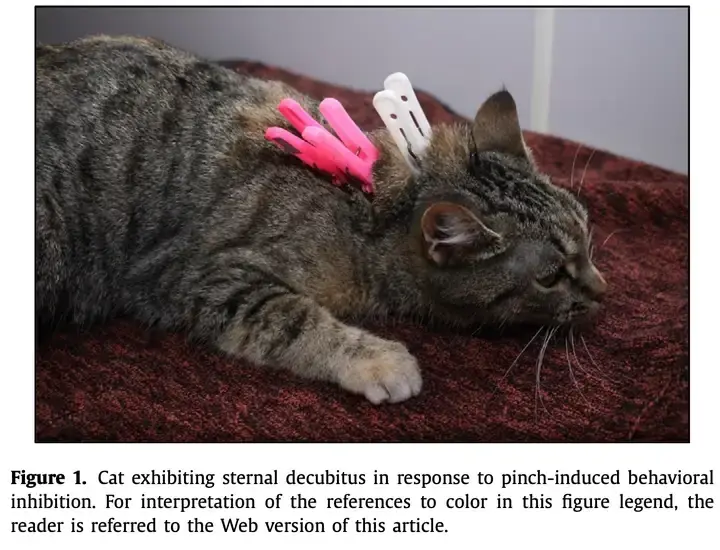
The clipped cats' pupils constricted — a hallmark of parasympathetic activation, not the dilated pupils of fear. Heart rates stayed steady. No stress-induced spike in body temperature. Quite a few cats simply started purring and kneading.
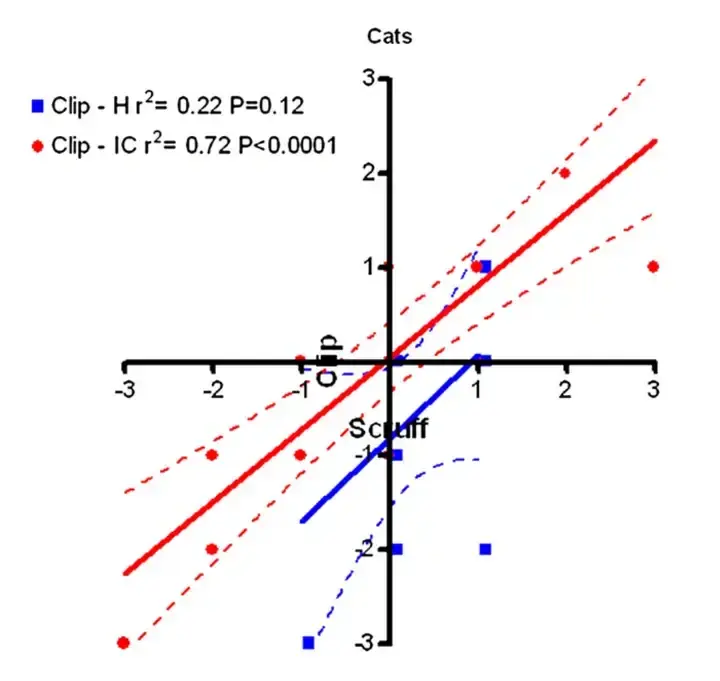
The correlation between the two restraint methods was striking, especially in the sick cats.
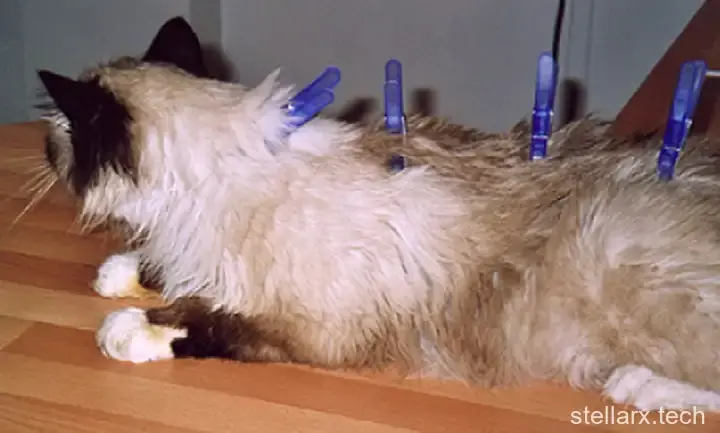
One cat flopped onto its side on the table. The researchers' paper describes it as "approaching a catatonic state."
Pozza named the response "pinch-induced behavioral inhibition" — PIBI for short — with the nickname clipnosis, clip plus hypnosis.
The scatter regression below shows how strongly a cat's response to scruffing correlated with its response to the clip — the link was strongest in the cystitis group.
The name is catchy, but clipnosis is not hypnosis.
A hypnotized cat would lose threat responses, facial sensation, and the ability to support its limbs. The clipped cats kept all three. Neurological exam showed the main change was a lowered level of consciousness in the forebrain — reduced alertness, but not loss of control.
It's also not "playing dead."
Tonic immobility — TI for short — is a fear-driven end-stage defense: the animal goes rigid and totally unresponsive. Its autonomic state is complicated: extreme sympathetic activation followed by a parasympathetic overlay, a composite state rather than pure sympathetic arousal.
As far back as 1974, Gordon Gallup's review defined TI as a state tied directly to fear [2]. PIBI is the opposite: parasympathetic dominance, a relaxed cat, not a rigid one.
So what is the neural basis?
The clearest evidence comes from mice.
In 1988, Fleischmann and colleagues found that the immobility induced by clipping a mouse's neck could be reversed by amphetamine — a dopamine agonist — and mimicked by haloperidol, a dopamine antagonist [3]. The accompanying analgesia was not blocked by naloxone, so it bypasses the opioid pathway; instead, the cholinergic system is involved.
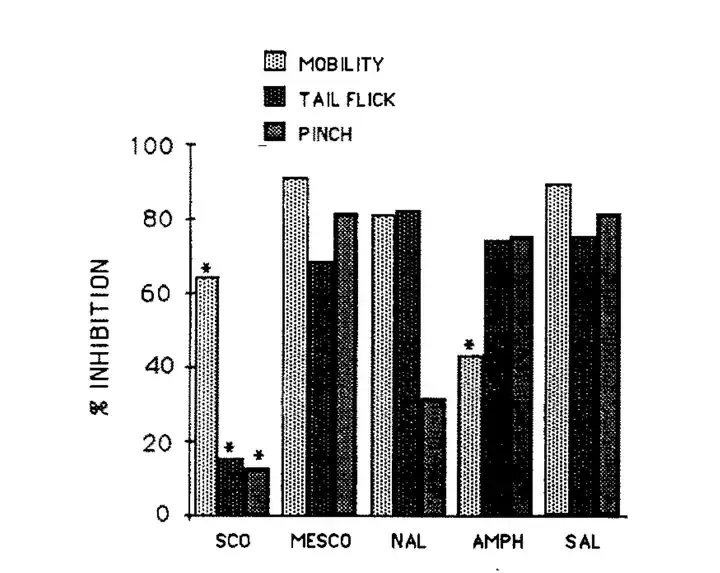
Put simply: the core of the response is suppression of the dopamine system (more precisely, dopamine and cholinergic systems cooperating), the motor program is switched off — but pain is not blocked along that route; it takes a separate analgesic pathway.
Does the trick work on cats of every age?
No. And it fades faster than you'd guess.
In 2022, scientists at Massey University in New Zealand published the largest age-effect study of PIBI to date in the Journal of Veterinary Behavior.
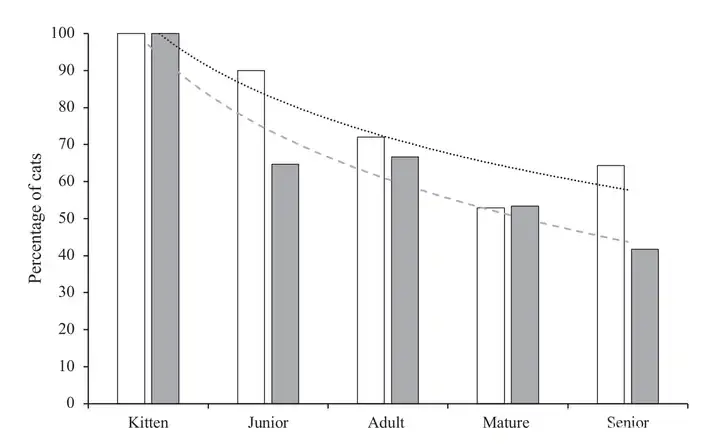
They tested 142 domestic cats in five life-stage groups: kitten (0–6 months), junior (6 months–2 years), adult (2–6 years), mature (6–10 years), and senior (10–14 years).
The curve falls hard:
Kittens: 100% effective. Juniors: about 74%. Adults: about 70%. Mature and senior cats: only about 53%.
The steepest drop comes between kitten and junior, and males lose the response faster than females.
So "scruff a tiger" is starting to sound like a bad plan.
To understand why, you have to find out where the response comes from.
It's not a feline special power. It's a widespread mammalian infant behavior called the transport response [4].
In 2013, the RIKEN Brain Science Institute team led by Kumi Kuroda published a cross-species study [5]. They tested human infants and mouse pups side by side.
When a mother walked while holding her baby, the infant stopped crying and stopped active movement almost immediately — heart rate dropped fast.
Mouse pups picked up by the scruff of the neck did the same: ultrasonic distress calls stopped, struggling stopped, heart rate fell, limbs tucked into a compact curl.
Then came the intervention experiments — and they are the key findings.
Blocking the pup's skin sensation with local anesthetic, or destroying its proprioception with excess vitamin B6, made the transport response vanish. Surgically removing the vestibular organ — the balance sense — did not. Balance, it turns out, is not required.
So the response depends on the combined input of skin touch and body-position sense: the parasympathetic system slows the heart, the cerebellum shapes the posture. It is not a simple reflex arc. It's a multi-system infant cooperation program.
That same year, Yoshida and colleagues showed this transport response is filial-specific — it exists only inside a narrow developmental window [6].
In C57BL/6 mice, the response disappeared completely by the end of the third week after birth — around day 21 — right as the pups began walking on their own.
Back to the cats.
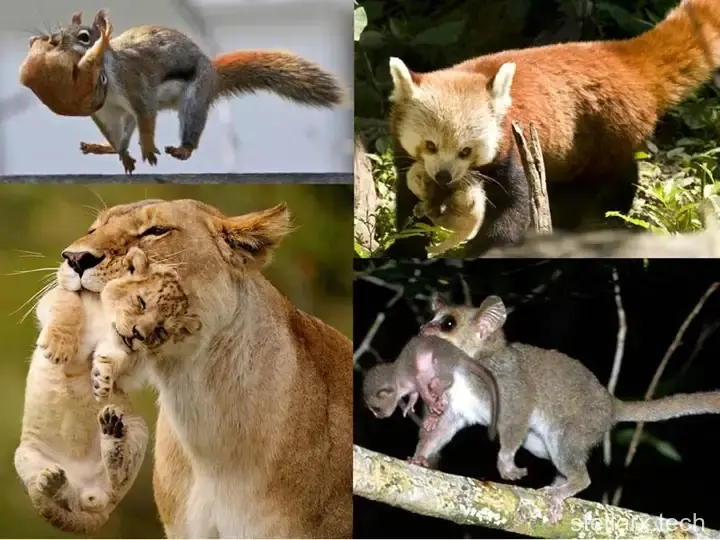
Every felid species on record — house cats, tigers, lions, leopards, cheetahs — carries its kittens by the scruff of the neck. And the kitten's response is identical: struggling stops, hind legs tuck, the body goes passive.
But the behavior has a physical ceiling.
A tiger cub is born weighing about 0.8 to 1.6 kg — roughly 1% of its mother's weight.
According to field footage from Ranthambore National Park in India, the window when a tigress can pick her cubs up and move them is about 6 to 8 weeks after birth. After that the cubs walk on their own, and she can't carry them anymore [7]. By six months, a male cub already weighs close to 40 to 47 kg.
An adult male tiger weighs 180 to 310 kg.
Even if the transport response circuitry survived intact into adulthood — every gram of it — you'd still face a purely engineering problem:
Who supplies the "being lifted" force?
An adult male tiger's scruff skin is far thicker and tougher than a house cat's. And even if you could somehow grip it, you could never reproduce the full sensory input of being lifted by a mother — because no force on Earth is going to lift a 300-kilogram tiger off the ground.
One more note: during mating, male big cats really do bite the female's scruff. A tiger's mating neck-bite lasts about 20 seconds — lions, leopards, and jaguars do something similar.
But it does not push the female into a transport-response collapse.
The female holds an active mating posture throughout, and when the male is done, she frequently turns and attacks him on the spot. The neck-bite's function is more likely postural fixation and ovulation stimulation — felids are induced ovulators — a different circuit entirely from the infant transport response.
So, theoretically, what happens if you pinch an adult tiger's scruff?
Most likely: nothing at all. Or worse.
And here's the twist — even the domestic-cat version of PIBI is now controversial.
In 2020, Moody and colleagues at the University of Guelph tested four restraint methods — passive restraint, manual scruffing, clips, and full-body restraint — on cats' behavior and physiology [8].
Clips and full-body restraint produced the most negative responses: dilated pupils, negative vocalizations, ears pinned back. Manual scruffing sat in the middle. Passive restraint produced the least.
That directly challenged Pozza's 2008 conclusion that PIBI is stress-free for cats.
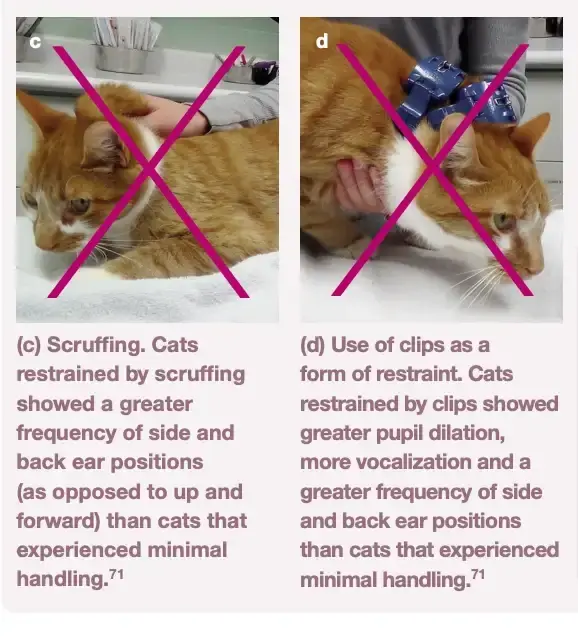
In 2022, the American Association of Feline Practitioners and the International Society of Feline Medicine published the Cat Friendly Veterinary Interaction Guidelines, stating plainly that cats show signs of fear-anxiety during such interactions, which should be avoided to safeguard feline welfare [9].
International Cat Care has gone further, launching a "no-scruff" campaign. Its position statement is blunt: the organization opposes scruffing as a restraint method because it causes stress and pain to cats, and that is unacceptable.
So here's the full picture of the neck-pinch.
A cat's "one-button pause" is, at its core, a cooperation program written for mammalian infancy. Its design purpose: keep a helpless infant still while its mother carries it from place to place, and lighten the mother's load.
The program decays with age. In domestic cats, by the mature stage it works on barely half of individuals. In grown big cats, it is almost certainly overwritten or deleted.
And even if it were still there — a 200-plus-kilogram tiger is not going to become an oversized ragdoll because you pinched its neck. Its more probable response is to turn its head, look at what you're doing, and then respond in whatever way it considers reasonable.
You get the idea.
If you've ever wondered what the nervous system behind that "pause button" actually looks like, WWAI's virtual microscope offers a rabbit spinal cord specimen — a cross-section where the butterfly-shaped gray matter and the surrounding white-matter fiber bundles are clearly visible. Search for WWAI in your app store and you can observe the specimen online, right now.

Related reading

Woodpecker Concussion Myth: Real Brain Damage
Why You Can't Balance on One Leg Eyes Closed
Homing Pigeons: War Heroes, Then \"Flying Rats\"

How Bees Communicate: Dance Language & Pheromones
References
1. Pozza M E, Stella J L, Chappuis-Gagnon A C, et al. Pinch-induced behavioral inhibition ('clipnosis') in domestic cats. Journal of Feline Medicine and Surgery, 2008, 10(1): 82-87.
2. G.G. Gallup Jr., "Animal hypnosis: Factual status of a fictional concept," Psychological Bulletin, Vol. 81, No. 11 (1974), pp. 836–853.
3. A. Fleischmann & G. Urca, "Clip-induced analgesia and immobility in the mouse: pharmacological characterization," Neuropharmacology, Vol. 27 (1988), pp. 641–648.
4. https://www.science.org/content/article/how-rocking-baby-mouth-carrying-mouse-pup
5. Esposito G., Yoshida S., Ohnishi R., Tsuneoka Y., et al. & Kuroda K.O., "Infant calming responses during maternal carrying in humans and mice," Current Biology, 2013.
6. Yoshida S., Esposito G., Ohnishi R., et al. & Kuroda K.O., "Transport Response is a filial-specific behavioral response to maternal carrying in C57BL/6 mice," Frontiers in Zoology, 10(1):50, 2013.
7. https://www.discoverwildlife.com/animal-facts/mammals/tiger-cubs-ranthambore-india
8. C.M. Moody, G.J. Mason, C.E. Dewey, L. Niel, "Getting a grip: cats respond negatively to scruffing and clips," Veterinary Record, 186:385 (2020).
9. https://journals.sagepub.com/doi/pdf/10.1177/1098612X221128760
- 秋天為什麼讓你咳不停?5 個咳嗽元兇
- Why Autumn Makes You Cough: 5 Causes of Fall Cough
- Why Do Humans Mate in Private? Ask a Desert Bird
- 為什麼人類交配要私密?沙漠裡的一隻鳥給出答案
- Why Do Cats Go Limp When Scruffed? Tigers Won't
- 捏住老虎後頸,牠會像貓咪一樣乖巧順從嗎?
- How to Tell If an Adrenal Nodule Makes Hormones
- 腎上腺結節功能檢查:抽血判斷,不是看 CT 大小
- Pacific Oyster Invasion: The Edible Ecosystem Engineer
- 牡蠣:入侵歐洲的海洋工程師,也是桌上美食

全部评论