Can't Do a Pull-Up? Body Weight vs. Arm Strength
He used to knock out 14 pull-ups without breaking a sweat — a perfect score back in high school, and 17 if he allowed himself a little body swing. Thirty-odd years later, the same man, standing under a bar in the community trees, cannot lift his own chin over the bar even once. He did not get lazy. He did not lose his gym. He got 25.5 kg heavier — and that weight quietly crossed a line his arm muscles could no longer afford.
Why is it that so many people — whole school years of them — can't do a single pull-up? The honest answer is that a pull-up is not a test of how strong your arms are. It is a test of how strong your arms are relative to your body weight.
A pull-up is a strength-to-weight ratio game
Exercise scientists call this relative strength. Every rep means lifting your own body weight, chin to bar, once. Your thighs squat a body all day and adapt to it; your arms, chest, and back do not. They are built for pulling groceries, not for hoisting 77 kilograms by their own fibers.
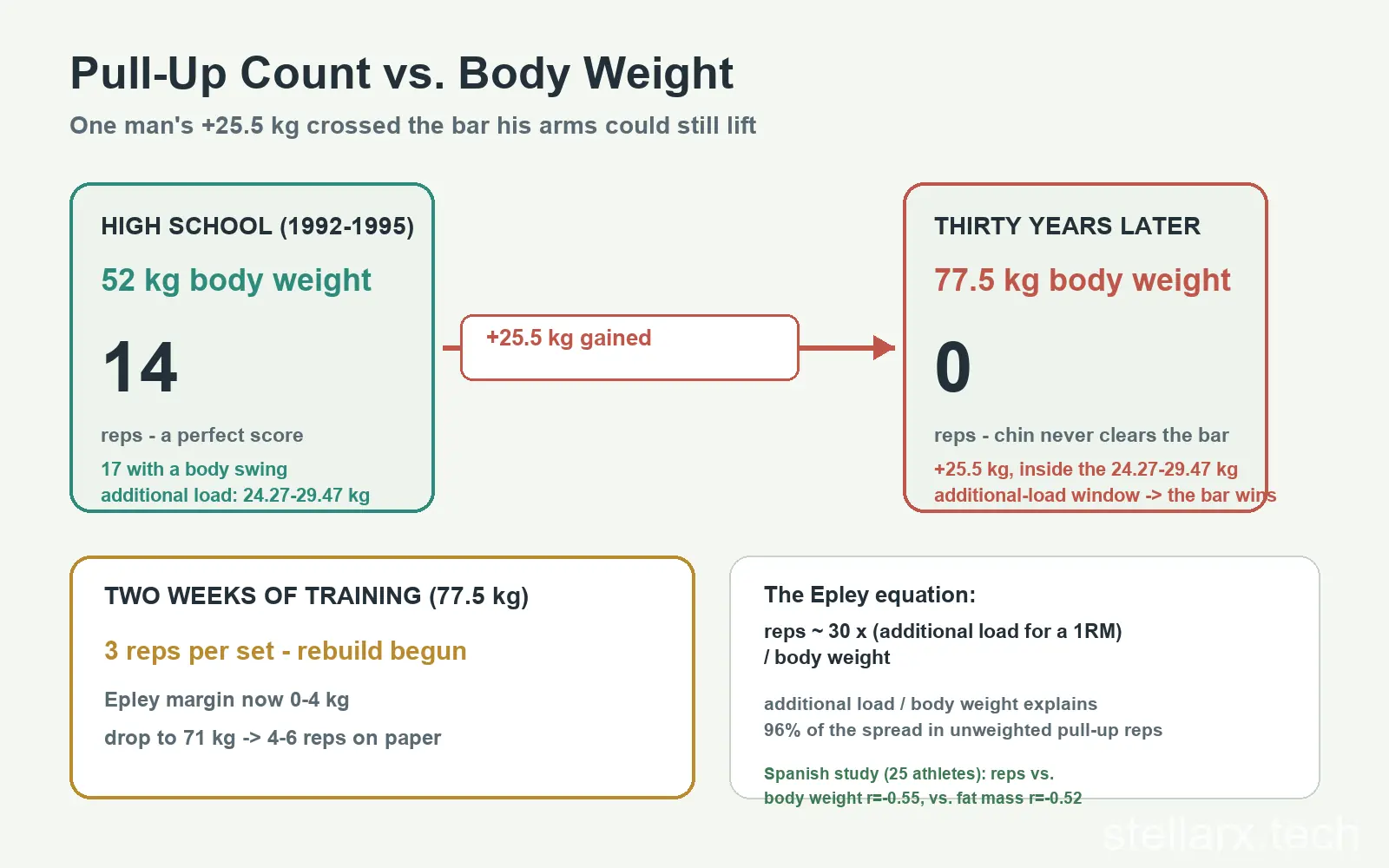
A Spanish study of 25 trained athletes found that pull-up performance tracks body weight in the wrong direction: rep count correlates negatively with body weight (r = -0.55) and with fat mass (r = -0.52). [1] A second study pushed the idea further: divide your "additional load for a 1RM" — the most extra weight you could strap on and still grind out one more rep — by your body weight, and that single ratio explains about 96% of the difference in unweighted pull-up reps between people, with an average error of just one rep. [2]
There is even a pocket formula, the Epley equation, for predicting your count:
Reps ≈ 30 × (additional load for a 1RM) ÷ body weight.
The "additional load" is the honest number: how many more kilograms could you hang on your belt and still barely pull yourself up? Once the weight you gained exceeds that margin, the math says the bar wins before you do.

One man's 25 kg, measured against his own formula
The study's logic hit home for its author in the most personal way possible. In high school (1992–1995) he weighed 52 kg and a perfect score was 14 pull-ups — he cleared it easily, and in contests he could push to 17, though the last few reps needed a body swing to cover the weak middle 90 degrees between full hang and full pull.
Plug his numbers into the formula. At 14 reps: additional load = 14 ÷ 30 × 52 kg = 24.27 kg. At 17 reps: 29.47 kg. So as a teenager, he could strap on a 24-to-30 kg sandbag and still manage one more rep.
Now he weighs about 77.5 kg. That is 25.5 kg more than the teenager — sitting almost exactly inside that 24.27–29.47 kg window. The memory of "I can do lots of pull-ups" was still intact; the bar disagreed. The first time he tried, he could not get his chin above the bar, once.
The formula, in other words, called it: assuming three decades of unchanged arm and back strength, he had added exactly the extra load that sits at the boundary between barely making one rep and not making it at all.
The comeback is arithmetic too
Two weeks later, and the bar is dry whenever it is not raining. One set of three, then a walk to the other side of the compound for a second bar, then a third set if his willpower holds. Three reps per set now feels like his ceiling.
Yesterday he was bold: two sets of three, then back to the first bar for another set of three. Forearms, stomach, even glutes ached into today. Today he went down anyway — two bars, two sets, three reps each — and, after seeing the question that inspired this article, one more set of three. At his current weight, the Epley margin has shrunk to a 0-to-4 kg cushion; making three reps after two weeks of training is, by the formula, already decent.
Drop to 71 kg and the paper cushion returns to 10–14 kg — four to six reps on paper. Add the strength he is building back, and seven or eight is no longer a fantasy. Getting back to high school is not in the cards. Getting back to a real pull-up count, quietly, is.
The short version of the whole problem: most people who can't do pull-ups are not weak — their body weight and their upper-body strength are simply out of balance. And the failure arrives on a specific day: the day the weight you gained passes the "additional load" your arms can still move. On that day, the bar wins before you do.
Want to see what "strength that pulls body weight" actually looks like at the microscopic level? Under the lens, a working muscle is a bundle of striated fibers packed with nuclei — including a Skeletal muscle specimen where striated muscle fibers, nuclei, and the sarcolemma are clearly visible. Explore real specimens in the Wwai app.

Related reading

Woodpecker Concussion Myth: Real Brain Damage

Dinoflagellate Genome: Largest on Earth

Blue Inhaler: Why Asthma Guidelines Dropped SABA
References
1. Sánchez-Moreno M, et al. Determinant factors of pull-up performance in trained athletes. PubMed 26176615. https://pubmed.ncbi.nlm.nih.gov/26176615/
2. Bayonas-Ruiz A, Sierra-del Rey A, Martínez-González-Moro I, Martínez-Gil I, Bonacasa B. Maximum number of repetitions and relative strength in the prone-grip pull-up exercise in men and women. The Physiological Society, "The Biomedical Basis of Elite Performance 2024", Proc Physiol Soc 62, C10. https://www.physoc.org?p=118879/
- Cervical Kyphosis: What a Reversed Neck Curve Means
- 頸椎反弓:低頭族的脖子痠痛
- 深海生物為何不被高壓壓扁?內外壓平衡的真相
- How Do Deep-Sea Creatures Survive Crushing Pressure?
- 臀肌萎縮與脂肪浸潤:臀部形狀透露糖尿病風險
- Dead Butt Syndrome: Why Your Gluteal Muscles Shrink
- Can't Do a Pull-Up? Body Weight vs. Arm Strength
- 引體上升做不到?體重與手臂力量的拔河
- Whales Breathe Air, Not Water. That's Why They're Huge.
- 鯨魚用肺呼吸,為什麼還能長得這麼大?

全部评论