Eye Stroke: The 90-Minute Window That Saves Sight
He was 30. Three nights running, he had worked past 2 or 3 a.m. to finish a big project — and then his right eye filled with ripples, like a stone dropped on water, that no amount of blinking would clear.
On the morning of October 9, a little after 10, the man — surnamed Liu, a marketing planner in Wuhan — opened his computer to keep going. His right eye flashed with a shifting wave of ripples. He blamed eye strain from staring at the screen and closed his eyes to rest. The ripples stayed, and his vision seemed to shrink, like an aperture turning down. Where he could once read the office building across the street, minutes later he could not count the fingers held in front of his own face.
Two days earlier, his right eye had gone briefly blurry a few times — each spell only seconds long — and he had shrugged it off.
Just after 11 a.m., a colleague helped him into the Eye, Ear, Nose & Throat Hospital of Renmin Hospital of Wuhan University. His right eye was nearly shut. He kept repeating: "Doctor, there is water moving in my eye. I cannot see anything."

The hospital's president, Xiao Xuan, held a flashlight to the eye. The reaction to light was sluggish. "Vision had dropped to a faint sense of a hand moving in front of the eye." The fundus exam showed why: a broad gray-white edema of the retina, and at the macula a striking cherry-red spot — the classic picture of central retinal artery occlusion, an "eye stroke."
The team moved fast. First, lower the eye pressure. Then vasodilators, a thrombolytic, and oxygen, all aimed at one thing: restoring blood flow to the retina as quickly as possible. The rescue ran close to two hours. When it was over, Liu could make out the buttons on the doctor's white coat. After several days in hospital, the blood flow in his right eye reopened — no permanent damage.
"Eye stroke" sounds strange, but it is the same logic as a brain stroke: a vessel is blocked. In central retinal artery occlusion, the main pipeline feeding the retina is sealed by a clot, and the retina's light-sensitive nerve cells, starved of oxygen, start to die within minutes.
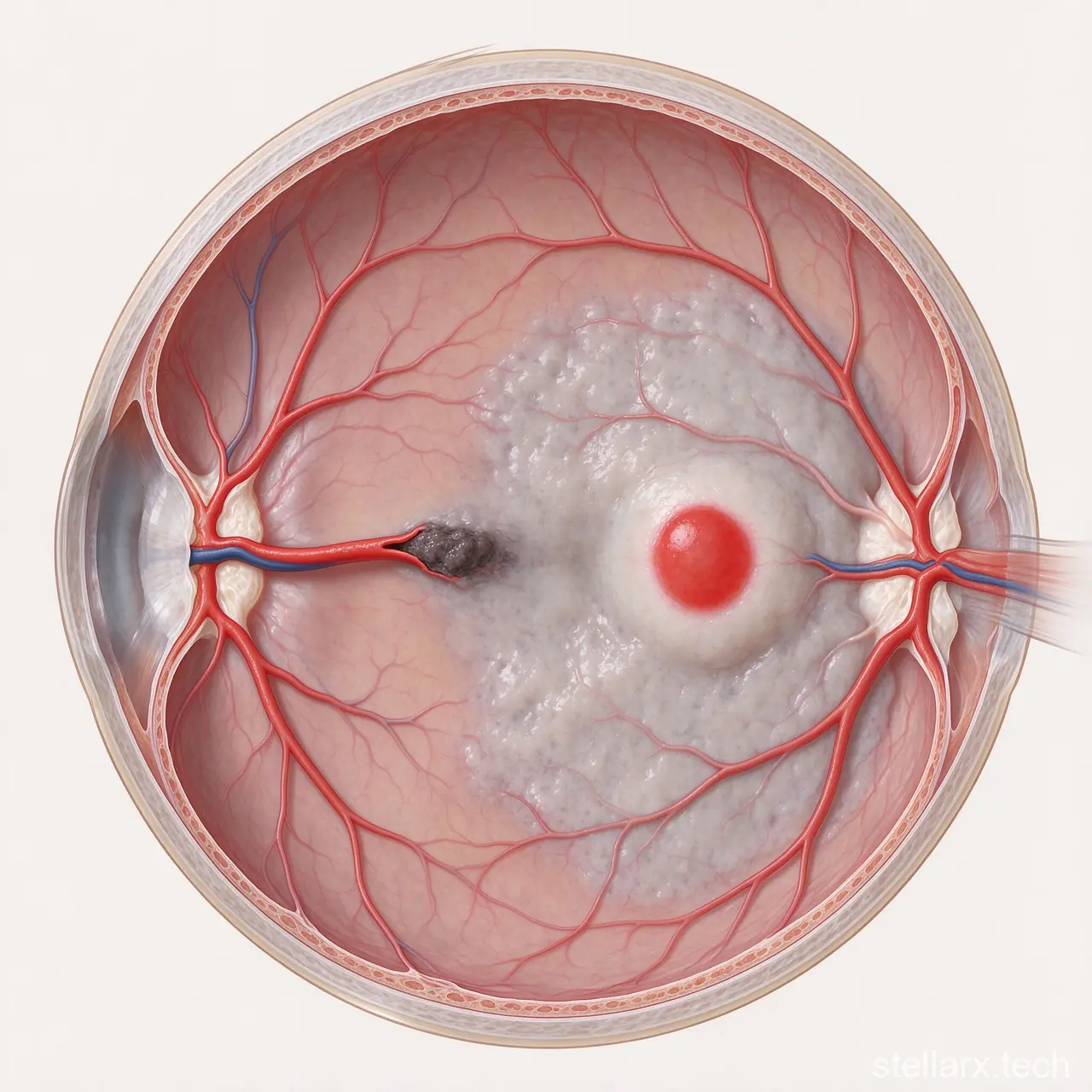
The old picture was "eye stroke" in people over 50 with high blood pressure, diabetes, or hardened arteries. The ward is getting younger. Long-term late nights and overworking the eyes make the vessels constrict and spasm, raising the risk of ischemia and clots; the high-fat diets and lack of exercise common among young people quietly accelerate atherosclerosis. In people under 30, occlusion of the central retinal artery is rare — less than 1 in 50,000 — yet the case exists to be real.
The clock is short. Retinal ischemia that lasts past about 90 minutes can do irreversible damage to the light-sensing cells; beyond six hours, a full recovery becomes unlikely. That is why this is an emergency with a window measured in minutes.
Which symptoms demand the emergency room? Sudden vision loss in one eye, complete within minutes, down to counting fingers or sensing light. Or a transient "blackout" — vision briefly gone for a minute or two, then back — a warning known as amaurosis fugax. When it recurs, the next episode can be a hard loss. Even if the blurring seems to ease, do not wait it out. Get to a hospital.

Your retina is a tissue you cannot see in a mirror, yet it is the part of you that lets you read this. If you want to see what a blood vessel — the kind that carries oxygen to your retina — actually looks like, inspect a blood vessel specimen under a virtual microscope, where the layered walls and the open lumen are clearly visible. Just search "WWAI" in your app store to download it.

Related reading

Dry Eyes? The Problem Is Oil, Not Water

Phone in Bed: Scrolling Hurts Your Eyes
Phone in the Dark: How It Damages Your Eyes
References
1. A review of the management of central retinal artery occlusion. Turkish Journal of Ophthalmology. https://pmc.ncbi.nlm.nih.gov/articles/PMC9558462/pdf/TJO-12-273.pdf
2. Successful Treatment of Central Retinal Artery Occlusion With Tissue Plasminogen Activator Followed by Recurrent Retinal Ischemia. https://pmc.ncbi.nlm.nih.gov/articles/PMC11418660/
3. Central retinal artery occlusion as the initial manifestation of mixed connective tissue disease in a young woman: a case report. BMC Ophthalmology. https://pmc.ncbi.nlm.nih.gov/articles/PMC11481478/
4. MedlinePlus. Amaurosis fugax. https://medlineplus.gov/ency/article/000784.htm
- 眼中風盯上年輕人:90分鐘黃金救治期
- Eye Stroke: The 90-Minute Window That Saves Sight
- 植物毛刺入眼:為什麼越揉越糟
- Plant Bristles in Your Eye: Why Rubbing Makes It Worse
- 沙丁胺醇吸入劑:為什麼不再推薦單獨使用?
- Blue Inhaler: Why SABA Is No Longer Recommended for Asthma
- 甲藻基因組:地球上最大的基因組,藏在單細胞裡
- Why Dinoflagellates Carry the Largest Genomes
- 玉米為何成為全球三大主糧?
- Why Corn Became a Global Staple Crop

全部评论