A Laundry Pod Burst in Her Hand — and Dissolved Her Cornea
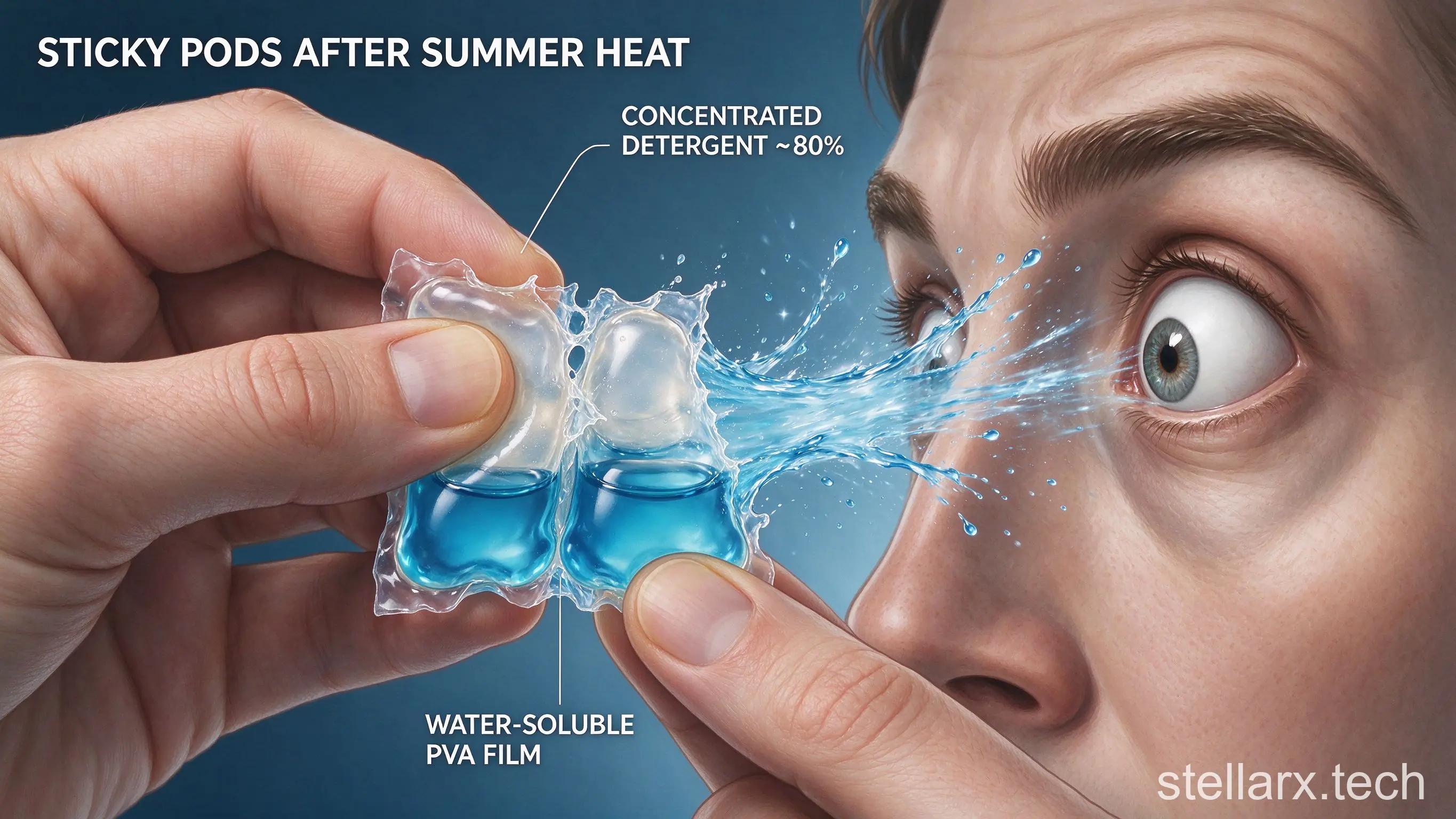
One night before the Mid-Autumn Festival, a family in Beijing had just finished dinner. The mother was in the bathroom sorting the family's laundry. She took out the box of laundry pods and found two pods stuck together — their outer film felt slightly sticky. The box had been bought in summer and stored through a heat wave, and the film seemed to have softened.
She didn't think much of it. She picked up one pod in each hand and pulled them apart with a little force.
There was a soft "pop." It was not the sound of separation. It was the sound of a pod bursting. Concentrated detergent burst from the torn film and sprayed straight into her face — a big blob of it went directly into her right eye.
The pain, she later said, was impossible to describe. Tears poured out uncontrollably; it felt like a handful of burning sand had been thrown into her eye. Her vision blurred instantly. She screamed. By the time her husband and child ran in, she was doubled over in pain.
The family rushed her to hospital. The first hospital's doctor said the injury did not look serious, flushed the eye and prescribed medication. Relieved, they headed home. But on the way, the pain suddenly intensified — far worse than the initial injury. They turned around and went to a second hospital, then a third: Beijing Tongren Hospital.
The doctor at Tongren examined her right eye carefully and said something that chilled the family: her cornea was missing a small piece. Not a scratch, not redness — a piece of tissue was genuinely gone, dissolved by the liquid from the pod.
This family's story is not an isolated case.
In November 2025, a woman in Hangzhou had almost the same experience. She found that pods stored through a summer of high heat had melted and stuck together. She pulled them apart with both hands. The pod burst, high-concentration detergent sprayed toward her face, and much of it went into her right eye. The ophthalmologist's diagnosis: chemical burn of the cornea. Her right-eye vision had dropped to 0.06. A healthy eye sees 1.0; at 0.06, the largest line on an eye chart that a normal person reads at five meters, she could barely make out at 0.3 meters. She was close to the edge of blindness. After treatment, her vision recovered — but the doctor told her not everyone gets that lucky.
In August 2022, at Aier Eye Hospital in Chongqing, corneal specialist Liu Jiandi saw two patients in a short period with nearly identical symptoms: red eyes, vision loss, and burned corneas. Both had been doing laundry when a pod burst and liquid splashed into their eyes.
| Year (US, ages 3–4) | Laundry-pod eye burns | Share of all pediatric chemical eye burns |
|---|---|---|
| 2010–2015 (total) | 1,201 | — |
| 2012 | 12 | 0.8% |
| 2015 | 480 | 26% |
The problem is not unique to China. In countries where pods spread earlier, the victims have mostly been children.
In March 2025, in Perth, Australia, four-year-old Luca was helping her mother Jodi with the laundry. Jodi handed her a Persil 3-in-1 pod to hold while she turned to the washing machine. In those few seconds, curious Luca bit the pod. The film burst, liquid sprayed into her eyes, and the child instinctively rubbed — spreading concentrated detergent across both eyes. Jodi rushed her to hospital, where doctors tried four times to flush Luca's eyes. Her left cornea had tissue loss. Over the following days, the four-year-old had three operations, including an amniotic membrane transplant, and spent 16 days in hospital.
The BMJ recorded a case series of 13 children back in 2010 — average age under two. Twelve recovered with treatment. One child, whose eyes were not flushed until arrival at the emergency department, ended up with full corneal epithelial burns on both eyes: the entire corneal surface of each eye was burned.
Why does a pod do this to an eye? The answer starts with what is inside it.
A laundry pod is, structurally, a water-soluble film wrapped around a fixed dose of highly concentrated detergent.
The film is mostly polyvinyl alcohol (PVA), a molecule whose chain is lined with hydroxyl groups — naturally hydrophilic. Dry, it is a tough film that seals the detergent in. The moment water touches it, the film dissolves and releases the detergent: measured, no scooping, no dirty hands. The UK Health and Safety Executive puts the liquid inside a single pod at 32 to 50 ml. The volume is small. The concentration is not.
| Liquid | Surfactant / active matter | Note |
|---|---|---|
| Regular liquid detergent | 10–20% | Industry standard ≥15% total active matter; the rest is mostly water |
| Laundry pod liquid | 70–80%+ | Most market products exceed 78%; concentrated surfactant plus alkaline builders can reach 80%+ |
| Safe eye-tolerance ceiling | ~0.25% | Max tolerated concentration even for mild surfactants (e.g. Tween 80) |
| Tears (pH) | pH 7.4 | Human tear baseline; pod diluted 1:100 still measures pH 7.1–8.7 — the undiluted concentrate is more alkaline |
Ordinary liquid detergent is typically 10% to 20% surfactant, and the rest is mostly water; industry standards require total active matter of at least 15%. A pod, to pack a full load's cleaning power into one small bead, has to squeeze out the water — market products commonly run 70% or more total active matter, many above 78%. One ophthalmologist's figure: concentrated surfactant plus alkaline builders can make up over 80%.
Spill a drop of ordinary detergent in your eye and the effective ingredient is a bit over one part in ten. Spill a pod's liquid and it is eight parts in ten — a four-to-five-fold difference in concentration. That is the first layer of why pods corrode far more than regular detergent.
Then there is pH. Human tears sit at about pH 7.4. The Chinese standard QB/T 5658-2021 requires pod products not to exceed pH 10.5, and consumer-test results for diluted pods mostly fall between 7.1 and 8.7.
Here is the detail most people miss: the standard is measured after a 1:100 dilution. Diluted a hundred times, the liquid is still pH 7 to 8.7 — and what actually splashes into an eye is the undiluted concentrate. Alkalinity is itself part of the cleaning power: grease is saponified and broken down in alkaline conditions. The alkaline builders and the high surfactant concentration together make a double threat.
Why Alkali Burns Are the Worst Kind
Most people picture a chemical burn as "it stings, rinse it, it passes." Ophthalmology sees it differently — and alkaline burns are the most vicious class of chemical burn.
Acid works one way. Acid touching tissue protein immediately coagulates and denatures it, forming a hardened eschar. That eschar acts as a barrier, blocking the acid from penetrating deeper. Acid burns tend to be relatively superficial, with clear edges and controllable depth.
Alkali works the opposite way.
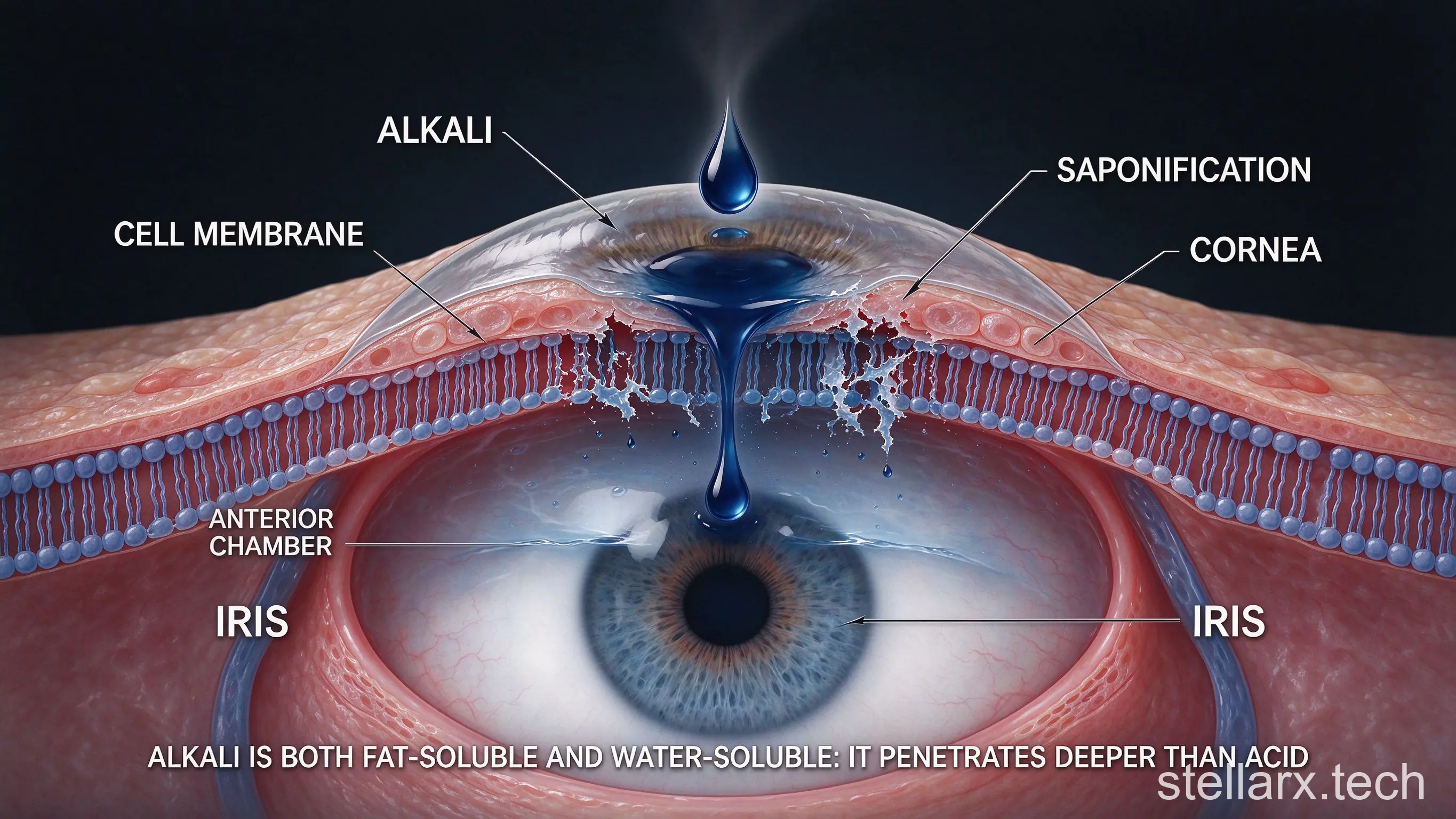
Alkali is both fat-soluble and water-soluble — what medicine calls "biphasic solubility." The cell membranes of the eye surface are mainly lipid. Alkali does not stop at the surface: it dissolves and penetrates the cell membrane directly, burrowing deeper into the tissue while saponifying the lipids inside the cells, destroying their structure and killing the cells.
Penetrating deep enough, alkali can cross the cornea into the anterior chamber — the space behind the cornea and in front of the iris, filled with aqueous humor — causing iris ischemia, fixed dilated pupils, raised intraocular pressure, ciliary body damage, and in severe cases acute cataract. Injured tissue also releases inflammatory factors that summon neutrophils, and those cells release collagenase, which dissolves the collagen fibers of the cornea — corneal ulceration, melting, even perforation. This is why ophthalmologists repeat that alkaline eye burns are far more serious than acid burns.
Then there is the surfactant itself.
A surfactant molecule has one end that loves water and one that loves oil; it emulsifies grease off fibers. That same oil-loving ability works perfectly well on cell membranes. Research has long established that surfactants disrupt membrane permeability, break down the phospholipid bilayer, leak cell contents, and kill the cell. Benzalkonium chloride, the preservative in many eye drops, is essentially a cationic surfactant — its eye toxicity comes precisely from destroying corneal epithelial cell membranes. The surfactant concentration in a pod is hundreds to thousands of times that of an eye-drop preservative.
Lab tests of surfactant safety for eyes: even relatively mild surfactants like Tween 80 and polyoxyethylated castor oil have a maximum tolerated concentration of about 0.25%. The concentration inside a pod is 70% to 80%.
The Cornea Was Never Built for This
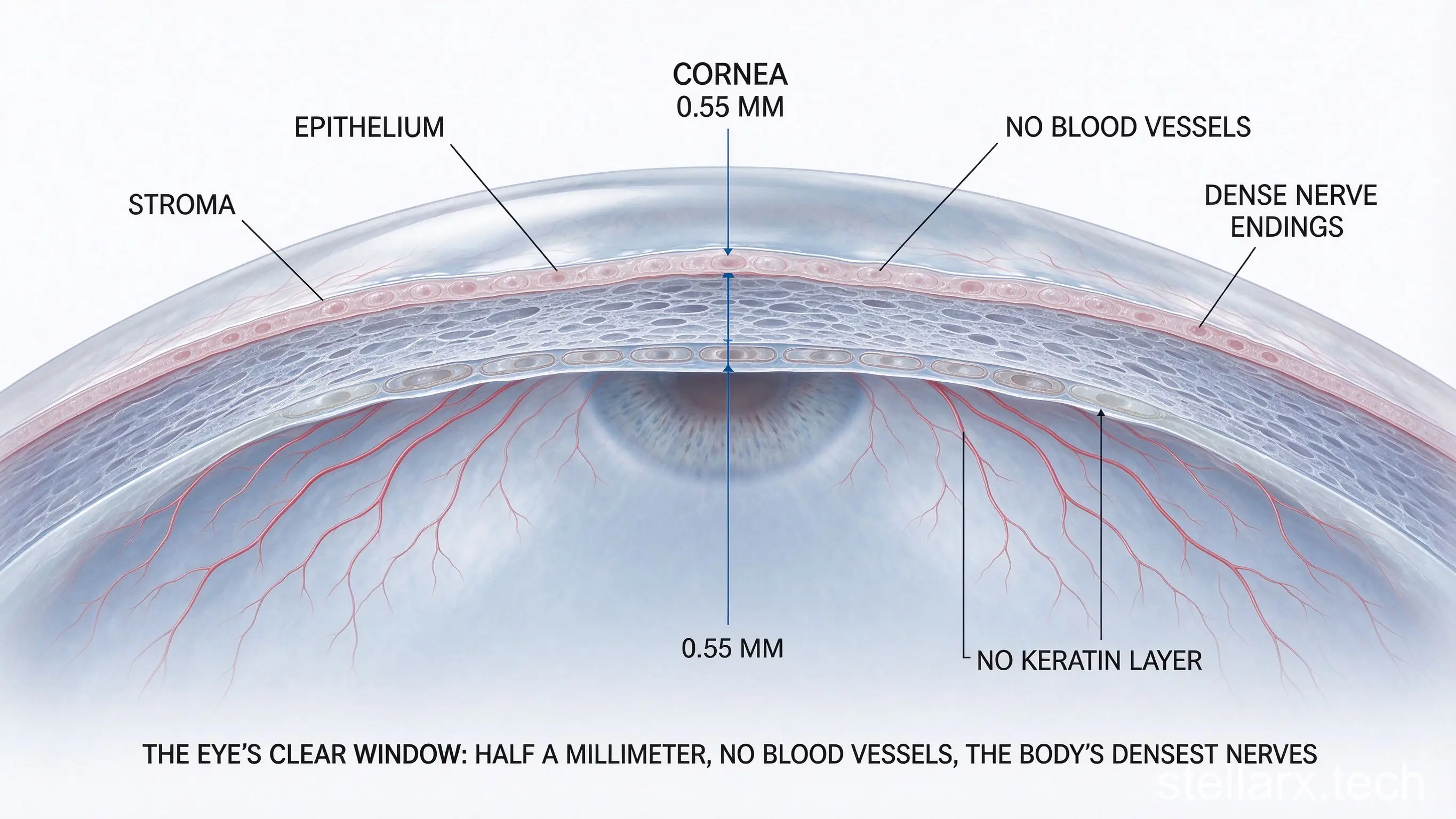
The cornea is the transparent film at the front of the "black of the eye" — the eye's light window, refracting light into the eye. An adult cornea is about 0.55 mm thick at the center — barely thicker than a credit card.
The cornea has no blood vessels; it is nourished by aqueous humor and tears, which keeps it transparent, but it also means it fights infection and repairs far more slowly than skin. There is no keratinized layer on the surface like skin — the epithelium is directly exposed. And the cornea carries the densest nerve endings in the body, from the ophthalmic branch of the trigeminal nerve — extraordinarily sensitive. Even a mild epithelial scratch causes marked foreign-body sensation, stinging, photophobia and tearing.
That is the full set of conditions for pod injury: an extremely concentrated, alkaline, surfactant-rich liquid, wrapped in a film that dissolves on contact with water, sprayed by the force of a tear onto a transparent tissue that has no blood vessels, no keratin layer, is half a millimeter thick, and is the most densely innervated in the body.
Once the liquid lands, a chemical burn starts within minutes: severe pain, photophobia, vision loss.
Worse, alkaline burns are delayed in their appearance: at the moment of injury they look mild, and the true damage shows hours later. The Beijing mother at the start of this story was told "not serious" at the first hospital and then suffered intensifying pain on the way home — that is this exact mechanism. This time lag deceives people, and a delay of hours can cost the best treatment window.
If flushing and treatment are delayed, the injury can climb a heavy ladder. Mild damage involves only the epithelium: red eye, punctate epithelial loss, vision loss. Moderate damage: full epithelial loss, obvious stromal opacity, patchy conjunctival ischemia. Severe — the worst alkali burns — the full cornea turns porcelain-white; shining a light in shows no iris texture, no pupil, sometimes direct perforation. The prognosis for this class is rated poor to very poor.
And the damage cascades. Healed ulcers leave corneal leukoma — a white scar sitting on the light path, causing permanent vision loss. Healed perforations can leave anterior synechiae and corneal staphyloma; in the worst cases the whole eyeball shrinks. Large conjunctival epithelial defects can cause symblepharon — the eyelid fuses to the eyeball during healing, restricting movement and even sealing the eye shut. Alkali in the anterior chamber brings uveitis, secondary glaucoma, and complicated cataract. Secondary glaucoma is especially easy to miss: with a cloudy cornea, standard tonometry cannot read an accurate pressure, and patients feel nothing as pressure climbs slowly — by the time it is found, the optic nerve is already damaged. In late stages, the corneal limbal stem cells are destroyed. These are the "seed cells" that regenerate the corneal epithelium; once lost, the cornea is covered by conjunctival epithelium and new vessels, becoming cloudy, dry, and repeatedly eroded. Treatment then is no longer eye drops: early-stage needs amniotic membrane transplant; late-stage may need limbal stem cell transplant, corneal transplant, or an artificial cornea — complex surgery, high cost, success limited by the original injury.
And the starting point may have been nothing more than a pair of wet hands in the bathroom tearing two pods apart.
What to Do in the First Minutes
If pod liquid hits the eye, every minute decides how much vision survives. The steps below are worth memorizing if you keep pods at home.
First, rinse immediately — do not wait a second. Do not reach for a towel, do not call anyone, do not study the packaging. Get to the nearest tap and rinse. Every second, alkali is penetrating deeper; flushing ten seconds earlier can mean a shallower injury.
Second, rinse correctly. Use your fingers to hold the eyelids open, expose the eyeball fully, and rinse with running water or saline from the inner corner toward the outer corner. Blink and roll the eye gently so water reaches every part of the cornea and conjunctiva — especially the fornix under the eyelids, where chemicals and film debris hide. Keep the water pressure gentle; do not blast the cornea. With no running water, submerge the face in a basin and open and close the eyes in the water.
Third, rinse long enough. Total rinse time must be at least 15 minutes, and 30 minutes for larger volumes. The Chinese expert consensus on eye trauma emergency care is stricter: at least 30 minutes, until the conjunctival sac returns to neutral pH. Without test paper, rinse for 30 minutes. Do not stop early because "it stopped hurting" — subjective relief does not mean the chemical is gone.
Fourth, if you wear contact lenses, remove them during rinsing. Lenses adsorb chemicals and hold them against the cornea; they must come out.
Fifth, after rinsing, go to an eye emergency department immediately — even if the pain has eased and the eye looks less red. Bring the pod box or the product itself so the doctor can read the ingredient list and judge the pH. If vision remains blurry, photophobia, severe pain, or worsening redness persist, return immediately.
And these are what you must never do: do not rub the eye — the number-one rule, since rubbing presses remaining chemical deeper and turns a superficial burn into a large epithelial tear; do not wipe the eyeball with tissue or a dry towel — rough fibers scratch the cornea and can carry bacteria in; do not self-administer eye drops — antibiotics, steroids, and "tired-eye" drops have varied ingredients, and some ingredients and preservatives are themselves toxic to an injured cornea; do not try to "neutralize" alkali with vinegar or acid — neutralization releases heat and causes a second burn inside the eye; chemical eye injuries are treated with water only, never neutralization; and do not conclude you are fine just because the pain faded after rinsing — see a doctor so the cornea and conjunctiva can be examined with proper equipment. One more detail: tilt your head toward the injured side while rinsing, so water flows away from the bad eye and does not carry chemicals into the healthy one.
The Pod That Gets Eaten
Pods threaten more than eyes. Their other injury path is the one that kills: swallowing.
A pod's look is almost designed for children: bright reds, blues, purples, greens, round and small, bouncy and fragrant. To a child it is indistinguishable from jelly beans or candy.
In 2020, a two-year-old boy in Guangzhou swallowed one whole after being drawn by the bright color. He began choking and struggling to breathe; after emergency intensive care he survived. In 2024, an 18-month-old boy in Jingdezhen ate half a pod like jelly. In March 2022, a nine-month-old baby in Henan was found with colored liquid on his face, a bitten pod beside him. A one-year-old in Shenzhen swallowed most of a packet.
Why is swallowing so dangerous? The water-soluble film dissolves instantly in the moisture of the mouth and throat, releasing concentrated detergent directly onto the mucosa — burning and necrotizing the oral cavity, throat, airway, and digestive tract, and causing laryngeal edema. Detergent aspirated into the lungs causes aspiration pneumonia; large amounts absorbed into the blood can cause seizures, coma, and death.
The overseas toll is worse. The US Consumer Product Safety Commission confirmed the death of a seven-month-old boy in Florida after he swallowed pod contents — the first recorded US pod death. Between 2013 and 2023, US poison control centers recorded more than 75,000 pod exposures in infants and young children. In one US case, a 20-month-old boy began vomiting and became lethargic within 15 minutes of biting a pod, and was nearly unconscious on arrival at the emergency department. In a study of 17,230 children who ingested pods, 102 needed tracheal intubation. A Milan study of 578 children found 76% of pod-swallowers developed symptoms, versus 27% of children who swallowed other laundry liquids.
To prevent this, QB/T 5658-2021 requires pods to contain bittering agents so children spit them out, and a film compressive strength of at least 300 N. Yet the cases keep coming — child-safe packaging and where the pods are stored remain the last line of defense.
Why the Pod Burst in Her Hand
Back to the original question: why do pods "explode" in the hand? The answer is the PVA film itself.
Polyvinyl alcohol is hygroscopic — it actively absorbs moisture from the air. A pod stored long-term in a humid bathroom, or handled with wet or sweaty hands, develops a sticky, softened film; two pods pressed together stick to each other. Heat accelerates it: in summer heat the internal pressure rises, the pods stick, and when a hand forces them apart — at exactly the spot where the film's strength has dropped — the film ruptures and the liquid sprays. The Beijing family and the Hangzhou woman both had pods that had been through an entire summer.
If you find pods stuck together: do not wrench, cut, or squeeze them. Leave them in a cool, dry place until the adhesion loosens naturally, then separate gently. If they will not separate but the film is intact, put both in whole with a large, dirty load — Persil's official advice is the same. Pods that are deformed, ruptured, or leaking should be thrown away; never soak them in hot water or spray them.
The pod is not a bad product. It is measured, convenient, and leaves no dirty hands. The problem is that most people treat it as a completely harmless everyday item, with no idea of its danger. The eye is the most fragile, least error-tolerant organ in the body — no thick keratin layer like skin, and plenty of chances to be injured.
A pod weighs about a dozen grams — light enough to feel like nothing. But the concentrated liquid inside can dissolve a piece of cornea in minutes, make an adult double over in pain, put a four-year-old through three surgeries, and take the life of a seven-month-old baby.
All of it was avoidable. Know that pods absorb moisture and stick, and burst when forced apart; know that liquid in the eye means rinse immediately and never rub; know that pods must live beyond a child's reach. Then most of these tragedies never happen.
After reading this, check where your pods are stored, whether any are stuck, and whether a child can reach them. Those few minutes are the distance between an eye and an operating room.
Telomeres are not the only place where seeing the tissue changes everything. WWAI gives you real microscopy specimens to explore at multiple magnifications — including a fibrous connective tissue specimen where collagen fibers are clearly visible, the same collagen that enzymes dissolve when a cornea melts — with AI answers about what you are looking at. Search "WWAI" in your app store and download it today.
Related reading

Stroke & Brain Hemorrhage: First Step Saves Life

Dry Eyes? The Problem Is Oil, Not Water
Phone in the Dark: How It Damages Your Eyes
>References
Case reports, epidemiological data, and chemical-burn mechanisms follow the cited literature (JAMA Ophthalmol 135(3):283-284, 2017; BMJ 2010 case series; Injury Prevention press release, 2016; QB/T 5658-2021; Chinese expert consensus on eye burn diagnosis and treatment, 2021). Illustrations are AI-generated.
- Polyacrylamide Hydrogel: A Banned Filler That Never Leaves
- 奧美定(聚丙烯酰胺水凝膠):被禁20年仍無法完全取出的填充劑
- Slow Breathing Before Bed: The Underrated Sleep Habit
- 睡前把呼吸放慢:被低估的助眠習慣
- 一顆洗衣凝珠在她手裡炸開,腐蝕掉了一小塊角膜
- A Laundry Pod Burst in Her Hand — and Dissolved Her Cornea
- The Silent Kitchen
- 推開門的那一刻
- 五百歲的鯊魚,與被逼放棄長壽的哺乳動物
- The 500-Year Shark, and Why Mammals Gave Up Longevity

全部评论