Slow Breathing Before Bed: The Underrated Sleep Habit
You've had those nights. Your body is already lying flat like a puddle, but your brain is still in a meeting:
The PPT for tomorrow is still missing a section. Did I say that sentence wrong today? There's a WeChat message I haven't replied to. Is that deadline on Friday…?
So here you are: body horizontal, brain running slides. You know you need to fall asleep, but you can't fully let go.
And the harder you force yourself to sleep, the more awake you get.

Anyone who has lost sleep knows this: the brain is the most disobedient organ you own. The more you order it to quiet down, the louder it gets.
So instead, start with something you can actually control — right now, from where you're sitting.
Your breath.
You can't command your heart to slow down from bed. You can't command your brain to stop thinking. But breathing is different: you never have to manage it — it breathes by itself — and the moment you decide to, you can slow it down.
Try it now: drop your shoulders. Loosen your jaw. Unclench your teeth.
Slowly breathe in. Pause. And breathe out, slower.
No need to suck in air with all your strength. No need to fill your chest until it hurts. Just slower. Steadier. Looser.
If you want, close your eyes and put a little attention on the breath. In. Pause. Out.
Notice anything? The thoughts are still there, but they seem quieter. The shoulders feel softer. The breath flows easier. You might even feel a little sleepy.
That is not a psychological trick. When your breathing slows, your body really does change.
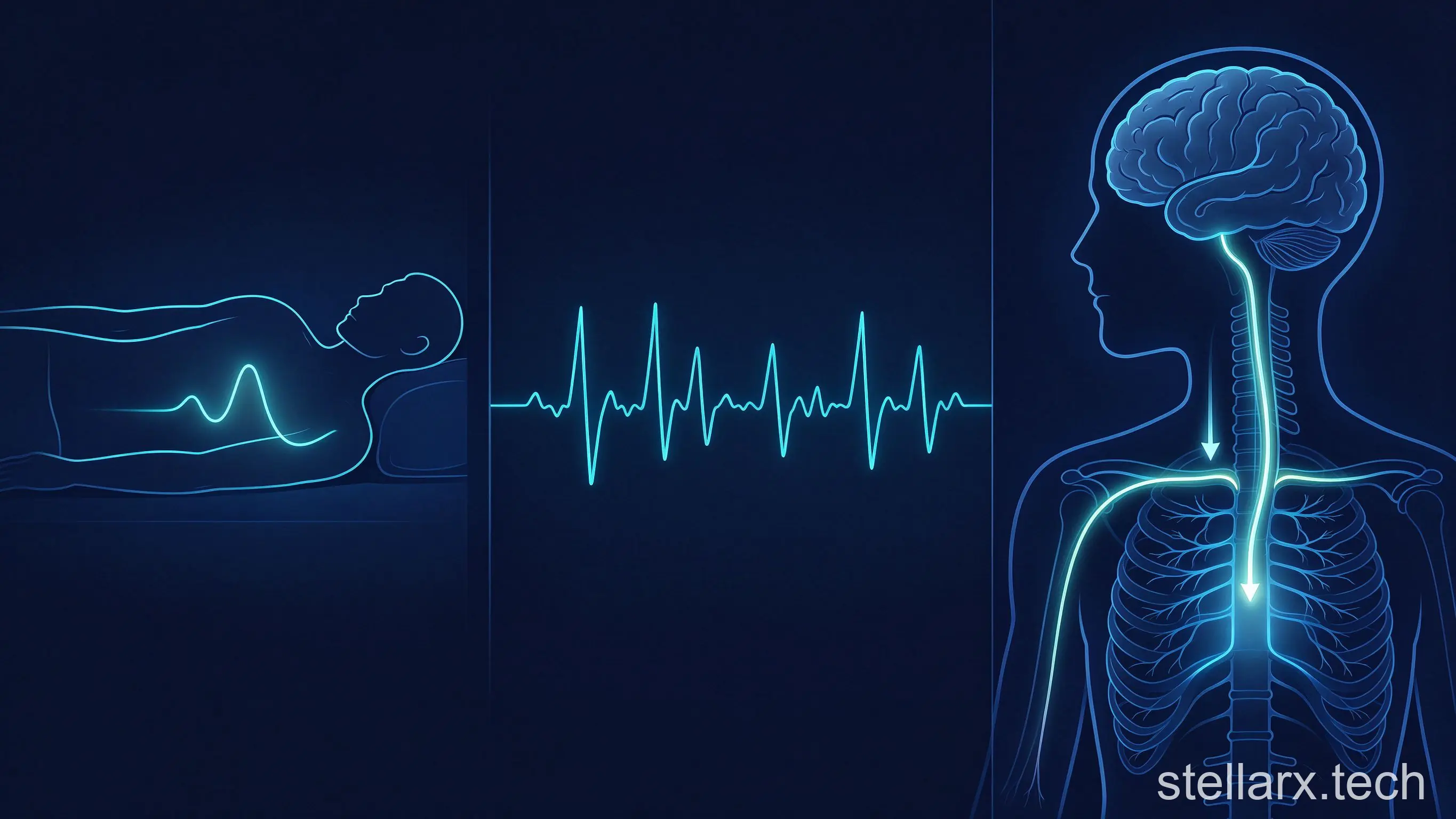
Breathing, heart rate and blood pressure are not three independent systems running side by side. When you breathe slowly and steadily, the pressure changes inside your chest drag your heart rate and blood pressure into a matching rhythm. Along the way, markers of autonomic regulation — heart rate variability (HRV), the baroreceptor reflex, and vagus-nerve-driven signals — all shift. Your body moves out of its high-alert state and toward the relaxed range [1][2].
A 2022 systematic review and meta-analysis pooled 223 studies of slow breathing and found that vagal-related HRV measures increased overall — during the breathing, right after a single session, and after weeks of training [2]. Plainly: slowing your breath hands your body a "it's OK to slow down now" signal, and a tense body becomes easier to relax. Meanwhile, focusing on your breathing pulls your attention away from the phone and the loop of thoughts — cognitive arousal drops, too.
And falling asleep is exactly this process.
You are not a computer. You don't stay awake until 23:59 and shut down at 00:00. Work, scrolling, replying, worrying — all of it keeps your brain and body revved up. Even when you're under the blanket, you don't fully exit daytime mode. Smooth sleep needs a gradual gear-down, and deliberately slowing your breath is an explicit braking move in the right direction.
Researchers actually tested whether slowing your breath before bed improves sleep:
In 2015, a Psychophysiology study had people who self-reported insomnia do one thing before bed: slow, paced breathing for 20 minutes. Sleep-onset latency dropped. Night-time awakenings dropped. Time awake dropped. Sleep efficiency went up [3].
In June of this year, a systematic review combed through the bedtime slow-breathing research — 9 studies, 457 participants, all breathing at ≤10 breaths per minute before bed. In studies using subjective sleep assessment, participants reported overall improvements in sleep quality and sleep duration [4].
One warning first, because everyone gets this wrong: slow breathing is not a huge desperate inhale. Many people, told to "breathe to relax," thrust their chest up, shrug their shoulders, and suck in as if trying to inhale the whole room.
Then: dizzy.
If the goal is relaxation, what matters is slower, steadier, and less effort — not bigger.
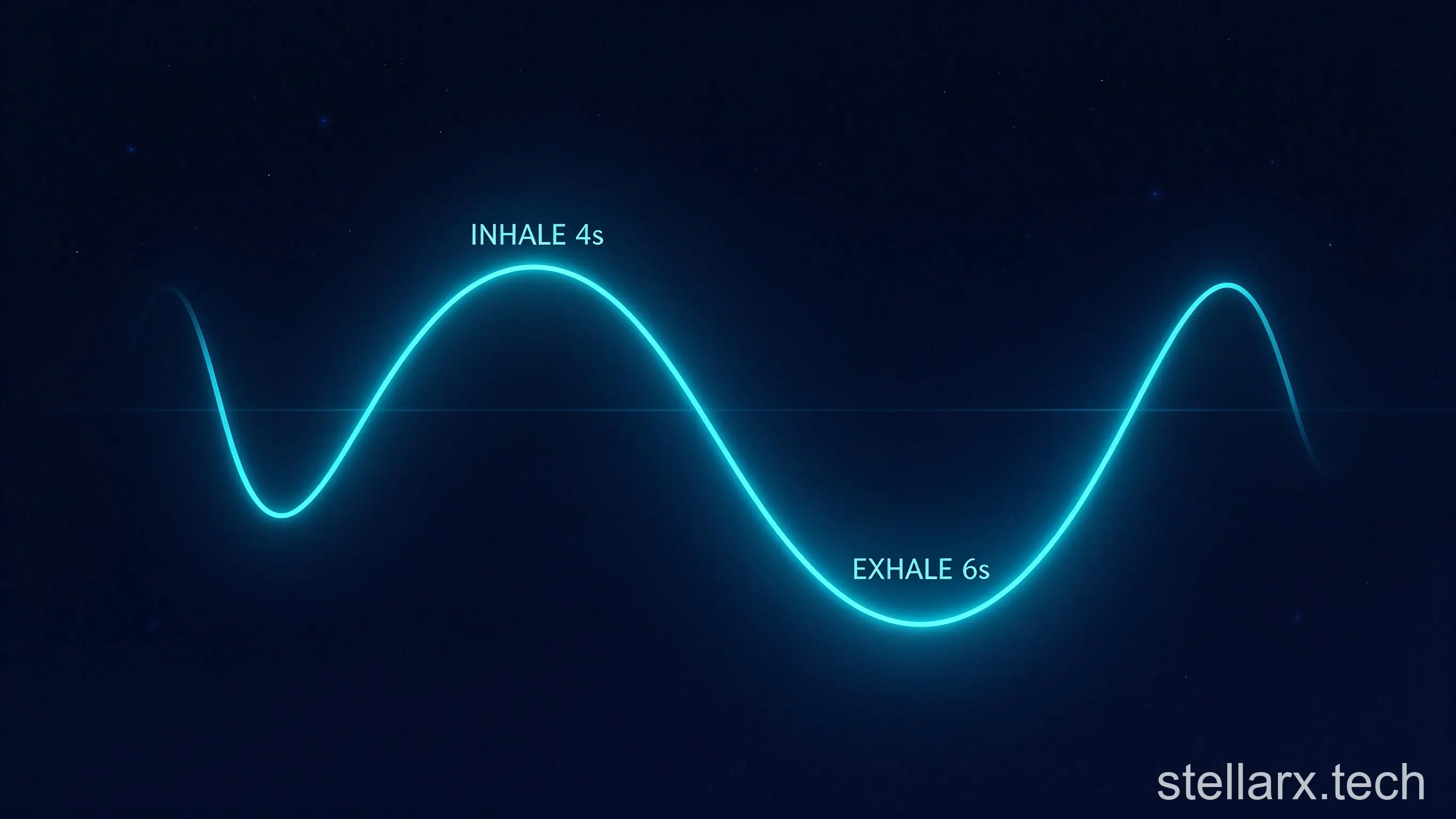
Why does the exhale matter more than the inhale? Because the exhale is the phase that switches the brake on. During a slow, unhurried exhale, the stretch-sensitive feedback from your chest and lungs — the same signals the baroreceptor reflex runs on — tilts your autonomic balance toward the parasympathetic, "rest and digest" side. That is also why most slow-breathing protocols make the exhale longer than the inhale: you are deliberately holding the brake a little longer on purpose.
The 4-6 rhythm has a technical reason behind it, too. Breathing around six times a minute — roughly one full cycle every ten seconds — lands near the 0.1 Hz frequency where respiratory sinus arrhythmia is strongest. Your heart rate rises a little with each inhale and dips with each exhale, and this rhythmic tug-of-war is exactly what keeps vagal flexibility in training. Across the 223 studies pooled in the 2022 review, this vagal-linked HRV increase was the most consistent finding in slow-breathing protocols — at rest, after a single session, and after weeks of practice [2].
One more reason this works at night: it requires nothing. No app, no equipment, no counting chart — just you, in bed, breathing a little slower than usual. And because slow breathing pulls your attention onto one simple rhythm, it also interrupts the 2 a.m. thought loop — the unfinished PPT, the unanswered message, tomorrow's deadline. A wandering mind is normal; when you notice it, simply come back to the counts.
There are many breathing recipes out there — 4-7-8, box breathing, belly breathing — and which one feels best is personal. The research behind them overlaps: what matters is a slower rate, a longer exhale, and no forcing. So don't collect techniques. Pick the one that feels natural tonight and let it become a habit; bedtime is a routine, and routines tolerate repetition well.
Here are two methods you can pick from tonight.
| Step | What to do |
|---|---|
| 1 · Inhale for 4 seconds | Breathe in slowly through your nose, counting 1, 2, 3, 4. |
| 2 · Exhale for 6 seconds | Breathe out slowly through your nose or mouth, counting 1 to 6. |
| Who it's for: people who want to wind down before bed but keep it simple. | |
| Reminder: no breath-holding, no straining — if it feels uncomfortable, shorten the counts. | |
The "Air Force" fall-asleep method reportedly comes from the U.S. Air Force: pilots have to be able to fall asleep in any gap — between missions, during a transfer — so they developed this three-step wind-down. Its point is not to force sleep, but to unload the body and mind layer by layer and let sleep come on its own.
| Step | Technique |
|---|---|
| 1 · Progressive body relaxation | Relax your face first, then drop your shoulders and let your arms go heavy; keep relaxing down through your chest, belly and legs to your feet. |
| 2 · Slow breathing | Breathe in slowly, breathe out even slower. No breath-holding, no straining. |
| 3 · Clear your mind | Picture one calm scene, like a still lake, and let your attention rest on it. |
| Who it's for: people whose minds won't stop at bedtime and whose bodies feel tight. | |
| Reminder: it is a relaxation practice — not a magic guarantee of falling asleep in two minutes. | |
Tonight, lying in bed, pick whichever one feels right. No forcing. No counting competition.
And if your mind wanders mid-breath, that's fine — it's still working.
Sleep well.
including a cardiomyocyte specimen where short, branched cardiac muscle cells are clearly visible — the cells your heart rhythm runs on, and the rhythm your slow breathing gently steadies. Search "WWAI" in your app store and download it today.

Related reading
Your Gut's "Second Brain": 500 Million Neurons of Its Own

Why You're Sleepy at 3 PM but Wide Awake at 7 PM

The 1-Hour Habit That Fixes Your Sleep
>References
1. Russo MA, Santarelli DM, O'Rourke D. The physiological effects of slow breathing in the healthy human. Breathe (Sheff). 2017;13(4):298-309.
2. Laborde S, Allen MS, Borges U, et al. Effects of voluntary slow breathing on heart rate and heart rate variability: A systematic review and a meta-analysis. Neurosci Biobehav Rev. 2022;138:104711.
3. Tsai HJ, Kuo TBJ, Lee GS, Yang CCH. Efficacy of paced breathing for insomnia: enhances vagal activity and improves sleep quality. Psychophysiology. 2015;52(3):388-396.
4. Eide EM, Hernes HM, Grønli J. Slow breathing techniques before bedtime and the effects on sleep: A systematic review. Sleep Med Rev. 2026;87:102284.
- Polyacrylamide Hydrogel: A Banned Filler That Never Leaves
- 奧美定(聚丙烯酰胺水凝膠):被禁20年仍無法完全取出的填充劑
- Slow Breathing Before Bed: The Underrated Sleep Habit
- 睡前把呼吸放慢:被低估的助眠習慣
- 一顆洗衣凝珠在她手裡炸開,腐蝕掉了一小塊角膜
- A Laundry Pod Burst in Her Hand — and Dissolved Her Cornea
- The Silent Kitchen
- 推開門的那一刻
- 五百歲的鯊魚,與被逼放棄長壽的哺乳動物
- The 500-Year Shark, and Why Mammals Gave Up Longevity

全部评论