The 500-Year Shark, and Why Mammals Gave Up Longevity
The oldest vertebrate on record is a Greenland shark born around the Ming Dynasty. Its maximum lifespan is estimated at 502 years. And yet, by the arithmetic of biology, humans should not be living this "short" — for which you can largely blame the ancestors of chickens.
Start with the record books. The longest-lived amniote is the Aldabra giant tortoise: a Seychelles giant tortoise named Jonathan is still alive at 194, and the upper record belongs to a tortoise called Adwaita, estimated from records at 255 years.
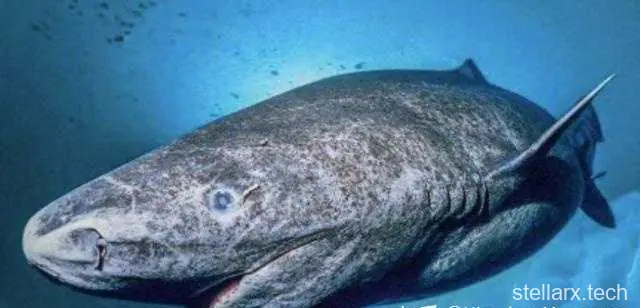
The oldest vertebrate, as mentioned, is a Greenland shark — a species that grows so slowly that it only reaches sexual maturity at around 150 years old.
Among mammals, the record holder is the bowhead whale, at roughly 130 to 200 years. But mammal lifespan roughly scales with body size — the whale's longevity is propped up by its sheer bulk, which is far less impressive than a 31-year-old naked mole rat.
So longevity needs a size correction. Take the predicted lifespan for an animal's body mass, then divide actual lifespan by the prediction. That ratio is the longevity quotient, or LQ.
By this measure, naked mole rats and modern humans are roughly equal — both at LQ = 4.5 — and far above the bowhead whale's LQ of 1.8. In other words, a modern human already lives about 4.5 times longer than the mammalian average for our body size, thanks largely to medicine, food, clothing, and shelter that minimized environmental vulnerability.
Yet the longest-lived mammal for its size is not a human and not a naked mole rat. It is a bat.
| Species | Longest recorded life | Body size | Longevity quotient (LQ) |
|---|---|---|---|
| Greenland shark | ~502 years (oldest vertebrate) | ~1 tonne | — |
| Bowhead whale | 130–200 years | ~75–100 t | 1.8 |
| Modern human | ~122 years | ~70 kg | 4.5 |
| Naked mole rat | ~31 years | ~35 g | 4.5 |
| Brandt's bat | 41+ years | ~7 g | 8–9.8 |
Brandt's bat (Myotis brandtii) has reached over 41 years at a body weight of about seven grams — roughly 9.8 times the lifespan predicted for its size. Among all mammals, only 19 species have a longer LQ than humans, and 18 of them are bats. To other mammals of its size, a bat looks like a human who lives to 1,000.
Why do bats live so long? The mainstream view is that it is an accidental side effect of flight. Flying demands high metabolism, which generates massive oxidative stress and reactive oxygen species. To survive that, bats evolved superb antioxidant defenses — and, as a byproduct, longer life. Their bodies run at about 40 °C, and their hearts can beat hundreds to thousands of times a minute.
And this extreme longevity evolved independently at least four times. Ancestral-state reconstruction of LQ across the bat tree shows that very long life (LQ > 4.2) arose separately in:
Horseshoe bats (Rhinolophus) — for example Rhinolophus ferrumequinum — evolved extreme longevity on their own.
Vampire bats (Desmodus rotundus) — a second independent origin of LQ > 4.2.
Long-eared bats (Plecotus) — for example Plecotus auritus — a third independent origin.
Mouse-eared bats (Myotis) — at least one lineage, including Brandt's bat (Myotis brandtii) — a fourth independent origin.
But recent work flips the question: maybe bats are not unusually long-lived. Maybe the mammalian average is unusually short.
In June 2022, a paper in Science pooled field data from 77 reptile species and 107 amphibian populations and found that about three-quarters of them age so slowly that senescence is negligible — mortality does not rise with age after maturity. In a lizard or turtle lineage, an animal that has a 1% chance of dying at age 10 still has a 1% chance at age 100. It is as if a human stayed a vigorous young adult from age 3 to 97, and only the final three years counted as old age.
The longevity bottleneck, in timeline form:
Permian (~300–250 million years ago) — Amniotes split: synapsids, the lineage that leads to mammals, versus sauropsids, the lineage of reptiles and birds.
Triassic–Jurassic (~250–150 million years ago) — Dinosaurs dominate. Mammal ancestors are squeezed into small, fast-breeding, short-lived bodies, and endlessly regenerating teeth are lost.
Cretaceous (~150–66 million years ago) — Longevity genes stay lost; trichromatic vision and the photolyase DNA repair system disappear from the mammal lineage.
Cenozoic (66 million years ago–present) — Dinosaurs are gone and mammals radiate — but the longevity genes are not regained.
One explanation is thermoregulation: cold-blooded animals run slower metabolisms and live longer. But birds have higher metabolisms than most mammals and still outlive them — so temperature is not the main story. The second explanation is the "longevity bottleneck" hypothesis: the mammals' unique aging pattern is a relic of their ecological niche during the Mesozoic, when dinosaurs forced the ancestors of mammals to abandon long-life genes — and mammals have been genetically stuck with that loss ever since.
The evidence lines up. Mammals lost their endlessly regenerating teeth right around the Jurassic. They lost trichromatic vision during the Mesozoic (primates re-evolved it later, under pressure from snakes and the need to find ripe fruit). And the photolyase DNA repair system — which efficiently removes UV damage from DNA — disappeared from eutherian mammal lineages in the dinosaur era.
Being small and breeding fast and dying fast let mammalian ancestors raise offspring and die, so generations never competed with their own parents for food. Population turnover sped up; the poorly adapted died off faster and stopped competing with better-adapted offspring. That was how mammals survived being crushed by dinosaurs for more than a hundred million years — by giving up longevity.
Why Telomeres Make It Concrete
Here is where the mechanism gets visible. Telomeres are the repeated DNA sequences at the ends of eukaryotic chromosomes — tandem 5′-TTAGGG-3′ repeats that protect the chromosome ends. With every cell division, the telomeres get shorter. When they shrink to a critical length, the cell emits a DNA-damage signal and enters cellular senescence — the point at which aging starts at the cellular level.
In germ cells, stem cells, and cancer cells, telomere length is maintained by telomerase, a reverse transcriptase that re-adds repeats to the chromosome ends.
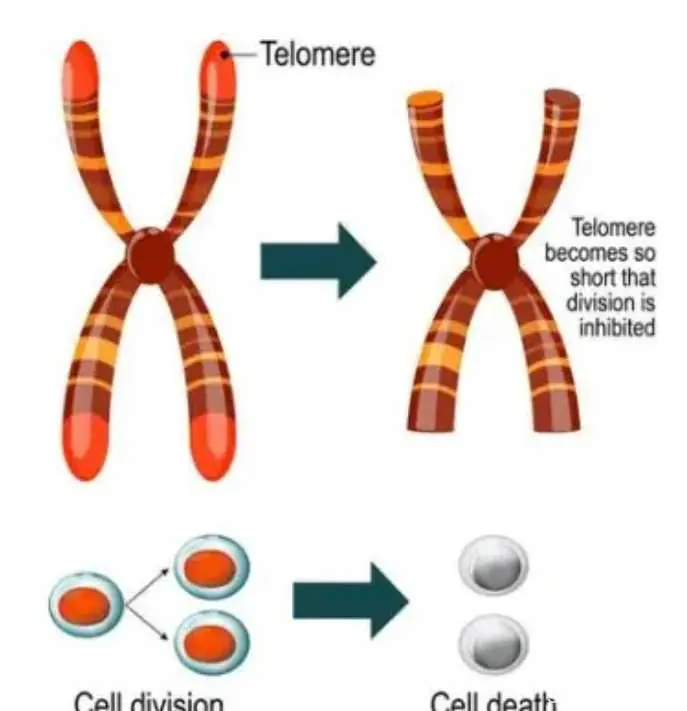
Bats are the exception that breaks the rule. In the longest-lived bat species — the Myotis group — there is no evidence that telomeres shorten with age at all. Long-lived bats appear to have evolved better mechanisms to prevent and repair age-related cell damage, with the genes ATM and SETX implicated. Surprisingly, they show no telomerase expression — yet they avoid cancer, despite the fact that excessive telomerase activity sharply raises cancer risk. Long-lived bats stay long-lived and almost never get cancer.
So the next time you hear about a 500-year shark or a bat that looks like a human living to 1,000, remember the other side of the story: mammals were once squeezed into short lives, and our own fourfold lifespan is already the exception that survived a hundred million years of dinosaurs.
Telomeres shorten with every round of cell division — the very process you can watch under a microscope. WWAI gives you real microscopy specimens to explore at multiple magnifications — including a maize root tip specimen where dividing cells with clear mitotic figures are clearly visible, the same cell division that shortens telomeres with every round — with AI answers about what you are seeing. Search "WWAI" in your app store and download it now.

Related reading

Glutes and Aging: What 61,000 MRI Scans Show
GLP-1 Mouse Longevity: 12% Lifespan Gain

Humans Are Lobe-Finned Fish: The Evolution Proof
>References
Lifespan records, longevity quotient, and telomere biology follow the cited literature (Nature 538, 257-259, 2016; Science abm0151, 2022; J Gerontol A 60, 1366-1368, 2005; Curr Biol 26, R397-R399, 2016). Diagrams are AI-generated; animal photographs are sourced photography.
- Polyacrylamide Hydrogel: A Banned Filler That Never Leaves
- 奧美定(聚丙烯酰胺水凝膠):被禁20年仍無法完全取出的填充劑
- Slow Breathing Before Bed: The Underrated Sleep Habit
- 睡前把呼吸放慢:被低估的助眠習慣
- 一顆洗衣凝珠在她手裡炸開,腐蝕掉了一小塊角膜
- A Laundry Pod Burst in Her Hand — and Dissolved Her Cornea
- The Silent Kitchen
- 推開門的那一刻
- 五百歲的鯊魚,與被逼放棄長壽的哺乳動物
- The 500-Year Shark, and Why Mammals Gave Up Longevity

全部评论