Why You Shouldn't Wash Raw Chicken: Bacteria Splash
A person who cannot cook walks into a kitchen and becomes a fully automatic accident machine. Its signature move: hold the raw chicken under a running tap and "wash it clean" before dinner. The machine means well. The water makes it worse — every rinse mails the bacteria around the whole kitchen.
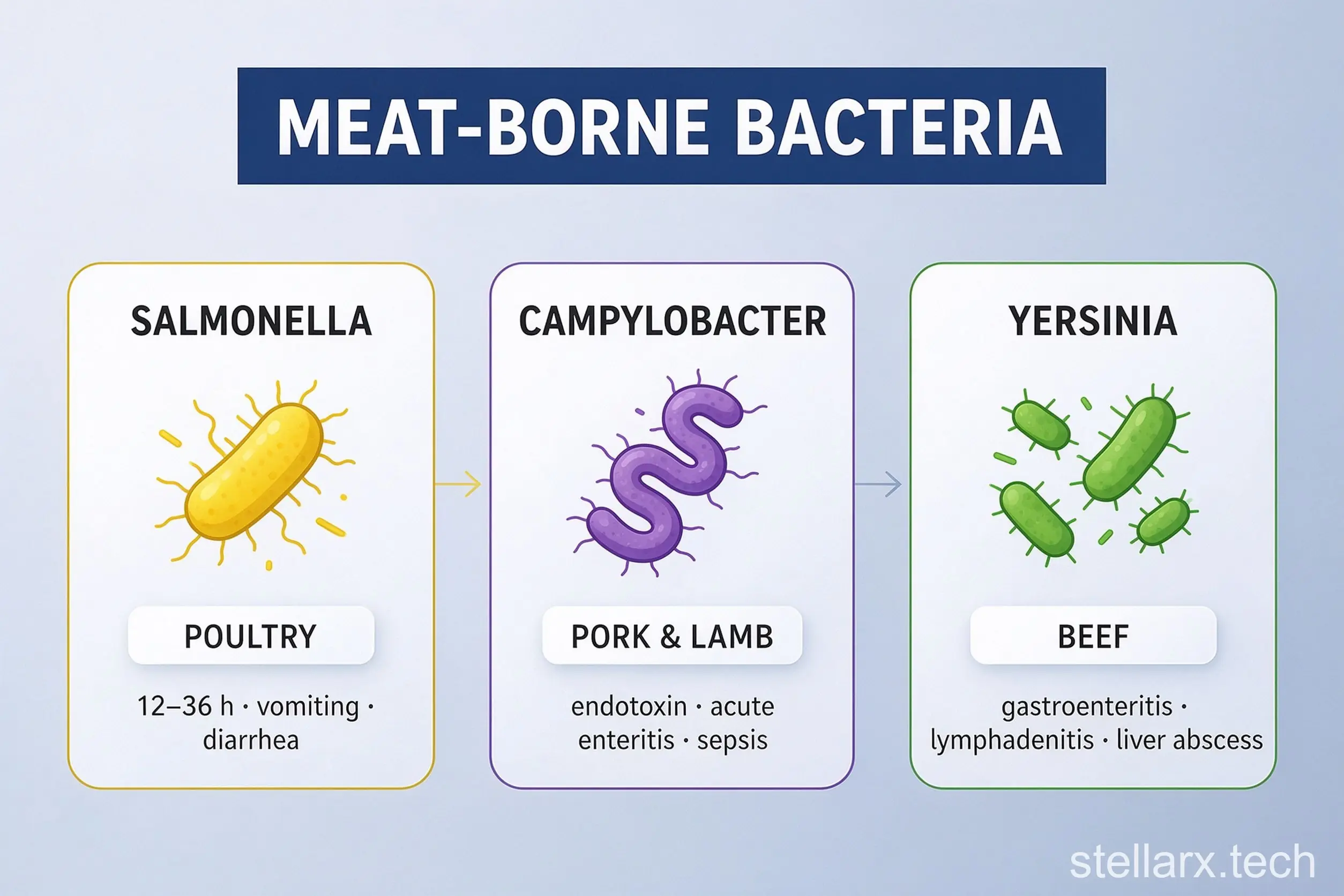
Three bacteria ride on raw meat.
Salmonella is found most often on poultry. It strikes 12 to 36 hours after the meal — vomiting and diarrhea, usually on the milder side.
Campylobacter jejuni is found most often on pork and lamb. Its endotoxin attacks the gut lining and produces acute enteritis; in severe cases the bacteria reach the bloodstream and turn into sepsis. Incubation: 3 to 5 days.
Yersinia enterocolitica is found most often on beef. It causes gastroenteritis and mesenteric lymphadenitis — in the worst cases sepsis, liver abscess, and erythema nodosum. Incubation: 3 to 7 days.
Regional numbers cut sharper than national averages. In northeastern China, Campylobacter contamination on chicken runs at roughly half the national average. In Scotland, a 2019 retail survey detected STEC — including O157 — in 22% of minced beef samples. In Jalisco, Mexico, Salmonella turned up in 18% of cattle carcasses, 39% of beef cuts, and 71% of minced beef.
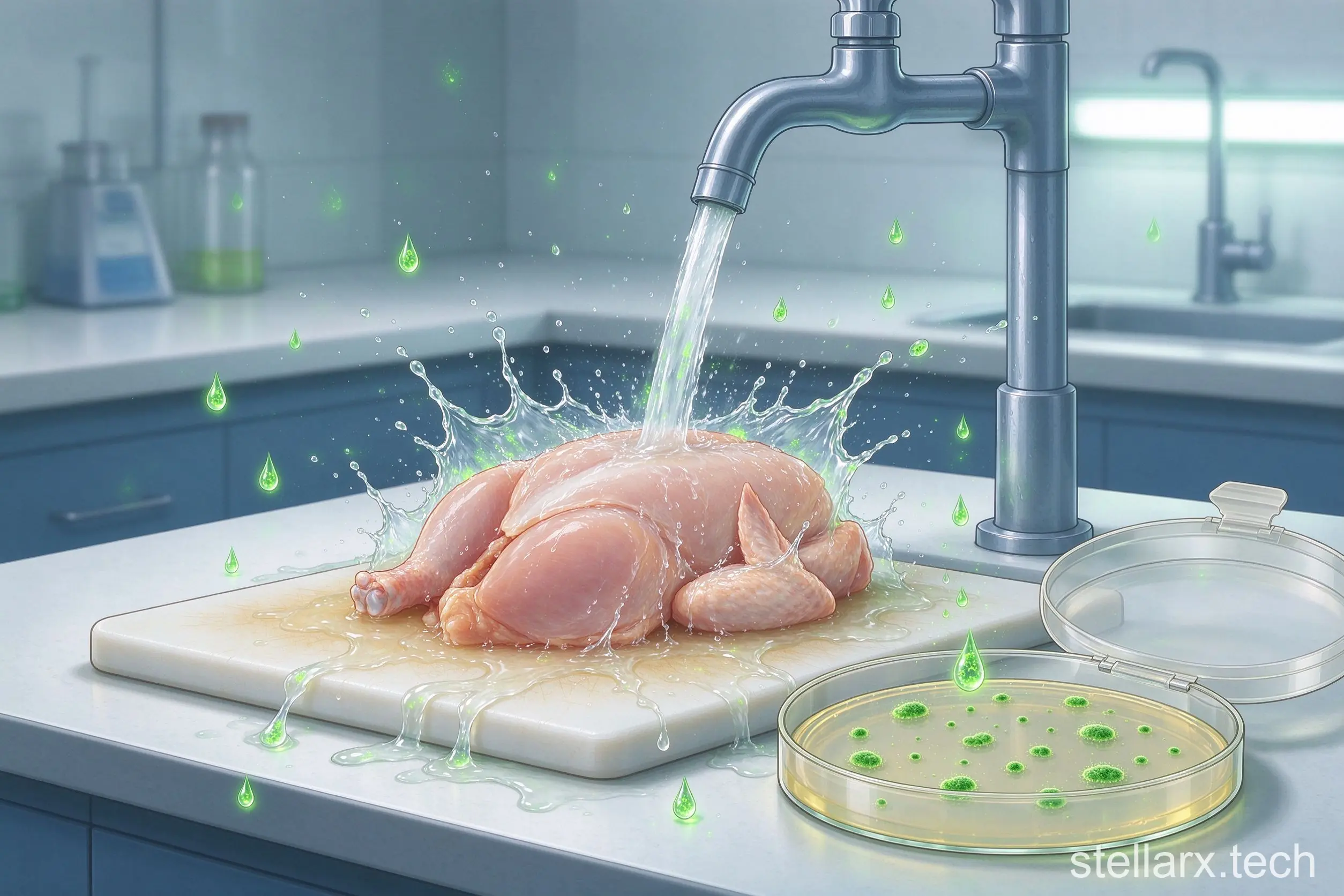
The "Chickensplash" experiment.
In 2022, a team led by Carmody et al. washed raw chicken under a tap and collected the splash droplets on agar plates. The higher the tap, the more bacteria-carrying droplets flew across the kitchen. Whether the stream was aerated or not made almost no difference. "Washing" does not remove the bacteria; it redeploys them.
Some bacteria do not need much to make you sick.
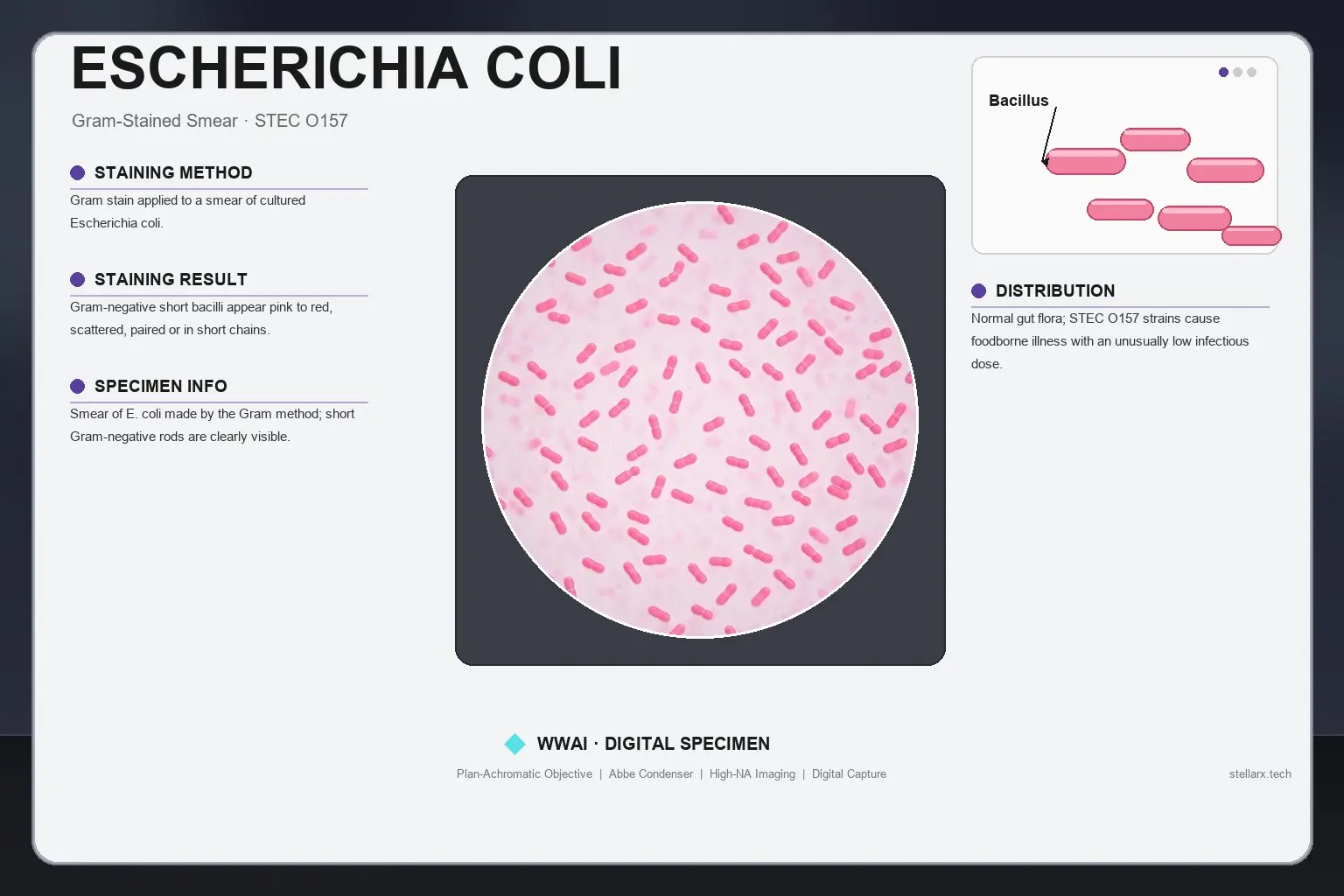
Shiga-toxin-producing E. coli O157:H7 has a famously low infectious dose. Dose-response models put the 50% illness probability at about 36 colony-forming units, and individual cases have been linked to single-digit CFU. Campylobacter and Salmonella need tens to hundreds of times more. A few invisible cells of the wrong kind can outweigh a generous splash of the common kind.
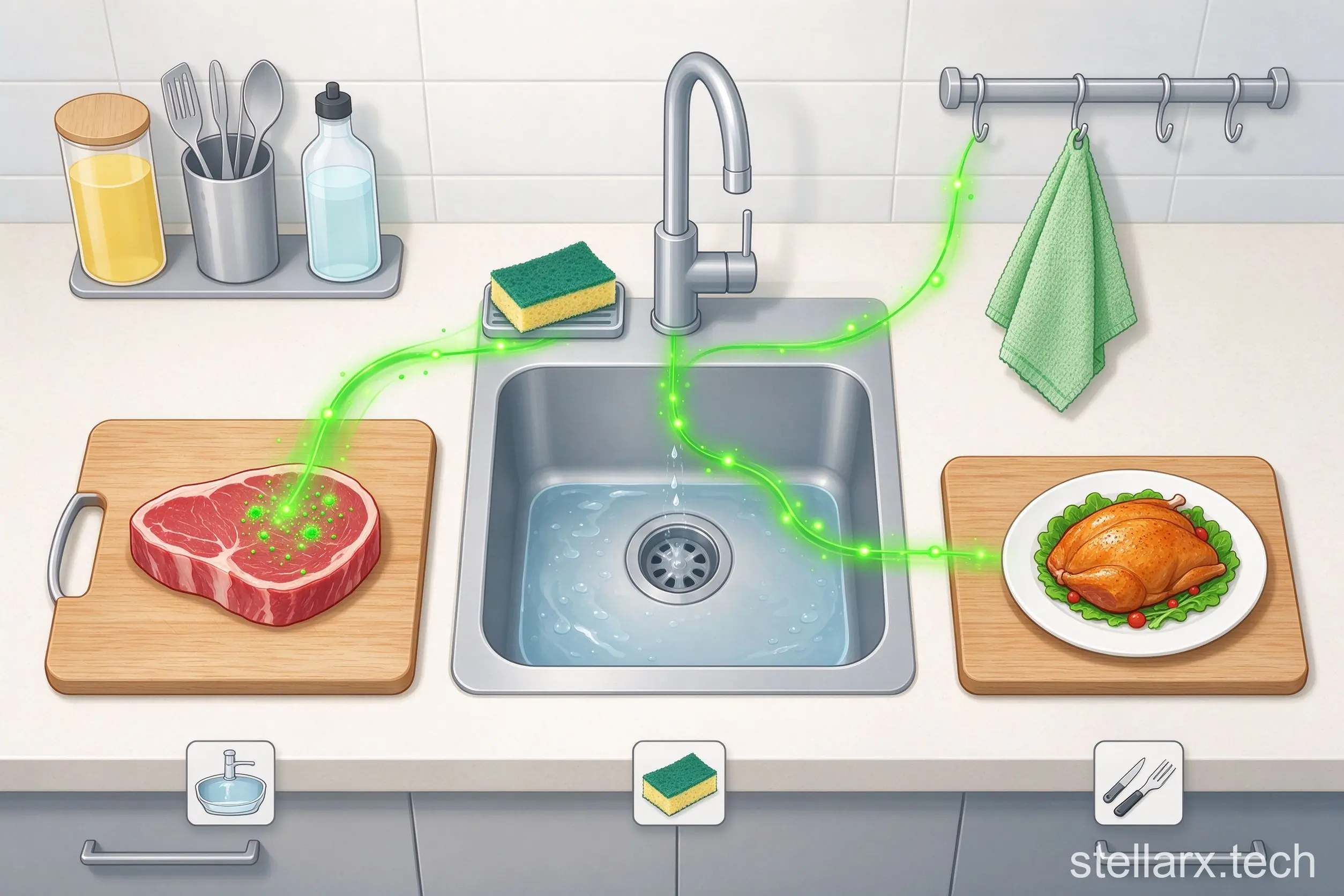
The sink is not where the bacteria stop.
A Portuguese study followed 18 household kitchens and observed cross-contamination in 4 of them — bacteria moving from raw meat to the sink, the sponge, the cutting board, the dishcloth, and other surfaces. One rinse, and the whole kitchen joins the team.
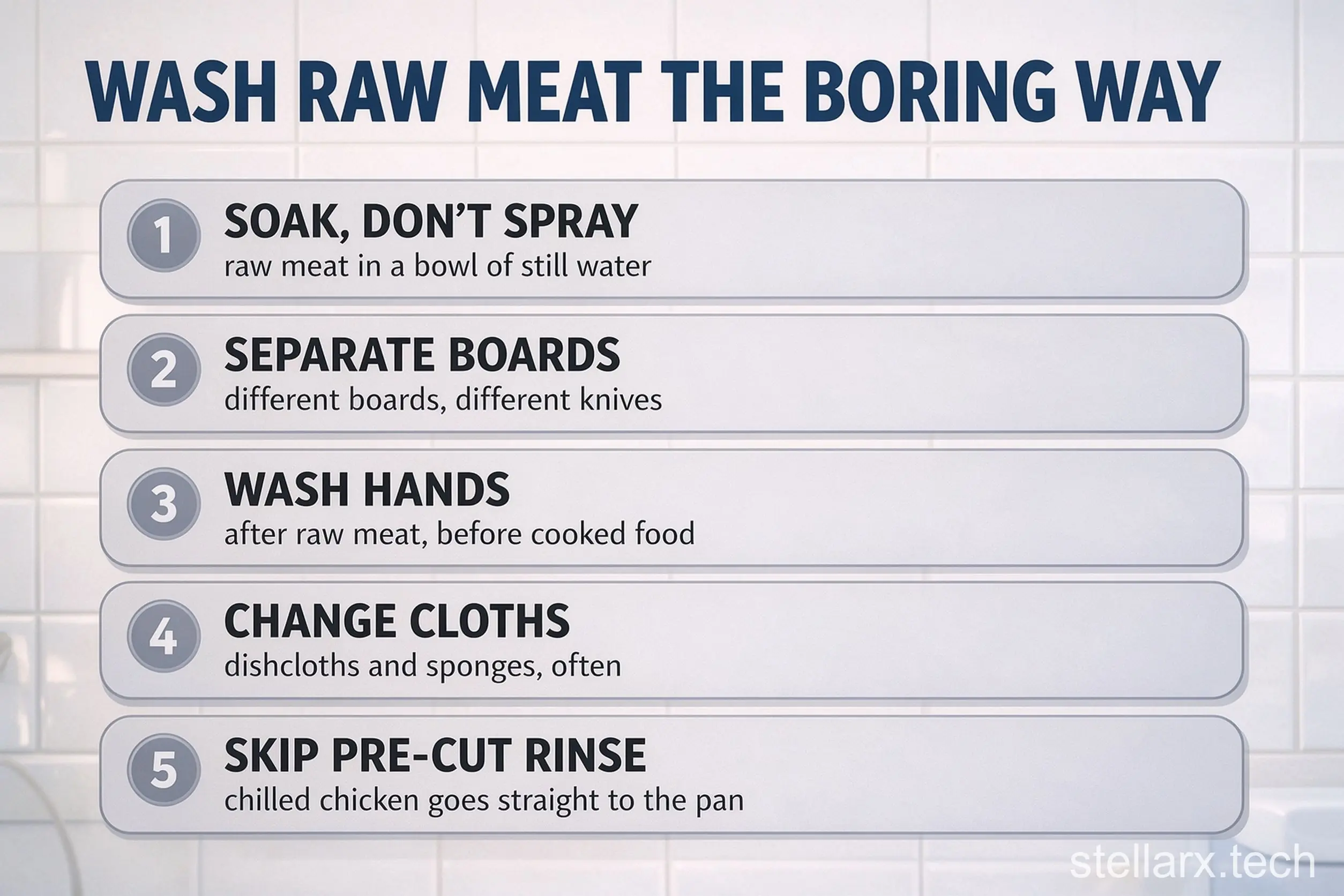
Wash it the boring way.
Soak, don't spray. Put the raw meat into a fixed container of water and let it sit, instead of rinsing under the tap.
Keep raw and cooked separate. Different boards, different knives.
Wash your hands after touching raw meat and before touching cooked food or cutlery.
Change dishcloths and sponges often. They are the bacteria's forward base.
Skip the pre-wash for chilled pre-cut products. Packaged chicken leg fillets and diced chicken can go straight into the pan; if there is no blood or foreign matter, there is nothing to rinse off.
A survey across 17 provinces in China, covering 500 households, found that two-thirds still rinse raw meat under the tap. The habit is older than the warning. But the tap doesn't clean the meat; it only spreads the bacteria. The correct wash is almost insultingly simple: put the meat in a bowl, and let the water stay still.
Want to see what you're dealing with? Those short rods under a microscope are the actual characters in this story — including an Escherichia coli specimen where Gram-negative short bacillus shapes are clearly visible. WWAI lets you observe specimens like this on your phone right now, no microscope, no slides. Search "WWAI" in your app store and download it today.

Related reading

Salmonella: How It Contaminates Your Food

Washed Eggs: Why a Family Got Poisoned

Fried Rice Syndrome: A Reheating Danger
References
1. Carmody PJ, et al. "Chickensplash! Exploring the health concerns of washing raw chicken." Physics of Fluids, 2022.
2. Hara-Kudo Y, Takatori K. "Contamination level and ingestion dose of foodborne pathogens associated with food poisoning." Epidemiology and Infection, 2011.
3. Strachan NJC, et al. "Dose response modelling of Escherichia coli O157 incorporating data from foodborne and environmental outbreaks." International Journal of Food Microbiology, 2005.
4. Retail minced beef survey, Scotland, 2019: STEC (including O157) detected in 22% of samples. Journal of Food Protection, 2022.
5. Salmonella detection in cattle carcasses, beef cuts and minced beef in Jalisco, Mexico. International Journal of Food Microbiology, 2015.
6. Campylobacter cross-contamination in household kitchens: 18 Portuguese households, transfer observed in 4. International Journal of Food Microbiology, 2021.
- Vegetable Nutrition: Why Lettuce Isn't the Healthiest Green
- 蔬菜營養排名:生菜墊底?真正的營養之王是這 5 種
- Metformin for Healthspan: Muscle, Bone, and a Tumor Switch
- 二甲雙胍延緩衰老?中年肌肉骨骼與膠質母細胞瘤的新證據
- 甜高粱會取代甘蔗與甜菜嗎?植物也會得「糖尿病」
- Why Sweet Sorghum Could Replace Sugar Cane and Beet
- Why You Shouldn't Wash Raw Chicken: Bacteria Splash
- 生雞肉不要洗?水龍頭沖洗讓細菌飛濺
- “大辞职时代”?双休?要松弛感?被忽悠了?
- 574集还在追更:皇帝想长生,臣子却只想让他当吉祥物
全部评论