AI Consumer Spending: Who Actually Pays for AI?
Recently, the well-known venture firm a16z released the seventh edition of its Top 100 Consumer AI Apps list. After three years of tracking, this traffic-based ranking has thoroughly solidified: this edition welcomed only 11 new products — a historic low.
But something more significant than the ranking itself: for the first time, a16z paired the list with real US consumer credit-card spending data.
When "who uses" and "who pays" are overlaid, an uncomfortable truth emerges: AI's traffic empire is held up by a very small number of people paying real money.
And those people are probably not visible in your social feed.
The Power-Law Reality of AI Spending
Survey data shows nearly half of US adults say they have used an AI product. But only 25% open one every day.
As of August 2026, consumers paying for ChatGPT, Gemini, or Claude subscriptions: just 4.5% — double the figure from a year earlier, yet still vanishingly small.
Roughly speaking, of every 100 Americans who have tried AI, only about 9 are willing to pay for it long-term.
More users are calling AI from inside desktop apps and traditional software, but those behaviors never enter web-traffic statistics. The traffic ranking shows only the tip of the iceberg; the spending data reveals the worrying part under the waterline.
So who is actually keeping this industry alive?
| Metric (US consumer AI market, 2026) | Value |
|---|---|
| Adults who say they have used an AI product | Nearly half (≈50%) |
| Who open an AI product every day | Only 25% of users |
| Consumers paying for ChatGPT / Gemini / Claude (Aug 2026) | 4.5% (roughly doubled in a year) |
| Top 1% of paying users — share of revenue | 19.5% (more than the bottom 50% combined) |
| Top power users — monthly spend | ≈$903/month (up 80% in 18 months) |
| Median subscriber — monthly spend | ≈$25/month (barely growing) |
| Gap between power users and the median | ≈36x |
a16z's data shows an extreme power-law distribution: the top 1% of paying users contribute 19.5% of consumer-AI revenue — more than the bottom 50% of users combined.
These pyramid-top users spend about $903 per month on AI tools — roughly ¥6,054 at recent exchange rates, about a month's salary for some people. Their spending has surged 80% over the past 18 months. The median paying user spends about $25 a month (≈¥167), a figure that has barely grown.
The gap: about 36x.
What Power Users Actually Buy
The shopping lists of these super-users are revealing: on one side, automation tools like n8n and Manus; on the other, creative-production platforms like Higgsfield, Figma, and HeyGen. Every tool shares one trait — they are all tools for getting work done.
They pay for AI not for casual chat or novelty, but as productivity components genuinely embedded in their workflows.
That is consumer AI's first "real market": the people willing to pay are precisely those who use AI to make or save money.
There is another telling pattern: among the top 50 AI vendors by real spending, 29 never appear on the traffic list at all. You may never have heard of them, yet a small cluster of heavy users keeps paying. Their users don't chase "download counts"; they only care whether the tool gets the job done.
Conversely, only seven companies appear on all three lists — web traffic, mobile MAU, and real revenue:
| Only companies on all three lists (web traffic, mobile MAU, real revenue) | |
|---|---|
| ChatGPT | |
| Claude | |
| Suno | |
| Perplexity | |
| Photoroom | |
| Canva | |
| Notion | |
| High-revenue AI vendors absent from the traffic list | 29 of the top 50 by real spend |
Most star products inflated by free traffic never make it to the table of real spending.
ChatGPT vs Claude: Two Strategies
The mass-market landscape is quietly shifting too.
ChatGPT remains the absolute traffic king: its mobile MAU is 14x Claude's, and its paid-subscriber count is 3x higher than Gemini's and Claude's combined.
But the real variable is Claude. In the first edition of the list (September 2023), Claude did not appear at all. Today it has not only surged in traffic but briefly overtaken Gemini in total US paying users.
The key is subscription structure: about 7.5% of Claude's subscribers buy premium plans at $100/month or more, while for ChatGPT and Gemini that share is only about 1%.
Claude follows a "refinement" strategy: it does not chase the most users; it chases the users most willing to pay. In the subscription game, that is often the smartest play.
Paying Is Easy, Staying Is Hard
Almost every leading AI company shares a contradictory pattern.
RevenueCat's 2026 subscription report shows AI apps convert trials to paid at 8.5% — 52% higher than non-AI apps — and their paid users' lifetime value leads traditional apps by a wide margin.
But retention is terrible: AI apps' annual retention is just 21.1%, versus 30.7% for non-AI apps. Users cancel annual subscriptions about 30% faster than with traditional apps.
In plain terms: AI products are first-rate at making people pay, and poor at making them stay.
The logic is easy to follow: users are attracted by a new feature, pay, discover after a while that it's just okay — or find a cheaper alternative — and cancel. The AI app market is still in its "trial period": users hop between products hunting for the newest, strongest tool.
Most AI products have not yet made users feel they can't live without them.
The Hidden Cost of "Free"
The free lunch has always carried a price.
A survey of college students makes the point: 45% think the free tier is good enough; 30% would pay only in specific scenarios like exam weeks or thesis season; about 70% would not pay immediately. Their core needs — paper summarization, research search, thesis outlines — are largely covered by free tiers.
So what actually stops them from paying? 40% say paying and then still hitting usage limits is the most frustrating; 25% worry about privacy, especially granting browser access or letting the app read files.
This exposes the deeper problem of the free model: users are not unwilling to pay for good products; they don't believe that paying will actually solve the problem.
In fact, free users' hidden costs are far larger than they realize. ChatGPT's free tier gives half the context window of subscribers, ads are on by default, and conversations are used for model training by default.
Gemini goes further: from October 9, 2026, free users will only get the lowest-performance Flash-Lite model — Flash and Pro are removed from the free tier.
Free users "pay" for AI in convenience and experience — and most don't know what they are paying.
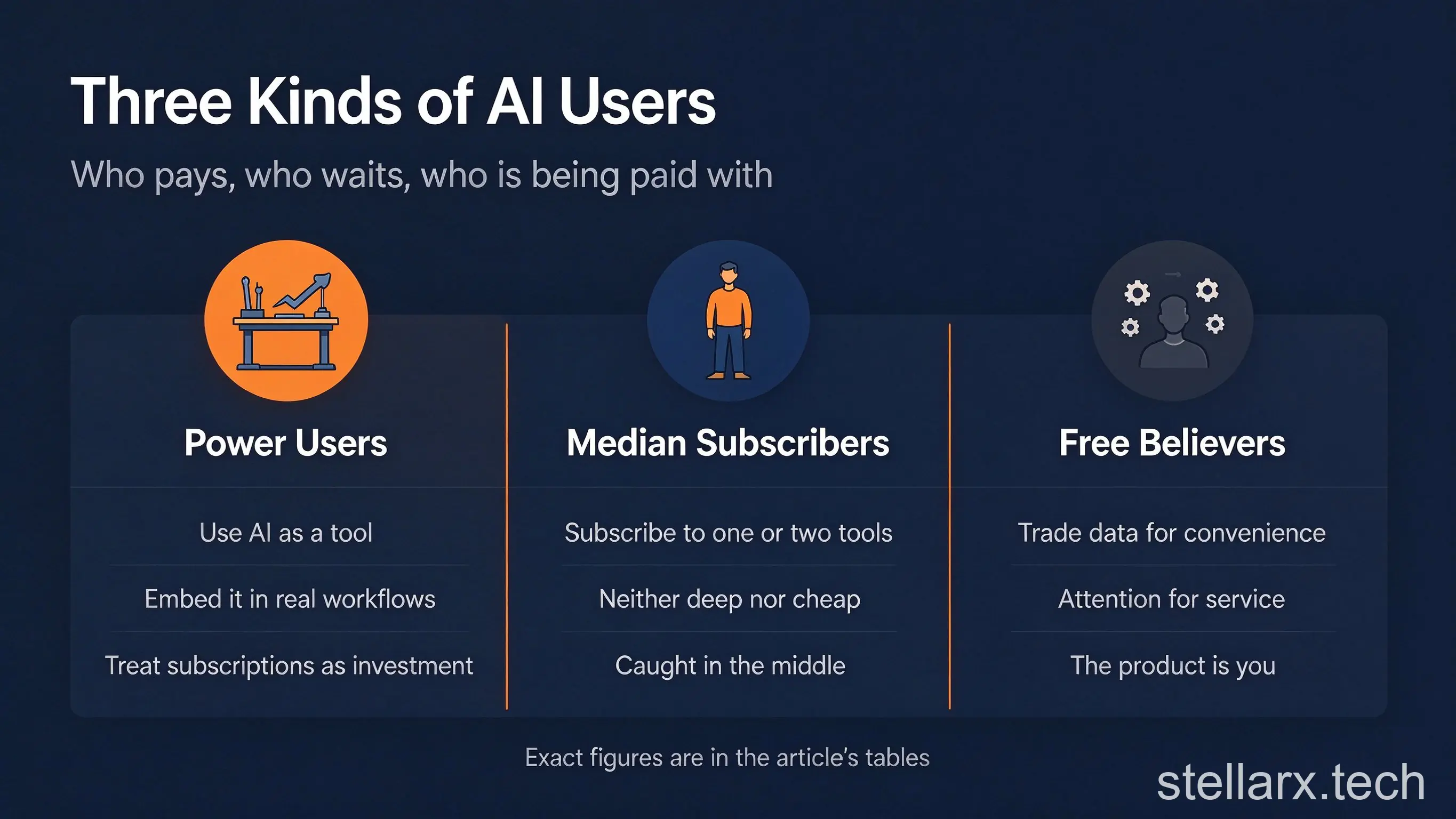
| Group | Behavior | AI is… |
|---|---|---|
| Power users (top 1%) | Buy automation and creative tools embedded in real workflows; replace outsourcing teams | An investment, not a purchase (≈$903/month) |
| Median subscribers | Pay for one or two tools; neither deep in productivity nor free | A modest subscription (≈$25/month) |
| Free believers | Trade data for convenience, attention for service; free tiers shrink over time | Being commoditized — if you do not pay, you are the product |
The Real Debate: Subscriptions or Ads?
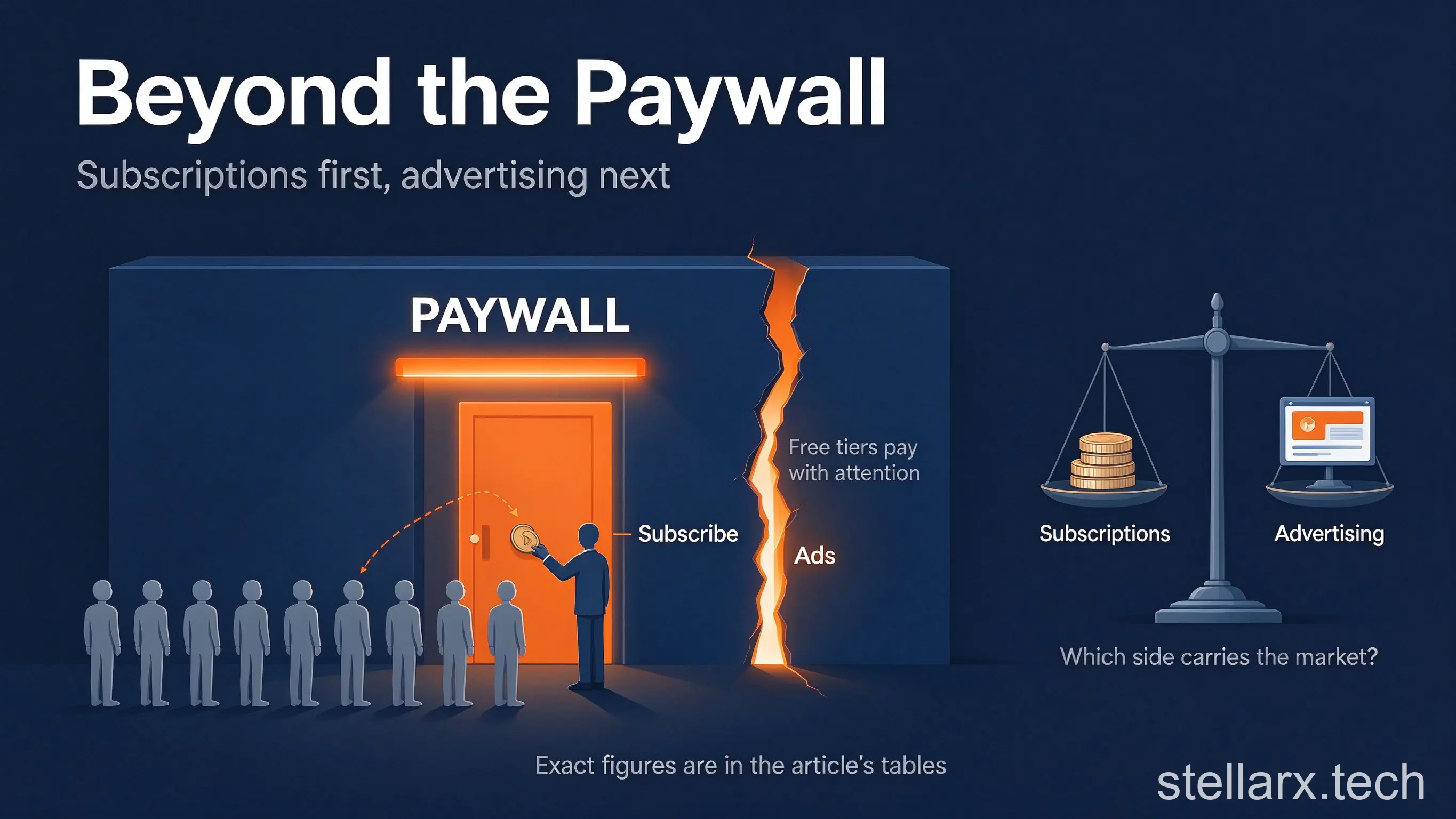
a16z's report also reveals a key metric: on the web, about 85% of AI product revenue comes from subscriptions, with only 13–14% from advertising.
That means consumer AI earns almost everything by charging users directly.
This logic is completely different from the previous internet era, when search, social, and e-commerce monetized users indirectly: users free, advertisers pay.
a16z investing partner Olivia Moore has raised a pointed question: subscription may fundamentally be a business model that cannot reach the mass market.
Her reasoning is compelling: Google earns roughly $460 per user per year from advertising. If AI products could reach that level through ads, the US market alone could generate about $152 billion in annual revenue.
OpenAI is already testing the waters: as of August 2026, its advertising business has reached an annualized revenue scale of $1 billion. Free and low-tier users see ads; high-tier subscribers enjoy an ad-free experience — the same tiered logic as streaming platforms.
Three Groups in the AI Gold Rush
Part of the crowd, believing "free means no cost," is being quietly harvested.
The winners are the power users. Someone spending $903 a month on a pile of AI tools is using them to replace outsourcing teams, compress labor costs, and multiply personal output. For them, AI is not consumption; it is investment.
The harvested are the free believers. They trade data for convenience and attention for service. When conversations are used for model training, when ads penetrate every interaction, when free-tier models are progressively downgraded… they discover that the price of "free" is being commoditized. In the brutal internet age: if you don't pay for the product, you are the product.
The most awkward are the median payers. Spending $25 a month on one or two AI tools, they have neither the power users' productivity returns nor the free users' zero cost — stuck in the middle, neither deep nor cheap.
Conclusion: A Professional-Tool Market
Looking back at the a16z list, one clear conclusion emerges: consumer AI today is essentially a professional-tool market. Its core users are developers, designers, content creators, and automation enthusiasts — people who can embed AI into workflows and generate real economic value with it.
For them, paying tens to hundreds of dollars a month is rational, because AI earns back far more.
But the ceiling of this market is also obvious: when subscription fees become a paywall that keeps the vast majority of ordinary users out, AI can only stay positioned as a "professional tool."
The true mass AI era is not everyone paying for AI. It arrives when AI becomes as ordinary as water and electricity — when you no longer think about whether to renew this month, and no longer fear that the free tier will lose features again.
That is when AI becomes a true mass celebration, and genuine mass adoption.
The a16z report has already hinted at the direction: when traffic rankings and revenue rankings split so sharply — when 29 high-revenue products can't even make the traffic list — today's AI consumer market is far from "for everyone." It is a highly efficient toolbox for a small group.
Only by crossing that paywall does AI's real world-changing era begin.
References
a16z. Top 100 Consumer AI Apps, 7th edition (2026). First release pairing the traffic ranking with US consumer credit-card spending data.
RevenueCat. 2026 State of Subscription Apps (trial-to-paid conversion 8.5%, annual retention 21.1% for AI apps).
Moore, O. (a16z). Commentary on the subscription model's ceiling and the advertising alternative (per-user Google ad revenue ≈$460/year; US AI ad market potential ≈$152B).
OpenAI advertising business: annualized revenue ≈$1B as of August 2026 (company-reported figure cited in the original source article).
All statistics in this article are sourced from the original report data; locally adapted for this site's technology and AI positioning.
Related reading

Old Phone to USB Drive: How to Turn a Dead Phone's Chip Into…

Trump Wants to Rename AI to 'SI': Why 'Artificial' Makes Int…

The One-Man Physics Encyclopedia That Beats a $20,000 Univer…
- 同手性是什麼?2026 諾貝爾化學獎得主解開生命之謎
- Homochirality Explained: Nobel Chemistry 2026 | stellarx
- Is Using Your Phone in Bed Bad for Your Eyes?
- AI Consumer Spending: Who Actually Pays for AI?
- How Do Bees Communicate? Dance and Pheromones
- How Kidneys Work: Filter, Reabsorb, Keep What Matters
- Female Thigh Fat: A Second Sex Characteristic
- IceCube Neutrino Detector: Ghost Particle Hunter | stellarx
- Lobster Mushroom: The Fungus That Parasitizes Mushrooms
- Sacculina: The Crab-Castrating Parasite Explained

全部评论