Sacculina: The Crab-Castrating Parasite Explained
Meet Sacculina — the "unstoppable feminizer" of the parasite world.
A male crab parasitized by it gradually becomes feminized: its abdomen widens, and it turns "maternal." Whatever the host originally was — male or female — its reproductive system is destroyed, while Sacculina forms its own reproductive organs inside the crab. In the end, the crab painstakingly tends Sacculina's egg sac. It plays mother so devotedly that it could move heaven and earth — yet every single egg it raises belongs to the parasite.
A Barnacle That Gave Up Barnacling
Sacculina may sound unfamiliar, but barnacles do not. In fact, Sacculina is a special member of the barnacle family (Cirripedia, the stalked and acorn barnacles) — the order Rhizocephala.
Ordinary barnacles have a hard shell, cement themselves to rocks, whale bodies or turtle shells, and filter-feed from seawater. Sacculina abandoned the hard shell and the filtering cirri entirely, evolving into a purely internal parasite. Within the barnacle family, its lifestyle is extraordinary.
The Injection
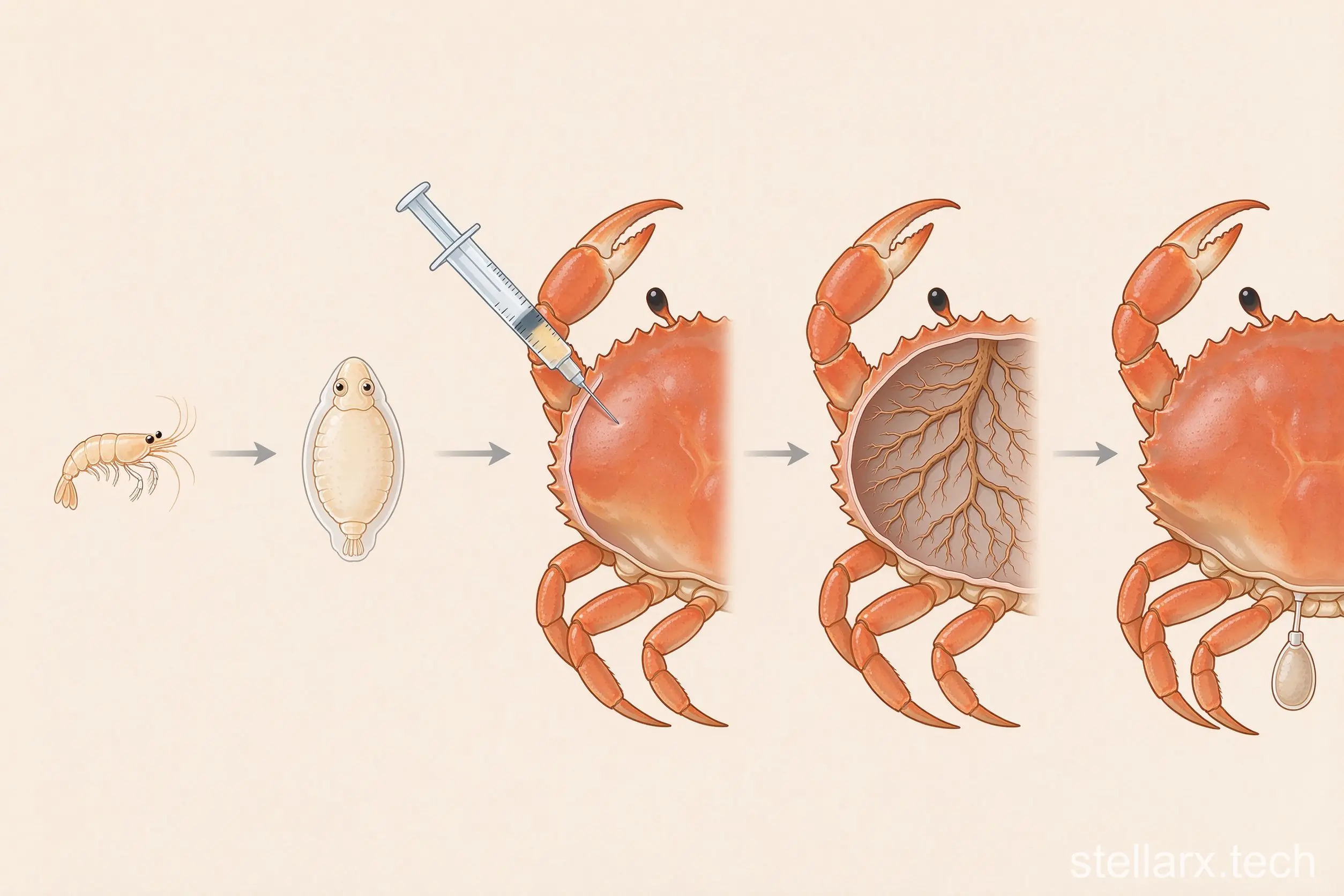
Sacculina's larvae are free-living. The larva that hatches from the egg, the nauplius, looks like a tiny shrimp with eyes and limbs, swimming freely in seawater.
When the nauplius reaches its final stage, it molts into a cyprid. It is the female cyprid that gains the ability to parasitize.
When such a larva meets a crab, it crawls over the crab's surface, looking for a soft spot as its entry point. There it molts into a kentrogon — a form shaped like a syringe. The kentrogon pierces the crab's body wall and injects its cells into the crab's hemocoel (blood cavity), leaving its shell behind outside the crab.
From that moment on, an animal with a "complete" body becomes an unconventional, "formless" parasite inside the crab.
Roots Inside
The injected cell mass extends along the gaps between the crab's muscles and organs, gradually growing into a vast, plant-root-like network inside the crab. This network — the interna — draws nutrients from the host and begins a comprehensive interference with the crab's nervous and hormonal regulation.
The crab's gonads atrophy and disappear; its genital openings may close; even the self-protective mechanism of regenerating lost claws fails. Every nutrient is redirected to meet Sacculina's needs.
The External Body
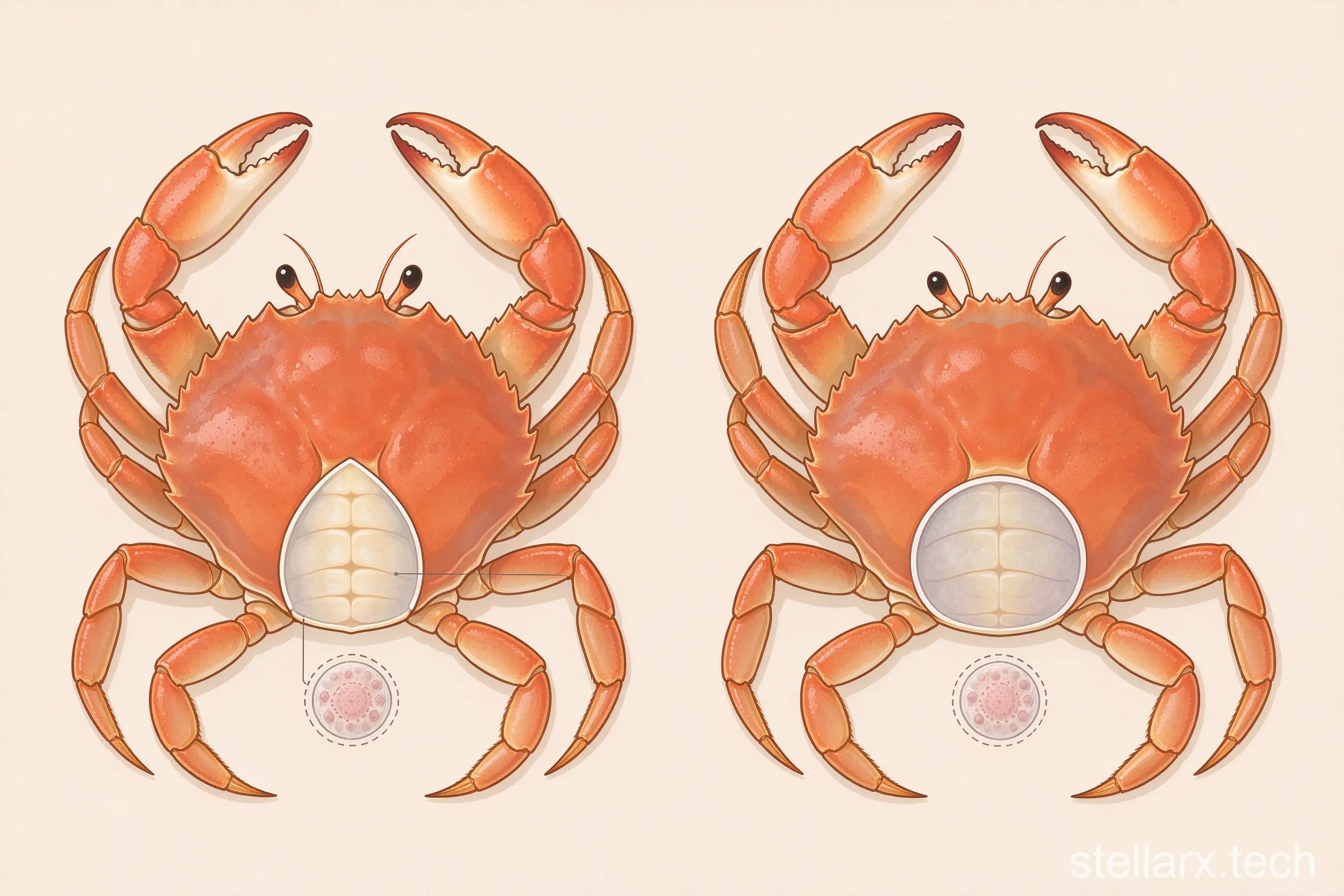
The folded part under a crab's body is its abdomen — the "apron" (the flap colloquially called the crab's belly or "脐"). Normally it folds tightly beneath the carapace like a lid. The shape of this lid is the main external feature used to tell male from female crabs: in most crabs, males have a triangular flap, females a semicircular one.
Inside a female crab's abdomen grow bristles used to hold eggs, forming a "nursery basket." A male crab instead develops a tubular copulatory organ here, used to deliver sperm during mating.
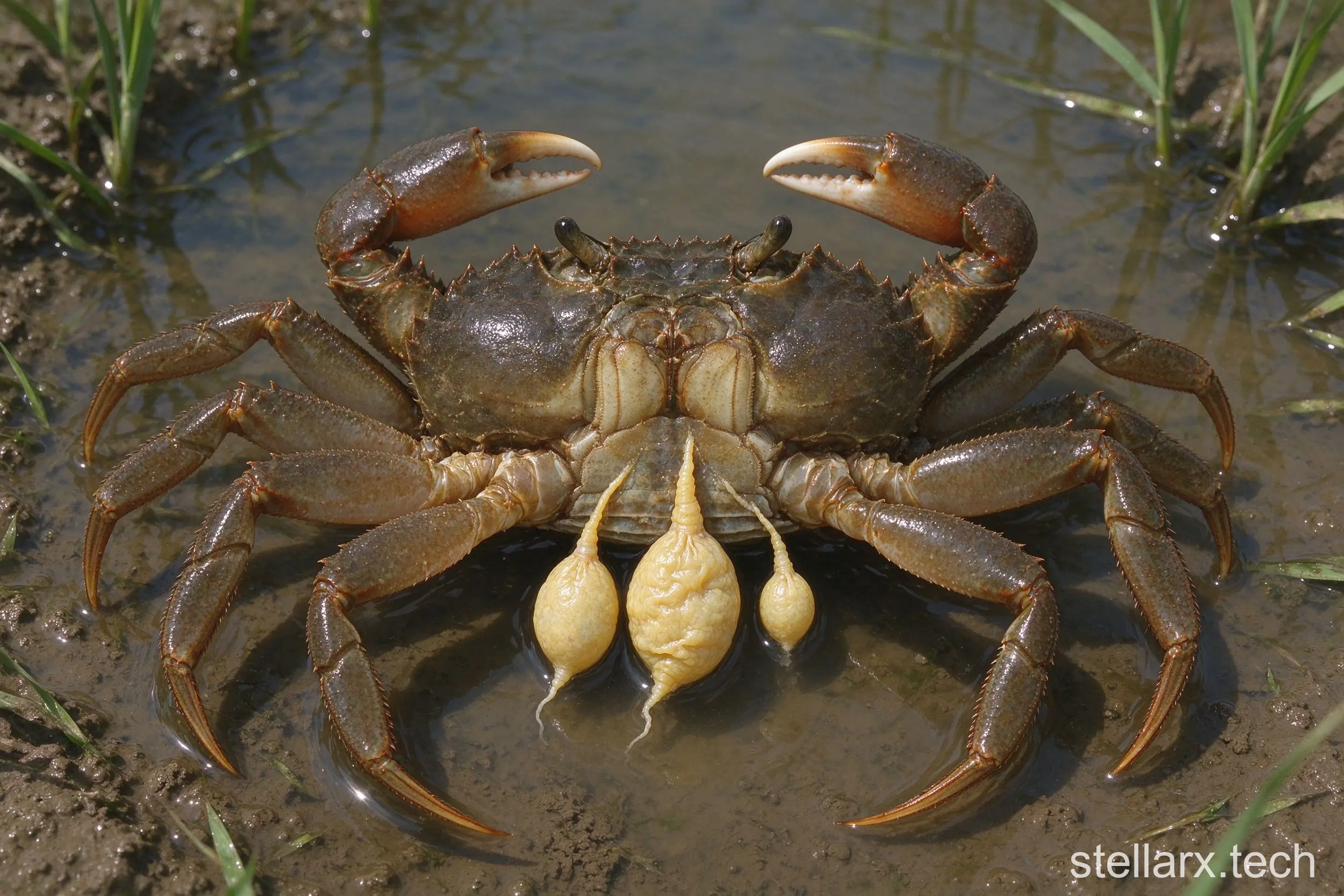
After parasitism, everything changes. The root-like tissue inside the crab is the interna; once mature, it forms a pale yellow or gray-white sac on the inner side of the crab's abdomen. Because it lies outside the crab's body, it is called the externa.
The externa sits exactly where a normal crab carries its egg mass. It mimics an egg sac, tricking the crab into caring for it. Once the externa is present, the crab stops molting.
A Parasite Inside a Parasite
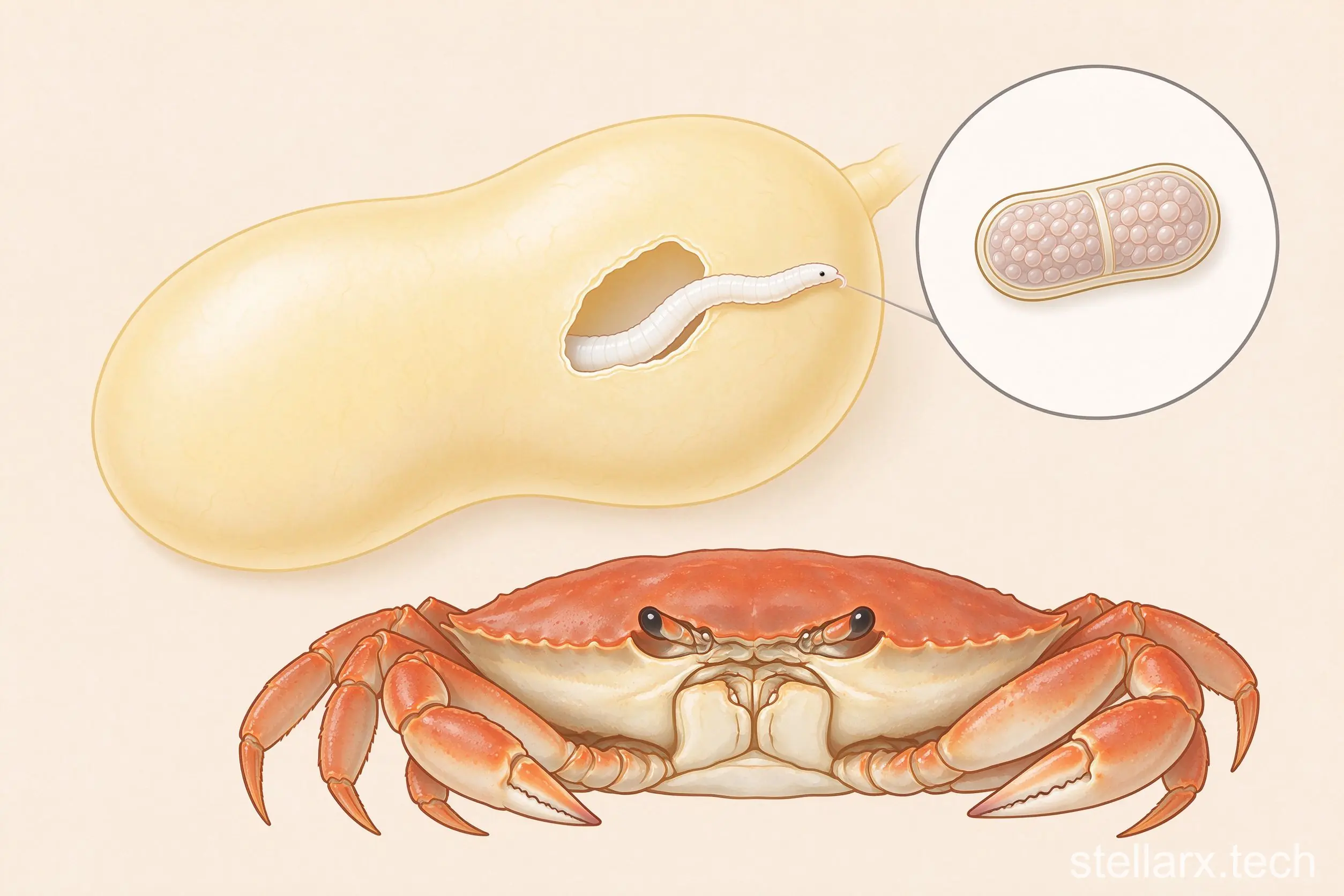
Once the female Sacculina has formed its externa, the male Sacculina steps in. It molts on the externa, transforming from a cyprid into a larva called a trichogon.
Like the female kentrogon, the trichogon's goal is to bore into a host — except the male's host is the female Sacculina's externa. It enters, finds the entrance to the "seminal receptacle" inside, and develops into a testis there.
From then on, it is no longer an independent individual, but a permanent parasitic appendage living inside the female Sacculina, supplying sperm for life.
This matryoshka-style parasitism is delightful: the female Sacculina parasitizes the crab, and the male Sacculina, as an appendage, permanently parasitizes the female's externa — nesting dolls of the parasite world. A female Sacculina usually has two seminal receptacles, so it is often colonized by two males.
Puppeteering the Host
The male inside the externa continuously supplies sperm, which fertilizes the female's eggs. The fertilized eggs develop inside the externa at the end of the crab's abdomen.
The parasitized crab — male or female — now shows the typical egg-care behavior of a female crab. Normally, female crustaceans (crabs, shrimp, lobsters) glue their fertilized eggs to the setae under the abdomen, then guard and carry them, carefully cleaning the egg surface with claws and pleopods, and rhythmically fanning the abdomen to create a steady current of water — supplying oxygen and washing away accumulating metabolic waste.
A parasitized crab performs these same behaviors, regardless of sex. The parasitized male displays behaviors that normally appear only in egg-carrying females — fully "maternalized."
Of course, a parasitized male can never lay eggs, and a parasitized female's gonads have atrophied, so she produces no eggs of her own. Under their abdomens there are no eggs — only the Sacculina externa, filled with Sacculina's eggs.
Launching the Larvae
When the eggs mature and the larvae are ready to be released, the crab behaves as if releasing its own brood: it climbs onto a rock or other high point, props itself up on its rear legs, and fans its abdomen to release the larvae.
A normal crab releases its own larvae into the water by fanning. In a parasitized crab, the abdomen fans, but the Sacculina larvae are mainly expelled by the contraction and squeezing of the externa itself. The crab body basically serves as a launch platform.
The reproductive output is astonishing: the externa releases larvae at an average interval of about 17 days (Sacculina polygenea), and one externa can produce up to 6 batches, each containing 100,000 to 300,000 larvae (Sacculina carcini).
The Cycle and the Toll
An externa usually survives 6–13 months. When the old externa finishes its mission and drops off, the interna grows a new externa at the same spot to keep reproducing. Over a crab's lifetime, it goes through 1 to 3 rounds of externa replacement. In the gap between the old externa dropping off and the new one growing, the crab may briefly regain molting behavior.
Because molting is drastically reduced, a parasitized crab's body basically stops growing — all nutrients are diverted to Sacculina's reproduction.
Lifespan effects are more complicated. In most cases, parasitized crabs live longer, possibly for several reasons: molting is the most vulnerable period for crabs, and parasitism sharply reduces molting; parasitized crabs no longer invest in their own reproduction, and Sacculina's reproductive cost may be less than the crab's own would have been; and parasitized crabs seem behaviorally manipulated — more reluctant to move, more docile, avoiding more danger.
But there are many exceptions. In farmed Chinese mitten crabs (Eriocheir sinensis), high-density rearing appears to intensify Sacculina's nutrient drain, and parasitized crabs live significantly shorter. In studies of the shore crab (Carcinus maenas), infected individuals had far higher mortality than normal ones. Sacculina's effect on host lifespan is far more complex than it first appears.
The "Stinky Crab" of Chinese Mitten Crab Farming
Sacculina is the collective name for all species in Rhizocephala — roughly 250–290 species. Their hosts are almost all decapods (shrimp and crabs), concentrated in true crabs (Brachyura) and hermit crabs (Anomura).
Sacculina mainly lives in seawater, but it can also parasitize crabs that migrate between salt and fresh water — the Chinese mitten crab is the classic example.
Mitten crab larvae develop to maturity in fresh water but must migrate to the brackish mixing zone of river estuaries to breed. When the larvae hatch at the estuary, they may meet infectious Sacculina cyprids and be entered. Infected young crabs show no immediate abnormality: they keep swimming upstream into the Yangtze and other freshwater rivers, growing normally. Inside the freshwater, the interna continues developing and eventually forms an externa on the abdomen.
But there are no male Sacculina in fresh water, so the parasite can never reproduce — until the crab returns to the estuary to breed, where male Sacculina from seawater can enter the female's externa and reproduction begins. Many farmed mitten crabs never get the chance to return to the estuary; in that case, the externa eventually just drops off.
So what about eating the parasitized crab? They are usually smaller than normal, with little meat — nutrients have been redirected to Sacculina's growth. Their gonads do not develop, so there is almost no roe or "crab butter." And they reportedly have a distinct bad smell, making the little meat there is even less palatable. If you meet such a crab, do not eat it — just throw it away.
Double Infection
Being parasitized by one Sacculina already seems harsh enough. Research has found crabs parasitized by two species at once.
Using molecular phylogenetic analysis based on 18S rDNA, scientists found a spider crab from the Sea of Japan (Scyra aff. ferox) simultaneously infected by two Sacculina species: Sacculina pugettiae (family Sacculinidae) and Parasacculina pilosella (family Polyascidae). The two interna grow independently, never overlapping or fusing, with clearly different morphologies: S. pugettiae forms cup-shaped organs around the host's nerve ganglia, while P. pilosella lacks those cups, instead producing masses of neuropil rootlets that reach directly into the nerve tissue. The externae also grow separately.
That is, one spider crab may carry externae of two different Sacculina species on its abdomen, each separate, never fusing.
Even more: a crab infected with a single species can sprout multiple externae. This mainly happens in the Polyascidae, which often produce several externae on one host, squeezing it to the utmost. Multiple externae working together substantially increase total reproductive output, producing more larvae in limited time and maximizing transmission. In farmed mitten crab ponds, one crab has been recorded with up to 28 externae, or scars from 19 dropped-off externae.
A Puppet Master Written in Tiny Bones
Sacculina takes an animal with a shell, a filter-feeder cousin of the barnacle, and turns it into a root-growing, hormone-jacking, egg-brooding parasite that hijacks its host from the inside out — feminizing males, silencing reproduction, and turning the crab's own body into a launch pad for its young. Behind every "maternal" crab with a pale yellow sac on its belly is a parasite that has been rewriting its host for millions of years.
Curious what a parasite built on entangled sex looks like under a microscope? WWAI is an AI-powered biology encyclopedia with an online microscope, including a Japanese blood fluke specimen where the male and female live coupled together, with the miracidium larvae visible inside the eggs — a parasitism as entangled as Sacculina's. Search "WWAI" in your app store and download it today.

References
Xie J, et al. Infection survey and pathological characterization of Sacculina in Chinese mitten crabs in the Anqing section of the Yangtze River. Acta Hydrobiologica Sinica, 2024, 48(12): 2092-2099. DOI: 10.7541/2024.2024.0164
Golubinskaya DD, et al. Sympatric two-species infestation by rhizocephalan barnacle parasites in the spider crab Pugettia aff. ferox from Peter the Great Bay (Northwestern Sea of Japan). Zoological Studies, 2021, 60: 54. DOI: 10.6620/ZS.2021.60-54
Chan BKK, et al. The evolutionary diversity of barnacles, with an updated classification of fossil and living forms. Zoological Journal of the Linnean Society, 2021, 193(3): 789-846. DOI: 10.1093/zoolinnean/zlaa160
All illustrations are AI-generated.
Related reading

Why Mitochondria Keep Their Own DNA


- 同手性是什麼?2026 諾貝爾化學獎得主解開生命之謎
- Homochirality Explained: Nobel Chemistry 2026 | stellarx
- Is Using Your Phone in Bed Bad for Your Eyes?
- AI Consumer Spending: Who Actually Pays for AI?
- How Do Bees Communicate? Dance and Pheromones
- How Kidneys Work: Filter, Reabsorb, Keep What Matters
- Female Thigh Fat: A Second Sex Characteristic
- IceCube Neutrino Detector: Ghost Particle Hunter | stellarx
- Lobster Mushroom: The Fungus That Parasitizes Mushrooms
- Sacculina: The Crab-Castrating Parasite Explained
全部评论