Anticipatory Homeostasis: Your Body Knows Before You Do
Here are two facts most people have never noticed.
The water you just drank is still in your esophagus, nowhere near filling your stomach — and your thirst is already half gone.
You have only tasted something sweet, the sugar has not reached your bloodstream — and your insulin has already started pouring out.
This is the body's most elegant design: anticipatory homeostasis. The textbook model says the body reacts: an imbalance happens, negative feedback kicks in, correction follows. In reality, the body does not wait for things to go wrong. The moment your senses touch a stimulus, a neural-endocrine chain has already laid down a buffer ahead of the change.
The Two Control Loops
Every major homeostatic system — thirst, blood sugar, temperature, heart-lung control during exercise — runs on two layers working together.
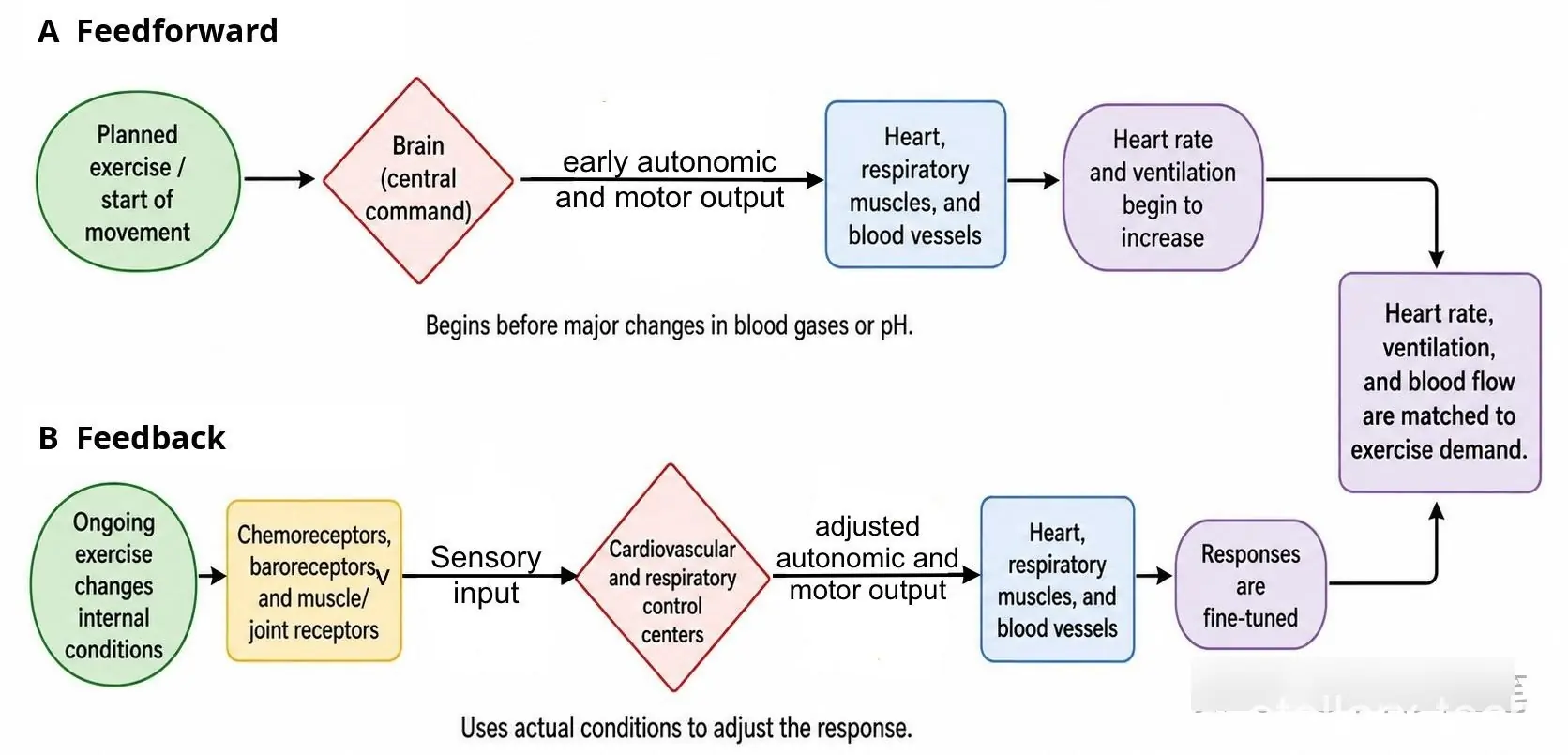
The first layer is feedforward: the brain issues command signals in advance, based on what the senses predict is coming. Heart rate and breathing rise before exercise has actually changed your blood chemistry.
The second layer is feedback: sensors detect what actually happened and fine-tune the response. Together they form a loop where prediction goes first, correction finishes the job.
Thirst: The Body Quenches You Before You Drink
The classic model goes: blood osmolarity rises → the hypothalamus senses it → you feel thirsty → you drink → osmolarity drops → thirst disappears.
Reality is faster and stranger.
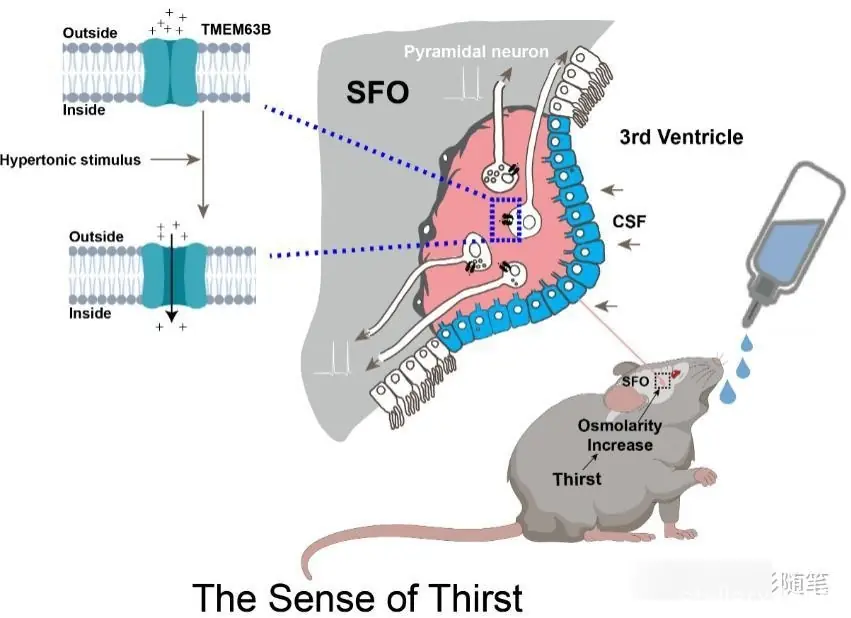
The mouth-and-throat phase. In 2019, the Zimmerman lab at Caltech published a study in Nature showing that when mice merely lick plain water — before a drop reaches the stomach — the thirst neurons in the subfornical organ (SFO) are already rapidly suppressed. Blood osmolarity has not changed at all. The brain reads the mouth's touch, the act of swallowing, and the osmolarity signal at the oral mucosa, predicts that osmolarity is about to fall, and switches the thirst pathway off early.
Why does this matter? If the body waited the ten-plus minutes for water to actually absorb before feeling quenched, an animal would keep drinking far past its need — and risk hyponatremia, a dangerous dilution of blood sodium. The neural signal delivers a temporary "enough" verdict, stops the drinking behavior, and lets real physiology catch up later.
The gastrointestinal phase. When water reaches the stomach, a second prediction layer kicks in. Osmolarity sensors in the stomach wall check the incoming liquid: plain water keeps SFO neurons suppressed; hypertonic saltwater reactivates the thirst neurons — even though nothing has entered the bloodstream yet. The brain has already judged whether this liquid can actually fix the deficit.
This is why cold water quenches thirst far better than room-temperature water. In a 2016 human study by Peyrot des Gachons and colleagues, drinking water at 6°C reduced subsequent intake by nearly 50% compared to water at 22°C. Cold signals from the mouth — carried by TRPM8 receptors and the trigeminal pathway — stack onto the SFO suppression, encoding "low temperature" as "higher hydration efficiency."
The intestinal phase. Only 10 to 15 minutes after drinking, once water is absorbed and blood osmolarity truly normalizes, the peripheral sensors fire the final confirmation and the thirst pathway closes for good. That is the classic feedback loop, arriving last to sign off.
Blood Sugar: Insulin Fires Before Sugar Arrives
The same predictive logic runs the glucose system — and it is the reason your blood sugar stays flat after a meal.
Textbook physiology describes glucose-stimulated insulin secretion: blood glucose rises → the beta cell's ATP-sensitive potassium channel closes → calcium flows in → insulin granules are released. But that path has an intrinsic delay. If insulin waited for sugar to enter the blood, every meal would end in a violent glucose spike.
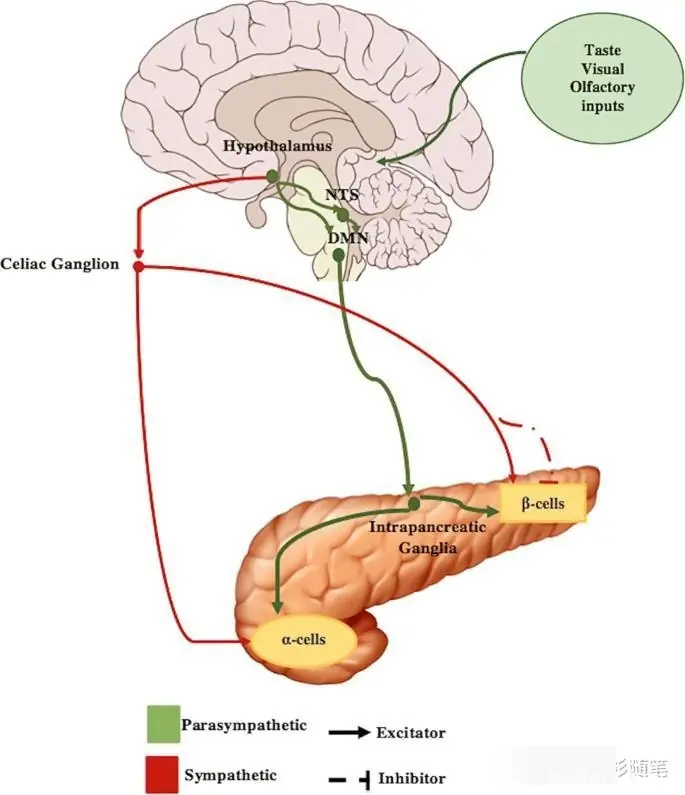
That spike is flattened by cephalic phase insulin secretion — insulin released before glucose ever reaches the bloodstream. It accounts for 10 to 15 percent of the meal-time insulin total, driven entirely by neural-endocrine signals:
The oral tier. Sweet receptors (the T1R2/T1R3 dimer) bind sugar on the tongue. The signal travels via the facial and glossopharyngeal nerves to the nucleus tractus solitarius, then out through the dorsal motor nucleus of the vagus. Vagus endings release acetylcholine onto the beta cell's M3 muscarinic receptor, which triggers calcium release from the endoplasmic reticulum through the Gq-phospholipase C pathway — and stored insulin granules empty out. The whole loop takes just 2 to 3 minutes, pure reflex.
The gastric tier. As food fills the stomach, stretch and chemical receptors amplify the signal through the vagus, keeping a basal insulin release running.
The intestinal tier. When chyme reaches the duodenum, K cells and L cells release GIP and GLP-1. These two incretins travel through the blood to the beta cell, amplifying insulin secretion before glucose climbs — while also slowing stomach emptying and suppressing appetite, a second calibration of intake.
A normal meal delivers tens of grams of carbohydrate, yet blood glucose stays within a remarkably narrow 3.9–7.8 mmol/L window. Not because the pancreas "reacts fast," but because it is permanently one step ahead, laying down a buffer before the glucose wave arrives.
When Prediction Fails, Disease Begins
Many metabolic diseases start as defects of the predictive pathway — not as failure of the final organ.
Type 2 diabetes. One of the earliest physiological abnormalities is the disappearance of cephalic phase insulin secretion. Many people with impaired glucose tolerance have perfectly normal fasting glucose but post-meal spikes — because the oral-vagal prediction pathway is damaged, the pancreas has lost its head start, and it responds only after the glucose has already overwhelmed the system.
Dehydration in older adults. Age-related thirst decline and low water intake trace back to degenerating osmolarity-predicting sensors in the mouth and brain. Thirst arrives a beat too late, only after blood osmolarity is significantly elevated — and dehydration risk multiplies.
Obesity and metabolic syndrome. Long-term high-sugar, high-fat diets drive incretin resistance. The gut-level calibration fails: insulin pre-release is weak, appetite suppression breaks, and the energy surplus compounds.
Why the Body Evolved to Predict
From an evolutionary view, anticipation is a survival weapon. In an unstable world of scarce food and water, passive negative feedback means every meal and drink costs a metabolic swing. A predictive body stops feeding behavior early and transitions smoothly — minimal disturbance, maximal stability.
We like to think we take care of our bodies: eating on schedule, drinking enough, keeping balance. But in every second, the body reads the future through the senses, answers with nerves, calibrates with hormones — and in places you never notice, silently dissolves countless potential imbalances.
It is always one step ahead of you. It knows how to survive better than you do.
Want to see the very neurons behind this prediction under a microscope? WWAI is an AI-powered biology encyclopedia that answers your biology questions instantly, from neural signaling to hormone regulation, and lets you observe real microscope slide specimens online — including a nerve cell specimen where the cell body, dendrites, and axon of a neuron are clearly visible, the exact structures that carry every anticipatory signal in this article. Just search "WWAI" in your app store and download it today.
Related reading

Why Thirst Vanishes When You Swallow

Food Coma: Why Heavy Rice Meals Drain Your Energy

Why You're Sleepy at 3 PM but Wide Awake at 7 PM
References:
[1] Zimmerman C A, Lin Y C, Leib D, et al. "Thirst neurons anticipate the homeostatic consequences of eating and drinking." Nature, 2019, 571(7766): 555-560.
[2] Peyrot des Gachons C, Avrillier J, Gleason M, et al. "Temperature and carbonation enhance the thirst-quenching efficacy of ingested liquids in thirsty adults." PLOS ONE, 2016, 11(11): e0166136.
[3] Teff K L. "Cephalic phase insulin release: mechanism and physiological significance." Appetite, 2019, 143: 104416.
[4] Kahleova H, Tura A, Klementova S, et al. "Loss of cephalic phase insulin response in subjects with type 2 diabetes is associated with impaired glucose tolerance." Diabetes Care, 2018, 41(10): 2141-2148.
[5] All illustrations are AI-generated.
- Why Humans Are the Only Animals That Need Clothes
- A Whole 1.25 kg Pomelo Has Only 280 kcal. Here's Why.
- Salmonella Is Everywhere. Here's How It Gets Into Your Food
- Your Dry Eyes Aren't Thirsty — They're Out of Oil
- 国庆团圆饭,我劝你一定要留一个位置给它……
- Tired No Matter How Much You Sleep? It Might Be Inflammation
- Why You Wake at 3 AM Every Night: Don't Check the Clock
- Why Foreigners Can't Handle Baijiu: It's the Aldehydes
- Why the Poor Love Grand Narratives: The Microscope Argument
- The Trojan Horse: How Plague Disarms Your Immune System
全部评论