Why the Poor Love Grand Narratives: The Microscope Argument
Bat droppings were once a prized Chinese medicine for sharp eyesight. The logic: bats fly at night, so their eyes must be extraordinary — and dung, after all, is the concentrated essence of food. The remedy even had a beautiful name: Yeming Sha, "night-bright sand."
The only problem: bats are nearly blind. They navigate by ultrasound.
Traditional Chinese medicine did not choose grand narratives. It was the only option it had.
Its theory speaks of heaven and man mirroring each other, yin-yang and the five elements, ascending and descending, the qi of good and evil — and with this vocabulary it can explain any disease, ever. Why always speak so grandly, never microscopically? Because it cannot do otherwise. It never invented the microscope, never practiced dissection, never had chemistry, physics, or biology — no knowledge of molecules, cells, bacteria, viruses, nerves, hormones, or compounds. It did not know how drugs work or how the body runs, so it watched from the outside and guessed.
The guesses became a whole system of "taking the shape as the cure" (yi xing bu xing):
The pangolin tunnels through mountains, so its hard shell, boiled, must open blocked milk ducts. (Today we could just rent a tunnel-boring machine.)
Ginseng makes your nose bleed, so your vital energy must be overflowing — a great tonic. (It is ginsenoside poisoning.)
Mercury makes people quiet and still, so it calms the mind — the main ingredient of the famous "Calming Spirit Decoction." (It is poisoning.)
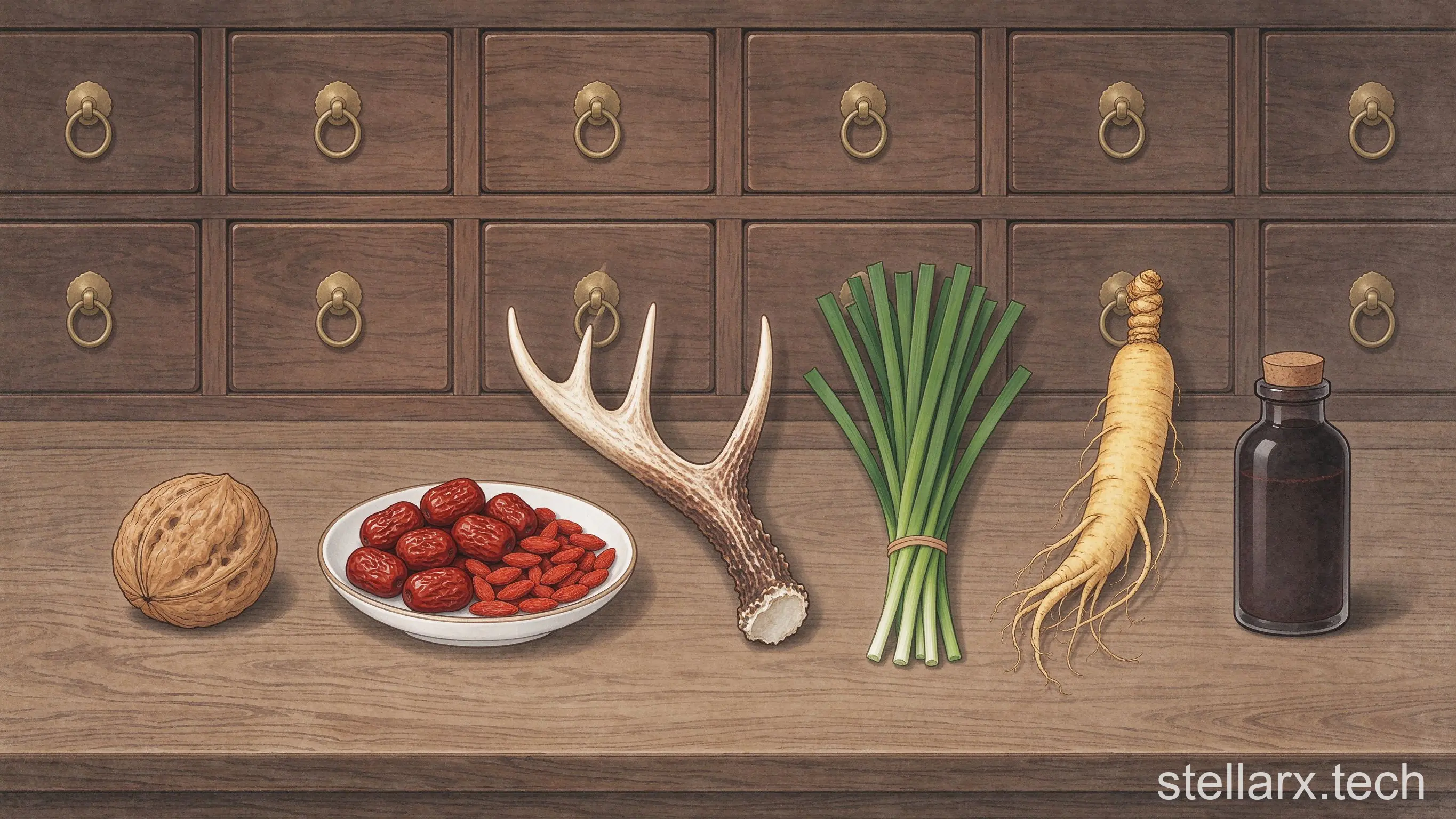
Walnuts look like brains, so they nourish the brain. Red dates and goji berries are red, so they tonify blood. Deer antler is long and hard, so it strengthens virility. Chives contain the character "long-lasting," so chives strengthen virility.
Rabbits have split lips, so a pregnant woman must not eat rabbit, or the fetus will have a cleft lip. A man's pubic hair curls like a snake, so pubic hair cures snakebite.
And because dung is the concentrated essence of food, all dung enters the pharmacopoeia.
Pig dung for cold, jaundice, and dampness. White dog dung — preferably still warm — for heart pain. Sheep dung for infant diarrhea, constipation, and gray hair (sheep eat fast, defecate fast, and the droppings are black). Water buffalo dung for edema (a water buffalo stands in water all day without swelling). Cat dung for pox sores. Rat dung for infant epilepsy.
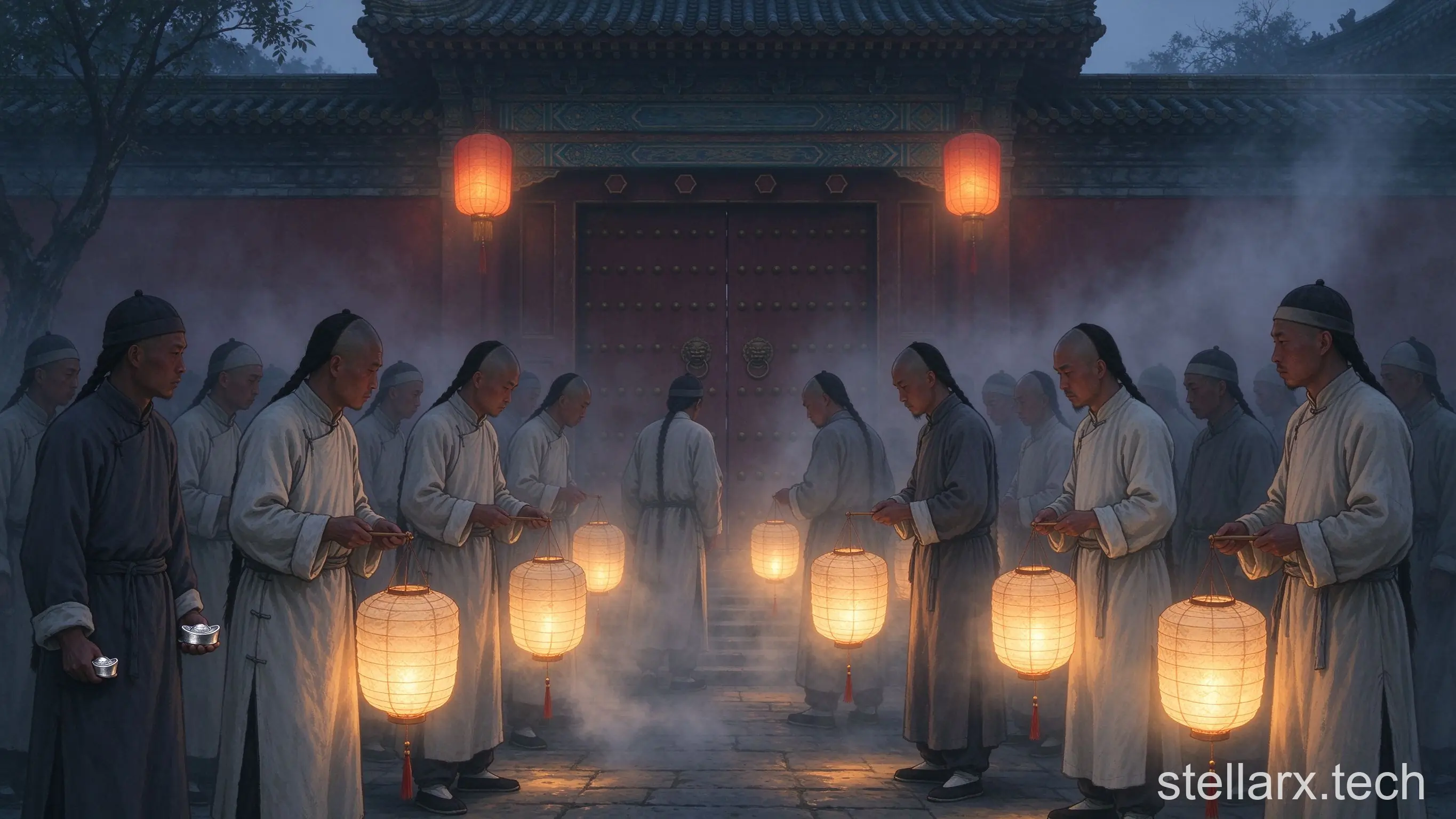
The best of all is human dung, known as ren zhong huang — and the most precious human dung belongs to the emperor. The Son of Heaven, of supreme rank in the hierarchy of ruler and subject, produced a sovereign remedy said to cure everything and prolong life. Before dawn every day, herbal shops crowded the palace gates, bidding hundreds of taels of silver to buy the emperor's fresh morning offering from the eunuchs. The waiting list stretched years long — a market with no supply, because there is only one emperor, eating only so much. Some eunuchs quietly sold their own instead.
Everything strange went into the pot: menstrual blood, children's urine, umbilical cords, fingernails, insects, the rope of a hanged man, dust from the head of the bed, a pair of old underpants, earwax. Boil it all together, and it could all be drunk.
The glass argument.
Chinese medicine never knew sperm or eggs. It only knew that a woman who has not conceived has menstrual blood, and a man has semen; join the two, both disappear, and months later a life appears. So humans are made of the father's semen and the mother's blood. Since there must be two pulses in a pregnant belly, physicians invented the "happy pulse," also called the "linked-pearl pulse": two pulses rolling together, "smooth, like a bead running over a plate."
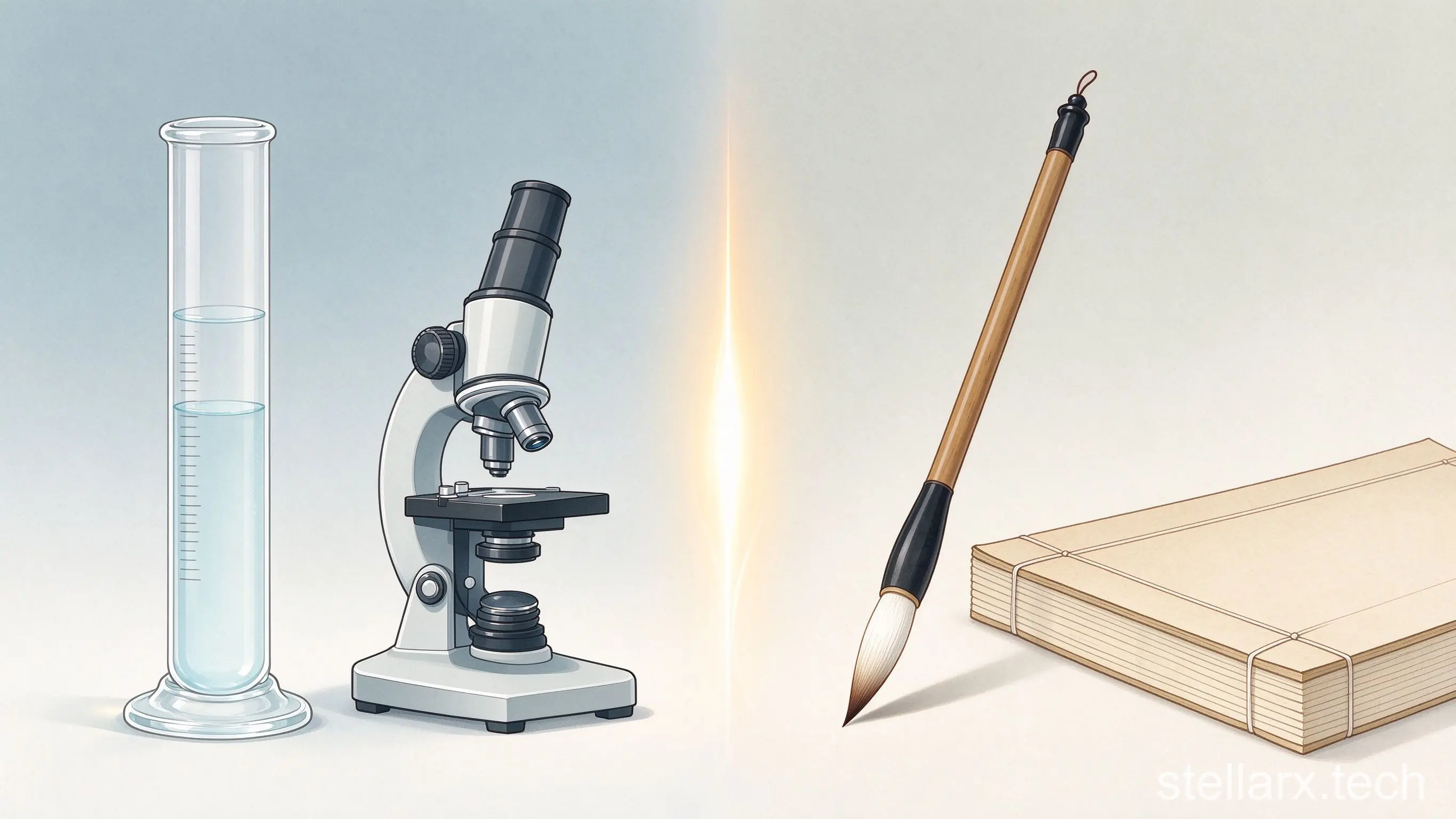
None of this was stupidity. Without glass there are no test tubes; without test tubes there is no chemistry; without chemistry you cannot extract HCG, the pregnancy hormone, from blood. Western medicine sells you ten test strips for a dollar fifty. Western doctors also know there is a radial artery in the wrist — but they do not need to feel it, because no amount of pressing on a pregnant woman's wrist will ever find a fetal pulse.
The nephew argument.
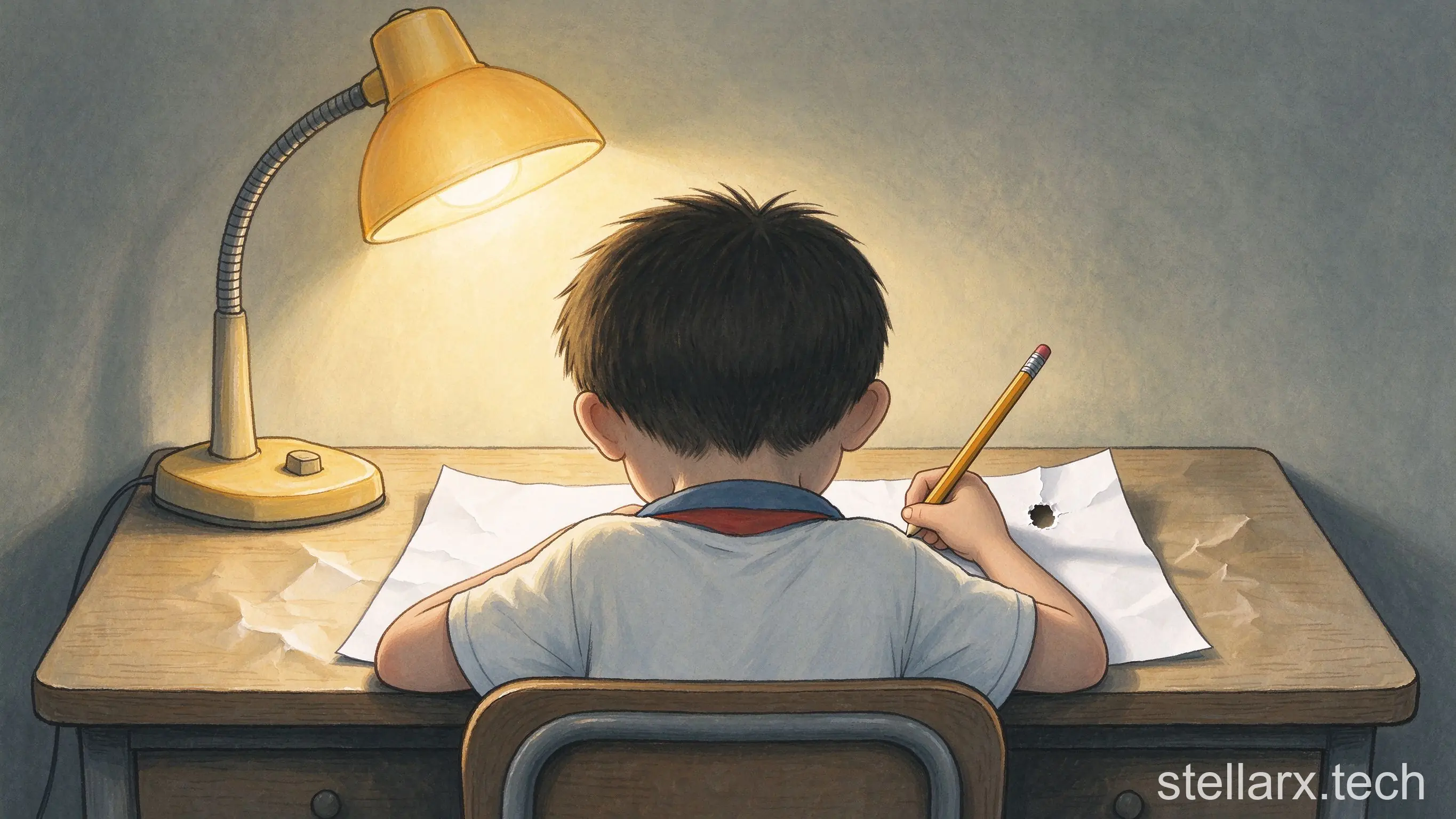
My little nephew, an elementary-schooler, at the New Year family table: whenever the talk turns to beating America, Japan, Korea, Australia, the tiny boy gets ecstatic — this one is bad, that one is bad, he will transform into Ultraman Tiga and fire the Zeperion Ray at each country in turn. So I made him a deal: finish his winter-vacation math homework, and then he may research missiles to fire at them. The room went dead silent. A whole morning hunched over the desk, the paper stabbed to shreds — not one digit written.
Grand narratives are easy. Math homework is microscopic — and that, exactly, is the thing he cannot do.

But the deepest reason is not a lack of ability. It is a lack of bandwidth.
The anthropologist Xiang Biao, in his book Transcending Boundaries: Zhejiangcun, describes interviewing residents of an urban village. One asked: "If I tell you all this, can you help us report it upward and solve the problems?" Xiang was ashamed — all he could do was write it down, for future readers. When the man heard his story could be preserved in a book and help people he would never meet, he changed at once: ask anything, I will hold nothing back. That moment moved Xiang deeply. People who spend every day merely surviving, once offered a chance to play a role beyond themselves, drop their pragmatism and feel a sacred mission.
"Man is an animal suspended in webs of significance he himself has spun," wrote Max Weber. Beneath food and shelter, everyone carries a hunger for meaning — for a role in the world, in the story of their people. This is the top of Maslow's pyramid, the urge for self-transcendence. The vast population at the bottom wants it too; the longing gathers like rivers into a sea, a quiet, immense force. But they can almost never satisfy it on their own: nearly all their mental resources go to barely maintaining the present.
Poor Economics calls poverty exactly that — not laziness or stupidity, but a trap that steals "bandwidth" (cognitive and executive capacity) and "surplus" (economic surplus to absorb risk, time surplus to invest in the future). In all of history, oppression has taken two forms: taking away the right to change (India's hereditary caste system, where to challenge your birth is to challenge the gods), and taking away the chance to rest (plantation slavery, where barely-surviving rations buy up all your energetic hours — work until exhausted, and no other thought survives).
So when the poor cannot reach self-transcendence alone, someone reaches it for them. Every regime develops a narrative that lets millions satisfy that need in a way it approves of — an imagined community, with the state as its worldly agent, collecting the goodwill of the sincere. A dangerous game; the extreme nationalism of the Second World War is the warning.
There are only two exits from grand narratives. One is to meet someone like Xiang Biao, who writes your life into something enduring. The other is to carve out meaning yourself, beyond work — hard at first, exhausting, but the only road that is yours. The web of significance is spun by our own hands.
If you want to see the hardware behind bandwidth and meaning, a neuron specimen under the microscope shows the cell body, dendrites, and axon of a nerve cell — the very structure that integrates and transmits every thought. Search "WWAI" in your app store and download it today.

References:
1. A. H. Maslow, "A Theory of Human Motivation," Psychological Review, 1943 — https://doi.org/10.1037/h0054346
2. Abhijit V. Banerjee and Esther Duflo, Poor Economics — https://www.pooreconomics.com/
All illustrations are AI-generated.
Related reading

Why You're Sleepy at 3 PM but Wide Awake at 7 PM

Babies Age Too — and Monthly Cash Payments Seemed to Slow I…

- Why Humans Are the Only Animals That Need Clothes
- A Whole 1.25 kg Pomelo Has Only 280 kcal. Here's Why.
- Salmonella Is Everywhere. Here's How It Gets Into Your Food
- Your Dry Eyes Aren't Thirsty — They're Out of Oil
- 国庆团圆饭,我劝你一定要留一个位置给它……
- Tired No Matter How Much You Sleep? It Might Be Inflammation
- Why You Wake at 3 AM Every Night: Don't Check the Clock
- Why Foreigners Can't Handle Baijiu: It's the Aldehydes
- Why the Poor Love Grand Narratives: The Microscope Argument
- The Trojan Horse: How Plague Disarms Your Immune System
全部评论