Why Humans Are the Only Animals That Need Clothes
Would humans die without clothes? Yes. That is the entire answer, and the reason is written across 3 million years of evolution.
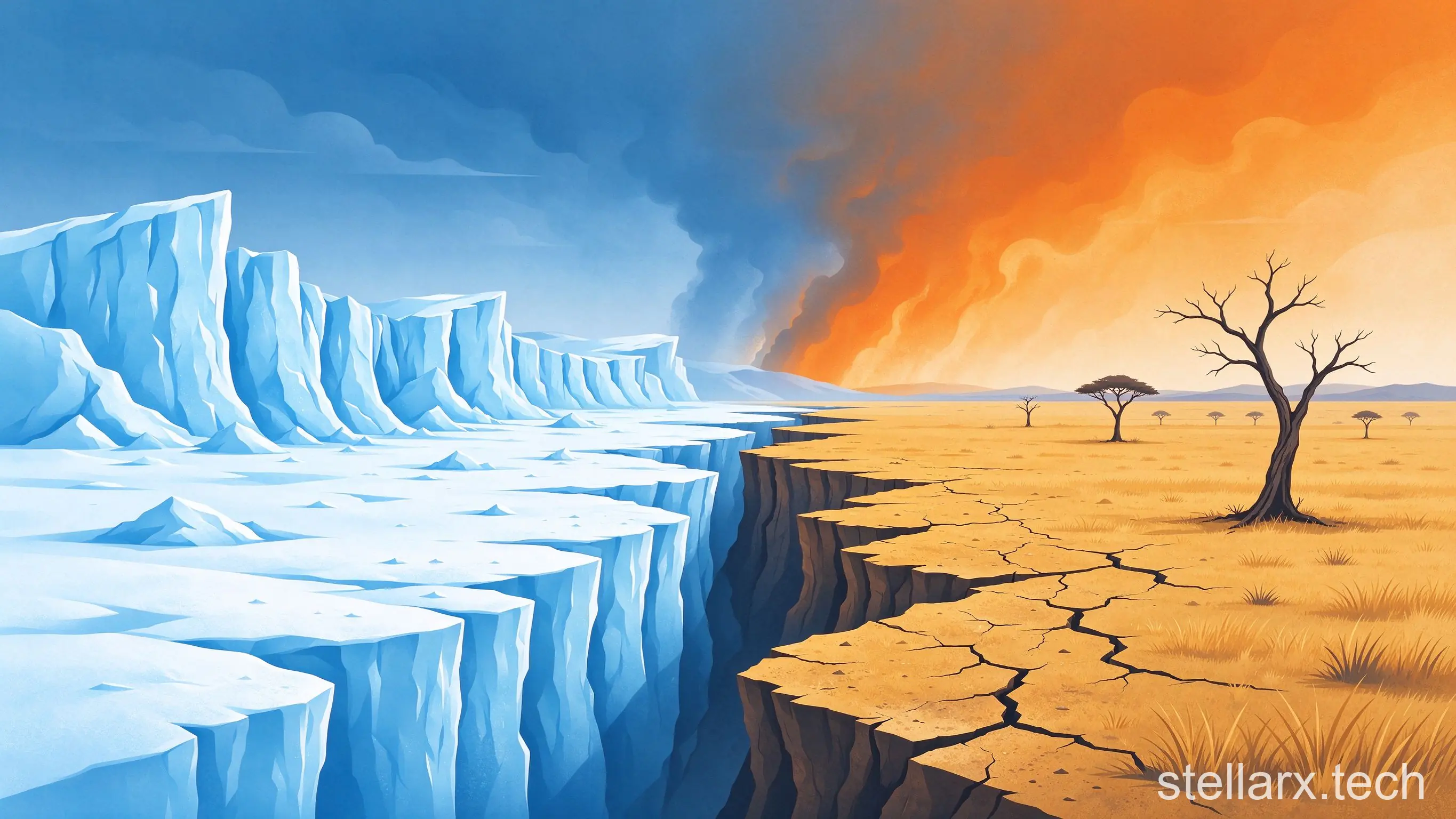
The seed was planted 30 million years ago. Plate tectonics tore Antarctica away from Australia, raising permanent ice sheets; the Tibetan Plateau rose toward 3,000 meters; the East African Rift split open for 6,500 kilometers. East and North Africa turned extreme — year-round drought, bitter winter cold, brutal summer heat and ultraviolet — and stable forests fragmented and vanished. Our last ancestors with monkeys were forced out of the trees they could no longer keep: they lost the forest niche to monkeys, the forest-edge niche to chimpanzees' ancestors, and walked out into the dry grassland.
Then came the Quaternary glaciation, beginning 2.58 million years ago — one of the coldest valleys the planet has seen in 500 million years, cycling between glacial and interglacial periods every 41,000 years at first, later every 100,000 years.
The killer upgrade: throwing.
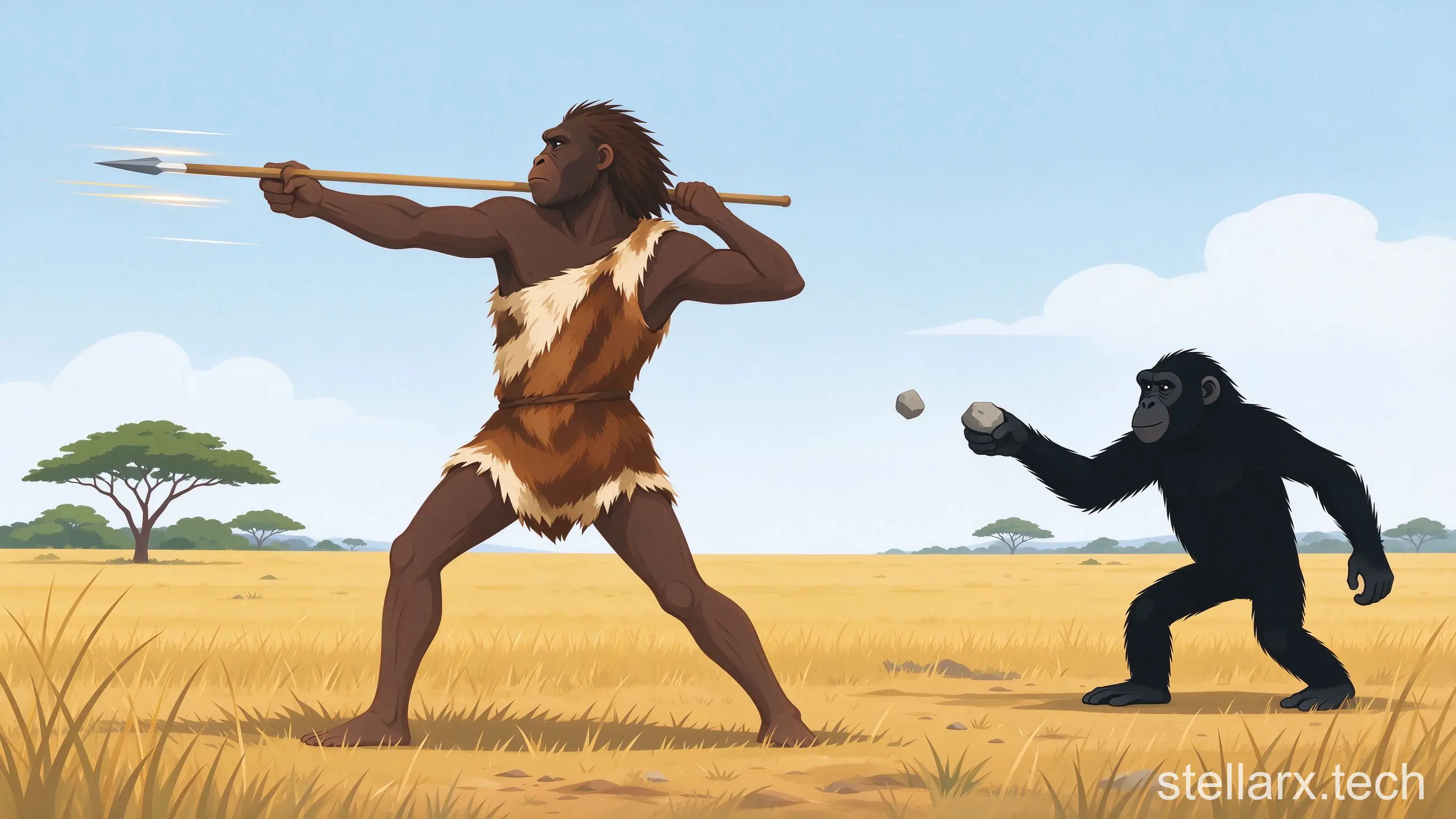
A 2013 Nature paper explained how our ancestors became "the terrifying upright ape." Chimpanzees can throw, but badly — an adult male chimp's explosive power exceeds a human man's, yet its throwing speed is only half that of an eight-year-old child, with accuracy best described as random. Our ancestors rebuilt their bodies for throwing: broad shoulders, long legs, flexible wrists, and a shoulder-arm structure that stores and releases elastic energy from the hips and waist. Fast, stable, sustained throwing flipped the food chain, and there was no predator left.
Then the heat problem forced us to take off our fur.
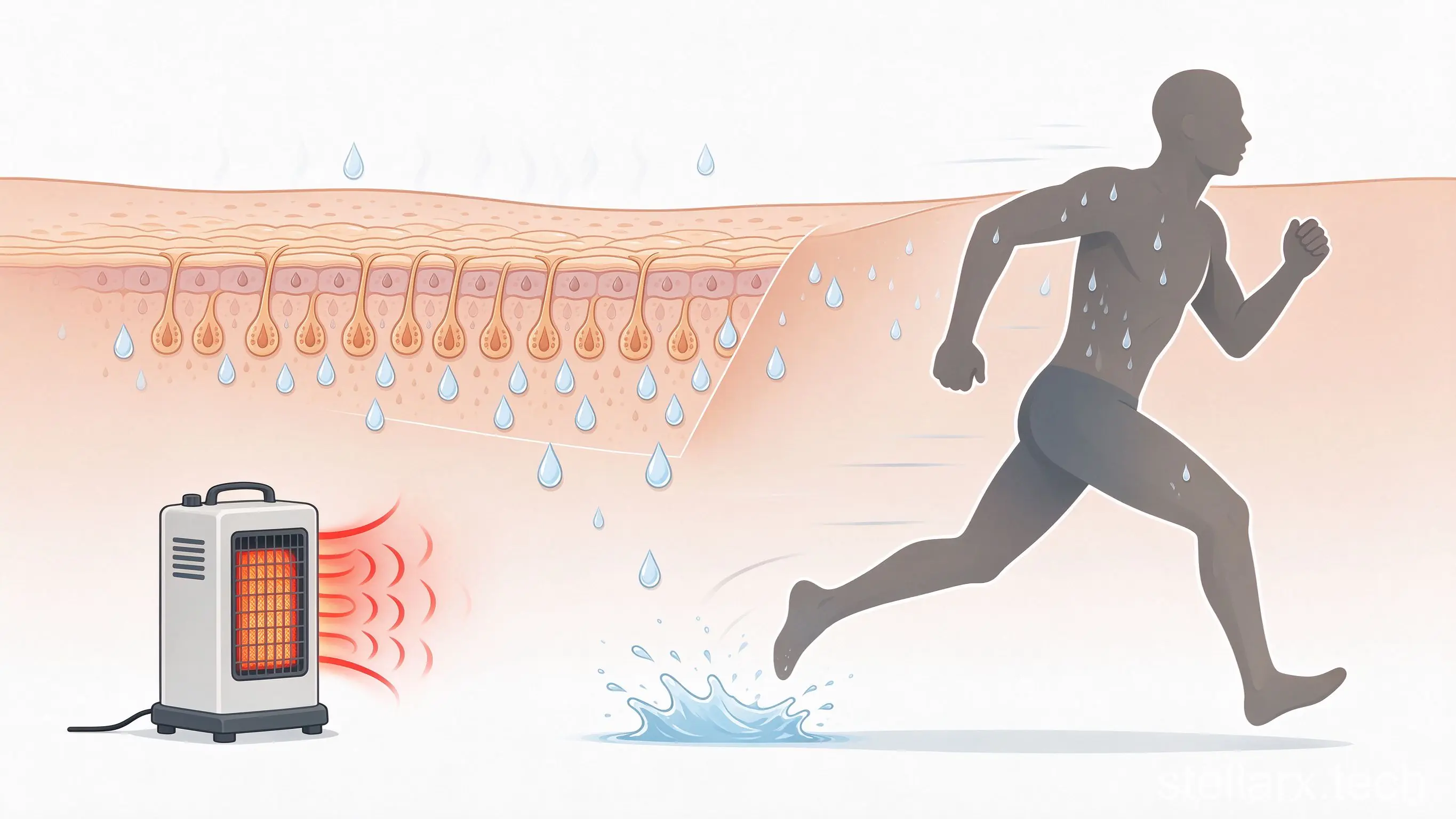
Persistence running at full tilt produces around 1,000 W of heat — ten times resting output. Picture a 1,000 W space heater set to 37 °C running for one or two hours straight inside a room. The earliest endurance runners literally died of heatstroke — until, among them, there were always a few mutants with reduced hair and well-developed sweat glands that could shed heat by sweating. They survived, and because they ran farther, they caught more prey and multiplied. Their genes took over. And since hunting provided animal hides, the loss of fur never threatened survival — it was just inconvenient without coverage.
Lice dated our clothes, and our naked skin.
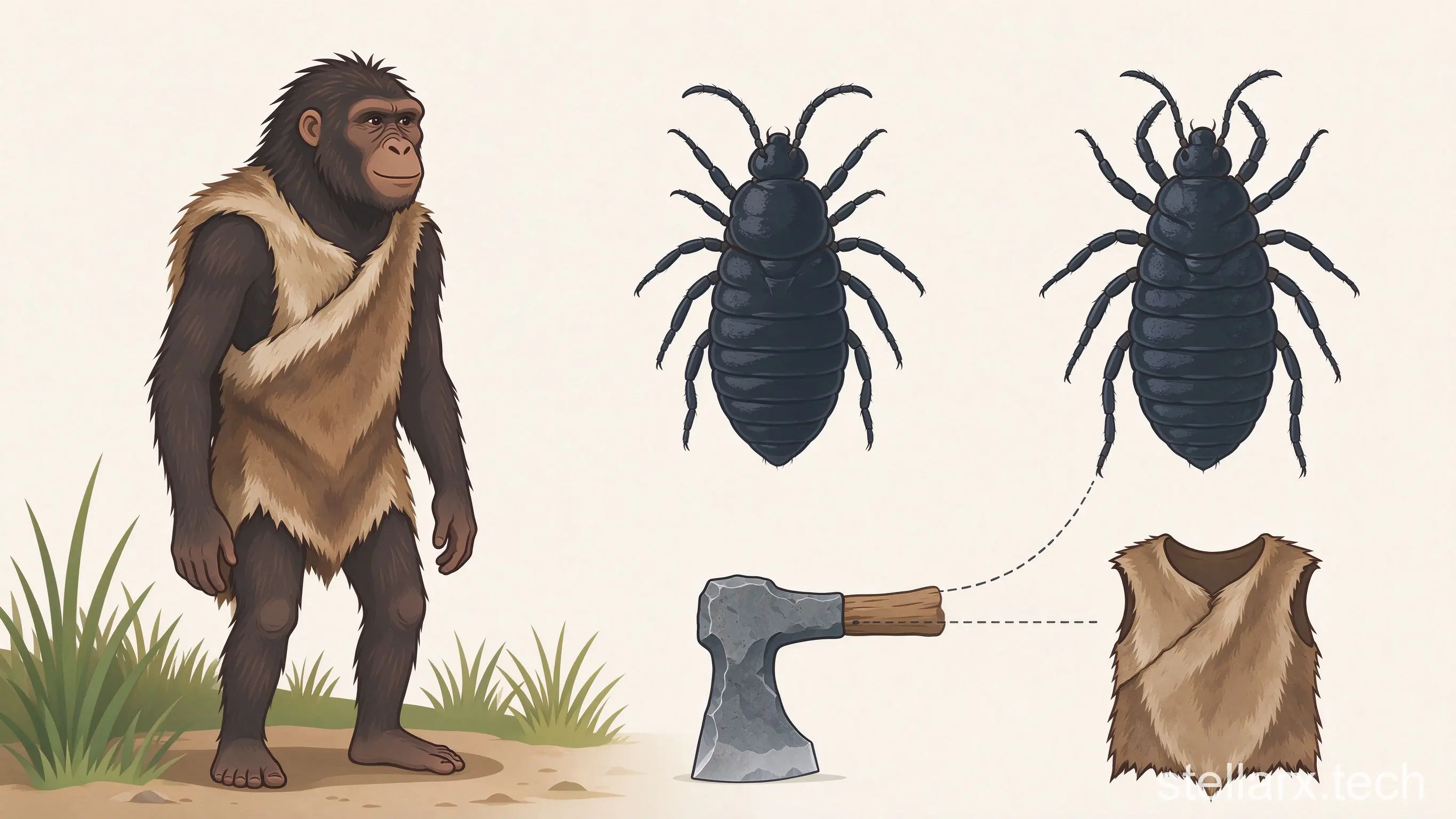
Human body lice evolved from head lice about one million years ago — which means our ancestors were already wearing clothes back then. Head lice, in turn, trace back to gorilla lice around 3.3 million years ago, hinting that hair loss happened somewhere between 1 and 3 million years ago. (An older hypothesis blames parasite pressure for stripping our fur; either way, the timeline holds.) The ice-age cycles then made clothing compulsory: any hominin that refused to cover up froze out of the gene pool.
Around 1.7 million years ago, the Acheulean tool industry arrived — hand axes, picks, and cleavers with precisely worked edges — and with it the ability to mass-produce clothing from animal hides and even plant materials. Clothing spread because it kept people alive.
The bottlenecks: humanity nearly went extinct, more than once.
Between 930,000 and 813,000 years ago, the ancestors of Homo sapiens crashed to a breeding population of about 1,280 individuals — one-fourteenth of the previous 18,000. The usual extinction floor is thought to be around 500 breeding individuals. They survived, barely. Then, around 70,000 years ago, the final bottleneck: the effective breeding population fell to about 2,000 — some local groups as low as 150. The Toba eruption was long blamed; newer work shows it was smaller than thought, though its volcanic winter still lasted nearly a decade and cooled the climate for a millennium.
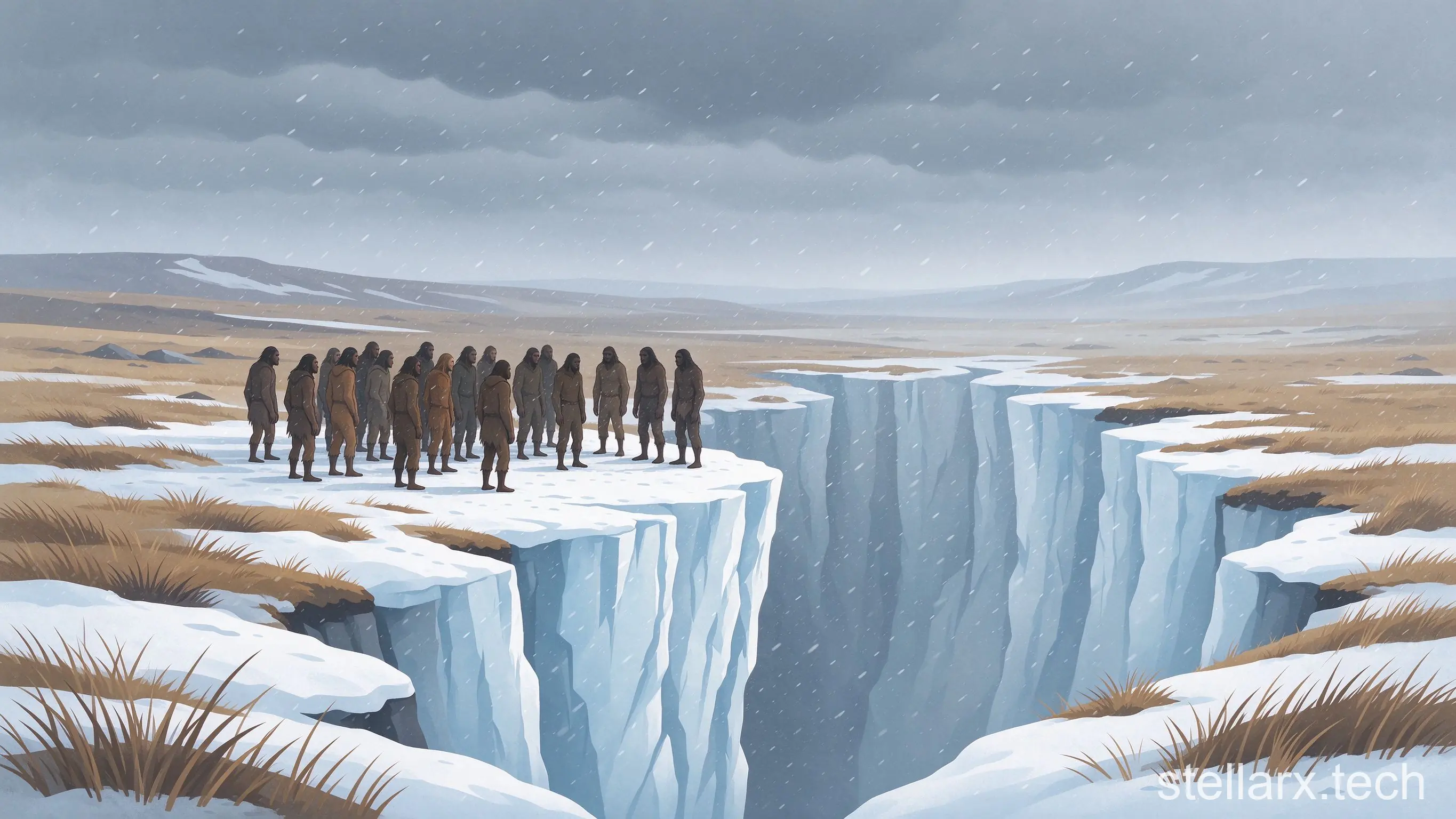
Why 1,700 ml of Neanderthal brain lost.
Late Neanderthals had brains up to 1,700 ml — bigger than ours. They made refined stone tools, bone tools, art, simple shelters, and had division of labor. They still died out 30,000–40,000 years ago, in the grip of the Last Glacial Maximum (which hit its extreme between 26,500 and 19,000 years ago). The leading explanation: over-specialization. They depended on close-range hunting of large game, resisted ice-age stress poorly, and their social networks stayed narrow — so when populations shrank, breeding opportunities and infant survival collapsed. It is estimated Neanderthals may have needed 1,000 individuals to avoid extinction where Homo sapiens could ride it out with 500. Meanwhile sapiens had abstract thinking, complex tools, refined ranged weapons, language, trade networks, and deep cultural transmission — social glue that kept a small population coherent.
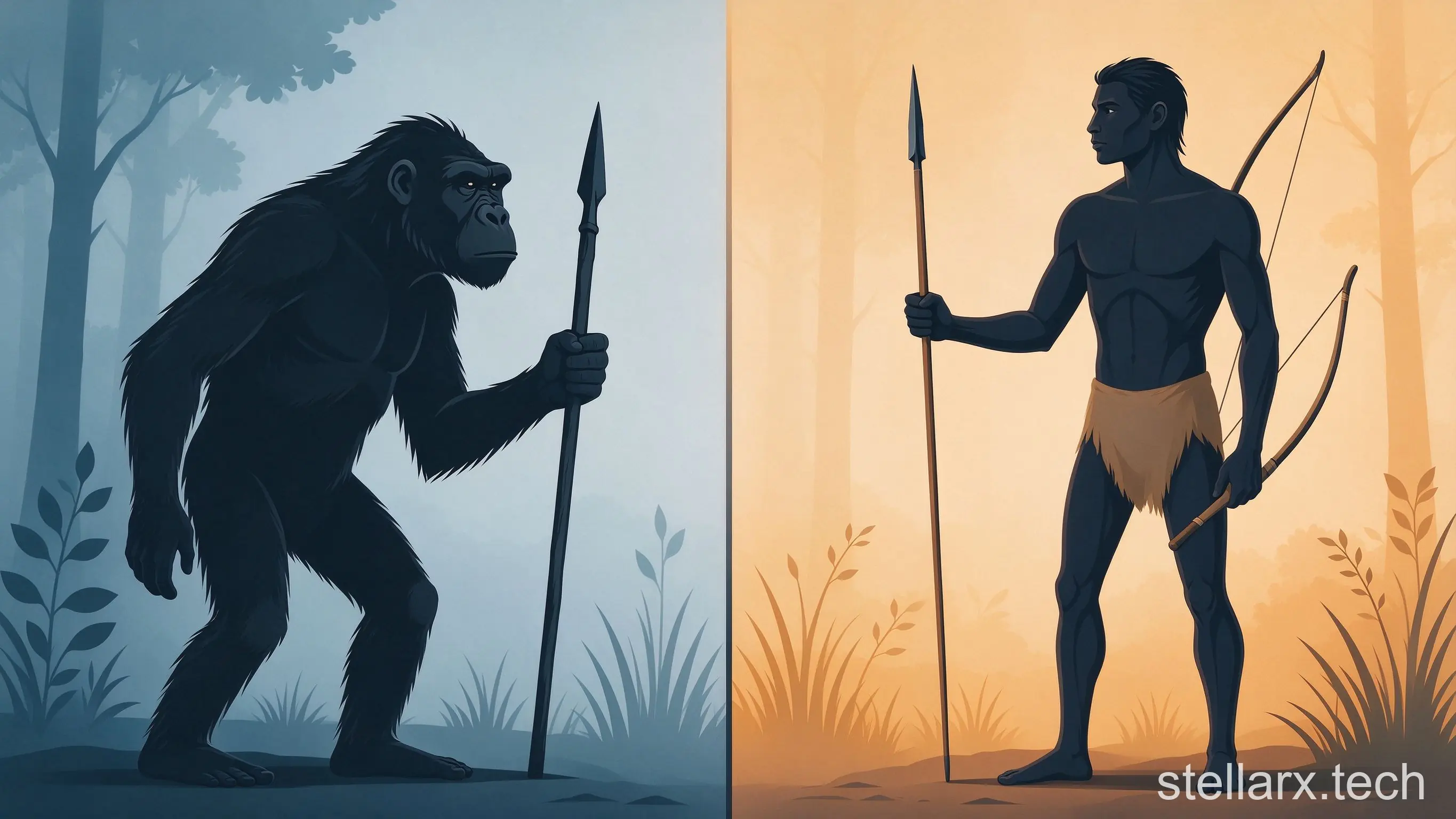
Every other mammal grows its own clothes. We sweated ours off, then had to invent them — or freeze. That is why, of all species on Earth, only humans wear clothes.
If you want to see the fur we lost under a microscope, you can: including a wool fiber specimen where the scale-covered surface structure is clearly visible — the hair that still coats every other mammal, and the reason we needed clothes. Search "WWAI" in your app store and download it today.

References:
1. Roach, N. T., Venkadesan, M., Rainbow, M. J., & Lieberman, D. E. (2013). Elastic energy storage in the shoulder and the evolution of high-speed throwing in Homo. Nature, 498(7455), 483–486. — https://www.nature.com/articles/nature12267
2. Toups, M. A., Kitchen, A., Light, J. E., & Reed, D. L. (2011). Origin of Clothing Lice Indicates Early Clothing Use by Anatomically Modern Humans in Africa. Molecular Biology and Evolution, 28(1), 29–32. — https://doi.org/10.1093/molbev/msq234
All illustrations are AI-generated.
Related reading

Humans Are Lobe-Finned Fish: The Evolution Proof


- Why Humans Are the Only Animals That Need Clothes
- A Whole 1.25 kg Pomelo Has Only 280 kcal. Here's Why.
- Salmonella Is Everywhere. Here's How It Gets Into Your Food
- Your Dry Eyes Aren't Thirsty — They're Out of Oil
- 国庆团圆饭,我劝你一定要留一个位置给它……
- Tired No Matter How Much You Sleep? It Might Be Inflammation
- Why You Wake at 3 AM Every Night: Don't Check the Clock
- Why Foreigners Can't Handle Baijiu: It's the Aldehydes
- Why the Poor Love Grand Narratives: The Microscope Argument
- The Trojan Horse: How Plague Disarms Your Immune System
全部评论