Why the Death's Head Hawkmoth Looks Like a Skull
That skull is not painted by the moth. It is drawn by your brain. Two pale patches on a dark background happen to line up as eye sockets and cheekbones, and a brain region built to find faces finishes the picture.
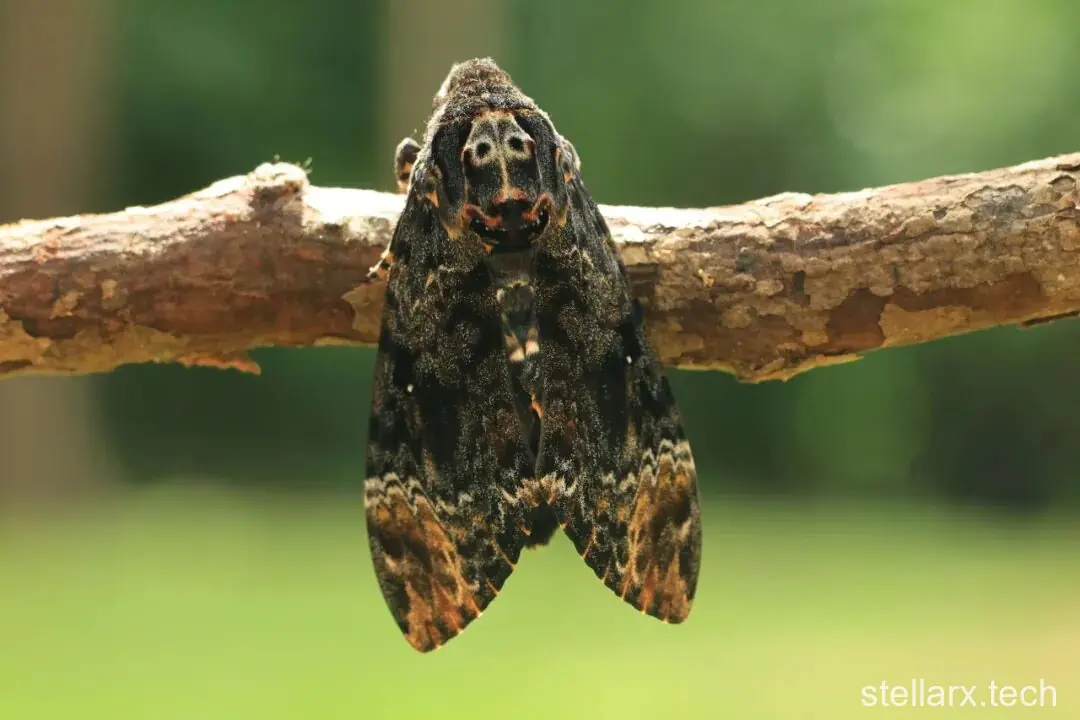
The death's head hawkmoth belongs to the genus Acherontia, family Sphingidae. There are only three species on Earth, and China holds two of them: Acherontia lachesis and Acherontia styx. The third, Acherontia atropos, lives mainly in Europe and Africa. The family names are just as ominous as the pattern — some come from a river of the underworld, others from a goddess who cuts the thread of life. It is an unfair reputation. These moths do not bite, sting, or carry venom. They are harmless to people. Their larvae chew the leaves of sesame and potato, and the adults raid beehives for honey, which is why Europe lists them as a minor agricultural pest.
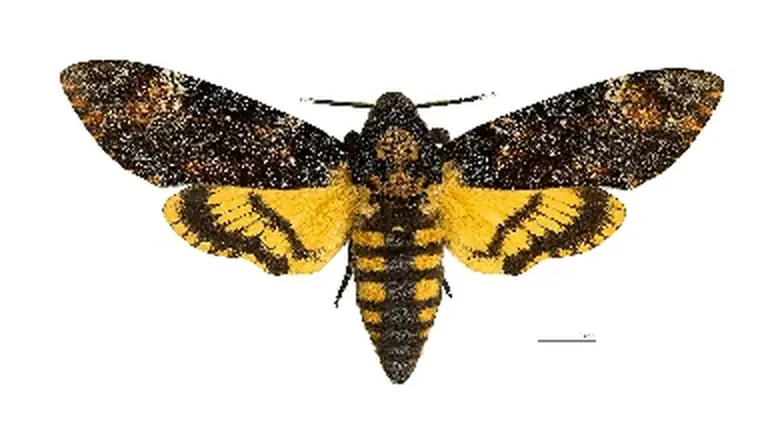
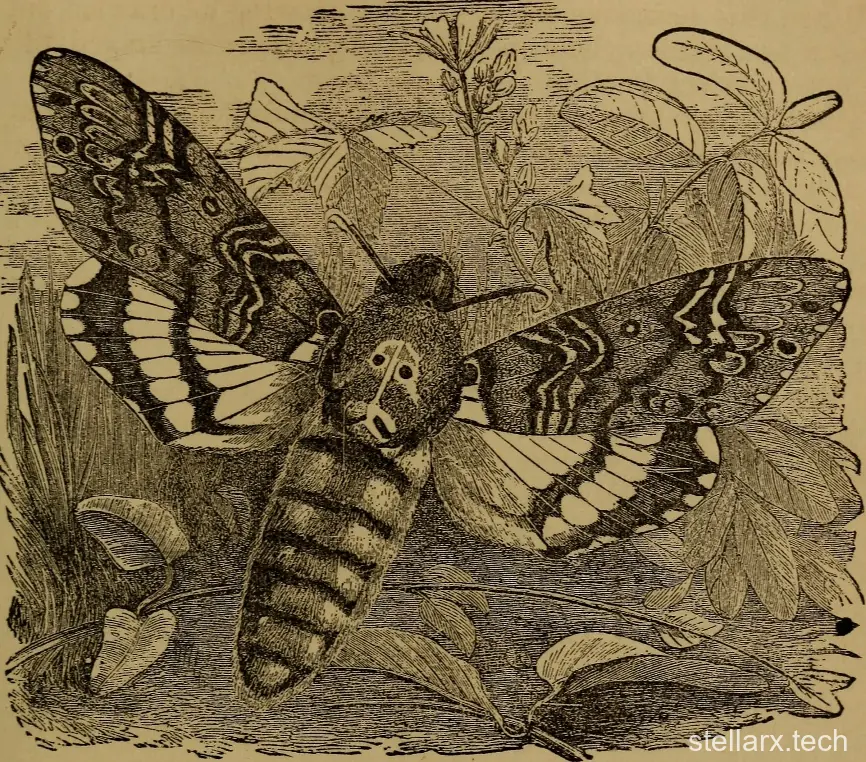
Where did the "harbinger of death" reputation come from? A naturalist in the 19th century recorded the scene: the skull-patterned moths were so abundant that someone caught fifty of them in a single potato field, and they flew into houses in numbers large enough to snuff out the lamps. Locals called them "skull ghosts" and "wandering dead birds," convinced that the marking on the thorax was a complete human skull, crossed bones included. The moth became an omen of war, plague, famine, and death. Fear even made it into children's books, where the moth was a witch's familiar that whispered the names of the dying. When one of these creatures flew near a village church, no one dared reach out to touch it. A whole village of adults, kept outside the church door by one fluttering moth.
The myth appeared suddenly. Before the 18th century there is almost no record of it; afterward, the moth turns up densely in literature and painting. Why did the legend crystallize around 200 years ago? The leading explanation is the potato. As potatoes spread across Europe, the moths' larvae gained a vast new dining table. The population swelled, encounters with people multiplied, and the folklore grew along with them. The skull pattern and the eerie squeak had always been there — two hundred years ago, people simply met the moth often enough to be astonished.
That the death's head hawkmoth "screams" was told for nearly two centuries before modern entomologists finally worked it out in the 21st. Sound-making insects are common, but the familiar ones are noisy on the outside: crickets rub their wings together, cicadas vibrate membranes on the abdomen. The death's head hawkmoth is different — it produces sound inside its own body, which is rare among insects. In 2015, a team of German entomologists used micro-CT and X-ray imaging to see the sound organ clearly: the moth's pharynx works like an accordion. A membrane at the top of the pharynx is lifted, and as air is drawn in through the proboscis and mouthparts, the airstream passes a flap-like structure called the epipharynx. The flap vibrates rapidly and produces the sound. In and out with each breath, the "breathing" sets a rhythm, and each burst of sound lasts about one-fifth of a second.
The dominant frequency peaks near 8 kilohertz. Human hearing spans roughly 20 hertz to 20 kilohertz, so 8 kHz sits squarely in our most sensitive range. The potato farmers of two hundred years ago probably heard exactly this band — and built their ghost stories around it.
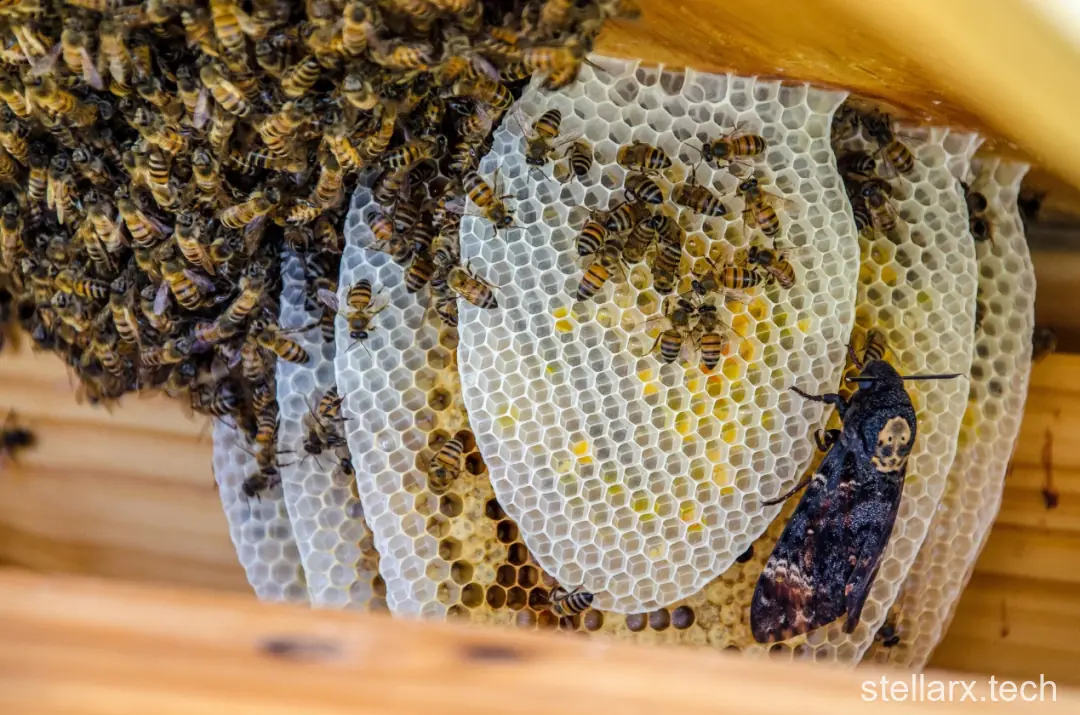
Why does the moth make the sound at all? Start with its diet. Most adult hawkmoths drink nectar through a long, thin proboscis and are legitimate pollinators. The death's head hawkmoth does otherwise: its proboscis is short and thick, useless inside a flower corolla, so it uses the proboscis to raid beehives and drink honey. A large moth with a wingspan near ten centimeters walks into a hive, eats its fill, and leaves unharmed. An old explanation said the squeak mimics the queen bee to confuse the workers. The real trick is chemical camouflage: the moth's cuticle carries four fatty acids, the same compounds found on honeybees, in similar proportions. In a society that recognizes its own by smell, that layer of compounds is a pass into the hive.
Then what is the squeak for? Consider the moth's situation. It cannot sting. It cannot bite. Its wings are so large that its body is heavy, and it must flutter for a while to warm its flight muscles before takeoff. Once caught, it cannot run. The only weapons it can deploy instantly are that membrane and flap in its throat. Cornered, it squeaks — when pinched by fingers, carried off by a bird, pressed under a twig. The sudden flutter and squeal startles the predator for an instant. That instant when the beak or grip loosens is the escape window.
The moth that suits Halloween so well has nothing to do with ghosts. The skull face is two pale patches on a dark background that happen to line up as eye sockets and cheekbones. The artist is a brain region built to find faces — a region that hunts for faces in clouds, in double-yolk eggs, on toast. Psychologists call it face pareidolia. If the skull frightens you, turn the picture upside down: the eye sockets become two large nostrils, and the horror becomes comedy. Many insects carry similar patterns; the best known is a stink bug nicknamed the "human-faced bug" (人面蝽). Seeing skulls and faces has always been our brains' doing.

Want to see the scales and antennae of this Halloween icon for yourself? They only reveal themselves under magnification — including a dragonfly antenna specimen where antenna segmentation, setae and sensilla are clearly visible. Just search "WWAI" in your app store and download it today.

Related reading

Why Are Mysterious Round Holes Appearing on Parked Cars? The…

Fall Webworm Biocontrol: Beijing's Tiny Wasp Army

Is Honey Bee Vomit? The Secret Life of Honey
References
1. Zhu H F, Wang L Y. Fauna Sinica · Insecta Vol. 11 · Lepidoptera: Sphingidae. Beijing: Science Press, 1997. p. 410.
2. The Mirror of Literature, Amusement, and Instruction. Vol. 19, No. 541, April 7, 1832.
3. Robischon M. Environmental and Cultural History of the Death's Head Hawkmoth. Environment and History, 2019.
4. Brehm G, Fischer M, Gorb S. The unique sound production of the Death's-head hawkmoth (Acherontia atropos (Linnaeus, 1758)) revisited. The Science of Nature, 2015, 102(7-8). DOI: 10.1007/s00114-015-1292-5.
5. Moritz R F A, Kirchner W H, Crewe R M. Chemical camouflage of the death's head hawkmoth (Acherontia atropos L.) in honeybee colonies. Naturwissenschaften, 1991, 78(4): 179-182. DOI: 10.1007/BF01136209.
6. Liu J, Li J, Feng L, Li L, Tian J, Lee K. Seeing Jesus in toast: Neural and behavioral correlates of face pareidolia. Cortex, 2014, 53: 60-77.
7. Kitching I J. Phylogeny of the death's head hawkmoths, Acherontia (Laspeyres), and related genera (Lepidoptera: Sphingidae: Sphinginae: Acherontiini). Systematic Entomology, 2003, 28(1): 71-88.
- Autocatalysis in Evolution: From Fish to Humans
- 自催化的演化:從魚到人的 5 億年
- Ectopic Tooth in Eyelid: A World-First Superior Orbit Case
- 眼瞼長牙的真相:全球首例眶上異位牙
- What Is Lean Muscle? 4 Factors Behind 'Thin Muscle' Physique
- 薄肌理論是啥?4 個特徵決定你的肌肉線條
- 雙層保溫碗夾層長黴:60℃ 熱水殺不死的細菌
- Mold in a Double-Wall Baby Bowl: What 60°C Can't Kill
- Why Vacuum-Sealed Food Can Cause Botulism
- 肉毒桿菌中毒:真空包裝不是保鮮保險箱

全部评论