Autocatalysis in Evolution: From Fish to Humans
The 2026 Nobel Prize in Chemistry went to two chemists for a discovery that sounds almost self-indulgent: a reaction that speeds up its own making. Henri B. Kagan and Kenso Soai found that a chemical product can act as its own catalyst, amplifying a tiny nudge into an overwhelming result.
But here is the part the prize citation does not spell out. That same self-accelerating loop appears to have driven 500 million years of evolution, from the first fish with a backbone to the human asking how she got here. The spine you sit up straight with may be an autocatalytic product.
The 2026 Nobel Prize in Chemistry Went to Self-Amplifying Reactions
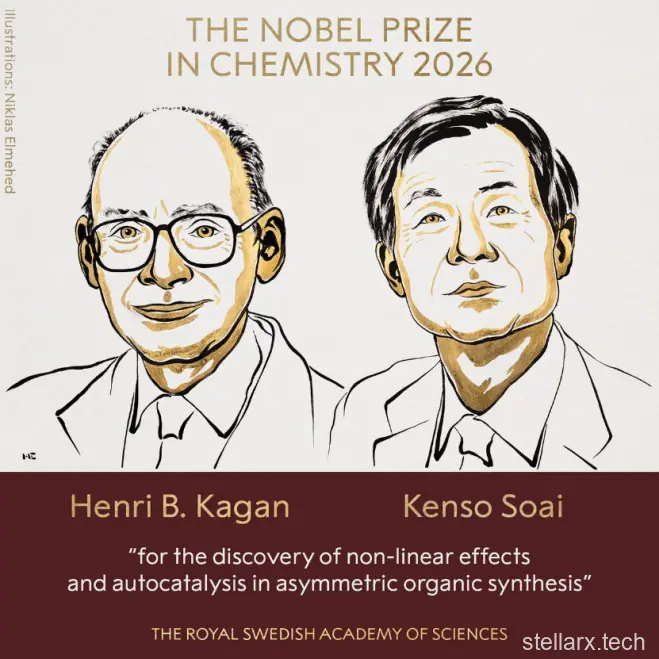
The Nobel Committee awarded the 2026 prize to Henri B. Kagan (France) and Kenso Soai (Japan) "for the discovery of non-linear effects and autocatalysis in asymmetric organic synthesis."
Committee chair Heiner Linke called their work a solution to a question that had puzzled chemists for generations: how homochirality — a world in which mirror-image molecules come in only one handedness — can arise spontaneously. The answer, he said, was "impressive."
What Is Autocatalysis?
Autocatalysis means the product of a reaction acts as the reaction's own catalyst. More product means faster catalysis; faster catalysis means even more product. The rate follows a characteristic S-shaped curve: slow at first, then accelerating, then slowing again as the starting material runs out.
The museum exhibit put it in a bakery. Imagine that every loaf you bake automatically kneads the next batch of dough for you — and the new loaf keeps helping. That is autocatalysis.
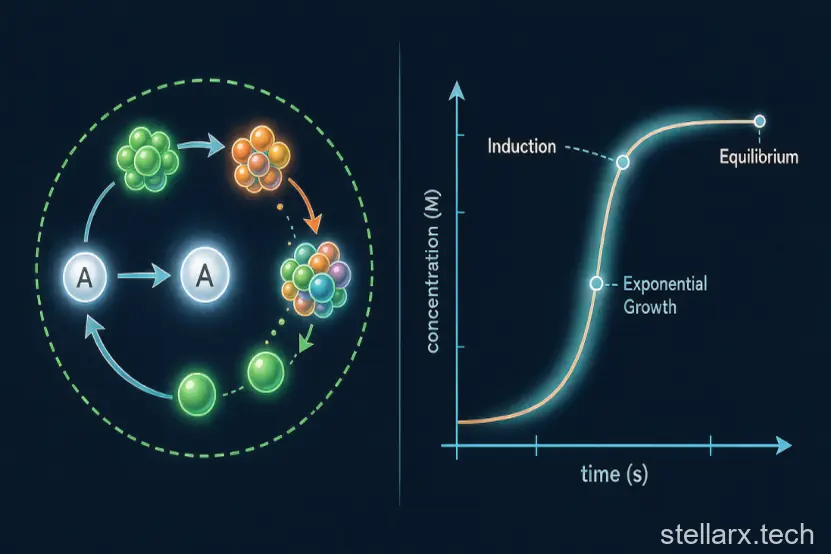
Kagan first found the non-linear effect: even a catalyst with a tiny handedness bias can push a product toward a far larger handedness bias than the input would predict. Soai then discovered asymmetric autocatalysis — the product itself catalyzes the formation of more product with the same handedness. In his 1995 experiment, a starting bias of just 0.00005% produced 99.5% optical purity. A 650,000-fold amplification, from a chemical nudge almost too small to measure.
Why Evolution Runs on the Same Logic
Autocatalysis is not only a laboratory phenomenon.
Theoretical biologist Manfred Eigen proposed in 1971 that the origin of life depended on a "hypercycle": a loop of autocatalytic reactions in which each molecule catalyzes the formation of the next, and the last one turns around to catalyze the first. The whole network keeps spinning like a wheel.
Stuart Kauffman later developed the idea of autocatalytic sets — networks of molecules that catalyze each other's formation and sustain themselves as a whole. Once such a network exists, it has the capacity to keep itself going.
The same logic scales up to evolution. Every major innovation — a new organ, a new body plan, a new ecological niche — opens a space of new possibilities, and those new possibilities in turn catalyze more innovation. That is autocatalytic amplification at the scale of half a billion years.
From Fish to Humans: A 500-Million-Year Chain
The Shanghai Natural History Museum's "Deep Time: From Fish to Human" exhibition traces this chain through a string of fossil evidence, from the origin of vertebrates to the rise of mammals and primates. At every key node, the autocatalytic pattern shows up.
A Spine Appears: Haikouichthys
Haikouichthys, from the Chengjiang fauna of Yunnan, is among the oldest known vertebrates, pushing the origin of the backbone back to the Cambrian, about 500 million years ago. It was small — so small that it held no obvious advantage in Cambrian seas. But it carried the first true "autocatalytic switch" of vertebrate evolution.
The 1999 Nature report on Haikouichthys described a creature with a proto-backbone. A spine supports the body and protects the nervous system. With it, animals could grow larger, faster, more agile — and those advantages pushed the spine itself toward further optimization, from cartilage to bone, from simple to complex. A small structural innovation, looping through "advantage → upgrade → bigger advantage."
Fins That Became Limbs: Tujiaaspis vividus
About 436 million years ago, in the early Silurian, a six-centimeter jawless armored fish called Tujiaaspis vividus swam in shallow seas. It holds the earliest fossil record of continuous fin folds — the rudiment of paired fins, and ultimately, of human limbs. Its holotype, IVPP V26668, was described in detail in a 2022 Nature study.
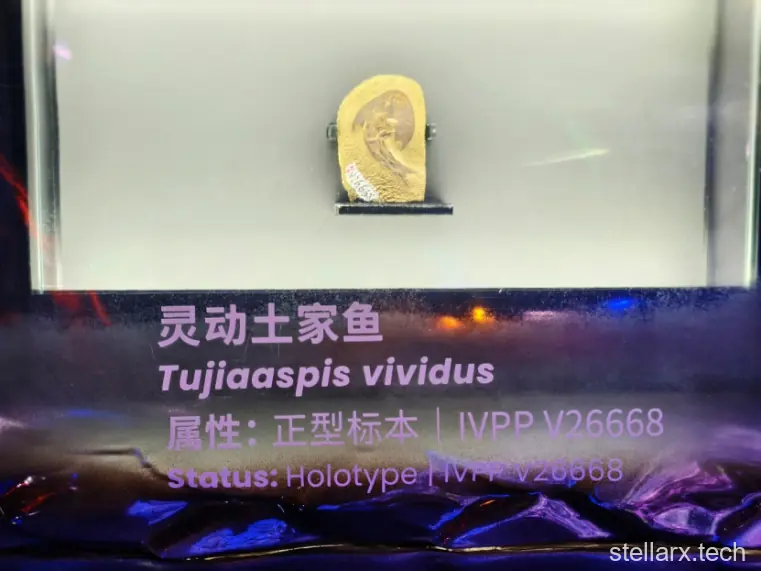
Paired appendages were another classic autocatalytic event. Fin folds gave fish better lift and speed, which meant better escape from predators; those gains in turn pushed the appendages toward finer, stronger structures. From paired fins to tetrapod limbs to the dexterous human hand — the whole chain starts with that unimpressive fold.
Jaws Start an Arms Race: Xiushanosteus mirabilis
Xiushanosteus mirabilis, also from the early Silurian, is a placoderm whose skeletal features provide direct evidence for the evolution of the jawed vertebrate skull. The jaw was one of the most decisive leaps in vertebrate history.
With jaws, vertebrates could hunt, tear, and chew — rewriting the rules of the ocean. Predators needed stronger jaws to catch prey; prey needed harder armor or greater speed to escape. This predator-prey coevolution is itself an autocatalytic cycle: every adaptation triggers a counter-adaptation, and every counter-adaptation triggers a new adaptation. Jaws dragged vertebrates into an arms race that lasted hundreds of millions of years.
The Move to Land: Ichthyostega
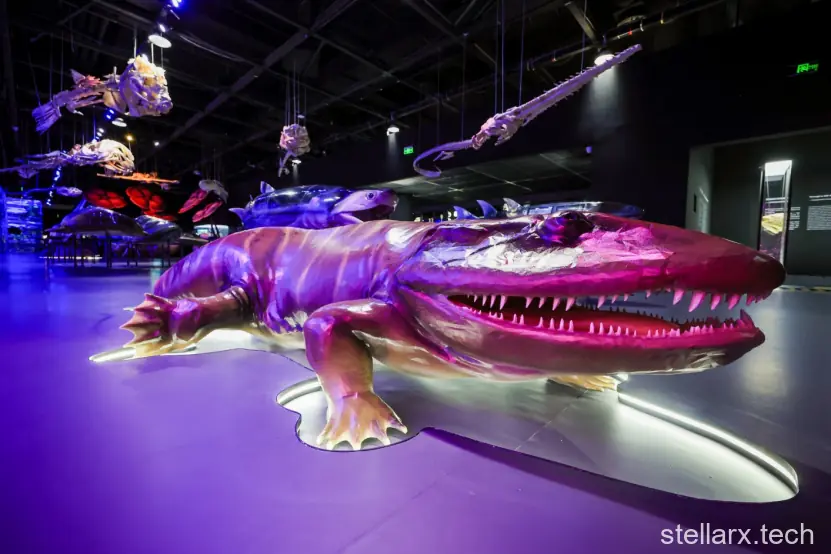
The most dramatic turn in the fish-to-human story came in the Late Devonian. Ichthyostega, one of the earliest known four-legged vertebrates, combined fish and amphibian traits: a fish-like tail and lateral line, alongside tetrapod limbs and ribs. Ahlberg and Milner's 1994 review of tetrapod origins placed it at the center of this transition.
Landing was not a single "decision" but the result of autocatalytic amplification reaching a tipping point. Marine jawed fish faced escalating competition; shallow water offered more food and fewer rivals; paired appendages let fish support their bodies in shallow water; lungs made air-breathing possible. When these features came together, leaving the water stopped being a question of "whether" and became a question of "when."
The Amniote Egg: An Independence Declaration
About 300 million years ago, in the Late Carboniferous, a group of lizard-like animals — exemplified by Hylonomus lyelli from Canada — completed the most profound "declaration of independence" in vertebrate history: they no longer needed water to reproduce.
Every tetrapod before them depended on water for breeding. Amphibians lay eggs in water or extreme moisture, and their young pass through an aquatic larval stage. No matter how land-adapted the adult, it was chained to the water.
The amniote egg broke that chain. Inside the egg sits a private water world: the amnion wraps the embryo, amniotic fluid provides buoyancy and protection, the allantois stores metabolic waste, and the chorion handles gas exchange. The embryo completes all development inside, hatching as a miniature adult ready for land.
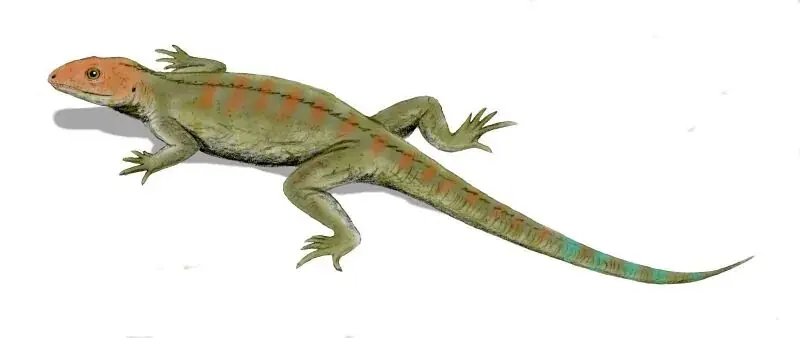
The autocatalytic logic unfolds here with unusual clarity. The amniote egg freed reproduction from water, letting amniotes push inland; inland habitats — forests, highlands, deserts — in turn selected for tougher skin, more efficient lungs, and stronger movement. And amniotes later split into two great lineages: sauropsids (lizards, snakes, turtles, crocodiles, dinosaurs, birds) and synapsids (the ancestors of mammals). One structural innovation seeded nearly all major land vertebrates of the following 300 million years.
Toward Mammals: Bienotherium and Sinoconodon
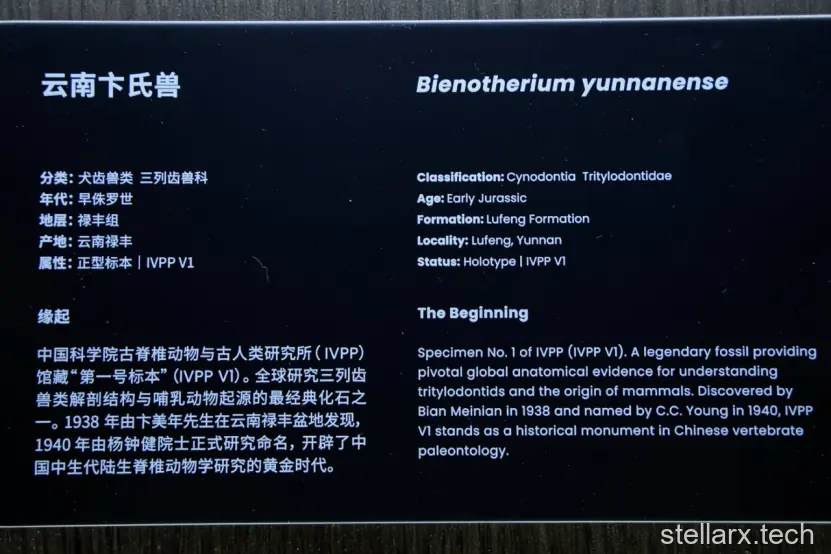
Among synapsids, a branch called therapsids rose during the Permian and Triassic and led toward mammals. The fossil evidence occupies a prominent position in the exhibition, led by Bienotherium yunnanense from the Lower Jurassic Lufeng Formation in Yunnan — its holotype, IVPP V1, the "Specimen No. 1" of the Institute of Vertebrate Paleontology and Paleoanthropology in Beijing, a cornerstone of research on tritylodontids and the origin of mammals. Discovered by Bian Meinian in 1938 and named by C. C. Young in 1940, its limb bones already resemble those of mammals, and its dentary is enlarged to occupy most of the lower jaw while the articular and surangular bones shrink.
Alongside it, Sinoconodon rigneyi represents one of the earliest diverging mammaliamorph groups.
Autocatalysis: One Logic From Chemistry to Life
Put the nodes together and a clear pattern emerges: Haikouichthys's spine laid the foundation for movement; Tujiaaspis's fin folds paved the way for limbs; Xiushanosteus's jaw triggered a chain reaction through ecosystems; Ichthyostega's landing integrated everything into a new way of living.
Each innovation was not isolated. It arose from the previous one and created the conditions for the next. That is the essence of autocatalytic amplification: the product catalyzes the reaction, and the reaction makes more product. In chemistry, it is a molecule amplifying itself. In evolution, it is a chain of innovations catalyzing each other, amplified across 500 million years.
Under a microscope, the same story repeats at tissue level — bone, muscle, nerve, blood vessel, all built on the scaffolding of earlier structures. The spine you use to sit upright, the paired limbs you walk on, the jaw you eat with: each is a product that kept making more of itself.
The 2026 Nobel Prize in Chemistry honored autocatalysis in a flask. The "Deep Time: From Fish to Human" exhibition shows the same law written in fossils across half a billion years. From the first jawless fish to the human who asks about her own origin, we are the most ambitious product autocatalytic amplification has ever made.
Want to trace this history yourself? You can still see its traces at the tissue level — including a fish tail cross-section specimen where the skeleton, muscles, blood vessels and nerves of a fish tail are clearly visible. Search "WWAI" in your app store and download it today.
Related reading
Asymmetric Synthesis & Autocatalysis: Nobel 2026

Homochirality Explained: Nobel Chemistry 2026
Was Animal Origin a One-in-a-Billion Accident?
References
The Nobel Prize in Chemistry 2026. NobelPrize.org. 2026.
Soai, K., Shibata, T., Morioka, H., Choji, K. Asymmetric autocatalysis and amplification of enantiomeric excess of a chiral molecule. Journal of the American Chemical Society. 1995.
Eigen, M. Selforganization of matter and the evolution of biological macromolecules. Naturwissenschaften. 1971.
Kauffman, S. A. Autocatalytic sets of proteins. Journal of Theoretical Biology. 1986.
Shu, D.-G., Luo, H.-L., Conway Morris, S., et al. Lower Cambrian vertebrates from south China. Nature. 1999.
Zhu, Y.-A., et al. Galeaspid anatomy and the origin of vertebrate paired appendages. Nature. 2022.
Ahlberg, P. E., Milner, A. R. The origin and early diversification of tetrapods. Nature. 1994.
- In Ancient China, Oil Was Gold — the Poor Ate Fried Dough
- Sweet Potato Leaves: Fiber, Calcium, Lutein in One Green
- 地瓜葉的營養價值:鈣比牛奶高、葉黃素超西蘭花
- 蟑螂粉的真相:71% 粗蛋白不是蛋白
- Why Cockroach "Protein Powder" Isn't Protein
- Autocatalysis in Evolution: From Fish to Humans
- 自催化的演化:從魚到人的 5 億年
- Ectopic Tooth in Eyelid: A World-First Superior Orbit Case
- 眼瞼長牙的真相:全球首例眶上異位牙
- What Is Lean Muscle? 4 Factors Behind 'Thin Muscle' Physique

全部评论