Why Cockroach "Protein Powder" Isn't Protein
Skip the nutrition lecture for a second — start with anatomy. You need to meet the roach first.
The powder being sold online as a cheap whey alternative claims 71.2% "crude protein." That word crude is doing a lot of heavy lifting: the number is counting nitrogen from chitin and uric acid, not just protein. Same arithmetic that made melamine milk famous.
Meet the roach
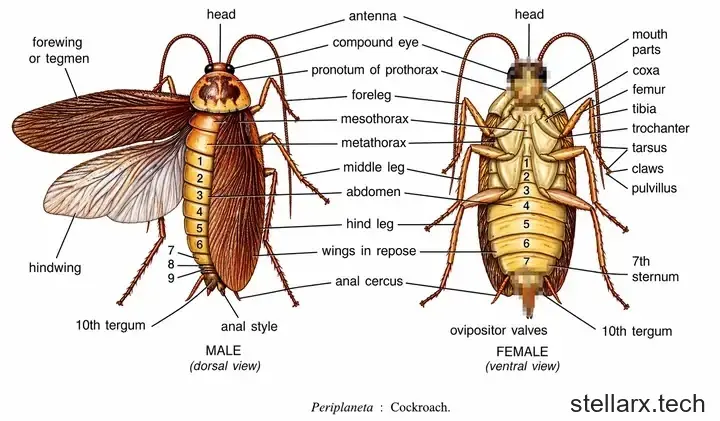
The species behind the trend is the American cockroach (Periplaneta americana) — the big southern roach that sends people running. It is native to Africa and the Middle East, a member of the Blattidae family, and it hitched a ride to the Americas on 17th-century ocean trade routes before spreading around the world.
Adults run 27–32 mm long, with a signature dark brown butterfly-shaped patch on the pronotum behind the head. Three pairs of legs carry rows of chitinous spines. Those legs are built to drop off at the slightest pull — an escape trick that explains why dried roach snacks always arrive missing legs.
The legs are not wasted, by the way. They get ground into the powder too, because livestock don't write bad reviews.
Why the roach could eat — but shouldn't
The American cockroach digestive system runs in three sections. The foregut holds the pharynx, esophagus, crop and gizzard; the crop is the biggest chamber of all, because roaches store food there. Behind it sit the gastric caeca, midgut, colon, rectum and Malpighian tubules.
A cockroach that has been eating — and storing — its way through whatever it found is carrying a gut full of microbes and their leftovers. Every organ is embedded deep in the body cavity, so you cannot exactly pick them out one by one.
The roach might be edible in theory. A roach you actually want to eat? Much less likely.
The fat body: liver, lard and a savings account
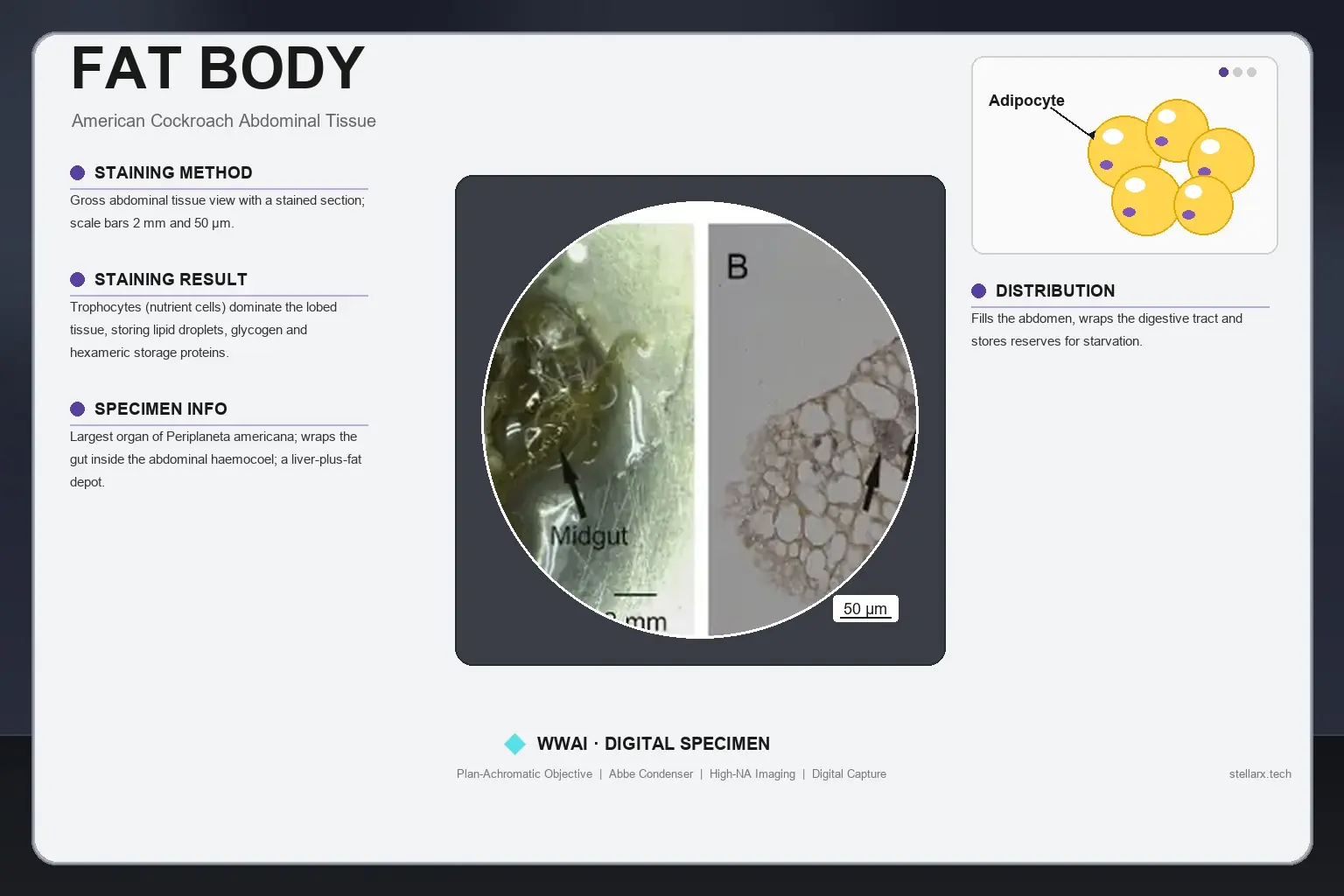
So what is the "explosive paste" inside? Meet the fat body — the largest organ in an American cockroach, a lobed, cream-white tissue that fills the abdominal haemocoel and wraps around the digestive tract. Think of it as a liver and a fat depot welded into one. In a well-fed roach, it is essentially a fatty liver.
It is built from three cell types. Trophocytes (nutrient cells) are the bulk of it, storing lipid droplets, glycogen and hexameric storage proteins — the roach's emergency fund for lean times. They are also the main source of that celebrated 71.2% crude-protein figure, which is not protein at all but total nitrogen measured by the Kjeldahl method and converted with a fudge factor.
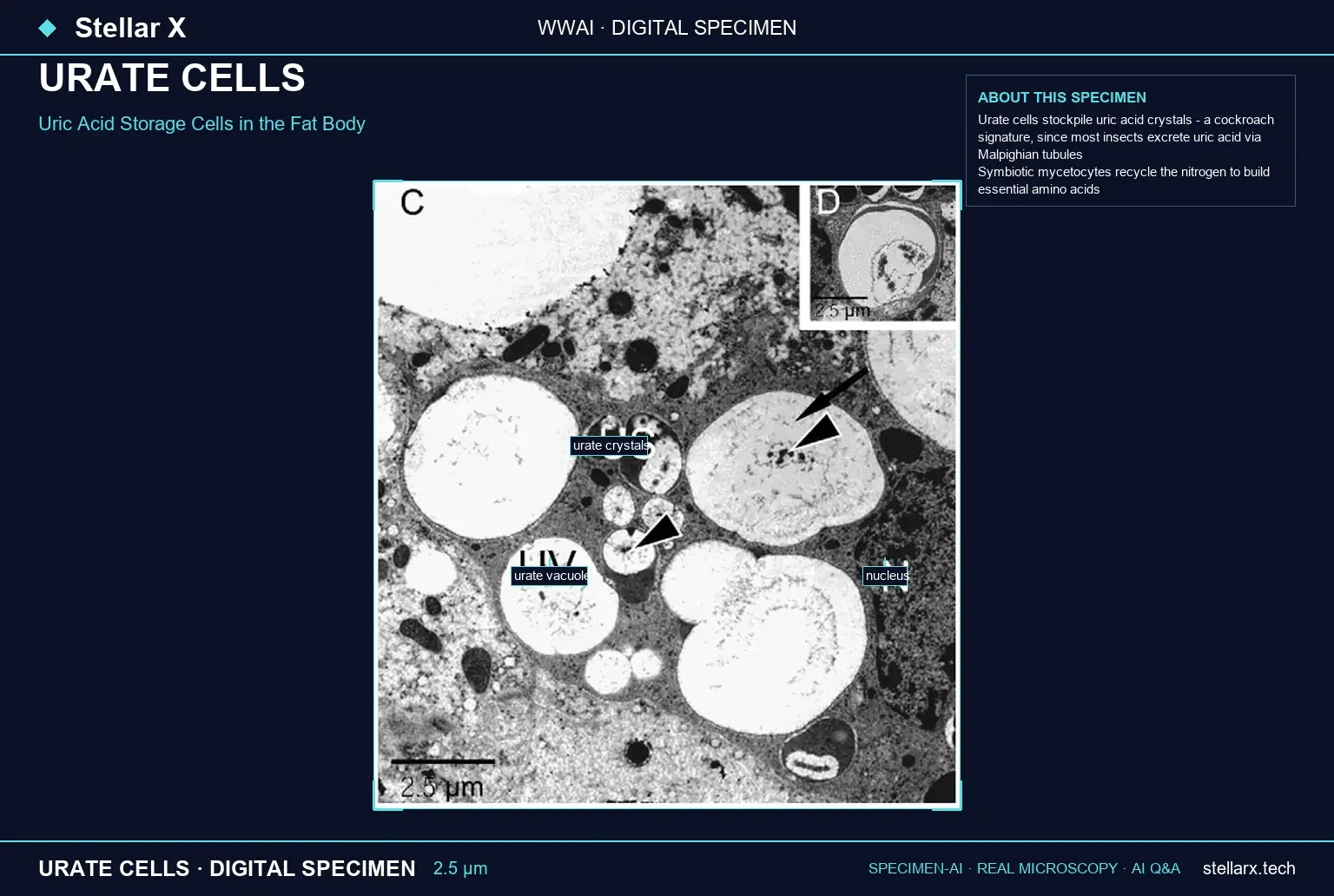
Urocytes are the roach's signature move. Most insects flush uric acid out through the Malpighian tubules; cockroaches instead stockpile the crystals inside these cells. A roach is basically walking around with its own gout savings account.
Then come mycetocytes, host cells packed with a hereditary endosymbiont, Blattabacterium cuenoti, passed down through the mother's eggs. It cannot break down the uric acid crystals, but it recycles the nitrogen released from uric acid degradation to build essential amino acids and B vitamins. The old rumor that roaches can turn waste into MSG? That's just urea doing organic chemistry — which somehow sounds worse.
[
The Kjeldahl arithmetic trick
Here is where the label starts lying. Uric acid contains nitrogen. Chitin contains nitrogen. The Kjeldahl method measures total nitrogen and multiplies by 6.25 to estimate "crude protein." Feed any of those nitrogen sources through the same machine and it reports them as protein.
This is the same trick that made melamine-tainted milk notorious — only here the extra nitrogen is built into the insect itself. Which means that 71.2% figure is not just imprecise; the roach's own uric acid is a kidney tax you get to pay. Call it protein powder and your kidneys get an invoice instead.
What you actually swallow
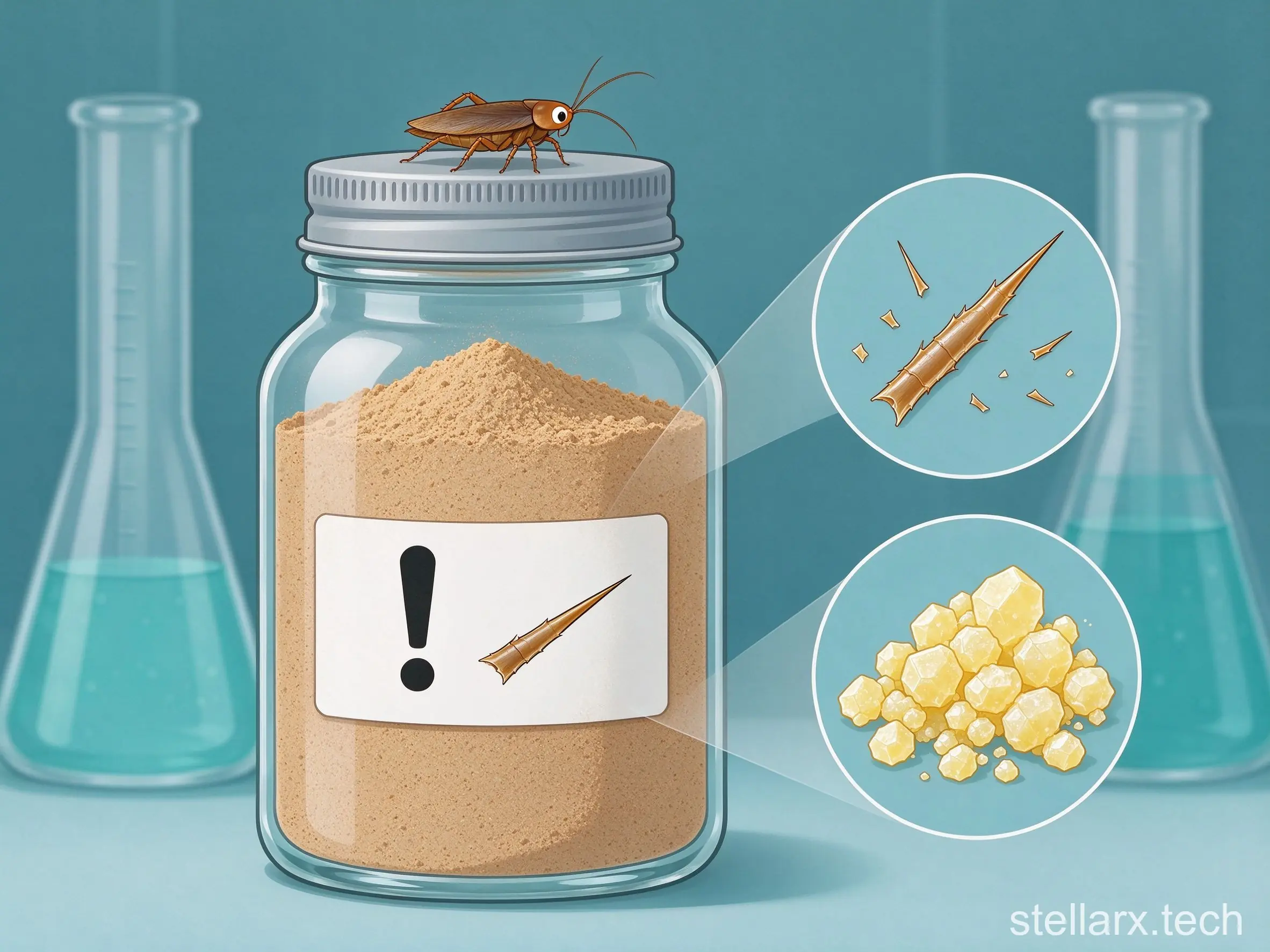
The exoskeleton is chitin, and chitin does not digest. Roach legs are lined with chitinous spines, and when a workshop-grade grinder has its way with them, those spines do not all break down. Expect a mouthful of splinters, a scratched throat — and an appointment at the toilet's summit the next morning.
How "wild roach powder" is raised
Roaches eat anything. Roaches store food in their crop. Put those two facts together and you get the business model: kitchen waste that has been through "harmless treatment" can feed a roach farm, and most roach meal goes into animal feed, where hygiene standards run loose.
High emotional intelligence: the powder is probably rich in nutrients. Low emotional intelligence: exactly.
For scale, here is how that 71.2% compares with a standard Peruvian fish meal under the same label math:
| Nutrient (% , as-is) | This study (roach meal) | Peruvian fish meal [8] (CP 65%) | Zhou et al. [7] |
|---|---|---|---|
| Crude protein | 71.2 | 65.3 | 63.1 |
| Crude fat | 18.4 | 8.9 | 17.2 |
| Crude ash | 8.8 | 16.2 | 5.7 |
| Crude fiber | 7.0 | — | — |
| Moisture | 4.9 | 8.3 | 9.8 |
| Acid-insoluble ash | 0.1 | 0.2 | — |
The honest label for 71.2% "crude protein" is this — a number that counts the roach's skeleton, its waste-management system and its actual meat in one bucket, measured by a method that cannot tell them apart. If that is what you want in your shake, the roach is willing. Your kidneys, throat and toilet are less enthusiastic.
All of this happens at a scale your eyes cannot see — urate crystals stacking inside cells, endosymbionts working a nitrogen pipeline, chitin spines barbing a leg. Curious what that looks like under a lens? The WWAI app pairs AI biology answers with an online virtual microscope, including a Pill Bug specimen where the segmented, chitinous body and seven pairs of walking legs are clearly visible. Search "WWAI" in your app store and download it today.
Related reading

Why Cockroaches Aren't as Tough as You Think

Uric Acid Crystals Under the Microscope

Food Adulteration in Ancient China
References
Park M S, Park P, Takeda M. Roles of fat body trophocytes, mycetocytes and urocytes in the American cockroach, Periplaneta americana under starvation conditions: an ultrastructural study. Arthropod Structure & Development, 2013, 42: 287–295.
Janssen R H, Vincken J P, van den Broek L A M, et al. Nitrogen-to-protein conversion factors for three edible insects: Tenebrio molitor, Alphitobius diaperinus, and Hermetia illucens. Journal of Agricultural and Food Chemistry, 2017, 65(11): 2275–2278.
Mustafa F, Sajjad A, Tahir R, et al. Use of Periplaneta americana as a soybean meal substitute: A step towards sustainable transformative poultry feeds. Insects, 2024, 15(9): 632.
- Sweet Potato Leaves: Fiber, Calcium, Lutein in One Green
- 地瓜葉的營養價值:鈣比牛奶高、葉黃素超西蘭花
- 蟑螂粉的真相:71% 粗蛋白不是蛋白
- Why Cockroach "Protein Powder" Isn't Protein
- Autocatalysis in Evolution: From Fish to Humans
- 自催化的演化:從魚到人的 5 億年
- Ectopic Tooth in Eyelid: A World-First Superior Orbit Case
- 眼瞼長牙的真相:全球首例眶上異位牙
- What Is Lean Muscle? 4 Factors Behind 'Thin Muscle' Physique
- 薄肌理論是啥?4 個特徵決定你的肌肉線條
全部评论