What Is Lean Muscle? 4 Factors Behind 'Thin Muscle' Physique
Scroll through any fitness feed right now and the advice sounds strangely unanimous: build "thin muscle," drink more water, sleep more. Three habits, one message — get back to the basics of your own body.
The first two are simple. The third one, "thin muscle," is not.
"Thin muscle" has no entry in any sports-medicine textbook. It grew up on social media, a wild word for something between a paper cutout and the Hulk: lean and firm but never skinny, muscle lines visible but never exaggerated, broad shoulders and a narrow waist — the inverted triangle.
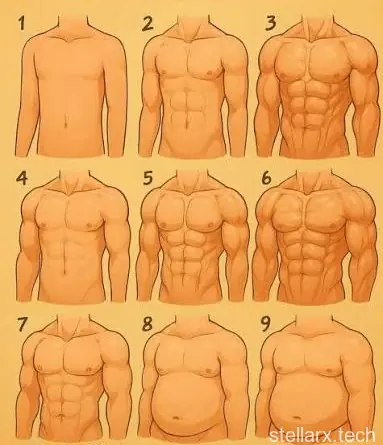
Online guides to the look split into two camps: build muscle but not too much, or cut subcutaneous fat so the lines show through.
Here is the uncomfortable part: neither camp can guarantee the look. Four separate factors decide it, and most of them are decided long before you enter a gym.
The Skeleton: A Coat Hanger You Can't Change
The typical "thin muscle" body looks broad in the shoulders, narrow in the waist, and light on its feet. Half of that feeling comes from muscle and fat; the other half comes from bones.
Start with shoulder width. It is set by clavicle length and by the shape and position of your shoulder blades. The longer your clavicle, the farther the shoulder joint sits from the midline of the body — and the wider the shoulders look. The clavicle is one of the most variable bones in the human body, so some people are born with broad-shoulder geometry before they ever touch a barbell, while others struggle to look wider no matter what they lift.
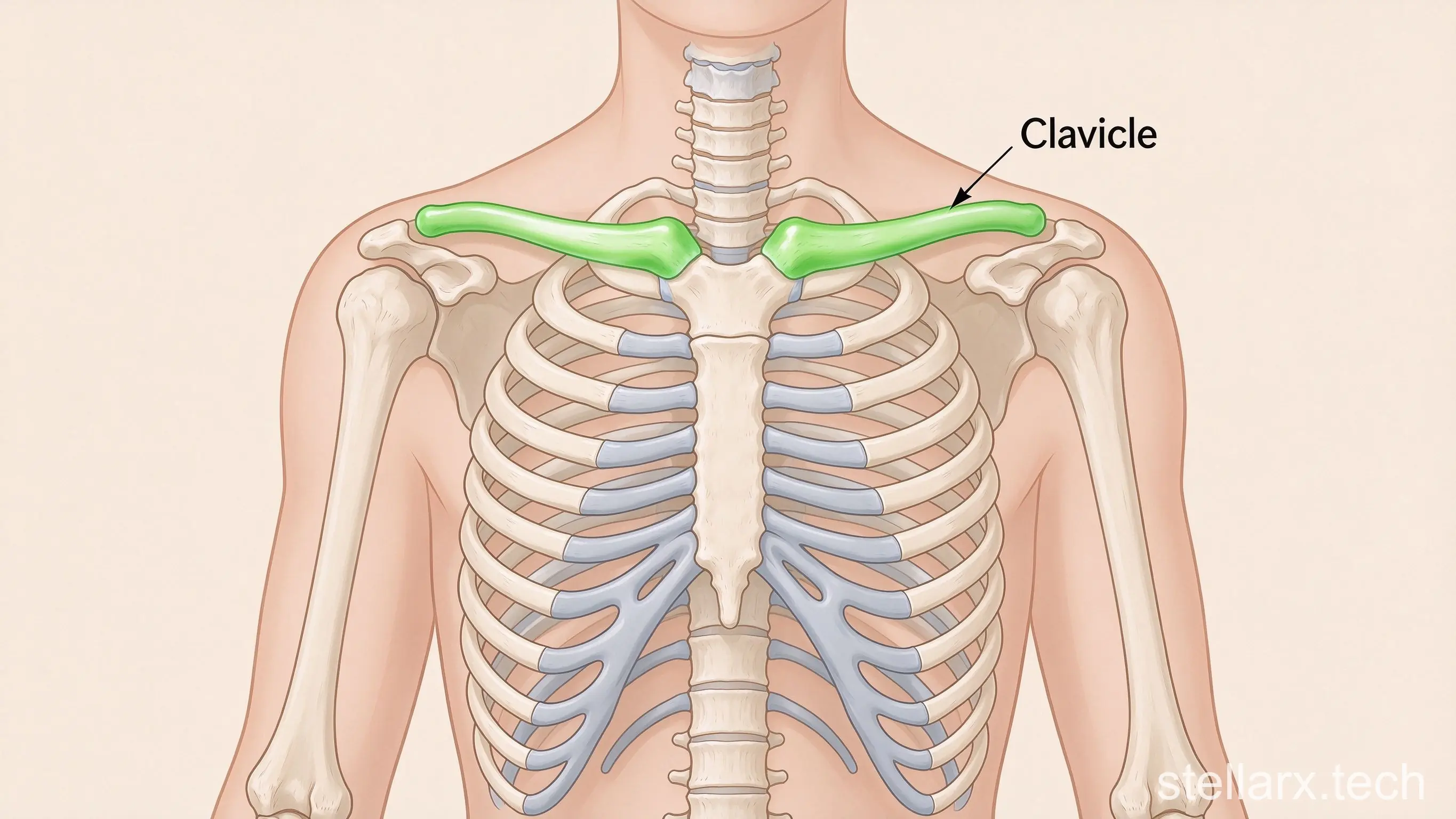
A narrow waist is not entirely about body fat or visible abs, either. On the skeleton, the waist looks narrower when the lower ribs tuck inward, the pelvis is wide, and the distance between the ribs and the pelvis is long. If that geometry runs the other way, even aggressive fat loss leaves a straight-tube look from the front.
And that elusive "lightness"? It tracks with the shape of the ribcage. People born with a flatter chest read as thin from the side; people with a broader, deeper ribcage carry visual volume even when lean.
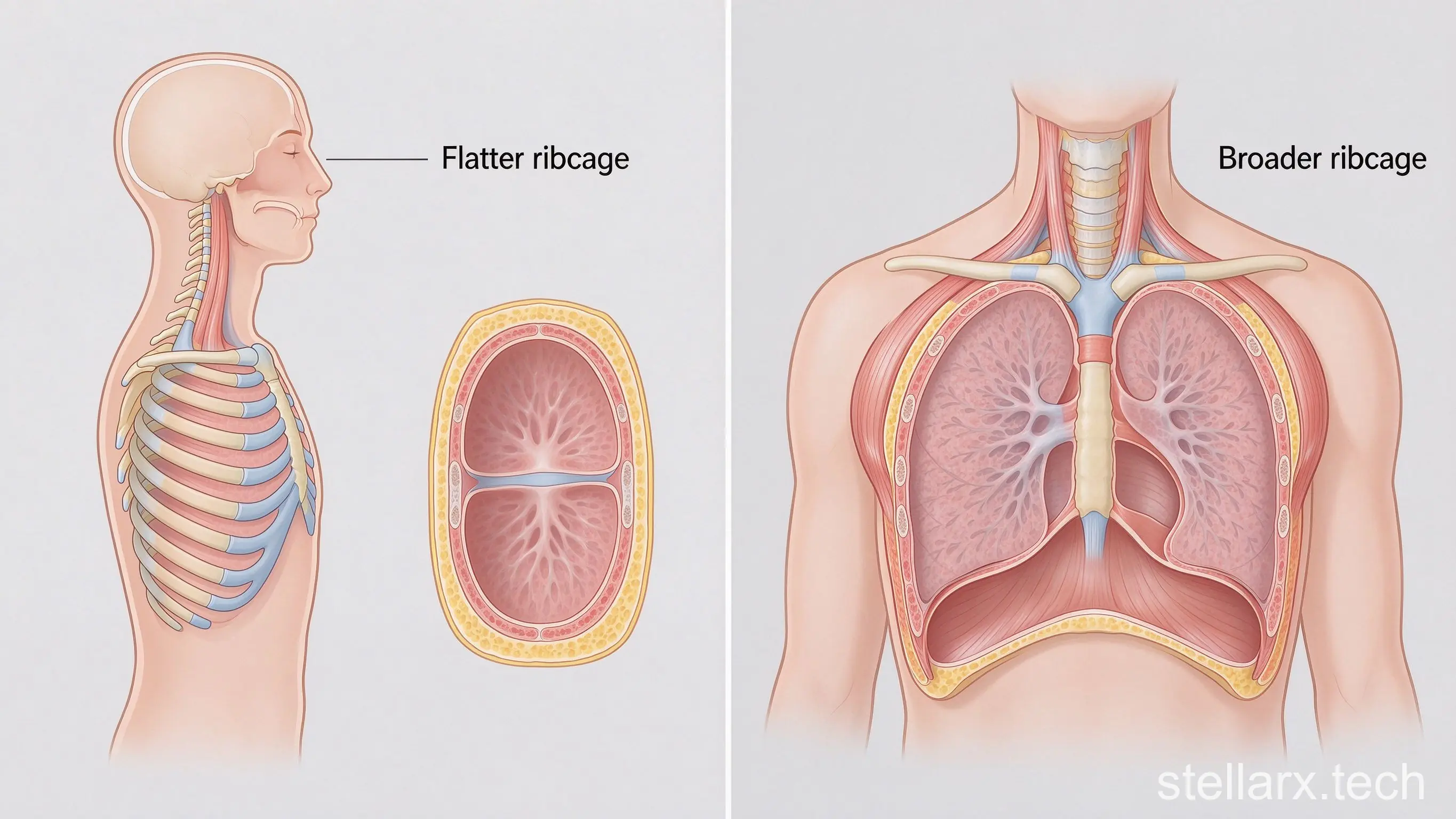
Think of the skeleton as a coat hanger and muscle as the clothes hung on it. The hanger is factory-installed. You cannot change it — but you can cut clothes to suit it, and make the whole silhouette work together.
Tendons vs Muscle Bellies: One Move, Two Shapes
Even with identical skeletons and identical training, two people can end up with different shapes from the same exercise: one gets the smooth, flowing lines "thin muscle" is after, the other gets a bumpy, knotted look.
That introduces the second lottery ticket: the length ratio between tendon and muscle belly, which decides the visual shape of every muscle.
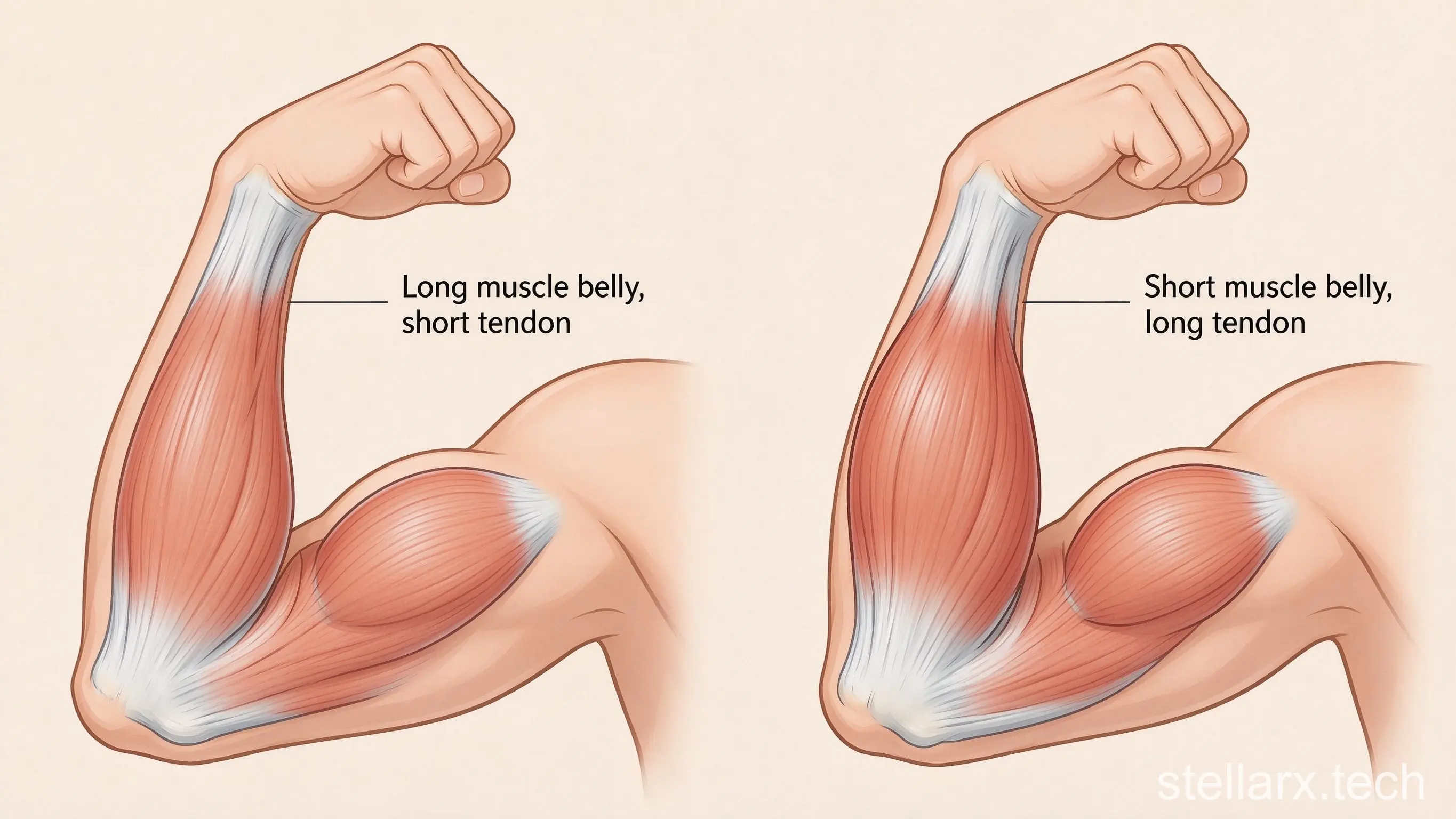
What you see from outside is mostly the muscle belly — it bulges when it contracts and thickens with training. The tendon sits against the bone, stays flat, and barely changes.
Take the biceps on your upper arm. One study measured the average length of its distal tendon at 5.7 cm, with a standard deviation of 1.2 cm. Do not underestimate that 1.2 cm. People with a short muscle belly and a long tendon build a high-set "ball" — a towering muscle peak. People with a long muscle belly build a longer, smoother strip of muscle. The same ratio shapes every other muscle in the same way.
So the long, lean lines of "thin muscle" are, to a surprising degree, a genetic draw. How long your muscle belly is decides how long your muscle line is.
Subcutaneous Fat: The Lines Show Through
Finally, a direction you can actually change with effort — thinning the layer of subcutaneous fat.
"Thin muscle" lines are not only pushed out by big muscles; they are also shown through by thin subcutaneous fat. Subcutaneous fat holds roughly 80%–90% of your total body fat. It is like a quilt draped over a sculpture: no matter how good the sculpture is, the contours are hidden until the quilt is thinned. Shave one centimeter off the quilt and the leg lines appear; shave another and the abs start to show.
Everyone's quilt is distributed differently — some carry the middle (all belly), some carry the lower half (hips and thighs). But when you thin it, you can only pull cotton out of the whole quilt; you cannot hollow out a single patch. That is why "spot reduction" — losing fat only where you train — does not work.
Muscle Doesn't Grow That Fast
Behind a thin layer of subcutaneous fat, bigger muscle means clearer lines. So people go after it with weights.
But the "I don't want to get too big" worry? The data says: a beginner under top-tier training, nutrition, and sleep gains roughly 0.5–1.0 kg of pure muscle per month. After the newbie gains slow, the rate drops further. Becoming a "muscle-bound Hulk" takes unusual genetics plus years of strict training and diet.
If you look "bigger" after a few days of training, that is probably glycogen and water storage plus mild swelling from micro-damage in the muscle fibers. Once the water clears, the muscle is about the same size it was before (and if the scale moved, you may simply have eaten more).
How to Actually Work Toward "Thin Muscle"
Lay out the four deciding factors and it becomes clear: copying someone else's exact body is not realistic. But moving toward the "thin muscle" direction, there is plenty you can do:
1. Lines are shown through — and eaten through. Diet is the precondition for thinning subcutaneous fat and revealing muscle lines. Keep a sensible total calorie deficit and protein intake to lose fat while limiting muscle loss. A conventional pace is 0.5–1.0 kg of weight loss per week, with protein at or above 1.2 g per kg of body weight;
2. Sleep is the recovery window. Short sleep harms overall health, raises hunger, and lowers muscle-building efficiency;
3. Resistance training — do it without fear. Compared with cardio, most people need resistance training more: at least 2–3 sessions per week, covering upper body, lower body, and core, each set taken close to failure with good form;
4. Cardio — but not too much. Cardio widens the calorie deficit, but excess adds strain and eats into the returns from resistance training.
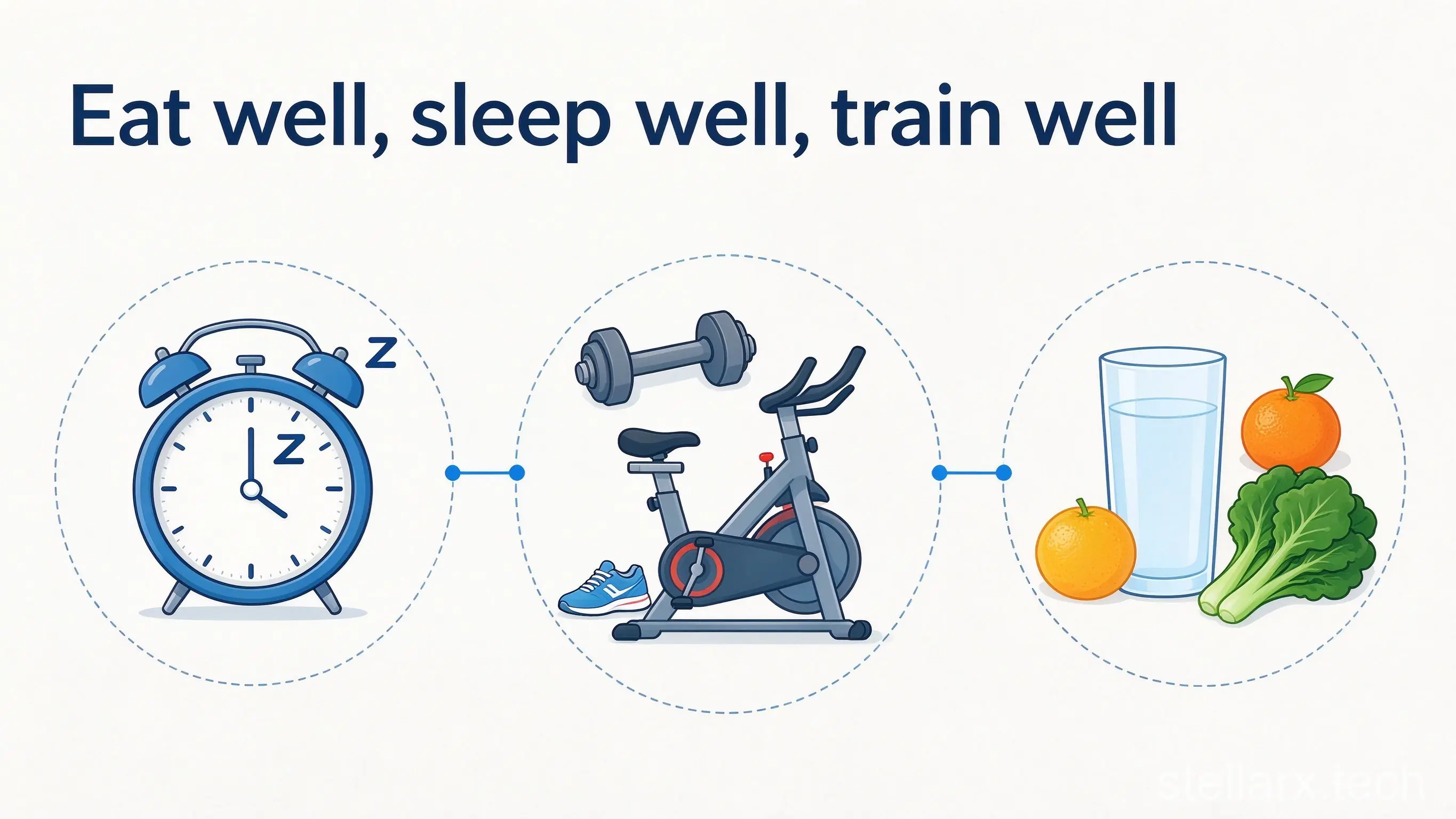
You may never build someone else's "thin muscle," but you can build your own lightness — and the whole pursuit is a good excuse to eat well, drink water, sleep well, and train.
That, these days, is about as premium as a lifestyle gets.
For reference, here are the body-fat percentage ranges that different visual body shapes typically fall into — the lower end of the range is where muscle lines start to show through:
| Body fat % | Men | Women |
|---|---|---|
| 5–9% | Yes | — |
| 10–14% | Yes | Yes |
| 15–19% | Yes | Yes |
| 20–24% | Yes | Yes |
| 25–29% | Yes | Yes |
| 30–34% | Yes | Yes |
| 35–39% | Yes | Yes |
| 40–44% | — | Yes |
| >40% (men) / 45% (women) | Yes | Yes |
Want to see the "quilt" for yourself? The fat cells that hide muscle lines are easy to spot under a virtual microscope — including a Human adipose tissue specimen where the orange-stained fat droplets and the flattened, edge-pushed nuclei are clearly visible. Just search "WWAI" in your app store to bring a digital microscope to your pocket and look at the microscopic world anytime you're curious.

Related reading

Why Lean Muscle Is Not a Real Muscle Type

Female Thigh Fat: A Second Sex Characteristic
Thigh Fat: Why Leg Fat Protects Your Metabolism
References
Sehrawat JS, Pathak RK. Variability in anatomical features of human clavicle: Its forensic anthropological and clinical significance. Translational Research in Anatomy. 2016;3-4:5-14.
Athwal GS, Steinmann SP, Rispoli DM. The distal biceps tendon: footprint and relevant clinical anatomy. J Hand Surg Am. 2007;32(8):1225-1229.
Morton RW, Murphy KT, McKellar SR, et al. A systematic review, meta-analysis and meta-regression of the effect of protein supplementation on resistance training-induced gains in muscle mass and strength in healthy adults. Br J Sports Med. 2018;52(6):376-384.
Ramirez-Campillo R, Andrade DC, Clemente FM, Afonso J, Pérez-Castilla A, Gentil P. A proposed model to test the hypothesis of exercise-induced localized fat reduction (spot reduction), including a systematic review with meta-analysis. Human Movement. 2022;23(3):1-14.
Ramírez-Campillo R, Andrade DC, Campos-Jara C, et al. Regional fat changes induced by localized muscle endurance resistance training. J Strength Cond Res. 2013;27(8):2219-2224.
Benito PJ, Cupeiro R, Ramos-Campo DJ, Alcaraz PE, Rubio-Arias JÁ. A systematic review with meta-analysis of the effect of resistance training on whole-body muscle growth in healthy adult males. Int J Environ Res Public Health. 2020;17(4):1285.
Damas F, Phillips SM, Lixandrão ME, et al. Early resistance training-induced increases in muscle cross-sectional area are concomitant with edema-induced muscle swelling. Eur J Appl Physiol. 2016;116:49-56.
- Sweet Potato Leaves: Fiber, Calcium, Lutein in One Green
- 地瓜葉的營養價值:鈣比牛奶高、葉黃素超西蘭花
- 蟑螂粉的真相:71% 粗蛋白不是蛋白
- Why Cockroach "Protein Powder" Isn't Protein
- Autocatalysis in Evolution: From Fish to Humans
- 自催化的演化:從魚到人的 5 億年
- Ectopic Tooth in Eyelid: A World-First Superior Orbit Case
- 眼瞼長牙的真相:全球首例眶上異位牙
- What Is Lean Muscle? 4 Factors Behind 'Thin Muscle' Physique
- 薄肌理論是啥?4 個特徵決定你的肌肉線條

全部评论