The Bacterium That Lived Alone for a Million Years
Deep in a South African gold mine, 2.8 kilometers below the surface, there is a bacterium that may have spent a million years entirely alone. It is called Desulforudis audaxviator — the "bold traveler," a name that may come from Jules Verne's Journey to the Center of the Earth.
It was discovered in 2008, in groundwater at the bottom of the mine: no sunlight, no oxygen, almost no other organisms, water temperature above 60°C year-round, and radioactive minerals everywhere. And there it was, thriving on its own. The water is thought to have been sealed off from the outside world for perhaps a million years — meaning this bacterium may have lived alone for a million years before researchers ever arrived.
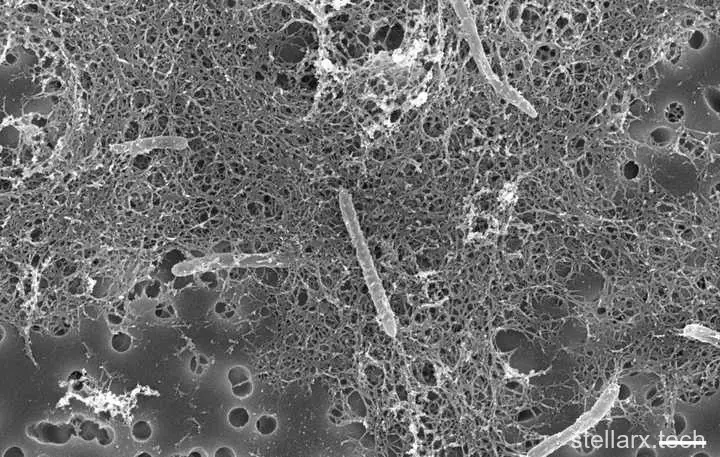
The survival kit of a very lonely bacterium
As a member of the phylum Bacillota, D. audaxviator has one remarkably overpowered trick: the endospore. When conditions turn bad, it converts into a dormant form — multi-layered, highly dehydrated, extremely resistant — and stops almost all metabolism. Thousands of years later (no exaggeration), when conditions improve, the spore "wakes up" and resumes normal life.
But it is also a chemolithoautotroph. It draws energy from high-energy compounds in the groundwater and uses that energy to build sugars and other organics from carbon dioxide and water. Specifically: radiation from radioactive elements splits water into hydrogen peroxide (H2O2) and hydrogen gas (H2). The peroxide's strong oxidizing power oxidizes pyrite (FeS2), converting its sulfur into sulfate. As a sulfate-reducing bacterium, D. audaxviator then uses H2 to reduce sulfate to hydrogen sulfide (H2S), harvesting energy in the process. The sulfide released outside the cell is oxidized again by peroxide — round and round. In effect, it is an indirect radiotroph.
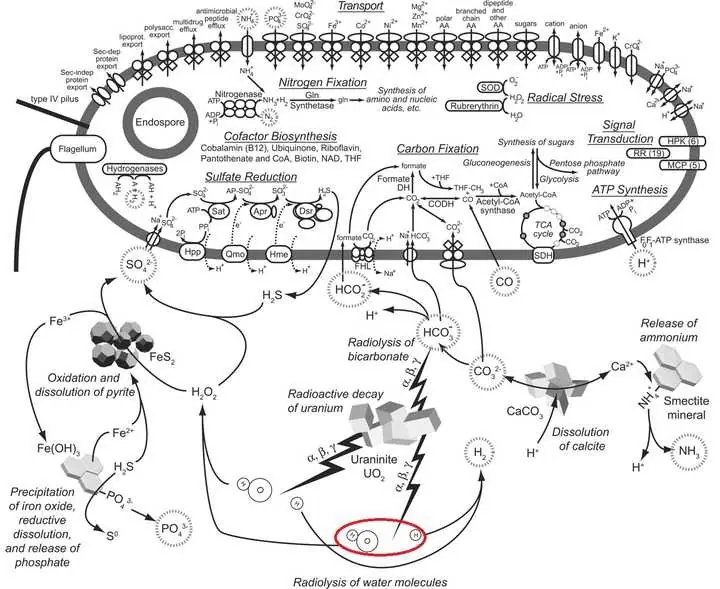
It can also fix nitrogen on its own (starting from nitrogen gas or ammonium), and carries the synthesis pathways for all amino acids and most vitamins. It even retains transporters for various sugars and amino acids — possibly for recycling nutrients from the corpses of its own kind.
Reproduction on a geological timescale
Even with all that, surviving in such an energy-starved environment is nearly impossible for ordinary organisms. D. audaxviator's final skill: an extremely slow metabolism. Estimates suggest each generation may take a hundred years or more to reproduce. Its lifespan is almost unknowable — "after all, you'll die before it does." We say "the morning mushroom knows not the month," but to this bacterium, humans are the morning mushroom.
Not actually a loner by choice
Later research showed D. audaxviator is widely distributed — its kind is found in deep groundwater all over the planet. In most places it is not a lone traveler at all, but coexists with other prokaryotes. It only became a single-species ecosystem because the unusual geology of the South African gold mine left it no choice.
It is far from the only strange organism living in cracks of deep rock. Some studies estimate at least half of Earth's biomass lives in the deep subsurface — a biosphere completely different from the surface. Another lone traveler: Altarchaeum hamiconexum, found forming almost single-species biofilms more than 4 kilometers deep. Its cell surface carries a hook-like structure up to 1 micrometer long, used to latch onto its own kind or anchor itself to rock.
Like D. audaxviator, it is chemosynthetic, fixes carbon, and uses the hydrogen produced by radiation splitting water. Molecular biology shows Altarchaeota represents a very ancient new archaeal lineage, diverging perhaps more than 3.5 billion years ago. Maybe, at the dawn of life, on that primordial Earth, microbes like this went the opposite way and built the early deep biosphere — a "second main line" of Earth's evolution, split from all surface life.
A frontier we still cannot enter
What evolutionary legends are these organisms writing under the lightless rock? We do not know. Only after the 21st century did the diversity of the deep biosphere begin to attract serious attention — and those bizarre microbes seem unwilling to show their faces. Nearly every attempt to culture deep-biosphere organisms in the laboratory has failed, and we cannot study them in detail under the rock. All we can do is analyze their genomes and try to reconstruct their lives — a method with obvious limits. This is a genuine biological frontier, and we can only hope future research lifts the veil on the most stubborn, most extreme microbes of all.
Curious what a spore-forming bacterium looks like under a microscope? Tetanus bacilli (Clostridium tetani) — another endospore-forming member of Bacillota — shows the drumstick-shaped cells with terminal spores that let a bacterium wait out the centuries. Search for WWAI in your app store: its Clostridium tetani specimen lets you zoom through stained spores and bacilli on screen.
Related reading

Tetanus From a Tiny Wound: No Rust Needed

Vibrio vulnificus: Seafood Prick Danger

The Trojan Horse Strategy of Yersinia pestis
References
Chivian, D. et al. "Environmental Genomics Reveals a Single-Species Ecosystem Deep Within Earth." Science, 2008.
Karnachuk, O.V. et al. "Domestication of previously uncultivated Candidatus Desulforudis audaxviator from a deep aquifer in Siberia sheds light on its physiology and evolution." ISME Journal, 2021.
Probst, A.J. et al. "Biology of a widespread uncultivated archaeon that contributes to carbon fixation in the subsurface." Nature Communications, 2017.
- Resistant Starch and Fatty Liver: What 40g a Day Really Does
- 抗性澱粉能救脂肪肝嗎?每天40克的數據與真相
- 大水理論、薄肌理論其實是好建議?最便宜的養生法最有科學依據
- The 'Big Water, Thin Muscle' Meme Is Quietly Good Advice
- Bananas Come in Every Color of the Rainbow
- The Bacterium That Lived Alone for a Million Years
- What ICU Actually Feels Like: Held Between Life and Death
- Why Some Wounds Heal in Days and Others Never Do
- The Heaviest Insect Ever Measured Is Back From the Brink
- Your Gut's "Second Brain": 500 Million Neurons of Its Own

全部评论