The Heaviest Insect Ever Measured Is Back From the Brink
In New Zealand there lives an insect heavier than a sparrow. The wētāpunga — Deinacrida heteracantha, the giant wētā of Little Barrier Island — holds the world record for the heaviest insect ever weighed: 71 grams, a Guinness World Record set by a pregnant female in 2011. A large egg is lighter.
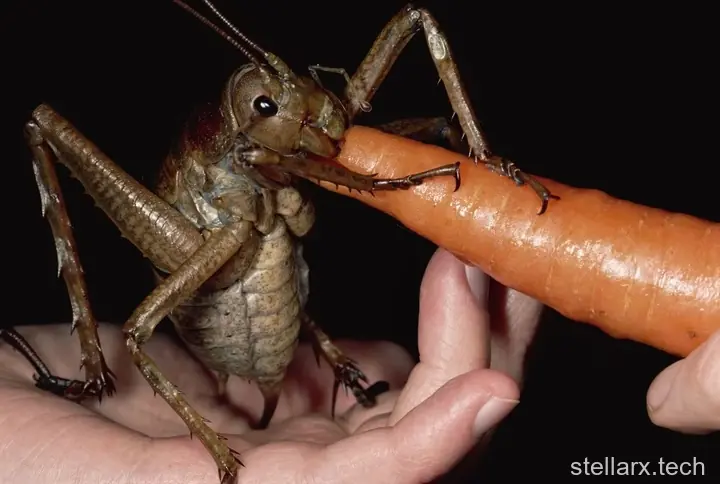
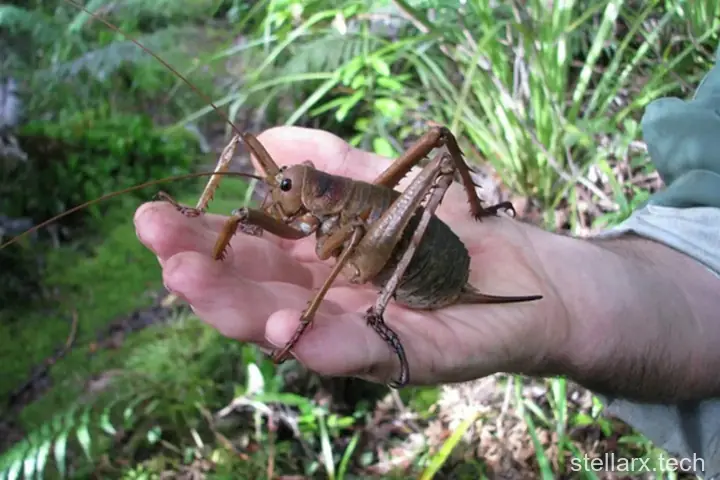
It looks like an oversized grasshopper: a body up to 10 cm long, hind legs almost twice the body length and covered in spines, a hard dark-brown shell, no wings, no flight. Its Māori name, Wētāpunga, translates to "god of ugly things," and the whole genus earned the nickname "ugly god." New Zealand holds 11 endemic species of this family.
The gentle giant
Not every wētāpunga reaches record weight. The species is strongly dimorphic: adult females average 32 g — heavier than a sparrow — at about 6.5 cm long, while adult males average just 7.4 g. The record-holder was a gravid (egg-carrying) female.
It cannot fly and cannot jump — it can only crawl. It is nocturnal, feeds on plants, and prefers the large leaves of native trees. For an insect this size, it is a docile herbivore. Māori legend even tells of people eating them; the insects were once abundant enough to be a food source.
When the mammals came, the giant became prey
New Zealand evolved without terrestrial mammals. With no mammalian predators, wētāpunga spread across parts of the North Island. Then humans arrived, and with them the mammals.
First Polynesian rats, then larger black rats, cats and mustelids. The giant's size and gentleness became a fatal liability: to these predators, it was walking protein. Numbers collapsed. Around 1870, the wētāpunga disappeared from the mainland of the North Island entirely — all that survived was the population on Little Barrier Island (Te Hauturu-o-Toi), a predator-free offshore sanctuary.
15 years of breeding, 45 transfers
Conservationists have been fighting to bring it back. First came predator removal on Little Barrier Island — feral cats, then rats. Numbers recovered, but not enough.
Then came the decisive program: 15 years of captive breeding and 45 ecological translocations. Wild individuals were collected for breeding; the first facility, Butterfly Creek Wildlife Sanctuary, started in 2008 with just six wild individuals as founding stock. The first release followed in 2010. Auckland Zoo joined in 2012 and soon scaled up to industrial-style batch breeding.
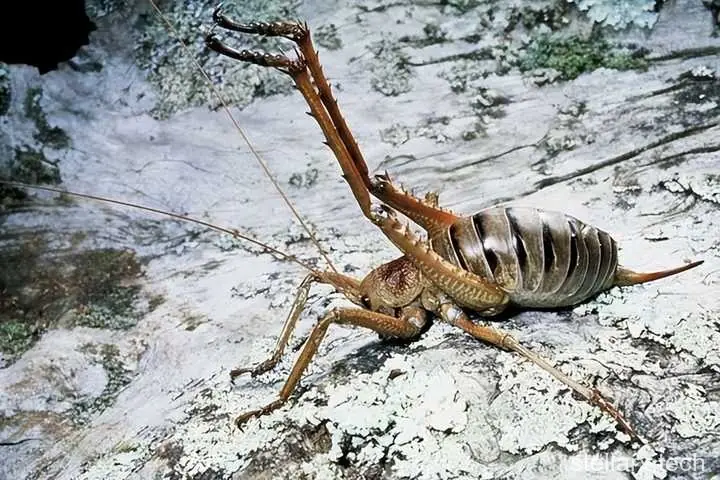
Release was never the end. A translocation only counts as success if the animals breed across generations in the wild. According to a paper published in September 2026, fourth-generation adults have now been found at one release site, and fifth-generation adults at another. By that measure, the multi-year breeding program has worked: the wētāpunga's conservation status has moved from "nationally critical" to "recovering."
The honest asterisk
But this is a partial victory. Of the 10 habitats where wētāpunga now live, 8 are predator-free islands and the other 2 are mainland sites behind predator-proof fences. It looks like a return to nature, but it is really a much larger human-built sanctuary. Cut the human protection and most of these populations would almost certainly slide back toward extinction.
The heaviest insect ever measured is not a fighter. It is a leaf-eater that nearly vanished because its giant, gentle body was the perfect meal for mammals that humans brought with them — and its future still depends on whether we keep guarding it.
Curious what an insect's leathery wing case looks like under a microscope? The tegmen of orthopteran insects like wētā shows the thickened, protective forewing that hides the delicate flight wings beneath — a specimen slide of an insect tegmen shows this wing-armor clearly. Search for WWAI in your app store: its Insect tegmen specimen lets you zoom through the wing structure on screen.

Related reading

Lazarus Species: Animals Found Alive Again

Termite Snap-Jaws: The Fastest Insect Mandibles

Fall Webworm Biocontrol: Beijing's Tiny Wasp Army
References
Guinness World Records: Heaviest insect. https://www.guinnessworldrecords.com/world-records/heaviest-insect
Museum of New Zealand Te Papa Tongarewa: Giant wētā (Deinacrida heteracantha) or wētāpunga. https://collections.tepapa.govt.nz/topic/1356
Animalia: Deinacrida heteracantha. https://animalia.bio/deinacrida-heteracantha
- Resistant Starch and Fatty Liver: What 40g a Day Really Does
- 抗性澱粉能救脂肪肝嗎?每天40克的數據與真相
- 大水理論、薄肌理論其實是好建議?最便宜的養生法最有科學依據
- The 'Big Water, Thin Muscle' Meme Is Quietly Good Advice
- Bananas Come in Every Color of the Rainbow
- The Bacterium That Lived Alone for a Million Years
- What ICU Actually Feels Like: Held Between Life and Death
- Why Some Wounds Heal in Days and Others Never Do
- The Heaviest Insect Ever Measured Is Back From the Brink
- Your Gut's "Second Brain": 500 Million Neurons of Its Own
全部评论