Your Gut's "Second Brain": 500 Million Neurons of Its Own
The idea that the gut has its own brain is not a wellness-marketing invention. It started in 1907, when anatomist Byron Robinson described the gut's nervous system as the "abdominal brain." It went largely ignored — until 1998, when Michael Gershon published The Second Brain, a book built on 437 peer-reviewed papers, and the concept entered mainstream science.
Gershon's question was simple: what did he actually find that earned the gut the name "second brain"?
A nervous system that runs without its manager
Structurally, the enteric nervous system (ENS) talks to the spinal cord and brain through the sympathetic and parasympathetic systems — yet it can operate independently of the central nervous system. The brain controls gut movement and sensation largely through the vagus nerve, but sever the vagus and the enteric nervous system keeps working on its own. Even after brain death, with other remnants of the CNS holding on, the independent operation of the enteric nervous system is part of what keeps basic bodily functions going.
The scale: 500 million neurons
The gut's nervous system contains about 500 million neurons — five times the spinal cord's count. To make sense of that number next to the brain's 86 billion, compare across animals:
Caenorhabditis elegans, one of the simplest nervous systems known: 300 neurons
Most insects: hundreds of thousands
Reptiles: a few million
Small mammals and birds: tens of millions
A rabbit- or turkey-sized animal: about 500 million in total
By that yardstick, your gut alone — with its half-billion neurons — outnumbers the nervous systems of almost every animal on Earth. The only comparable outlier is the octopus, which also runs on about 500 million neurons.
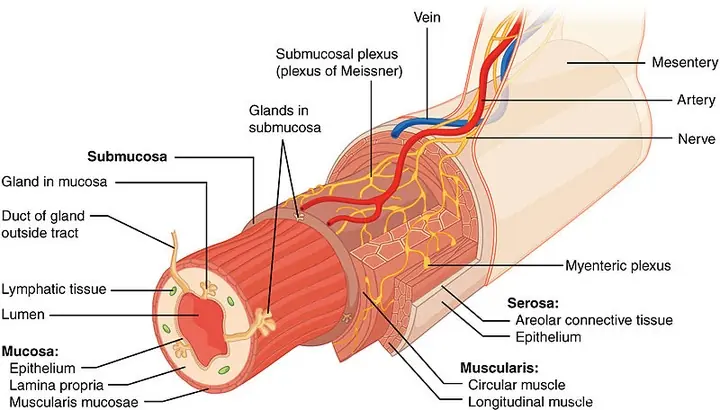
It can form its own reflexes
The enteric nervous system has its own sensory neurons, motor neurons and interneurons, so it can build completely independent reflexes. These neurons even combine into integration centers that control gut motility, mixing, secretion of gastrointestinal hormones and neurotransmitters. The brain can influence the gut — but the gut also influences the brain. This two-way relationship is the gut-brain axis, a network spanning the CNS, sympathetic and parasympathetic nerves, the ENS, neurotransmitters, the endocrine system, the immune system, the HPA axis and the gut microbiome.
Through that axis, the gut touches appetite, mood, cognition and mental state. The human body makes more than 100 neurotransmitters; the gut alone produces about 40 of them — roughly 50% of the body's dopamine and 95% of its serotonin. When the gut goes wrong, the list of associated conditions is startling: depression, autism, diabetes-related metabolic disease, even neurodegenerative conditions like Parkinson's and Alzheimer's.
Evolution: the gut was the first brain
From function, the gut is the second brain. From evolution, it may be the first.
All protostomes and deuterostomes share a radially symmetrical ancestor, probably descended from the planula larva of a cnidarian about 650 million years ago. Cnidarians are two-layered animals, simple as a piece of gut — they were once grouped with comb jellies as coelenterates. They evolved the earliest nerve nets, spread throughout the body cavity. That gut-like body is the prototype of our digestive tract, and the original nerve net is the prototype of the enteric nervous system. The brain came later, over tens of millions of years, as nervous tissue concentrated toward a head end.
That is why Nick Spencer of Flinders University argues the gut deserves to be called the first brain: in the earliest stages of animal evolution, before systems and organs differentiated, the original body of the nervous system was the enteric nervous system.
How the gut got so complex
About 600 million years ago, in the Ediacaran, ancient cnidarians under extreme cold transformed into benthic worm-like animals during the planula stage. They became bilaterally symmetrical and three-layered. The old body cavity evolved into a true digestive tube with a new opening — the gut was born.
As bodies grew more complex, digestion demanded more: annelids developed foregut, midgut and hindgut; the earliest vertebrates appeared 530 million years ago; jawless fish had short straight guts with a spiral valve to increase surface area; jawed fish folded and regionalized the tract into mouth, pharynx, esophagus, stomach, intestine and anus, and secretory cells lining the gut wall gave rise to the liver and pancreas. Carnivorous fish have short guts, herbivorous fish long ones.
When early tetrapods came ashore 360 million years ago, guts grew longer and began to coil. Reptiles 340 million years ago added folds and villi. But the real explosion came with warm-blooded animals around 200 million years ago: constant high energy demands required extraordinary digestive systems — ruminants evolved multi-chambered stomachs where symbiotic microbes digest cellulose; single-stomach herbivores like horses and donkeys developed bulky ceca and, often, coprophagy.
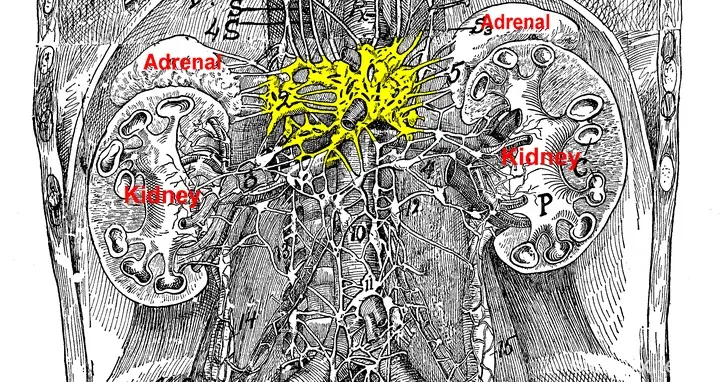
Mammals are the champions of gut complexity. In human embryos, the developing gut recapitulates half a billion years of evolution: at day 20, the endoderm folds broadly to form the digestive tube, splitting into foregut (which gives rise to mouth, esophagus, stomach, upper duodenum, liver, gallbladder, pancreas — and, surprisingly, the respiratory system, since lungs and fish swim bladders are homologous, both derived from gut-derived sacs), midgut, and hindgut.
And one quiet twist of evolution: primates mostly eat fruit with little cellulose, so their ceca degenerated. That degeneration helped push human ancestors' digestive tracts toward carnivory — one of the quiet keys that let us stand upright and become apex predators.
In every sense, the gut is another brain — except that it cannot produce consciousness. Its nervous system descends from the same ancestral nerve nets that gave rise to the brain. From an evolutionary view, the gut that silently supports you, never complaining, looks less like a second brain and more like a mother.
Curious what the simplest nervous systems the gut-brain story compares against look like? A planarian slide shows a bilaterally symmetrical flatworm with an anterior brain and eye spots — the early nervous architecture that stands between a nerve net and a brain. Search for WWAI in your app store: its planarian specimen lets you zoom through the whole body on screen.

Related reading

Your Gut Makes Most of Your Serotonin

Why You Poop When Leaving Home: Gut-Brain Axis

Gut Microbiome: Why It's Called Your Second Brain
References
Robinson, Byron. The Abdominal and Pelvic Brain. Betz, 1907. https://archive.org/details/abdominalpelvicb00robi
Gershon, M. D., & Tack, J. "The serotonin signaling system: from basic understanding to drug development for functional GI disorders." Gastroenterology 132.1 (2007): 397-414.
Cryan, J. F., & Dinan, T. G. "Mind-altering microorganisms: the impact of the gut microbiota on brain and behaviour." Nature Reviews Neuroscience 13.10 (2012): 701-712.
Spencer, N. J., & Hu, H. "Enteric nervous system: sensory transduction, neural circuits and gastrointestinal motility." Nature Reviews Gastroenterology & Hepatology 17.6 (2020): 338-351.
- Resistant Starch and Fatty Liver: What 40g a Day Really Does
- 抗性澱粉能救脂肪肝嗎?每天40克的數據與真相
- 大水理論、薄肌理論其實是好建議?最便宜的養生法最有科學依據
- The 'Big Water, Thin Muscle' Meme Is Quietly Good Advice
- Bananas Come in Every Color of the Rainbow
- The Bacterium That Lived Alone for a Million Years
- What ICU Actually Feels Like: Held Between Life and Death
- Why Some Wounds Heal in Days and Others Never Do
- The Heaviest Insect Ever Measured Is Back From the Brink
- Your Gut's "Second Brain": 500 Million Neurons of Its Own

全部评论