What ICU Actually Feels Like: Held Between Life and Death
The best description of the intensive care unit comes from the people who have been inside it. One patient describes it this way: ICU is the station modern science has built at the border of death — on the far shore of the river, at the far end of the bridge.
Every patient there, except the ones under observation, would have been dead a hundred years ago. Modern technology is what still holds them to this world. Since it is the land of the dead, it extracts the price of the land of the dead.
The horror of ICU is not death. It is being caught between life and death — endless pain and fear, with complete helplessness.
The first thing that comes back: breathing
The truly critical patients lie in deep sedation, a state close to death that is not frightening at all. You feel nothing; time stops existing; everything is void. If you die in that state, you die — a parallel crossing.
But if you do not die, if ICU holds you back, then the journey back across the border of life and death costs skin. To return to the world, they reduce your sedation and let you wake. Sensation returns to your body. The respiratory system is one of the first.
You feel something pumping air into your lungs — the ventilator. You try to take a slow breath; a rush of air slams into your lungs. You instinctively fight it; the airflow vanishes. You cannot breathe, try a deep breath, and the airflow comes back harder, indifferent, nearly bursting your lungs. You struggle, and the airflow grows more chaotic with your breathing, the ventilator fails to synchronize, and it starts screaming.
Your trachea feels full of foreign matter. You cough involuntarily, but the balloon of the endotracheal tube seals your airway, and the ventilator amplifies every cough into agony without letting you clear the secretions. Your face turns red, your mouth fills with saliva, you cannot breathe, cannot swallow — you are sure you are dying.
The nurse hears the alarm, sees your distress, comes over. Water enters your trachea. You choke, cough desperately. Then something moves down your airway — pain like a knife cut, itching like a feather duster shoved inside. Tears pour out; you want to escape and cannot. That is suctioning: refuse it and you choke in agony; accept it and you suffer needle-cut pain, repeated every few minutes in bad stretches, several times a day at minimum. The suction tube can even cut your trachea, doubling the pain each time.
The tube passes your epiglottis; the balloon sits below your vocal cords. Your oral secretions cannot go down the digestive tract and pool at the balloon — you always feel a pool of water in your throat. You feel you are suffocating, drowning; you panic, and you can do nothing.
Occasionally another plastic tube goes into your mouth, suctioning secretions while probing your throat. Your abdomen twitches; you want to vomit. Someone says with satisfaction, "Good, he has a gag reflex." You do not understand what they are saying, or why they keep probing your throat, while your whole body aches with every twitch, and you can do nothing.
You instinctively reach to pull out the hated tube — and discover your hands are tied. You want to, but you cannot. You can do nothing.
The test that decides whether you can leave the machine
To end your suffering, to free you from the ventilator, they decide to test and train your spontaneous breathing. They lower the ventilator settings and force you to breathe with your own muscles. Breathing instantly becomes heavy. You try, but you are terribly weak; you struggle in suffocation for an hour and can no longer pull air. The tidal volume alarm goes off. A voice says, "That's enough for today. We'll try again tomorrow."
Every day, you struggle through this suffocation, reliving the fear of dying. Right now, unable to breathe, you are a dead person. But if you want to return to the world of the living, this is a gate you must pass. How long it takes — no one knows. Some cross it in one step; some never do.
Pain returns, then withdrawal
As sedation and analgesia are reduced, pain returns. You ache everywhere. Every so often someone pinches your finger hard with a pen or syringe like an instrument of torture. You scream, but you are so weak that all your effort only opens your eyes. A voice says, "No response to pain? Try again." Someone rubs your sternum with something hard; waves of pain crash; your heart rate and blood pressure spike. You want it to end, but you can do nothing. Finally they give up: "I think I saw his face twitch... let's try again later." You want to say, please let me die, but you cannot.
Pain is the sensation a living person must have. Returning from the land of the dead means passing through more and more pain. Slowly you gain the strength to respond — you can grimace, localize pain, and they stop testing so often. Then withdrawal begins.
The analgesics you were given were all opioids. Your sedation drugs may have included benzodiazepines, and propofol — the "little milk" that gave you death-like sleep. All of them are addictive. You are anxious, agitated; you see strange things, hear terrible sounds; ten thousand ants seem to crawl inside you; you wish you could burn yourself into a flame and be done. But if you cannot bear even this, you cannot return from the land of the dead.
The body swells, the skin leaks
You want to move a finger, but your fingers are too swollen. Your whole body is swollen. To support your blood pressure they poured liters upon liters of fluid into you — medication, nutrition, all liquid. But your kidneys fail; tens of liters of extra fluid accumulate in your body. Your skin swells transparent, leaking sticky drops like a saturated sponge.

Dignity becomes logistics
The feeding tube does not hurt much, because it was placed while you were unconscious. But you cannot control defecation. To reduce your gut burden, they keep you in a state of diarrhea with various drugs. You cannot control it. You lie in your own excrement, hoping a nurse has time to clean you. Feces irritate your skin; your entire private area is red, swollen, even ulcerated — painful and itchy. If you happen to be a decompensated cirrhosis patient, your diarrhea is more frequent to excrete blood ammonia, and you may experience lactulose enemas several times a day: stripped, turned, enduring the strange humiliation of an enema, then letting go completely. Every day, several times. Humiliating and painful — and you can do nothing about any of it.
You are covered in tubes: neck, wrists, groin — central venous lines and arterial lines. They are not the worst pain, but they hurt. Drainage tubes rub against your fragile organs as you breathe and move. To stop you touching them, your hands stay tied. Your skin can be as fragile as soaked tissue paper; when the nurse changes dressings, strips of skin tear away with the tape. If you are a trauma patient with necrotizing fasciitis... better not to go into that. It spoils the appetite.
No comfort, ever
The bed and pillow, for easy cleaning and disinfection, are airtight. You can never get a comfortable position, never a comfortable temperature. Nurses turn you to protect your skin — not to make you comfortable. They always prioritize the tubes (which are your life) over your comfort. You are uncomfortable 24/7, and you can do nothing about it.
A friend once asked how bad ICU really is. I said: forget everything else — the airtight bed and pillow, hands tied, never lying comfortably. How long could you last? He said one night, no problem; three days, he would probably go mad.
The real terror is helplessness
For the patient, the most terrifying thing in ICU is helplessness. All the torture, humiliation and pain cannot be escaped or objected to.
How many people struggle in ICU to live when everyone knows there is no hope? How many beg for death but cannot claim their own lives, enduring endless torment? As Dante wrote above the gates of Hell: abandon all hope, ye who enter here.
In ICU, nothing is in your hands anymore. Whether you want to live or die, others decide. You are a fish on a chopping board: disease is butchering you, and ICU is keeping you from dying. Your death is artificially prolonged; you experience the pain of dying over and over, until you truly die — or return.
Post-ICU syndrome
Even if you return to the world, you are someone who has died at least once. Post-intensive care syndrome covers physical dysfunction, cognitive impairment, emotional disorders — occurring in 75–80% of survivors. Two months in ICU can inflict more psychological trauma than two years on a battlefield. As brutal as war is, it is still a human hell. ICU is genuinely not in the human world.
A note on the "I felt nothing" replies: patients under observation are different from the truly critical. And many of those who say they felt nothing do not remember — the agitation, the struggle, the pain written on their faces, the rigid bodies, the rapidly changing vital signs all prove the suffering was real. We cannot ignore suffering just because the patient will not remember it. That would be neither moral nor humane.
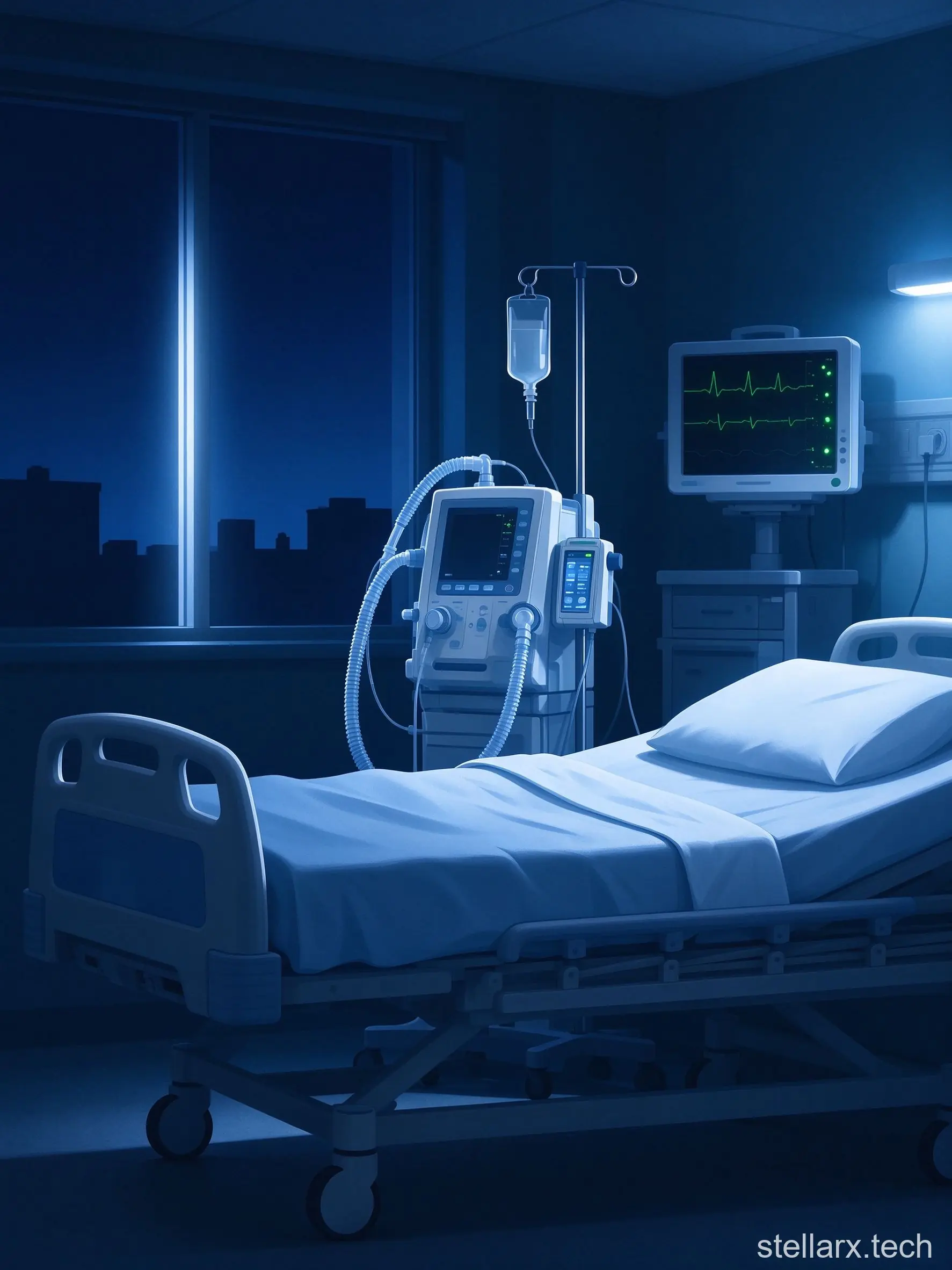
A prayer on the ICU wall
God, grant me the serenity to accept the things I cannot change, the courage to change the things I can, and the wisdom to know the difference.
Curious what the muscle that never stops — the one the monitor watches — looks like under the microscope? Cardiomyocyte specimens show the striated, branched cardiac muscle fibers that keep firing even when everything else fails. Search for WWAI in your app store: its Cardiomyocyte specimen lets you zoom through the heart muscle on screen.

Related reading

Heart Attack at 49: Fit, Sober, Still Struck

Stroke & Brain Hemorrhage: First Step Saves Life

Deep Vein Thrombosis: Sitting Too Long Can Kill
References
Needham, D.M. et al. "Improving long-term outcomes after discharge from intensive care unit: report from a stakeholders' conference." Critical Care Medicine 40.2 (2012): 502-509.
Harvey, M.A. & Davidson, J.E. "Postintensive Care Syndrome: Right Care, Right Now…and Later." Critical Care Medicine 44.2 (2016): 381-385.
Elliott, D. et al. "Exploring the scope of post-intensive care syndrome therapy and care." Critical Care Medicine 42.12 (2014): 2518-2526.
American Thoracic Society. "What Is Post-ICU Syndrome (PICS)?" Patient education.
- Resistant Starch and Fatty Liver: What 40g a Day Really Does
- 抗性澱粉能救脂肪肝嗎?每天40克的數據與真相
- 大水理論、薄肌理論其實是好建議?最便宜的養生法最有科學依據
- The 'Big Water, Thin Muscle' Meme Is Quietly Good Advice
- Bananas Come in Every Color of the Rainbow
- The Bacterium That Lived Alone for a Million Years
- What ICU Actually Feels Like: Held Between Life and Death
- Why Some Wounds Heal in Days and Others Never Do
- The Heaviest Insect Ever Measured Is Back From the Brink
- Your Gut's "Second Brain": 500 Million Neurons of Its Own
全部评论