Why Fish in a Plastic Bag Beat Fish in a Bucket
The fish seller at the market waves off the bucket. "Scoop it straight into a plastic bag and carry it," she says. "A fish in a bag lives longer than a fish soaking in a bucket of water."
It sounds backwards. It isn't. Here is why fish die out of water — and why a thin, wet plastic bag can keep one alive longer than half a pail of lake water.
Why Fish Die Out of Water: The Gill, Not the Sky
Most fish that die on land are not suffocated by missing oxygen. They do it to themselves.
Air at sea level is 20.95% oxygen. Even on a plateau at 5,000 meters, the oxygen partial pressure of air still sits near 10%. A lake holds only 5–10 mg of dissolved oxygen per liter. Oxygen in the air is roughly 25 times as concentrated as in water, and gas diffuses about 10,000 times faster in air than in water.
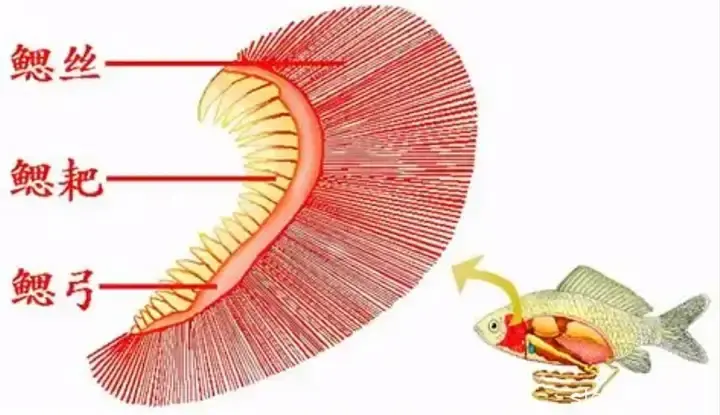
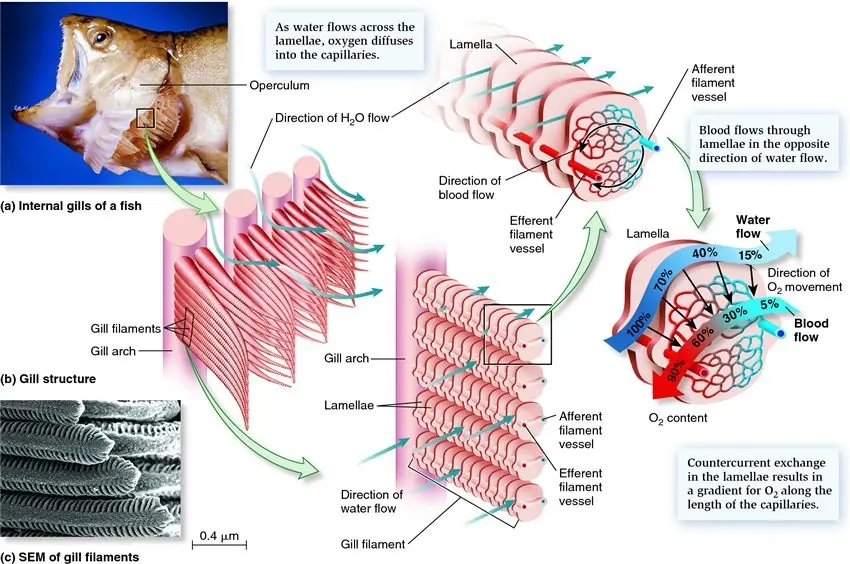
Breathing is diffusion, powered by Brownian motion: oxygen and carbon dioxide molecules jostle down their concentration gradients across a membrane. A fish gill is engineered for that trade: gill arches, filaments, rakers and lamellae, every lamella packed with capillaries under a single-cell epithelial layer.
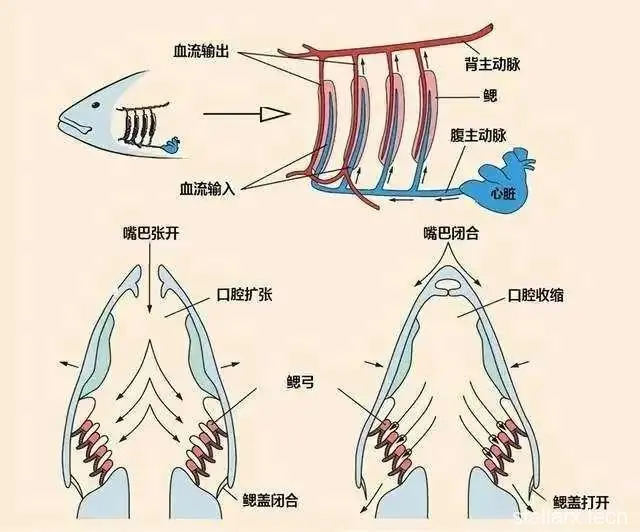
The gill only works underwater, where the filaments spread apart and stay wet. Haul a fish onto the bank and the filaments stick together like wet hair, collapse, and dry out — the exchange surface shrinks toward zero. That is the real killer: not an empty sky, but a gill that stops working.
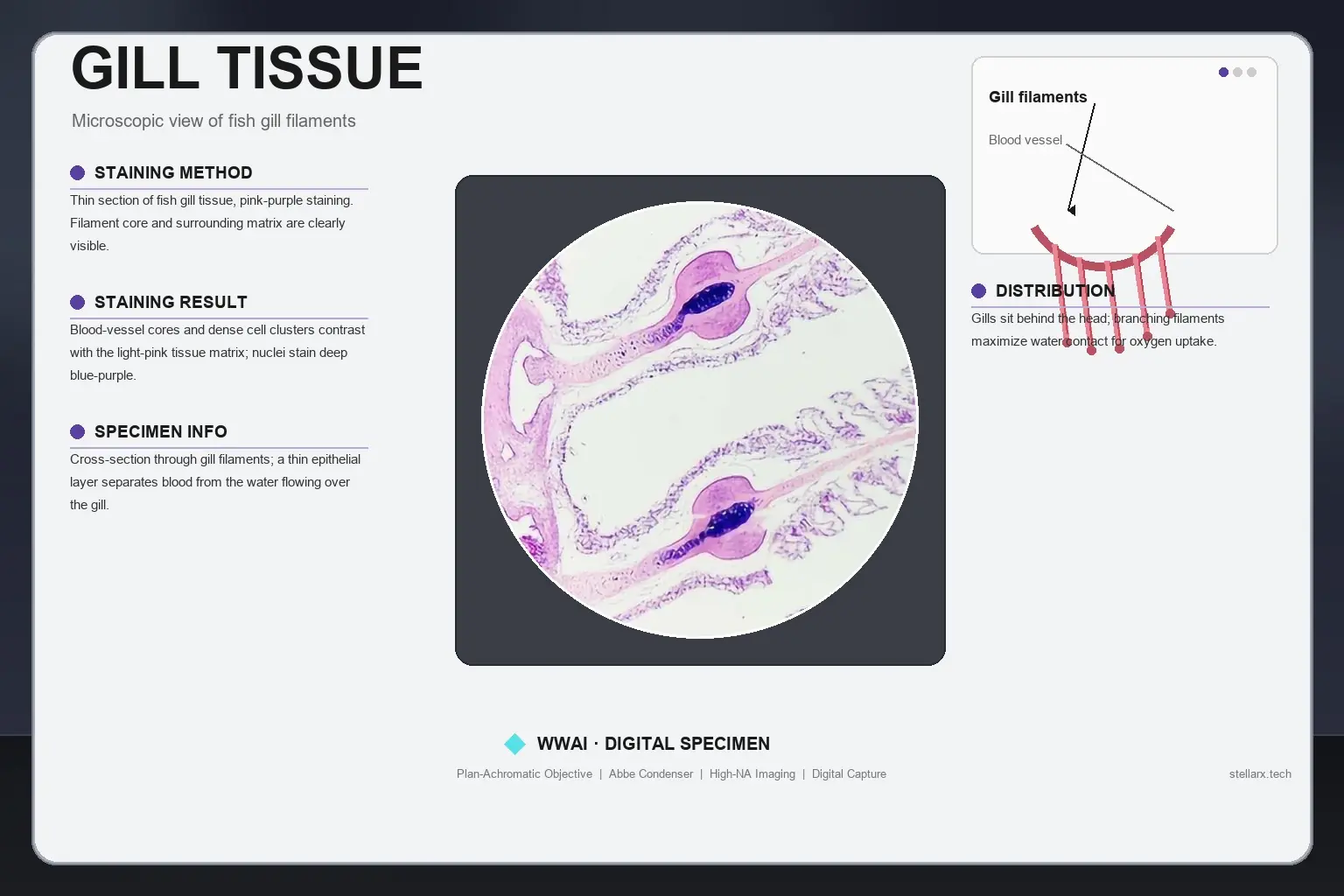
This is what that machinery looks like under a microscope: pink-purple stained gill tissue, with blood-vessel cores and dense cell clusters standing out against the light-pink matrix. A single-cell layer is all that separates a fish's blood from the water flowing over the gill.
Most fish even run a countercurrent exchange: blood through the lamellae flows opposite to the water, holding the oxygen gradient along the entire capillary so the last drops of oxygen are pulled out of the stream.
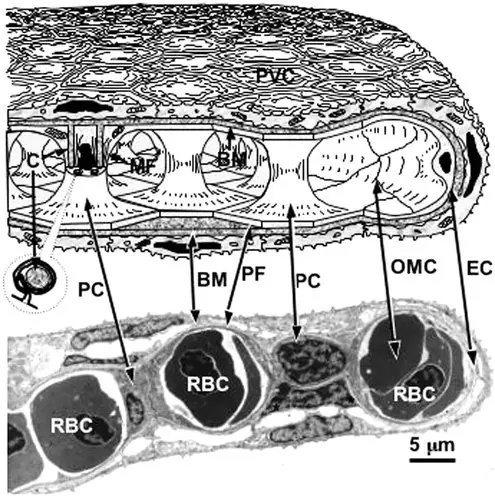
Blood slides through these capillary sheets while water rushes past the other side of the same single-cell wall.
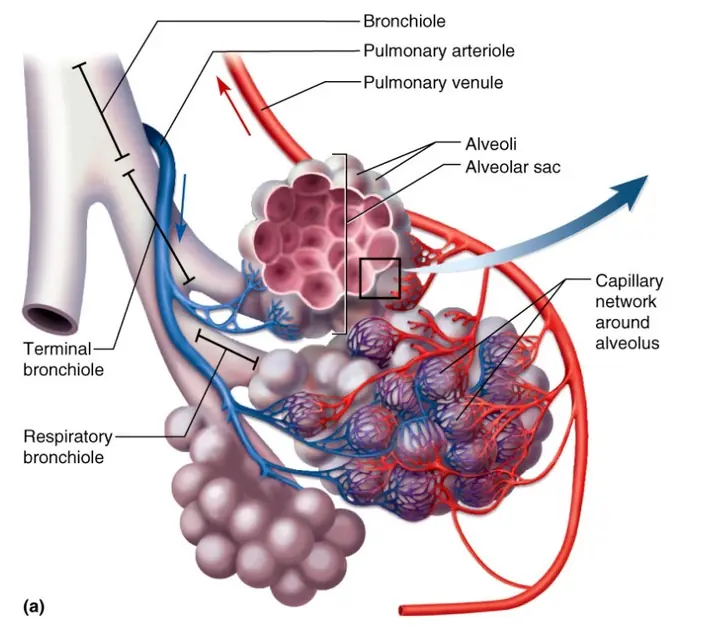
The principle is the same as your own alveoli: one thin membrane, two gas streams, diffusion doing the work.
So step one of keeping a fish alive out of water is not "give it more oxygen." It is: keep the gills wet, and keep the exchange surface spread.
Why Fish Die in a Bucket: Henry's Law and Carbon Dioxide
A bucket of water looks generous. It isn't.
Henry's law — p_B = k_{x,B}·x_B — says the oxygen dissolved in water tracks the partial pressure of oxygen at the water's surface. A half-full bucket breathes through a tiny surface. And carbon dioxide is heavier than air: it settles over the water and pushes the O₂ partial pressure down, which by Henry's law drags dissolved oxygen down with it.
Fish crowded in shallow water burn through dissolved oxygen fast. Too many fish, too little water — in minutes, they are dizzy, gasping, "seeing grandma," as the Chinese saying goes.
A big deep bucket, or one small fish in plenty of water, works fine. It is the fish-to-water ratio that decides.
What a Plastic Bag Does Better
Step two of keeping a fish alive on land: ventilation.
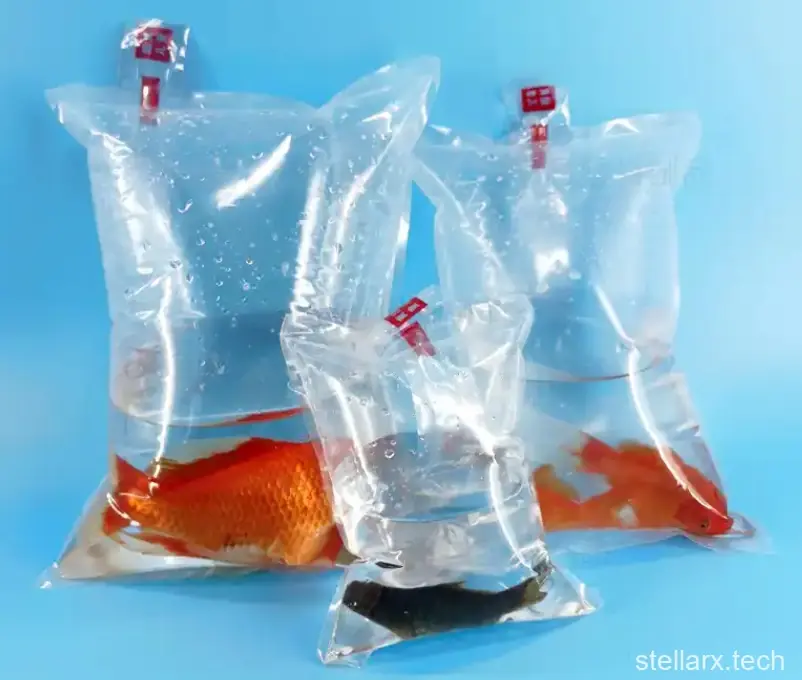
A wet plastic bag gives three things at once. The fish can barely thrash, so it burns less oxygen. The bag walls stay wet, so the gills stay moist. And a pocket of fresh air is trapped with the fish — the air pocket's surface replenishes oxygen as the fish breathes.
The Gongyu Method: A Fish Kept Alive for 10–24 Hours
In Jian'ou, Fujian, fishermen refined the idea into an art. Gongyu — "bent fish" — is a provincial intangible cultural heritage, and a fish tied the gongyu way stays alive 10–24 hours out of water.
It is not simple binding. First, thread a rope through the fish's mouth and tie it to the tail behind the anus. Soak it in water for 1–2 hours. Then re-tie the rope ahead of the anus, bending the fish into a ring. Soak and condition it for 1–2 days before sale.
"Making the fish unable to move, letting it adapt gradually," is the key condition.
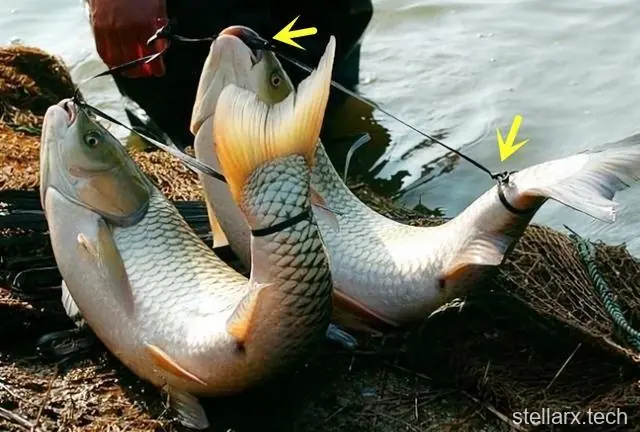
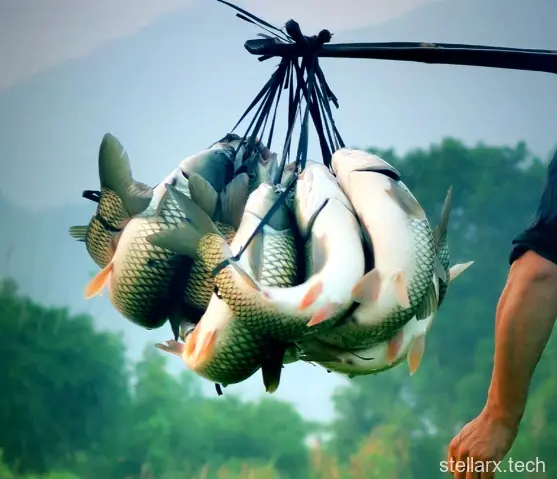
Anglers recognize the scene: a string of grass carp tied and carried home from the riverbank.
Cut Activity, Live Longer
Every method above reduces one thing: activity.
Commercial transporters chill live fish with ice packs — cold slows metabolism and oxygen demand. And then there is the anaesthetic. Fish sedatives such as MS-222 (3-aminobenzoic acid ethyl ester methanesulfonate) put live salmon into a dreamy, slow state for long hauls, dramatically raising survival.
Anglers even adopted the trick: a dash of fish sedative in the groundbait keeps the bait fish calm — and stops them from "exploding the nest."
The fish seller at the market was not guessing. She was running applied physiology: keep the gills wet, keep the fish still, keep the air moving.
All of this — the collapsing filaments, the blood sheets inside the lamellae — lives below the resolution of the naked eye. Want to see what a fish's own tissues look like up close? Under the lens, a fish tail (cross section) specimen shows bone, muscle, blood vessels and nerves packed into one fin: the same structures that keep a fish moving and breathing. Ask an AI biology tutor anything about what you see, or explore 110+ real biological specimens at multiple magnifications. Just search "WWAI" in your app store and open a virtual microscope in your pocket.

Related reading

Woodpecker Concussion Myth: Real Brain Damage

Dinoflagellate Genome: Largest on Earth

Blue Inhaler: Why Asthma Guidelines Dropped SABA
References
1. Evans D.H., Piermarini P.M., Choe K.P. The Multifunctional Fish Gill: Dominant Site of Gas Exchange, Osmoregulation, Acid-Base Regulation, and Excretion of Nitrogenous Waste. Physiological Reviews. 2005;85(1):97–177. https://journals.physiology.org/doi/full/10.1152/physrev.00050.2003
2. U.S. Environmental Protection Agency. N-STEPS: Dissolved Oxygen — Nutrient and Response Variable Overviews. https://archive.epa.gov/epa/nutrient-policy-data/n-steps-nutrient-and-response-variable-overviews.html
3. Effects of Ascorbic Acid and β-1,3-Glucan on Survival, Physiological Response and Flesh Quality of Cultured Tiger Grouper during Simulated Transport in Water. Animals. 2022. https://pmc.ncbi.nlm.nih.gov/articles/PMC7167869/
4. Fishery Anesthetics in Aquaculture Products: Safety Concerns and Analytical Methods. Foods. 2025;14(3):3928. https://pmc.ncbi.nlm.nih.gov/articles/PMC12651363/
- Why Fish in a Plastic Bag Beat Fish in a Bucket
- 魚離開水能活多久?塑膠袋比水桶更保命
- Shamonda Virus: The First Human Case Ever Reported
- 沙蒙達病毒:全球首例人類感染病例
- Vegetable Nutrition: Why Lettuce Isn't the Healthiest Green
- 蔬菜營養排名:生菜墊底?真正的營養之王是這 5 種
- Metformin for Healthspan: Muscle, Bone, and a Tumor Switch
- 二甲雙胍延緩衰老?中年肌肉骨骼與膠質母細胞瘤的新證據
- 甜高粱會取代甘蔗與甜菜嗎?植物也會得「糖尿病」
- Why Sweet Sorghum Could Replace Sugar Cane and Beet
全部评论