Your Morning Pee Is Foamy. Here's What That Actually Means.
At a veterans' hospital clinic in Seoul, over six months, 72 new patients volunteered the same complaint: "There's a lot of foam in my urine." That is 6.3% of everyone who walked in. When they were tested, 16 of them — 22.2% — actually had obvious proteinuria. The other 56 did not.
The foam in your toilet bowl is not a diagnosis. It is a reminder. Whether it matters is decided by one ratio on a lab slip, not by the way the water looks.
| Finding | Number |
|---|---|
| New outpatients who volunteered "lots of foam in my urine" (6 months, Seoul veterans' hospital clinic) | 72 — 6.3% of all new patients |
| Actually had obvious proteinuria on testing | 16 of 72 (22.2%) |
| Had microalbuminuria or obvious proteinuria (ACR measured in 38 of the 72) | 12 of 38 (31.6%) |
| Sex and age of the 72 complainers | 59 male; median age 65.5 years |
| Still significant in multifactor regression | Blood creatinine and blood phosphorus |
1 in 5: What a Seoul Clinic Actually Found
The 72 patients skewed older and male — 59 of 72, median age 65.5 — so the 22% number does not transfer to a 25-year-old. The younger you are, and the further you are from diabetes and high blood pressure, the lower the real proportion gets.
The same paper opened with an honest line: foamy urine is widely treated as a proteinuria signal, yet medicine has no objective definition of "foamy urine." How many bubbles, how long they must last — nobody ever set the rule.
The authors also asked who, among the 72 complainers, was most likely to actually have proteinuria. Diabetes, poor kidney function (high creatinine, high urea nitrogen, low eGFR), high blood phosphorus, and high blood sugar all correlated with it. Put into a multifactor regression, only blood creatinine and blood phosphorus stayed significant. The same complaint carries different weight in different people.
One more number worth keeping: of the 72, 38 had their urine albumin-to-creatinine ratio (ACR) checked, and 12 of them — 31.6% — had microalbuminuria or obvious proteinuria. "One in five" is the floor, counted on obvious proteinuria only; count the earlier stage too, and it is closer to one in three.
And the study quietly left one direction unmeasured: it never tested the new patients who did not complain about foam. It can answer "of those who complain, how many really have a problem" — but it cannot answer "no foam, therefore fine." Those two directions are constantly treated as the same thing.
Foam Needs Two Things to Form
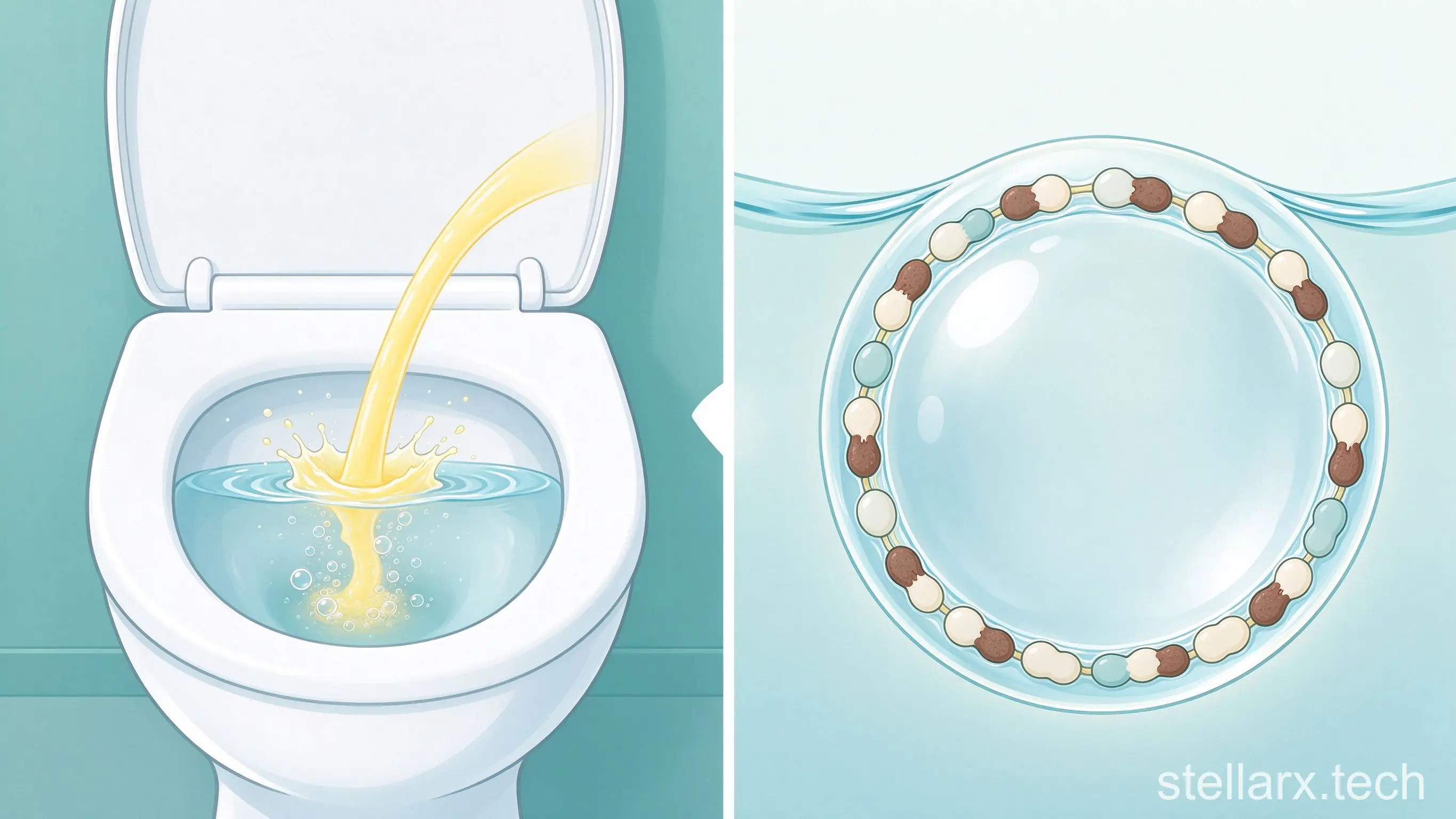
Foam forms when two conditions are met: air gets dragged into the water, and the bubbles manage to survive.
The first condition is physics. Standing to pee, a fast stream, a long drop — the urine column slams into the surface and drags air down with it, the same reason pouring water from a height into a cup makes a layer of bubbles. The same urine, sitting down or aimed at the side of the bowl, foams far less. Leftover cleaner in the toilet bowl also helps bubbles along, and that part has nothing to do with your kidneys.
The second condition carries the information. Whether a bubble survives depends on what sits at the air-water boundary and holds it open. Pure-water bubbles pop on contact, because water molecules pull on each other and shrink the interface to minimum. Protein molecules have both water-loving and water-fearing parts; at an air-water interface they spread out, turning the hydrophobic side toward the air, and in effect laminate a skin onto the bubble. That bubble is far more stable than a pure-water one. Soap and cleaner — surfactants — can do the same job.
This is the difference between soda and beer. Soda bubbles are big and vanish the moment they rise, because it is only carbon dioxide in sugar water. Beer foam is fine and clings to the rim of the glass, because proteins from the malt sit on the interface and hold it. Urine is the same: with the same amount of air dragged in, a "clear broth" and a "broth with protein" foam in visibly different ways.
Why Morning Pee Shows It Best
There is one layer people miss: concentration. The first urine of the morning has little water and high concentrations of everything dissolved in it. The same amount of leaked protein looks far more obvious in morning urine.
That is also why the lab reports a ratio — urine albumin divided by urine creatinine — instead of a plain protein concentration. The creatinine on the denominator cancels out whether the urine is concentrated or dilute. Otherwise, drinking two extra glasses of water would simply wash the number away.
And a clinical saying deserves honesty: "big bubbles that break fast vs. fine bubbles that persist" is an experienced observer's description. No study has quantitatively measured foam physics — bubble height, half-life — against urine protein concentration. "No objective definition" points exactly at that gap. Foam's appearance can only help you decide whether to get a urine test once. It cannot replace the test.
How Protein Gets Past the Kidney's Filter
The glomerulus is a sieve. Blood flows in; water and small molecules are filtered out; albumin — about 66 kDa, negatively charged — is held back. It is blocked by the gaps between podocyte foot processes and by negatively charged sugar chains on the basement membrane: size and charge, two checkpoints. Crack the sieve a little, and albumin rides the filtrate downstream.
Downstream there is a cleanup crew: cells of the proximal tubule use receptors on their membranes to swallow leaked protein back and break it down inside the cell. But the recovery system has a saturation ceiling. Once leakage exceeds what it can process, the excess simply goes into the urine. That is why urine protein can flip from "not detected" to "detected" surprisingly fast — once the leak crosses the recovery ceiling, it shows up within a short time.
So urine albumin is a readout of filter integrity. And that readout predicts more than most people expect.
One Ratio That Predicts More Than You'd Think
A 2010 collaborative meta-analysis in The Lancet pooled 14 cohort studies that measured the albumin-to-creatinine ratio (105,000 people, 730,000 person-years) and 7 studies that used urine dipsticks (1.13 million people) into one model. Taking ACR 0.6 mg/mmol as the reference: at 1.1 mg/mmol (about 10 mg/g), all-cause mortality hazard ratio was 1.20 (95% CI 1.15–1.26); at 3.4, 1.63 (1.50–1.77); at 33.9, 2.22 (1.97–2.51).
The striking part: on a log-log scale the relationship is a straight line, with no knee below which you are "safe" — and it operates independently of eGFR. Neither number substitutes for the other.
That meta-analysis also answers a practical question: does the dipstick in your annual checkup count? The 7 dipstick cohorts — 1.13 million people — pointed the same direction: protein on a stick also tracked mortality. The stick just reports coarse "+" grades that swing with how much you drank, while ACR cancels concentration and resolves finer tiers. A dipstick finding is not a verdict; it is a signal to get an ACR done.
One honest caveat: this is an observational association, not proof that leaked protein "poisons" the heart. The more likely explanation is that the glomerulus is the one capillary bed in the body you can sample for free every day — damage that hypertension, high glucose, and chronic inflammation do to endothelium and basement membrane is invisible elsewhere and shows up here as albumin. That explanation has support, but it is an explanation, not what the meta-analysis itself proved.
| Urine albumin-to-creatinine ratio (ACR) | All-cause mortality hazard ratio (95% CI) |
|---|---|
| 0.6 mg/mmol (reference) | 1.00 |
| 1.1 mg/mmol (about 10 mg/g) | 1.20 (1.15–1.26) |
| 3.4 mg/mmol | 1.63 (1.50–1.77) |
| 33.9 mg/mmol | 2.22 (1.97–2.51) |
When Foam Is (Probably) Nothing
Proteinuria after hard exercise is real — and temporary. A half-Ironman study of 7 male athletes measured urine after each leg: at the end of the swim, albumin excretion jumped to 30 times resting levels and albumin clearance rose 13-fold; after the bike and run legs, excretion showed no statistical difference from rest. Seven people is not a precise estimate, but the direction is clear: hard exercise temporarily raises glomerular permeability, and how much depends on the type of exercise, not on how tired you feel.
A companion study of 29 marathoners and 20 runners of 16 km compared pre- and post-run urine, saw total protein and albumin rise significantly — and added the key detail: the abnormalities returned to normal within 2 to 6 days after the race.
So proteinuria found in the days after hard exercise, fever, or dehydration is very likely this kind of transient change. The way to separate it from real kidney disease is not to keep staring at the toilet bowl. It is to recheck ACR on the first morning urine a few days later, rested and fever-free. One "+" on a stick proves little; two or three ACR elevations separated in time are what count.
| Ask this first | If yes | If no |
|---|---|---|
| Does the foam drop after changing position or drinking more water? | Mostly air intake — fast stream, long drop, or cleaner in the bowl. Observe; don't panic. | Ask the next question. |
| Have you run long distance, had a fever, or been dehydrated recently? | Likely temporary exercise proteinuria — rest a few days, recheck ACR on morning urine. | Ask the next question. |
| Is there swelling, red urine, rising blood pressure, or diabetes at the same time? | Don't wait — check ACR and see a nephrologist. | One morning ACR check is enough. |
| What do the ACR results say? | One normal ACR → routine checkup follow-up. | Two or three elevated ACRs separated in time → nephrology workup. |
A few more cases have nothing to do with kidneys at all: cleaner or disinfectant in the bowl; an unusually fast stream and a long drop; semen mixed into urine (peeing right after ejaculation, or retrograde ejaculation). All of them foam. None of them move your ACR.
When to Actually See a Doctor
The reasons to act are what comes alongside the foam: bubbles that persist for weeks regardless of position and water intake; swelling of the eyelids or ankles; urine the color of meat-washing water or cola; blood pressure that is rising; a known history of diabetes or high blood pressure; an ACR that keeps climbing on repeat tests. Those are the grounds for the next step — a doctor's judgment, not a bubble count.
Foam is, at best, a doorbell. Ringing it doesn't change what's inside the house. Get the ratio tested once, then decide.
Your kidney's filter is one of the few capillary beds in your body you can sample for free, every day. WWAI gives you real microscopy specimens to explore at multiple magnifications — including a blood vessels specimen where the capillary walls that decide what stays in and what leaks out are clearly visible — with AI answers about what you are seeing. Search "WWAI" in your app store and download it now.

Related reading

Kidney Function: How Waste Leaves the Body

How the Kidney Filters 180 Liters of Plasma a Day

Uric Acid Crystals Under the Microscope
References
Kang KK, et al. Chonnam Med J 2012;48:164-8. doi:10.4068/cmj.2012.48.3.164
Matsushita K, et al. Lancet 2010;375:2073-81. doi:10.1016/S0140-6736(10)60674-5
Poortmans JR, et al. Int J Sports Med 2015;36:979-83. doi:10.1055/s-0034-1398681
- Why Fish in a Plastic Bag Beat Fish in a Bucket
- 魚離開水能活多久?塑膠袋比水桶更保命
- Shamonda Virus: The First Human Case Ever Reported
- 沙蒙達病毒:全球首例人類感染病例
- Vegetable Nutrition: Why Lettuce Isn't the Healthiest Green
- 蔬菜營養排名:生菜墊底?真正的營養之王是這 5 種
- Metformin for Healthspan: Muscle, Bone, and a Tumor Switch
- 二甲雙胍延緩衰老?中年肌肉骨骼與膠質母細胞瘤的新證據
- 甜高粱會取代甘蔗與甜菜嗎?植物也會得「糖尿病」
- Why Sweet Sorghum Could Replace Sugar Cane and Beet
全部评论