Fried Rice Syndrome: Why Leftover Rice Can Poison You
It has a nickname — "fried rice syndrome." The proper name is Bacillus cereus food poisoning, and it is so common from leftover-rice stir-fries that the nickname stuck.
Here is what makes it sneaky: the rice looks fine, smells fine, and tastes fine. And it can still make you sick.
Boiling Doesn't Kill Everything
Cooking rice at 100°C kills the living bacteria. It does not kill their spores.
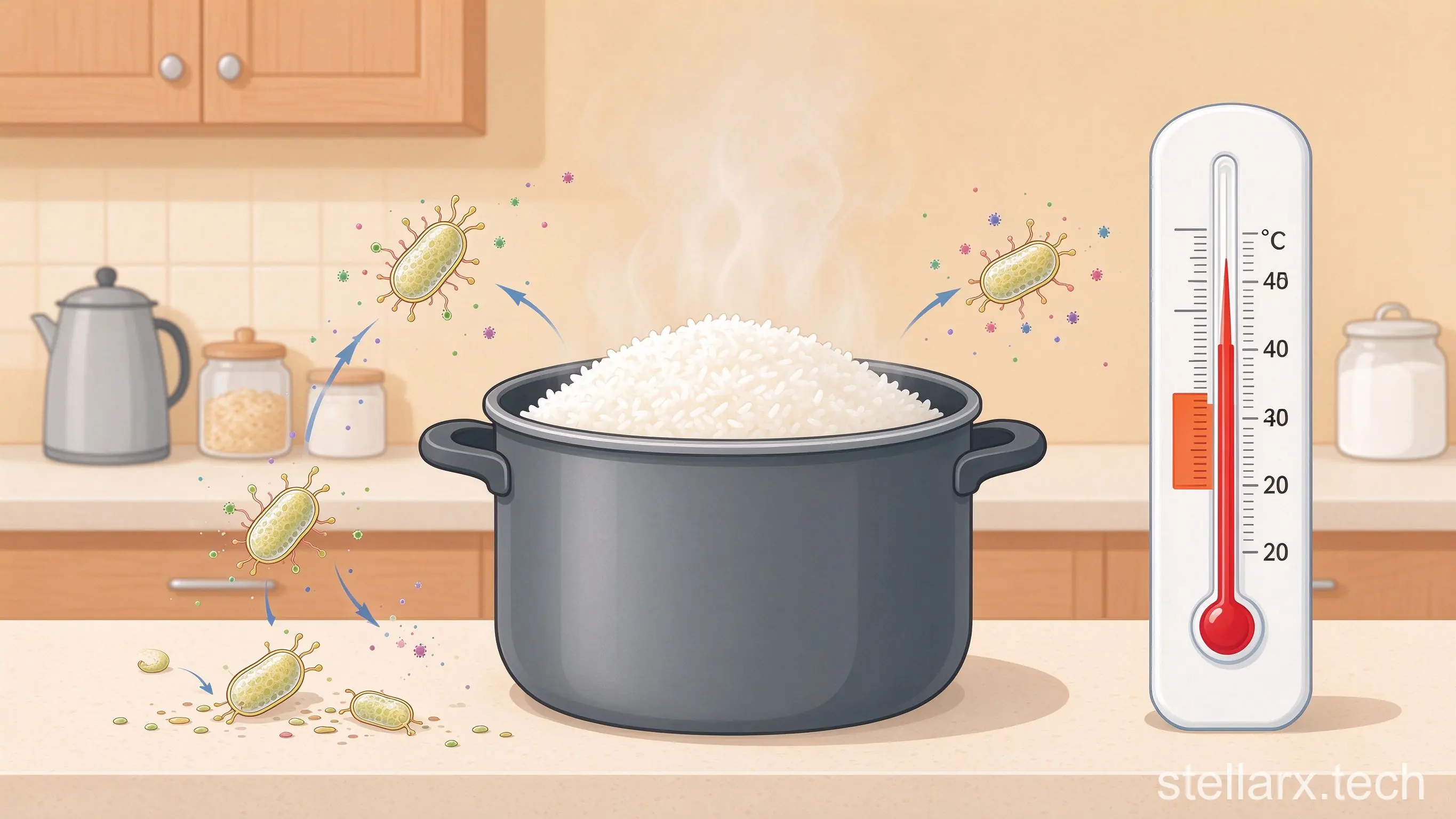
Spores are dormant, armored versions of the bacteria, built to survive boiling. As cooked rice cools slowly on the counter, it passes through the danger zone — roughly 20–45°C — which is exactly the temperature range where the spores wake up, multiply rapidly, and secrete their emetic (vomiting) toxin.

The Toxin That Laughs at Your Wok
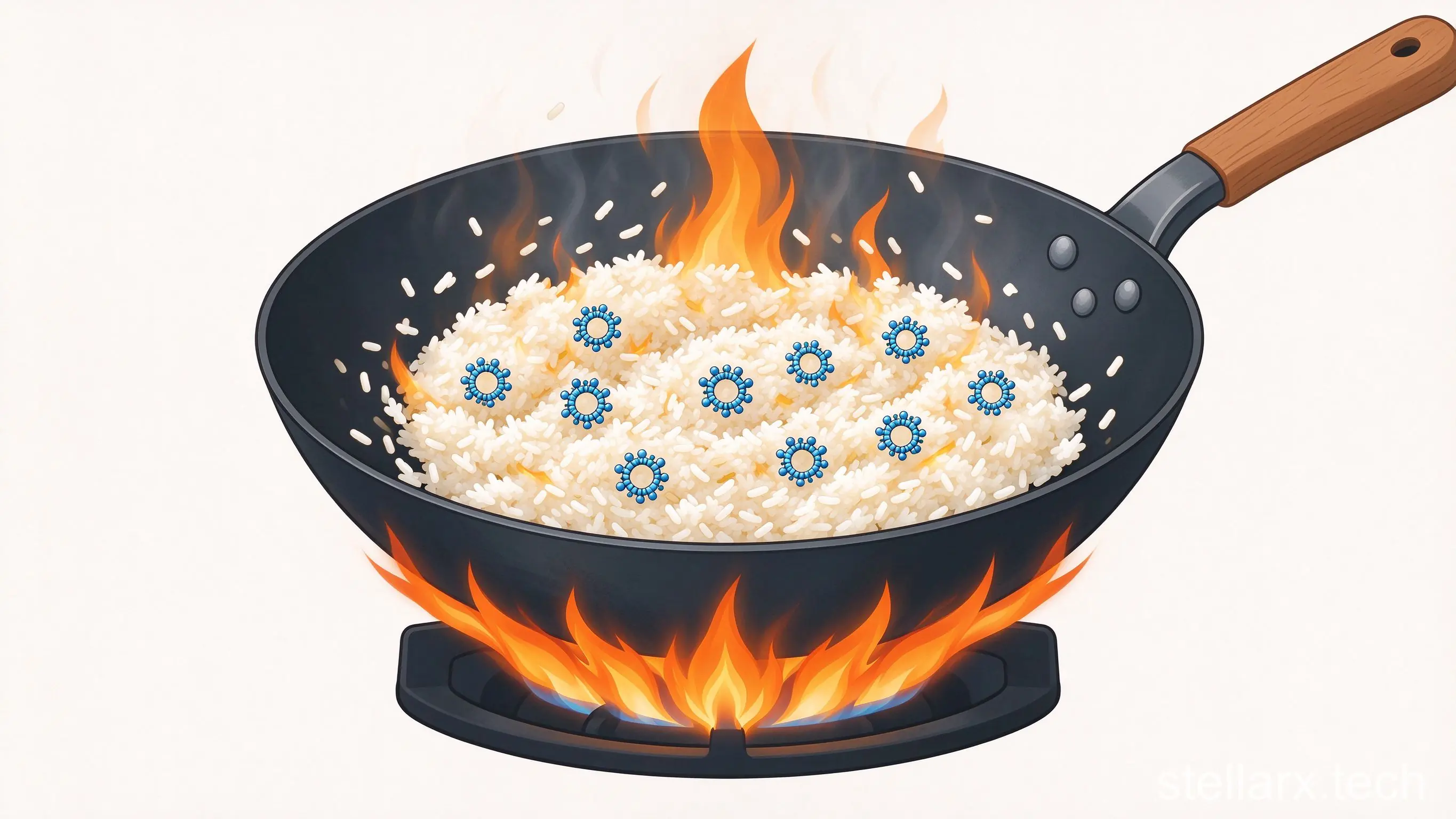
The vomiting toxin made by Bacillus cereus — called cereulide — is astonishingly heat-stable. The brief high heat of a home stir-fry does not destroy it at all. It takes 126°C under high pressure for 90 minutes to break it down.
So you can fry leftover rice until it is scorching hot: the toxin stays right there in the rice, and eating it still poisons you. And because the rice has no off smell — no sour note, no visible change — nobody can tell by looking.
The Safe Rice Routine
Rule 1: Don't let cooked rice sit out. Keep it at room temperature for no more than two hours. If the air is above 25°C, aim to portion it and get it into the fridge within one hour.
Rule 2: Cool it fast, spread it out. Spread the rice in a shallow layer on a tray to lose heat quickly. Do not leave a big pot of rice covered and slowly cooling on the stove.

Rule 3: Refrigerate, and don't linger. Stored cold, rice should be eaten within about 24 hours. The longer it sits, the higher the risk.
Rule 4: Fry fresh rice. The safest fried rice is made from rice that was cooked fresh, cooled quickly, and fried right away — not from the cold leftover rice that sat in the fridge for a day or two.
The Bottom Line
The rice smells fine. The toxin does not care. "Fried rice syndrome" is the price of letting warm rice linger — and the fix is not more heat at the end. It is more speed at the beginning.
Curious what the bacteria that pull this off look like under a real microscope — including the spores that survive boiling? WWAI is an AI-powered biology encyclopedia with an online microscope, including a Gram-positive rod bacterium specimen with visible endospores — the same spore-forming family as Bacillus cereus — where the dormant spores are clearly visible. Search "WWAI" in your app store and download it today.

References
[1] CDC MMWR — Bacillus cereus Food Poisoning Associated with Fried Rice at Two Child Day Care Centers, Virginia, 1993 (fried rice as a leading cause; heat-resistant spores survive cooking). http://ftp.cica.es/mirrors/ftp.cdc.gov/mmwr/wk/mm4310.pdf
[2] PMC — Modeling Bacillus cereus Growth and Cereulide Formation in Food (cereulide withstands 126°C for 90 min). https://pmc.ncbi.nlm.nih.gov/articles/PMC7925994/
[3] Tokyo Metropolitan Institute of Public Health — Bacillus cereus (emetic toxin not deactivated even at 126°C for 90 minutes). https://www.hokeniryo1.metro.tokyo.lg.jp/shokuhin/eng/micro/bachiru.html
[4] PMC — Development of a simple screening method for cereulide toxin in fried rice (resilient to 126°C for 90 min; fried rice the most typical vehicle). https://pmc.ncbi.nlm.nih.gov/articles/PMC11269499/pdf/11419_2024_Article_683.pdf
[5] Based on a Zhihu post by "田天向上" (2026-10-04); community comments were excluded from this article.
Related reading

Salmonella: How It Contaminates Your Food


- Fermented Sauces: Why Sichuan's Champion Chef Wins on Taste
- Cisplatin: How an Electrode Accident Became a Cancer Cure
- Lazarus Species: Six Animals That Came Back from Extinction
- Termite Snap-Jaws: The Fastest Insect Mandibles
- Fried Rice Syndrome: Why Leftover Rice Can Poison You
- Washed Eggs: Why a Family Got Poisoned by Scrambled Eggs
- Optogenetics Nobel: Luck, Timing, and the Names Left Off
- Infantile Amnesia: Why You Can't Remember Being Three
- Optogenetics Nobel 2026: How Light Controls Neurons
- Sudden Death and the 100,000 km of Blood Vessels
全部评论