Infantile Amnesia: Why You Can't Remember Being Three
Your brain did not wipe your first three years because they seemed useless. And no, it was not a childhood "third eye" that sealed shut. The strangest part is this: you probably did form those memories — you just lost the ability to open them.
The phenomenon has a name: infantile amnesia. Adults usually cannot recall specific personal experiences from their first three or four years, and autobiographical memory from ages four to seven is also thinner than what comes later. "Three" is not a hard line — it drifts a bit in either direction [1].
Babies Form Memories Earlier Than You Think
A 2025 study in Science asked a delicate question: how do you tell whether a baby who cannot talk remembers anything?
Researchers ran awake fMRI on infants aged 4 months to 2 years while the infants did a visual memory task. The babies watched new faces, objects or scenes; 20–100 seconds later, the old image appeared side by side with a similar new one. Where the infant looked — gaze behavior — revealed whether the earlier information had left a trace.
The result: from about age one, the strength of hippocampal activity when an infant saw a new image predicted whether the infant would remember it later. A one-year-old's hippocampus can already encode specific events [2]. Infants aged 12–24 months showed a clear hippocampal "subsequent memory effect," and the effect grew stronger with age.
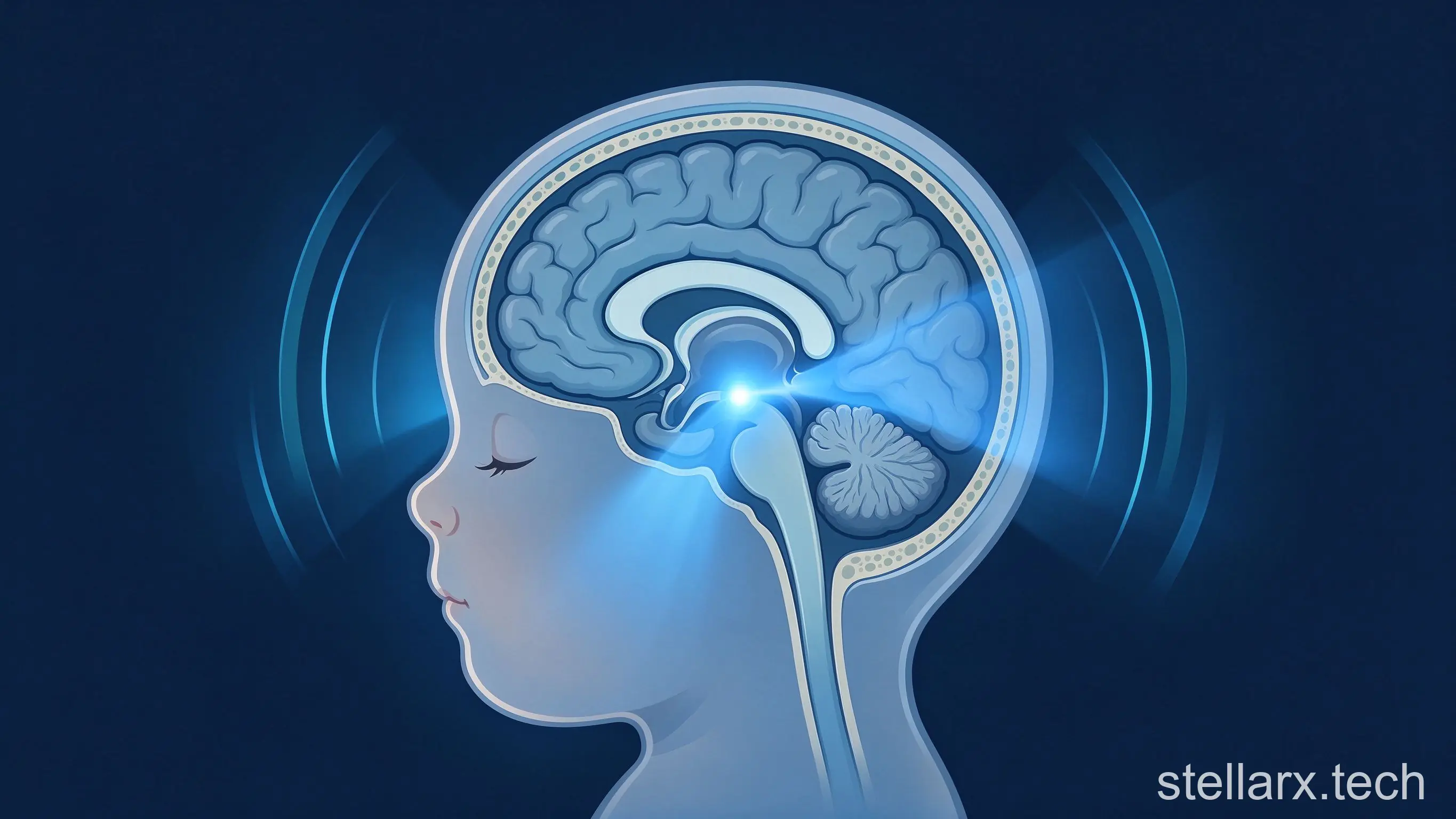
So the question becomes: where did those memories go?
The Hippocampus Was Still Under Construction
Episodic memory — "on this date, at this place, this happened" — leans heavily on the hippocampus. But after birth, the human hippocampus, especially the dentate gyrus and CA3 regions, still spends years maturing, and the networks linking hippocampus to cortex keep reorganizing [3][4].
There is one mechanism worth stopping on: neurogenesis.
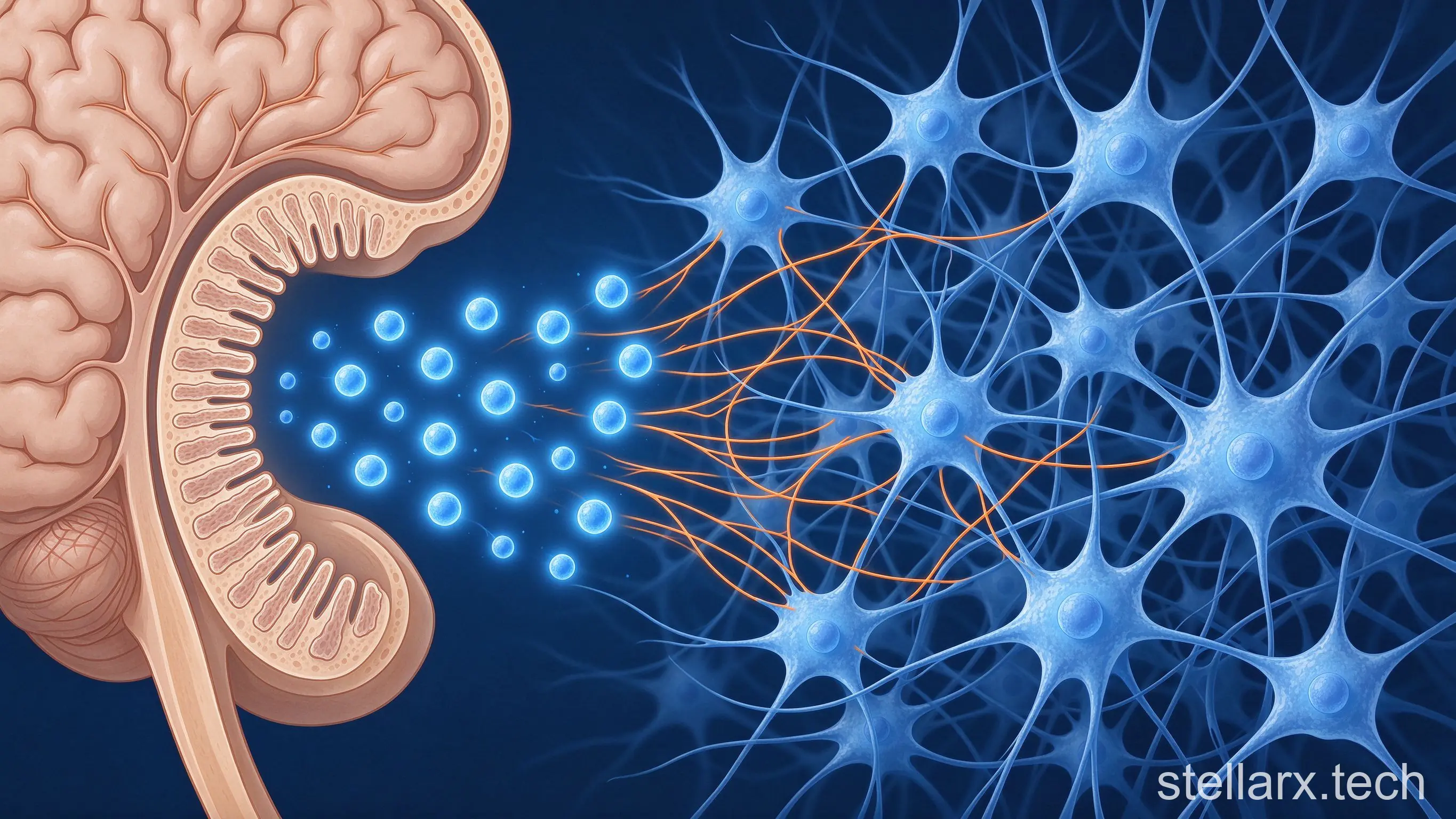
In infancy, the dentate gyrus keeps adding large numbers of newborn neurons. New neurons are good for learning — but they also rewire existing connections. Think of memorizing a route in a city that is constantly being rebuilt. Yesterday you learned: "turn left, pass the convenience store, then turn right." A month later the roads are redesigned, the convenience store is gone, the intersection has moved. The map was never truly deleted — but the old cues can no longer pull that map back up.
A 2014 Science animal study supports exactly this. Boosting hippocampal neurogenesis in adult mice promoted forgetting of established memories; reducing neurogenesis in young mice softened the rapid forgetting of infancy [5]. Young mice have more newborn neurons in the dentate gyrus and CA3 — and far shorter memory retention. Trained right after the task, the pups remembered; as time passed, the memory faded fast.
Infantile amnesia, from this angle, is partly the price of a brain growing at full speed.
Babies Lack the "Story of Me"
When an adult recalls a trip, the brain is not replaying a video. It calls up a stack of frames: How old was I then? Where was this? Who was with me? In what order did things happen? Why did it matter to me?
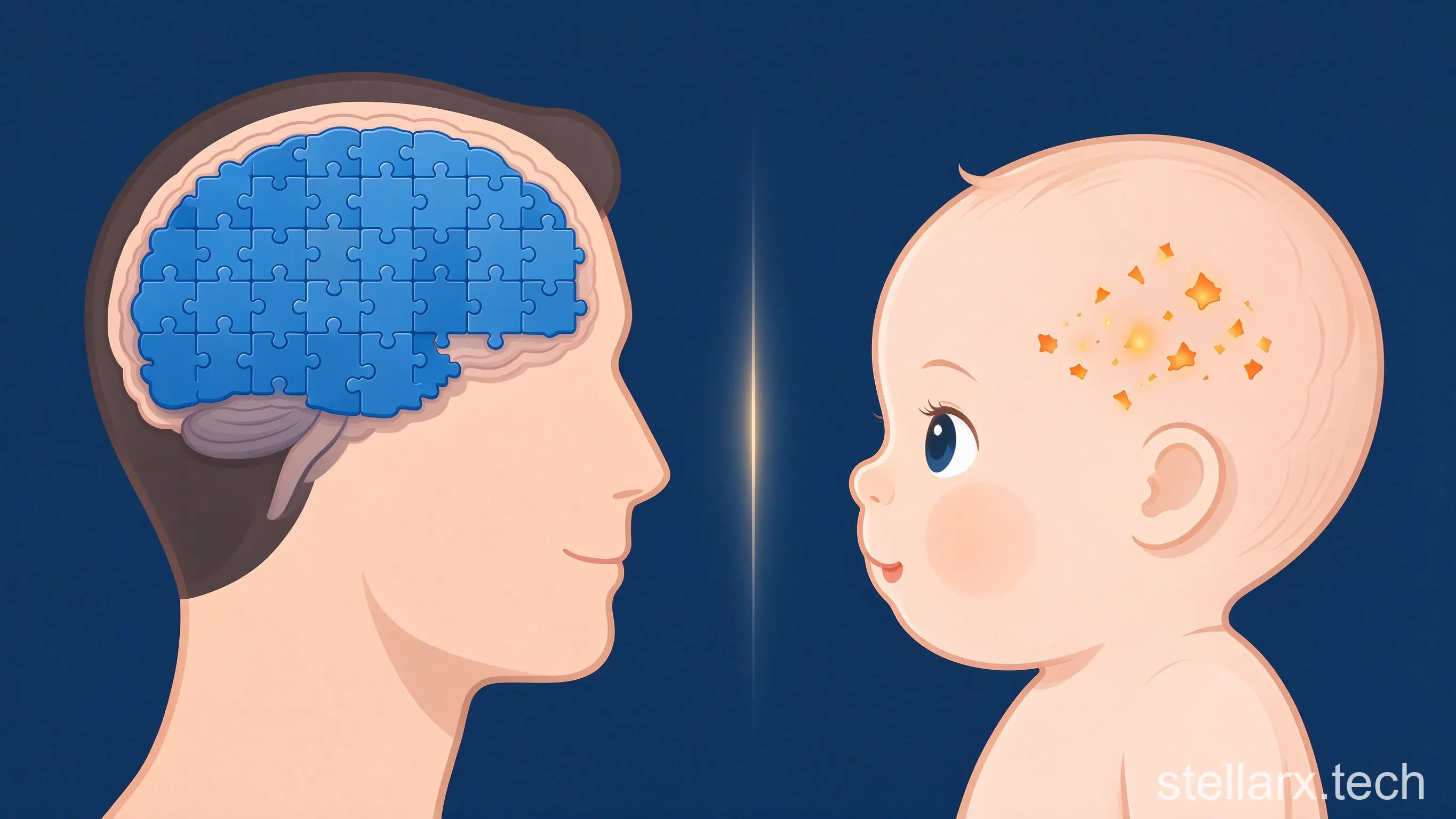
That is autobiographical memory, and it needs language, a concept of time, a self-concept, narrative ability, and the capacity to separate past from present — all of which develop gradually between roughly ages two and six [6][7].
A one-year-old can genuinely remember: this person is familiar, this place frightens me, this toy works like this. What a one-year-old cannot form is: "During Spring Festival when I was two and a half, Dad took me to Grandma's house and I saw…" — because "two and a half," "Spring Festival," "Grandma's house," and "this happened to me in the past" are cognitive frames built later. Once the frame matures, early memories were encoded with a different system, and retrieving them becomes far harder.
This also explains a cross-cultural curiosity: the age of a person's earliest autobiographical memory varies across cultures, and children whose parents discuss past events with them in detail tend to grow richer autobiographical memories [6].
"Can't Recall" Doesn't Mean "Nothing Left"
When we say memory, we usually mean: can I tell the story? But the memory system is bigger than that. Procedural learning, conditioned reflexes, familiarity, emotional learning and behavioral tendencies can all form very early.
Animal studies even show that memory traces from infancy that can no longer be retrieved can still be reawakened by the right tools. Young mice formed memories; as adults they could no longer naturally retrieve them — but using optogenetics to reactivate the dentate gyrus neurons that originally encoded those memories re-triggered the memory behavior [8].
So not remembering who held you every day at age one does not mean those days left no mark on your brain.
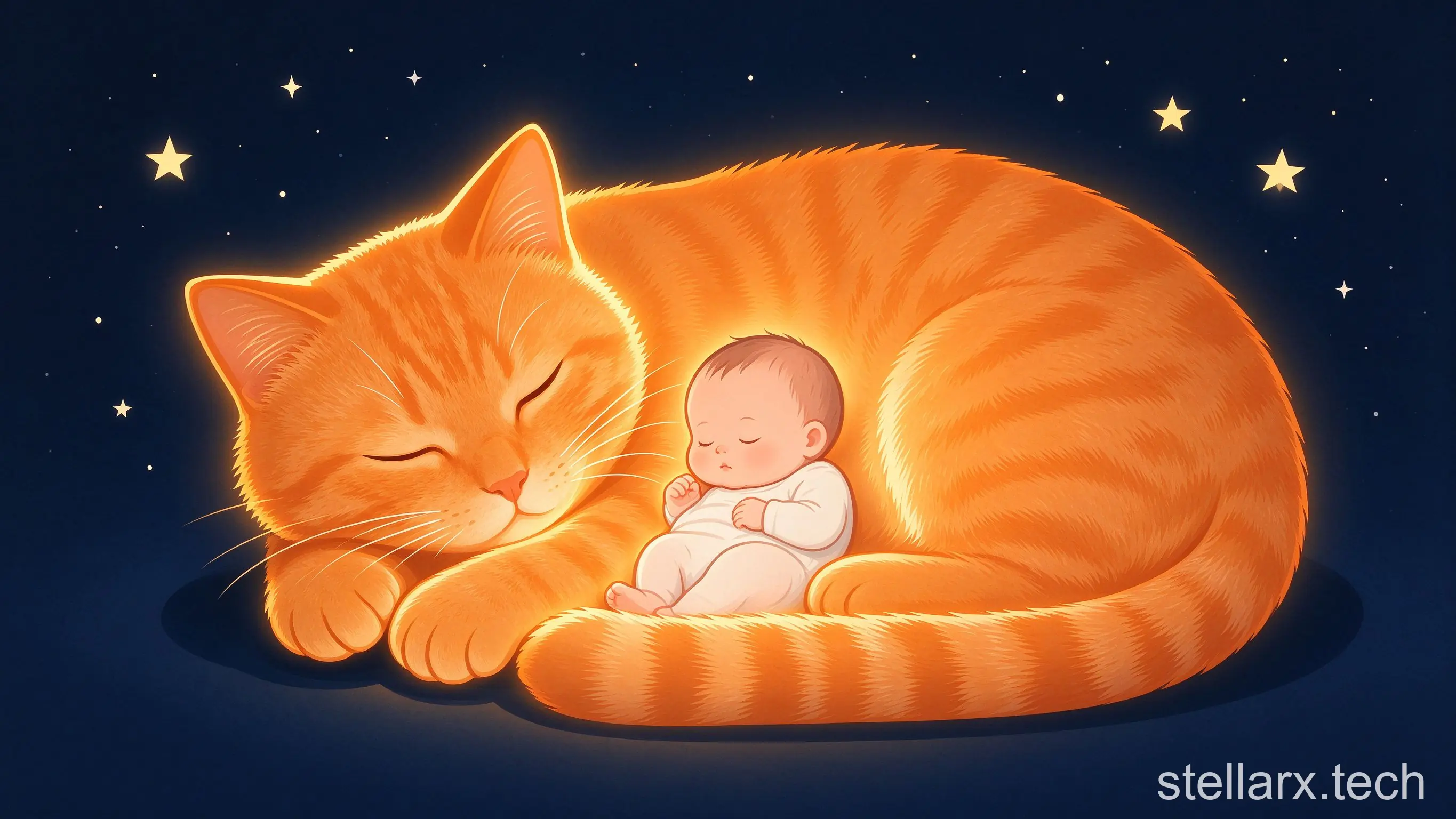
A story that made the rounds online fits perfectly: a child "remembered" a grandmother at home who often held him, and the warm temperature of her body. His mother confirmed there was no grandmother in the house — but there had been an old cat.
So was the brain built to delete pre-three memories? The better answer: no dedicated deletion program exists. In the first years of life, the brain is learning furiously on one side, while the hippocampus and its cortical networks are still under heavy construction on the other — and language, self-awareness, time and narrative are all being assembled at the same time. Early memories form, but they are stored unstably, fade quickly, and the retrieval system that would later open them changes dramatically.
Infantile amnesia is less a deletion than this: you really did save those files, and then your operating system went through several major upgrades — and the old files no longer have a path that opens them.
Curious what the cells behind this look like — the neurons of the hippocampus that encode and lose these memories? WWAI is an AI-powered biology encyclopedia with an online microscope, including a nerve-cell specimen where the neuron's cell body, dendrites and axon are clearly visible. Search "WWAI" in your app store and download it today.

References
[1] Bauer PJ. A complementary processes account of the development of childhood amnesia and a personal past. Psychological Review. 2015;122:204–231. doi:10.1037/a0038939.
[2] Yates TS, et al. Hippocampal encoding of memories in human infants. Science. 2025;387:1316–1320. doi:10.1126/science.adt7570.
[3] Lavenex P, Lavenex PB. Building hippocampal circuits to learn and remember. Behavioural Brain Research. 2013;254:8–21. doi:10.1016/j.bbr.2013.02.007.
[4] Riggins T, et al. Empirical evidence supporting neural contributions to episodic memory development in early childhood. Current Opinion in Behavioral Sciences. 2020.
[5] Akers KG, et al. Hippocampal neurogenesis regulates forgetting during adulthood and infancy. Science. 2014;344:598–602. doi:10.1126/science.1248903.
[6] Nelson K, Fivush R. The emergence of autobiographical memory: a social cultural developmental theory. Psychological Review. 2004;111:486–511. doi:10.1037/0033-295X.111.2.486.
[7] Fivush R. The development of autobiographical memory. Annual Review of Psychology. 2011;62:559–582. doi:10.1146/annurev.psych.121208.131702.
[8] Guskjolen A, et al. Recovery of "lost" infant memories in mice. Current Biology. 2018.
Related reading

How the Kidney Filters 180 Liters of Plasma a Day


- Fermented Sauces: Why Sichuan's Champion Chef Wins on Taste
- Cisplatin: How an Electrode Accident Became a Cancer Cure
- Lazarus Species: Six Animals That Came Back from Extinction
- Termite Snap-Jaws: The Fastest Insect Mandibles
- Fried Rice Syndrome: Why Leftover Rice Can Poison You
- Washed Eggs: Why a Family Got Poisoned by Scrambled Eggs
- Optogenetics Nobel: Luck, Timing, and the Names Left Off
- Infantile Amnesia: Why You Can't Remember Being Three
- Optogenetics Nobel 2026: How Light Controls Neurons
- Sudden Death and the 100,000 km of Blood Vessels

全部评论