Termite Snap-Jaws: The Fastest Insect Mandibles
Soldier termites are the colony's standing army — the caste that defends fragile workers, reproductives and nymphs. Over hundreds of millions of years of fighting predators, especially ants, they have invented a remarkable toolkit: biting off enemy limbs with brute force, spraying toxic glue from head glands, plugging tunnels with hardened heads, even storing poison in the body and self-destructing in a kamikaze blast.
But the strangest weapon in the arsenal is the snapping mandible.
Two Ways to Snap
There are roughly two designs of snapping mandible, and they work very differently.
The symmetric (or near-symmetric) snap. The two mandibles are mirror images, or close to it. At rest, their tips barely touch. In danger, the soldier squeezes both mandibles inward, bending them against each other and storing elastic energy. When the load reaches its limit, both snap outward and straighten in an instant, converting that stored energy into kinetic energy that slams into the enemy. You can simulate it with two index fingers pressed together.
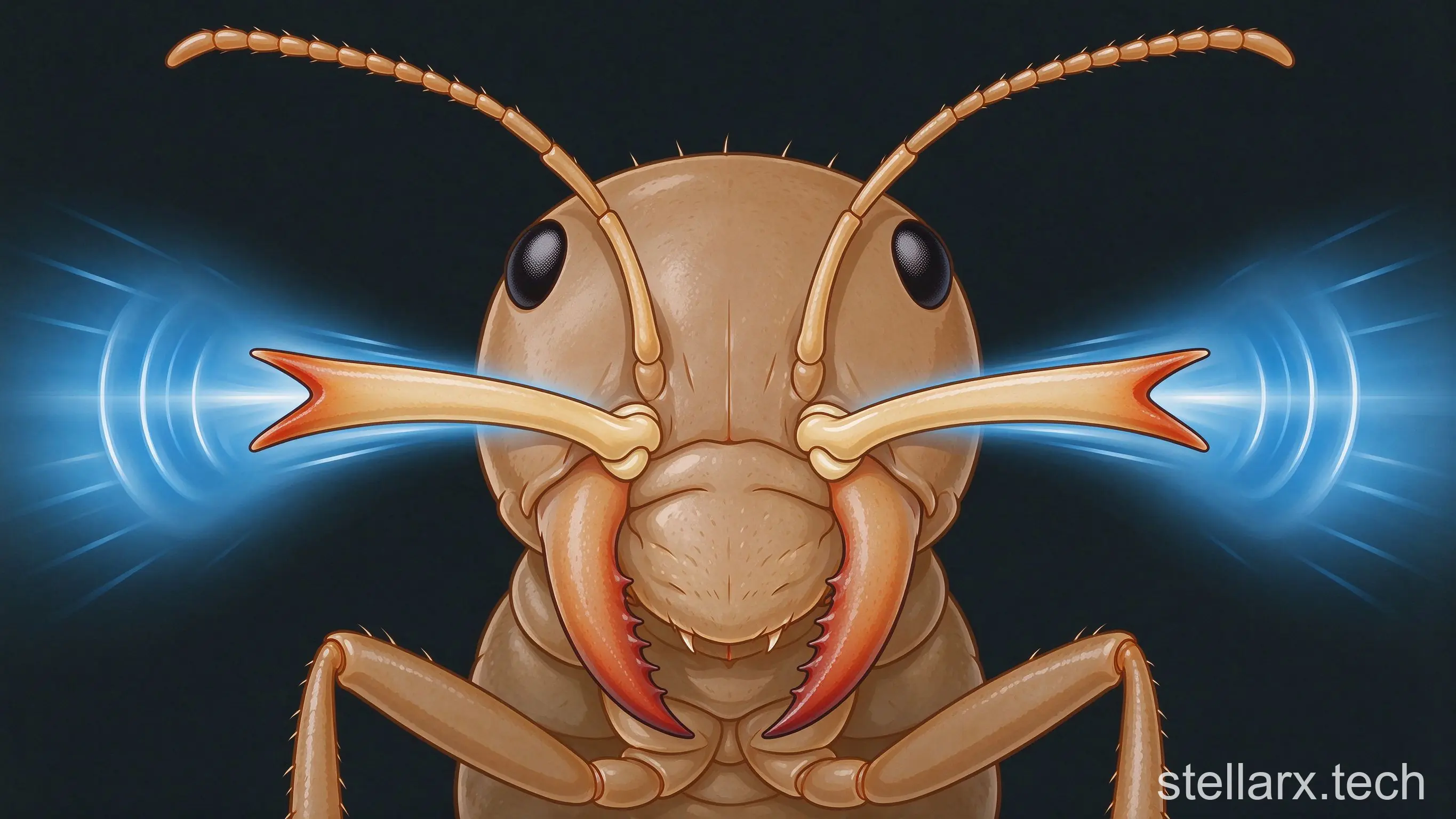
The asymmetric snap. This design is dramatically lopsided. One mandible — usually the right — is slightly curved to cradle a left mandible twisted like a spring. To load it, the right mandible presses down on the left, bending its flexible "joint" until the twisted spring stores a large amount of elastic energy. At the limit, the left mandible slips free, whips to the right with enormous force, and strikes with its hardened tip. Simulate it with a finger snap.
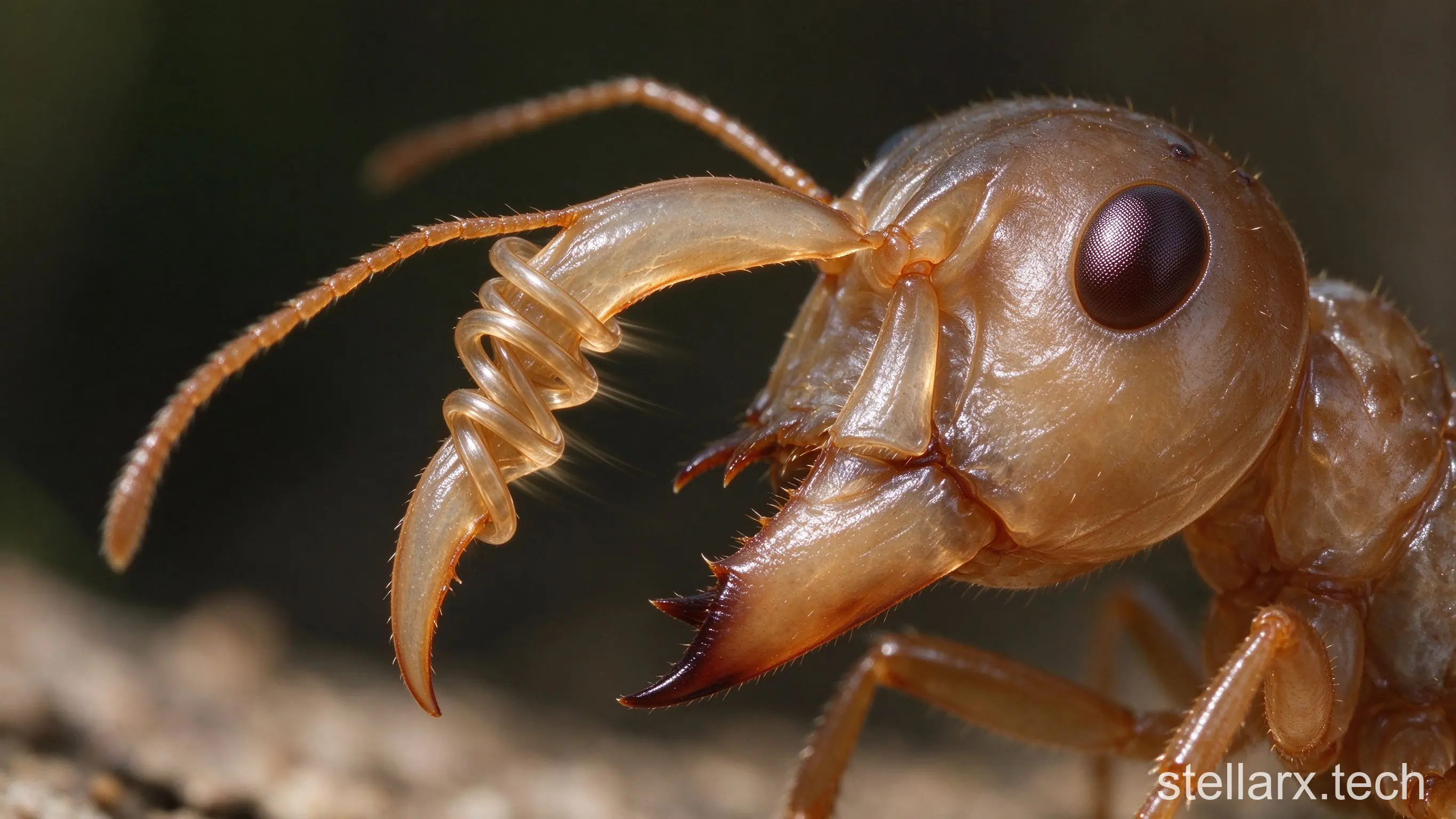
The two designs differ in effect. The symmetric snap fires sideways, so the soldier can only hit enemies to its side; against a frontal attacker it must reposition. The asymmetric snap sweeps across the entire front of the head — which matters a lot for fighting inside a narrow tunnel. And because the twisted mandible deforms further, it stores more energy and delivers more damage for less effort.
The Speed Records
The elastic energy system lets these insects beat a hard physiological limit: the maximum contraction speed of muscle.
The Panamanian termite Termes panamaensis (symmetric) was measured at 67 m/s — already faster than the previous champion, the trap-jaw ant Odontomachus bauri, whose mandibles snap closed at 64.3 m/s.
The record then passed to another ant, the Dracula ant Mystrium camillae (also a symmetric snap), at 111.1 m/s.
But the termites took the crown back: the asymmetric snap of Pericapritermes nitobei reaches 132.4 m/s — the fastest biological movement ever recorded.
Kills by Shockwave, Not by Bite
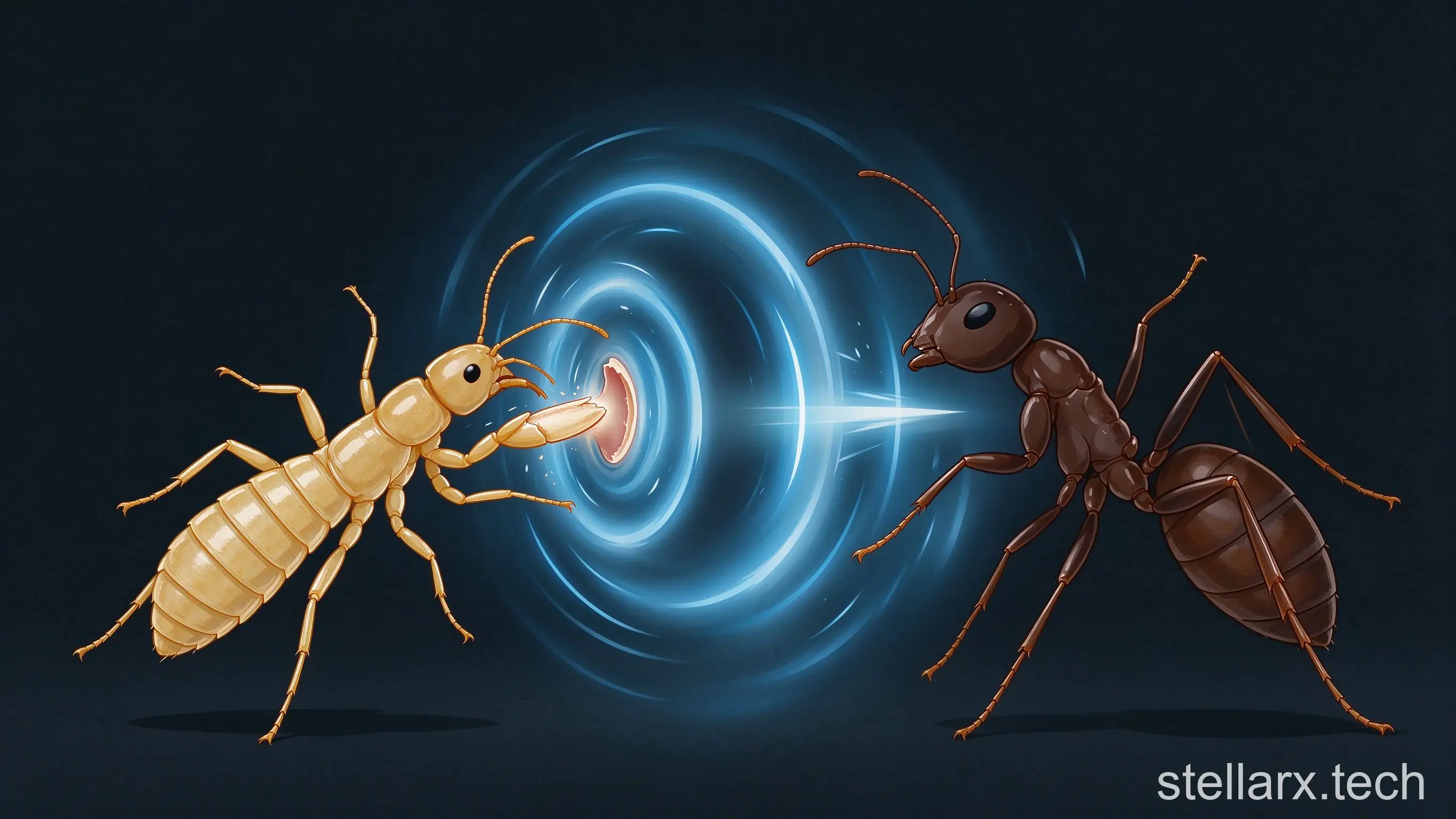
The experiments are striking: soldiers killed in the lab showed no fatal external damage to their exoskeletons. The snap kills through internal injury — the shockwave from the impact crushes organs from the inside.
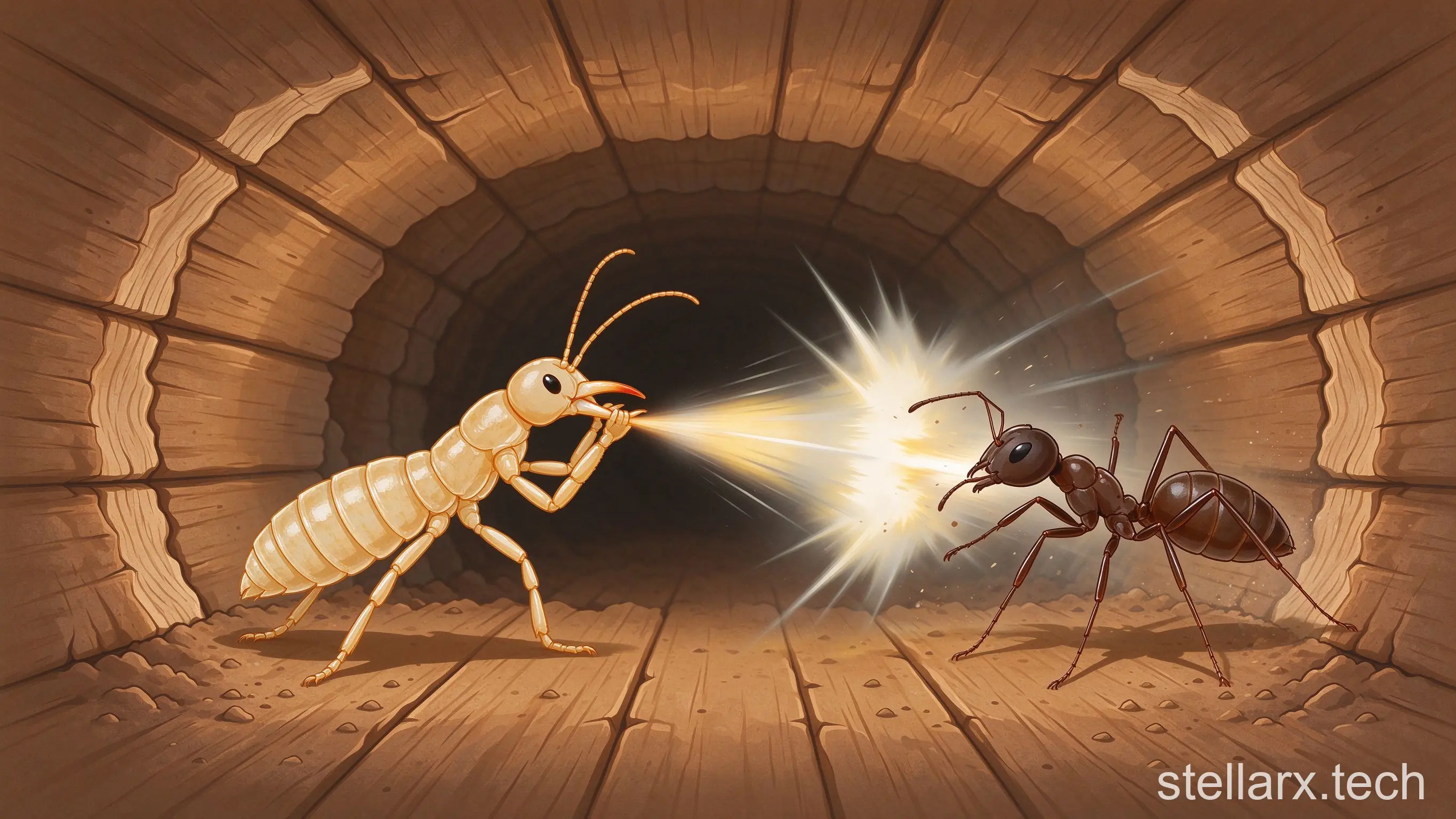
The recoil also flings the termite and its enemy apart, letting the soldier break contact instantly. That makes the weapon especially useful in tunnels, where narrow space limits normal mandible biting and protects the soldier's vulnerable abdomen.
One clever detail: the shock damages the soldier's own antennae, so the termite tucks them back in the milliseconds before it snaps.
The Limits of the Snap
Termites are blind. They detect nearby enemies only with their antennae, and loading the mandible takes time. A big, heavy-armored ant like Ectomomyrmex javanus can survive the strike — stunned and disabled, but alive. And if an ant spots the termite from a distance, pounces, and bites the loaded mandible off before it fires, the whole defense collapses.
Evolution and Distribution
The symmetric and asymmetric snaps are not cleanly separated categories — the asymmetric design clearly evolved from the symmetric one, and many living termites have mandibles in intermediate stages (the genus Procapritermes is a transitional form).
Most snapping termites live in the most advanced termite family, the Termitidae, where the asymmetric snap may have evolved independently four to seven times. In the Old World, snapping termites belong mainly to Promirotermitinae and Mirocapritermitinae; in the New World, to Termitinae and Neocapritermitinae. One striking exception sits outside the family entirely: the wood-dwelling Roisinitermes has symmetric snapping soldiers.
Why Cheap Soldiers Win
All snapping termites share one trait: they eat food of very low nutritional value. Termitidae snapping termites mostly eat humus — swallowing soil and absorbing the little organic matter in it. Roisinitermes eats dry wood like other wood termites.
That explains the strategy. When nutrition is scarce, big-bodied biting soldiers with thick muscle — or glue-spraying soldiers that must constantly secrete — are simply too expensive. A snapping soldier gets devastating attack power from a small body and modest strength. So the design keeps reappearing: cheap soldiers, with a spring for a jaw.
The Bottom Line
A muscle has a speed limit. A spring does not. The termite soldier turned its own jaw into the fastest biological weapon on Earth — and the ants that have fought them for millions of years are still trying to catch up.
Curious what the enemies in this arms race actually look like under a microscope? WWAI is an AI-powered biology encyclopedia with an online microscope, including an ant specimen where the segmented body, geniculate antennae and three pairs of legs are clearly visible — a close look at the termite's oldest rival. Search "WWAI" in your app store and download it today.
—— 在此插入推广图 ——
References
[1] Chen Kuan-Chiu, et al. Termite's Twisted Mandible Presents Fast, Powerful, and Precise Strikes. Science Advances, 2021 (Pe. nitobei up to 132.4 m/s; T. panamaensis 67 m/s; peak within 8.68 µs). https://pmc.ncbi.nlm.nih.gov/articles/PMC7289866/
[2] Larabee FJ, et al. Snap-jaw morphology is specialized for high-speed power amplification in the Dracula ant, Mystrium camillae. Royal Society Open Science, 2018 (finger-snap mechanism; strike in as little as 23 µs). https://pmc.ncbi.nlm.nih.gov/articles/PMC6304126/
[3] Trap-jaw ant Odontomachus bauri mandible closure: 35.5–64.3 m/s (compiled kinematic data). https://www.stoneageherbalist.com/p/the-eternal-world-war-of-the-underground
[4] Based on a Zhihu answer by "广町七深Official" on unexpected defense mechanisms in nature (2026-10-05); original photo captions and image credits were replaced with AI illustrations.
Related reading

Why Open-Air Car Carbon Monoxide Kills


- Fermented Sauces: Why Sichuan's Champion Chef Wins on Taste
- Cisplatin: How an Electrode Accident Became a Cancer Cure
- Lazarus Species: Six Animals That Came Back from Extinction
- Termite Snap-Jaws: The Fastest Insect Mandibles
- Fried Rice Syndrome: Why Leftover Rice Can Poison You
- Washed Eggs: Why a Family Got Poisoned by Scrambled Eggs
- Optogenetics Nobel: Luck, Timing, and the Names Left Off
- Infantile Amnesia: Why You Can't Remember Being Three
- Optogenetics Nobel 2026: How Light Controls Neurons
- Sudden Death and the 100,000 km of Blood Vessels
全部评论