The Kidney Isn't a Sieve: How It Decides What to Keep
Try designing a sieve that sorts kidney waste from nutrients, and you will hit an impossible problem.
A sieve sorts by size. But urea — the waste the kidney must get rid of — has a molecular weight of only 60. Glucose, the nutrient it must keep, weighs 180. The waste molecule is one-third the size of the nutrient. What pore size do you choose? Too small, urea stays behind and you die of uremia within days. Too large, glucose pours out and you lose everything you eat.
The kidney's actual design is a completely different approach. It does not sort. It first dumps everything out, then picks the valuable things back up one by one.
Dump first: 180 liters a day
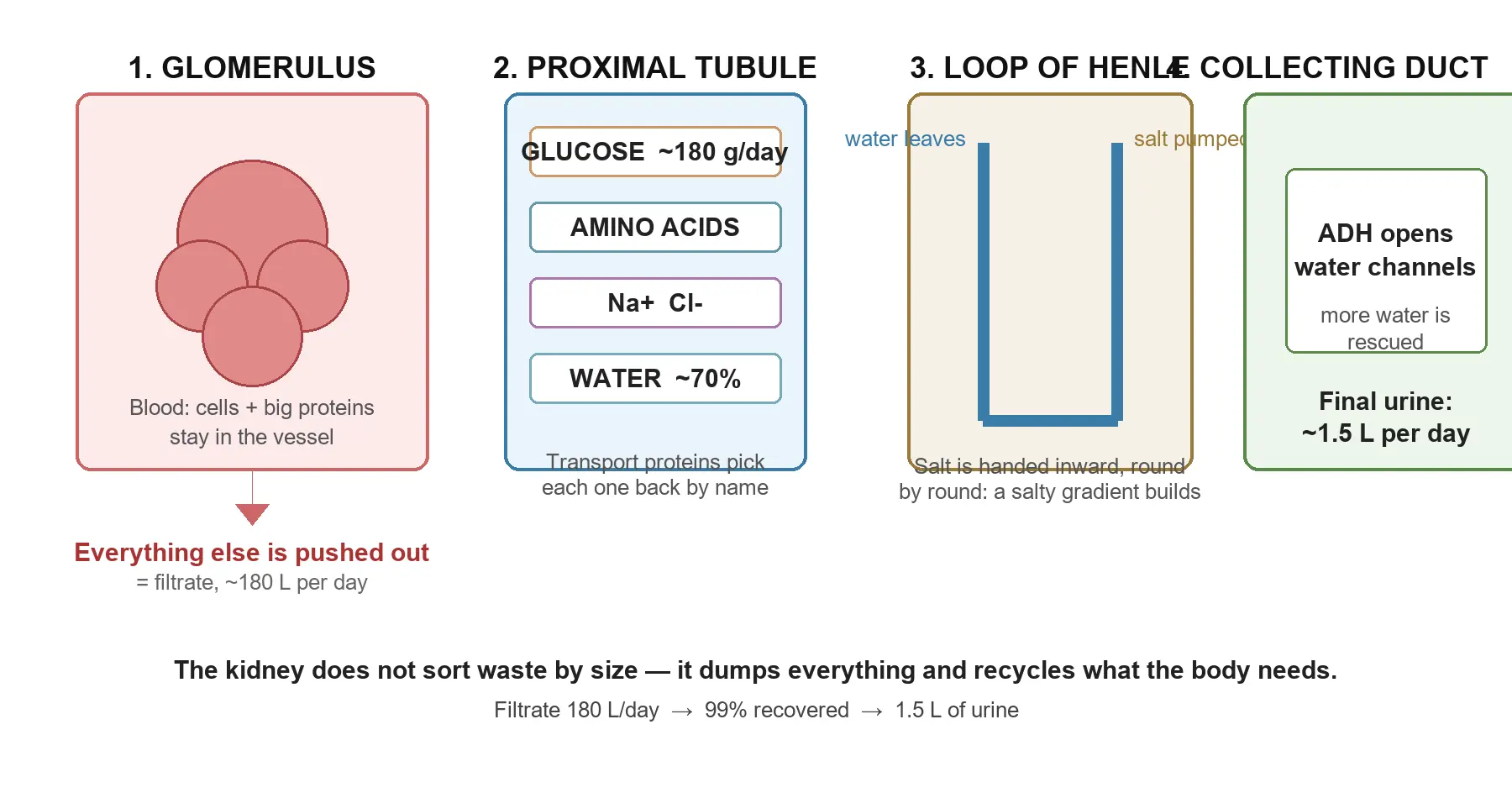
The kidney is only 0.5% of body weight, yet it takes one-fifth of the heart's output. As blood flows through the glomerulus, everything except blood cells and large proteins is pressed out indiscriminately — glucose, amino acids, salt, water and urea all leave together. The resulting filtrate amounts to 180 liters a day: your entire blood plasma gets turned over fifty or sixty times. Your actual daily urine output? About 1.5 liters.
That means 99% of what was dumped is retrieved. About 178 of the 180 liters of water come back. The roughly 180 grams of glucose filtered out every day — equivalent to nine taels of sugar — is recovered to the last gram.
Pick back: transport proteins as dock workers
The job of retrieval falls to a tube a few centimeters long downstream of the glomerulus: the renal tubule. Its wall is lined with transport proteins, working like dock workers picking cargo against a checklist. Glucose has its own dedicated carrier, amino acids have theirs, sodium, potassium and bicarbonate each have their assigned lanes. What is not on the checklist — urea, creatinine, uric acid — simply drifts downstream and becomes urine.
Why bother? Why dump 180 liters a day and then pick it all back?
Blacklist or whitelist: how the kidney "knows" what is waste
It doesn't know. And it doesn't need to.
A sieve works on a blacklist: you must recognize every kind of garbage to block it. But metabolic waste is endlessly varied — the drugs you take, accidental toxins, bacterial byproducts — many of them molecules this body has never met in its evolutionary history. A blacklist could never be complete.
The kidney uses a whitelist instead. It only needs to recognize a few dozen valuable "old friends" worth recovering — a short, stable list that has barely changed in hundreds of millions of years. Friends get picked back up; everything else, whatever its origin, is shown out. That is why, when you take a drug that has never existed before in human history, the kidney still excretes its metabolites. It does not recognize the molecule — and not recognizing it is precisely the reason it is excreted.
Diabetes: when the whitelist hits its capacity
This whitelist also explains the name of a disease. The glucose transporters have a limited capacity — plenty for normal blood sugar, but once glucose rises past a certain line, the dock is overwhelmed and the extra sugar leaks straight into the urine. Ancient Indian physicians noticed patients whose urine attracted ants; the Chinese name for the disease, 糖尿病, literally means "sweet urine." Sugar in urine is not a sieve with a hole — it is a recycling line running at full capacity.
One class of modern diabetes drugs even works by reversing this: deliberately holding down some of the transporters (SGLT2 inhibitors) so that patients lose a few dozen grams of glucose in urine every day — and their blood sugar stabilizes.
The hardest problem: water
Getting rid of waste is easy. Getting rid of waste without wasting water is hard. You cannot flush 30 grams of urea away with 180 liters of water. The urine must be concentrated dozens of times — the most difficult piece of engineering in the whole system.
The kidney's answer is hidden in a hairpin-shaped loop of tubule. Two tubes — one flowing down, one flowing up — run close together. Salt is handed over round after round, building up a gradient in the deep kidney that gets saltier and saltier. As urine flows through this salty region, water is pulled out at every step.
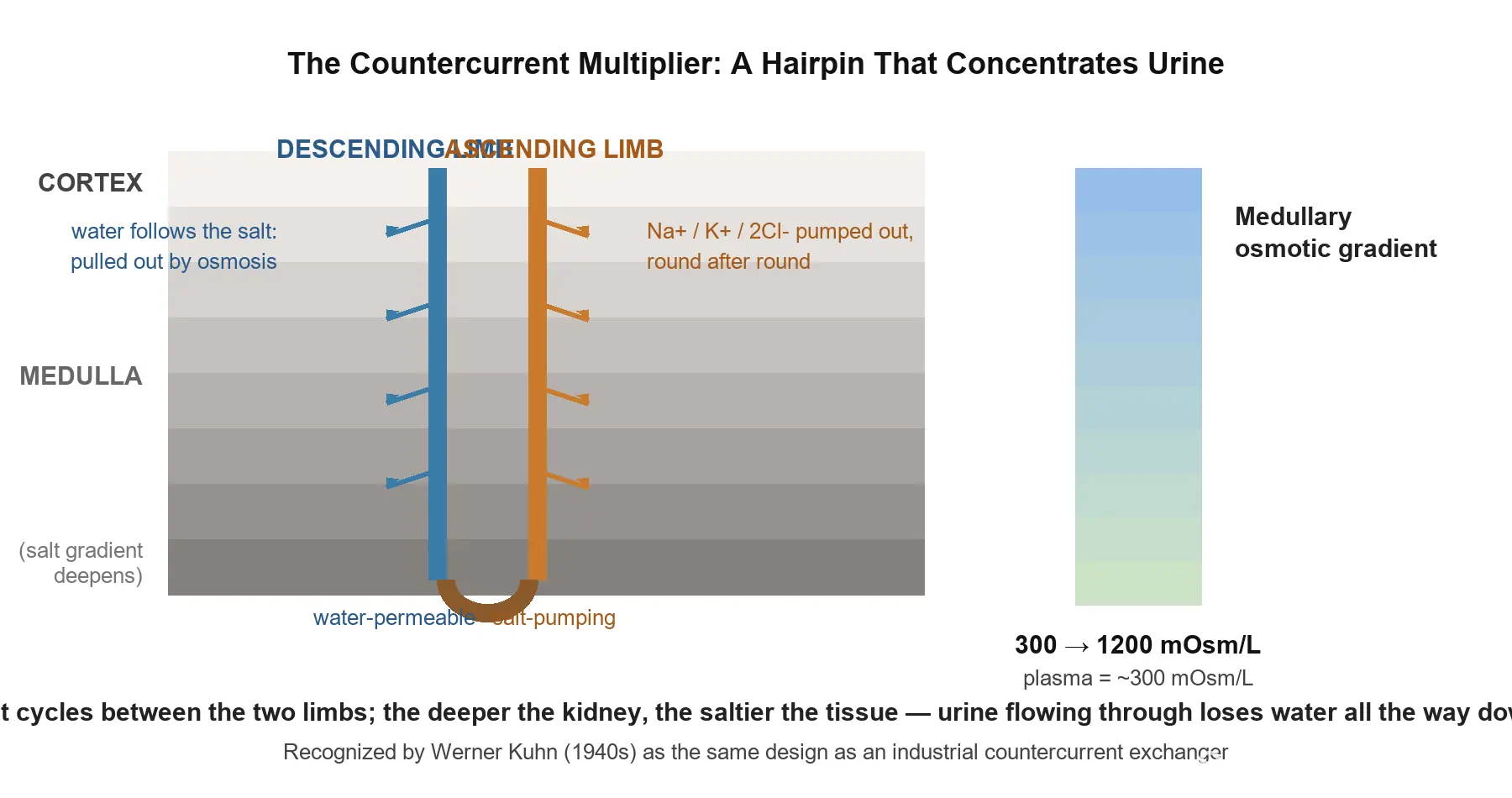
The first person to recognize this structure was not a physiologist. In the 1940s, a Swiss physical chemist named Werner Kuhn looked at the hairpin and recognized it instantly: it was the same design as the countercurrent exchanger in a chemical factory. He proposed the countercurrent multiplier model. Physiologists were skeptical — until, about a decade later, micropuncture experiments measured concentrations along the tubule segment by segment, matching the model perfectly.
Desert kangaroo rats take this hairpin to extremes: the loop runs extremely long, and the animal can go its whole life without drinking — living entirely on the metabolic water in its food.
How much water is finally kept, and how much salt remains, is fine-tuned by hormones at the end of the line. When you are dehydrated, the brain releases antidiuretic hormone (ADH), water channels in the collecting duct open, and a little more water is rescued — which is why, when you are thirsty, your urine is small in volume and dark yellow.
The kidney is not a smarter sieve. It is a whitelist machine: dump everything, and let a short, stable list of transport proteins decide what is worth coming back. The waste does not need to be recognized. Not being recognized is exactly how it leaves.
Curious what the blood vessels feeding this filter actually look like? A blood vessel slide shows the layered walls and lumen of arteries and veins — the plumbing of the kidney's filtration network. Search for WWAI in your app store: its blood vessel specimen lets you zoom through the whole structure on screen.
References
NIDDK — Your Kidneys and How They Work. https://www.niddk.nih.gov/health-information/kidney-disease/kidneys-how-they-work
National Kidney Foundation — How Your Kidneys Work. https://www.kidney.org/kidney-basics/how-your-kidneys-work
Related reading

How the Kidney Filters 180 Liters of Plasma a Day

How Kidneys Work: Filter Waste, Keep Nutrients


- Why Fish in a Plastic Bag Beat Fish in a Bucket
- 魚離開水能活多久?塑膠袋比水桶更保命
- Shamonda Virus: The First Human Case Ever Reported
- 沙蒙達病毒:全球首例人類感染病例
- Vegetable Nutrition: Why Lettuce Isn't the Healthiest Green
- 蔬菜營養排名:生菜墊底?真正的營養之王是這 5 種
- Metformin for Healthspan: Muscle, Bone, and a Tumor Switch
- 二甲雙胍延緩衰老?中年肌肉骨骼與膠質母細胞瘤的新證據
- 甜高粱會取代甘蔗與甜菜嗎?植物也會得「糖尿病」
- Why Sweet Sorghum Could Replace Sugar Cane and Beet
全部评论