Why Stomach Acid Can't Kill Parasite Eggs
Your stomach can dissolve a piece of steak into mush. Its hydrochloric acid reaches a pH of 1.5–3.5 — strong enough to kill most bacteria and viruses. So why does a tiny parasite egg pass through completely unharmed?
Because evolution turned parasite eggs into enteric-coated capsules.
The egg shell is built like armor
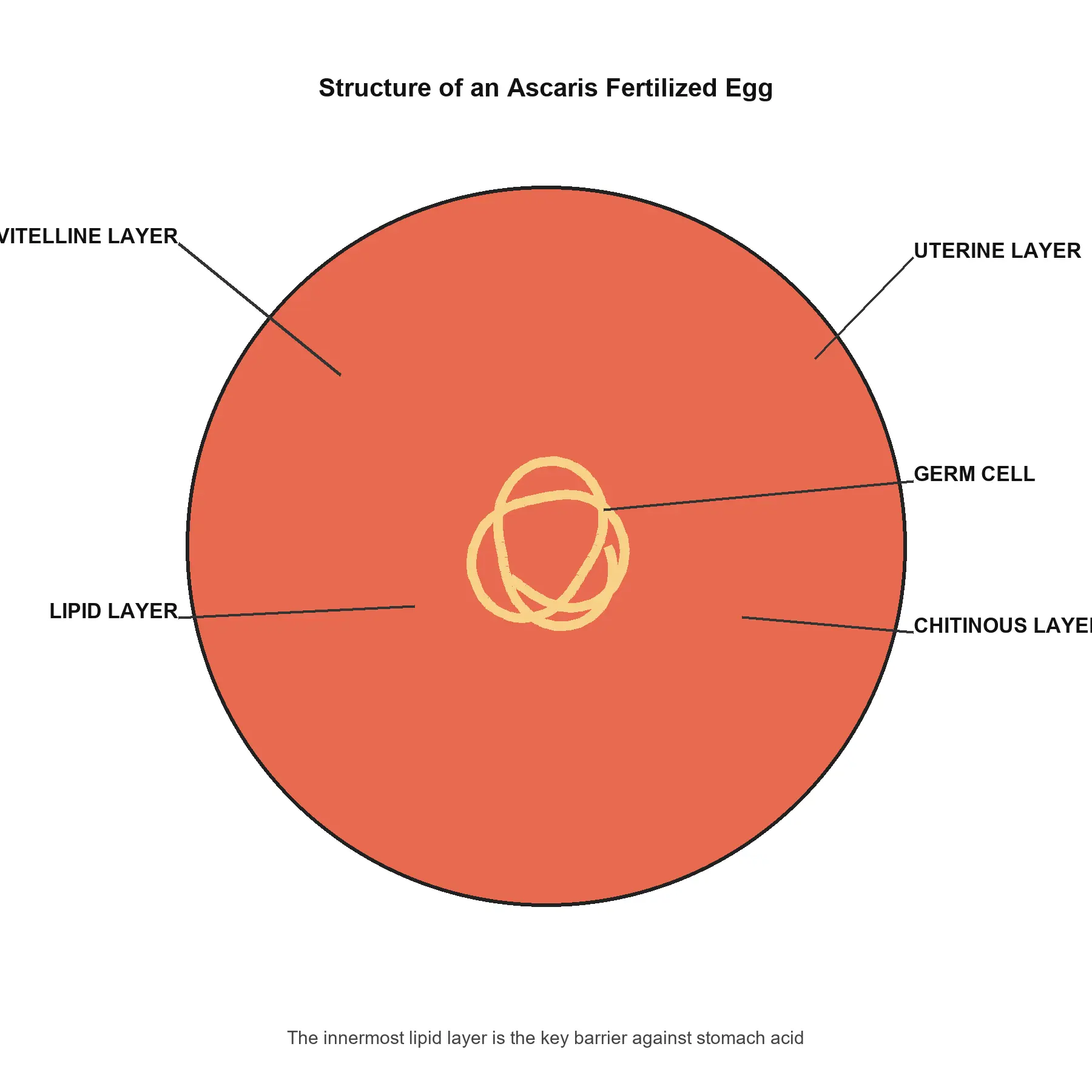
Take the roundworm (Ascaris) egg. Its shell is not one layer but three, each with a different job:
The outer layer is made of protein and glycoprotein. The middle layer is chitinous — the same tough material that makes up insect exoskeletons. And the innermost layer is a lipid layer: an almost waterproof film that acid, water, and digestive enzymes cannot easily cross.
That lipid layer is the key barrier against stomach acid. The acid attacks from outside, and the egg simply refuses to let it in.
What is already inside the egg
A fertilized roundworm egg does not start its journey as a helpless cell. In soil or damp environments, it develops from a fertilized egg through an embryo into a larva, molting once inside the shell to form an L2-stage larva.
Other parasites use the same trick
Roundworms are not the only ones. Intestinal protozoa such as Giardia and Toxoplasma also form cysts and oocysts with lipid-rich walls, giving them the same acid- and enzyme-resistant protection.
The stomach actually helps them wait
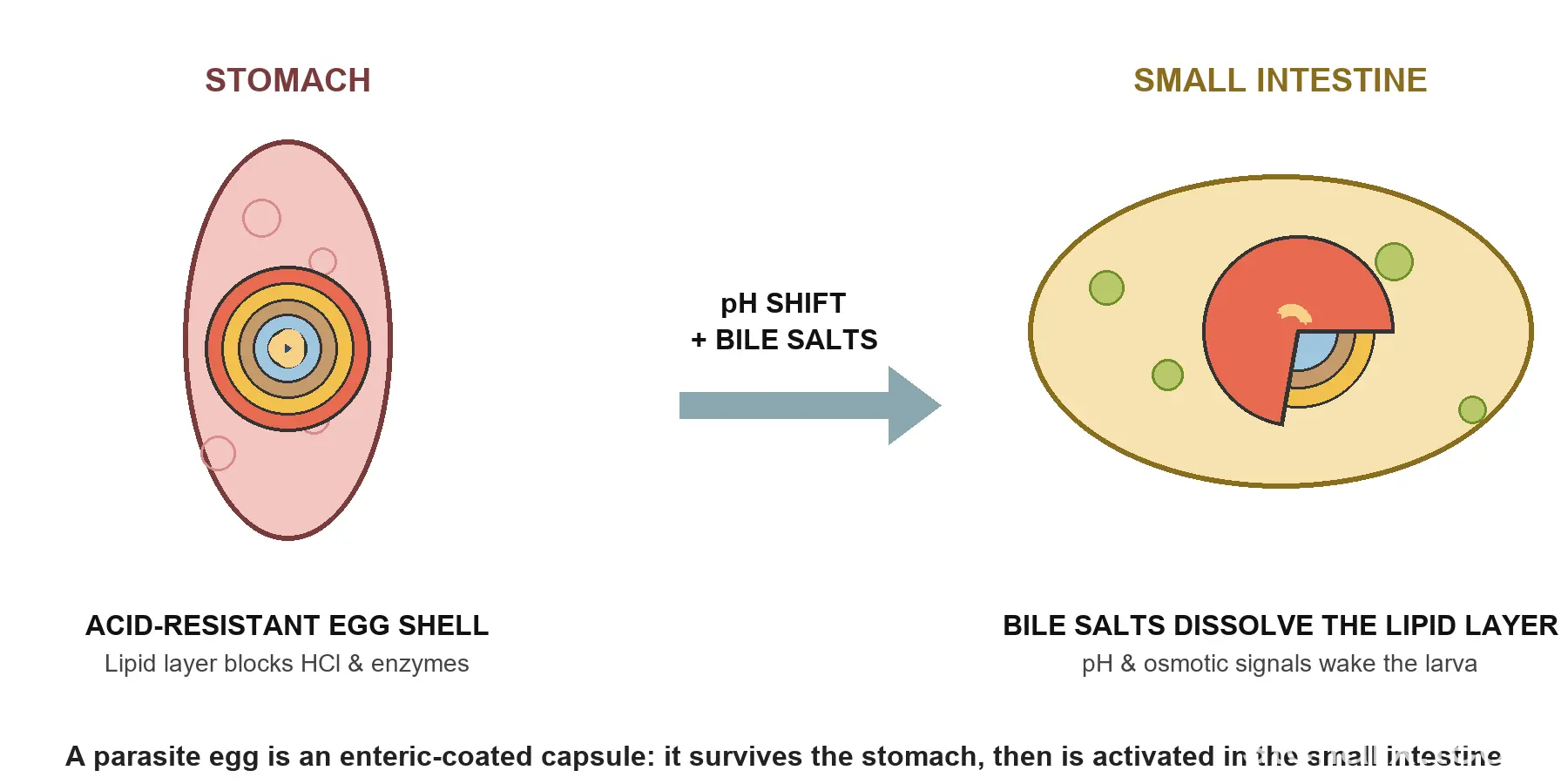
A dormant egg is protected by its multiple shell layers, living in a sealed environment with an extremely low metabolic rate. Stomach acid does not destroy it — it actually suppresses hatching, which helps the egg survive the extreme conditions of the stomach.
The alarm clock is in the small intestine
So what finally opens the capsule?
When the egg reaches the small intestine, bile salts such as taurocholate — amphiphilic molecules that normally emulsify fat — dissolve and disturb the lipid layer that stomach acid could not penetrate, increasing the shell's permeability. The egg then senses the pH and osmotic signals of the small intestine and wakes from dormancy.
The stomach cannot crack the shell. The small intestine is exactly where the shell is meant to open. Evolution engineered parasite eggs to survive exactly where you would expect them to die — and to hatch exactly where they can do the most harm.
Curious what the adult worm behind these eggs actually looks like under a lens? A male Ascaris cross-section slide shows its tough cuticle, intestinal tube and twin reproductive tubes — the parasite that produces eggs tough enough to sail through your stomach. Search for WWAI in your app store: its Ascaris specimen lets you zoom through the whole worm on screen.

References
CDC — Parasites: Ascariasis. https://www.cdc.gov/parasites/ascariasis/
WHO — Soil-transmitted helminth infections (fact sheet). https://www.who.int/news-room/fact-sheets/detail/soil-transmitted-helminth-infections
Related reading

Heartburn or GERD: The Valve That Gives Up


- Why Fish in a Plastic Bag Beat Fish in a Bucket
- 魚離開水能活多久?塑膠袋比水桶更保命
- Shamonda Virus: The First Human Case Ever Reported
- 沙蒙達病毒:全球首例人類感染病例
- Vegetable Nutrition: Why Lettuce Isn't the Healthiest Green
- 蔬菜營養排名:生菜墊底?真正的營養之王是這 5 種
- Metformin for Healthspan: Muscle, Bone, and a Tumor Switch
- 二甲雙胍延緩衰老?中年肌肉骨骼與膠質母細胞瘤的新證據
- 甜高粱會取代甘蔗與甜菜嗎?植物也會得「糖尿病」
- Why Sweet Sorghum Could Replace Sugar Cane and Beet

全部评论