Rove Beetle "Acid" Myth: Pederin Stops Protein Synthesis
There is a widely repeated claim about rove beetles: their "venom" is a powerful acid, with a pH around 1–2, and that is why contact burns your skin. The claim sounds scientific. It is not. It is pure folklore dressed up in numbers.
The molecule in question is pederin, the main toxic compound in the hemolymph of poisonous rove beetles. Look at its functional groups and the acid story collapses.
Why pederin cannot be a strong acid
The molecule carries two hydroxyl groups, both on saturated carbons: classic alcohol hydroxyls. Alcohols barely ionize in water — their pKa sits around 15–19, far outside anything you would call acidic. In pederin, the oxygen and nitrogen atoms around those hydroxyls raise the local electron density, making the hydrogens even harder to release.
Next to the left hydroxyl sits an amide group. The amide's lone pair forms a conjugated system that makes the nitrogen hard to protonate, and amide hydrogens have a pKa around 15–17 — again, nowhere near strong-acid territory.
Pederin also carries several methoxy groups, one of them linked to an ether. All these oxygens are locked into stable covalent bonds; they cannot release protons, and their electronegativity makes the neighboring hydrogens cling even harder.
Scan the whole molecule and you find no acidic hydrogen at all: no carboxylic hydrogen, no phenolic hydrogen, no nitrous or sulfonic hydrogen. Every hydrogen-bearing group sits on a saturated carbon or inside a stable conjugated environment.
So pederin is a neutral large molecule. There is no "strong acid" anywhere in it.
What pederin actually does: stop the protein factory
The way pederin works has nothing to do with acid. It is a cytotoxin.
Once inside a cell, it binds the large subunit of the ribosome. The ribosome can no longer use amino acids to build proteins. The cell quickly loses its repair enzymes and cytoskeletal proteins, DNA synthesis is disrupted, the cell cycle is disturbed and mitosis grinds to a halt. The cell dies and lyses. Proteases released from dying skin cells then break down the links between cells — and that is rove beetle dermatitis: burning, redness, blisters, sometimes erosion, taking two to three weeks to heal, with crusting and peeling along the way.

Only females carry it — and even they borrowed it
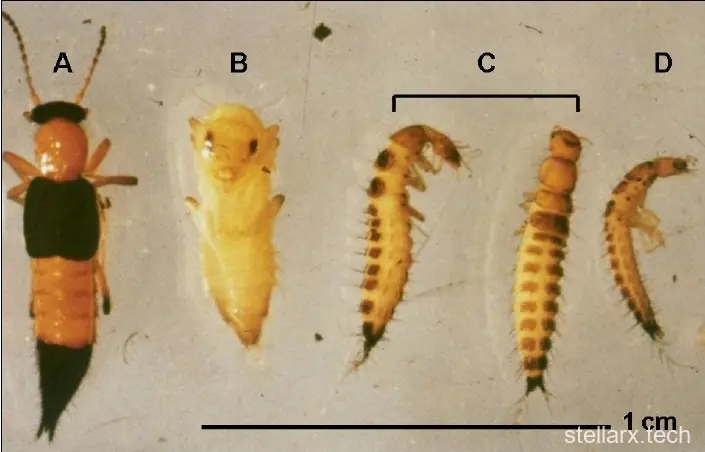
Only adult female poisonous rove beetles carry pederin. And the beetle does not even make it itself: the toxin comes from symbiotic bacteria living inside her. Males look nearly identical but are completely non-toxic — a textbook case of Batesian mimicry, a harmless copy wearing the warning colors of a dangerous original. Larvae have no defense at all and hide in rotting matter by the water, eating small organisms and organic debris.
Do they have natural enemies? Yes — with a twist
Predators certainly exist. In the defenseless larval stage, any small arthropod-eater will take them. But adult females' pederin affects different predator groups differently. Insect predators like ground beetles are only mildly affected — pederin may interfere with their metabolism or reproduction, yet they still hunt rove beetles. Wolf spiders and jumping spiders, by contrast, are strongly repelled: the toxin is an effective defense against them.
So the next time someone tells you a rove beetle burned you with acid, you can politely correct them. The burn is real. The acid is not. It is a molecule that quietly switches off the protein factory of a cell — and the beetle that wields it did not even invent it.
Curious what a spider that stands up to rove beetles looks like under a microscope? A spider slide shows four pairs of walking legs and a fused head-thorax — the arachnid design that even pederin has to respect. Search for WWAI in your app store: its spider specimen lets you zoom through the whole body on screen.
Related reading

Fall Webworm Biocontrol: Beijing's Tiny Wasp Army

Why Are Mysterious Round Holes Appearing on Parked Cars? The…

Termite Snap-Jaws: The Fastest Insect Mandibles
References
Britannica — Pederin (paederin) toxin overview. https://www.britannica.com/science/pederin
NCBI Bookshelf / PubChem — Pederin compound summary. https://pubchem.ncbi.nlm.nih.gov/compound/Pederin
- Why Fish in a Plastic Bag Beat Fish in a Bucket
- 魚離開水能活多久?塑膠袋比水桶更保命
- Shamonda Virus: The First Human Case Ever Reported
- 沙蒙達病毒:全球首例人類感染病例
- Vegetable Nutrition: Why Lettuce Isn't the Healthiest Green
- 蔬菜營養排名:生菜墊底?真正的營養之王是這 5 種
- Metformin for Healthspan: Muscle, Bone, and a Tumor Switch
- 二甲雙胍延緩衰老?中年肌肉骨骼與膠質母細胞瘤的新證據
- 甜高粱會取代甘蔗與甜菜嗎?植物也會得「糖尿病」
- Why Sweet Sorghum Could Replace Sugar Cane and Beet
全部评论