Why a Batch of Black Sesame Paste Tested 27× the Mold Limit
By the wwai Editorial Team
In its latest round of food-safety sampling, the Shanghai Municipal Market Supervision Administration flagged a batch of "Weiwei" (维维) unsweetened black sesame paste produced on August 13, 2025 (320 g per bag). All five samples from the batch failed the mold test, with the highest reading reaching 2,800 CFU/g — 27 times the national limit of 100 CFU/g set by GB 19640-2016 for reconstituted cereal products. When asked, the company's customer service confirmed that the entire affected batch had already been recalled.
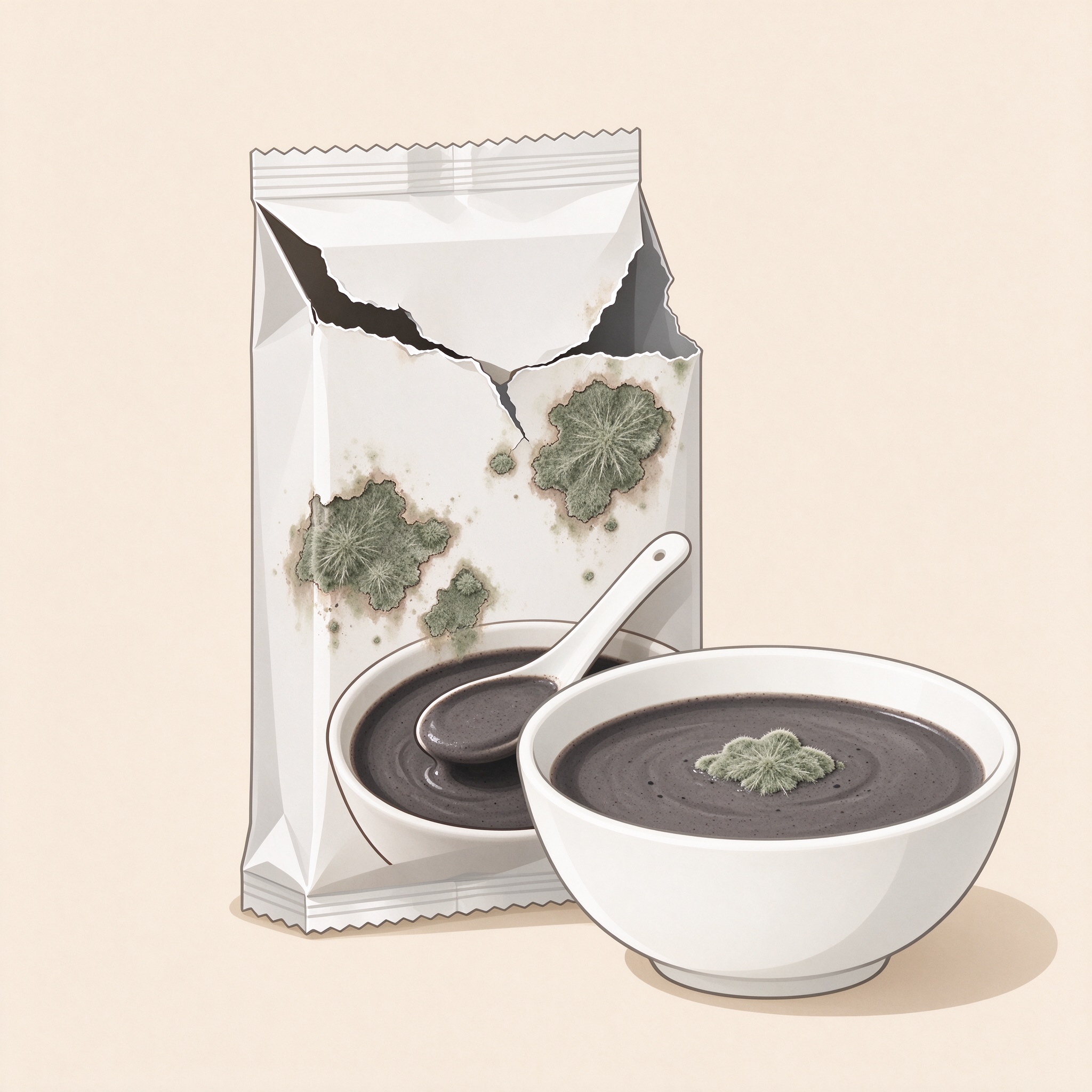
Behind the headline numbers is a story worth telling from the ground up — what mold actually is, why a bag of powder is such an easy target, and what a "27× over limit" reading really means. Let's take a closer look.
What Is Mold, Exactly?
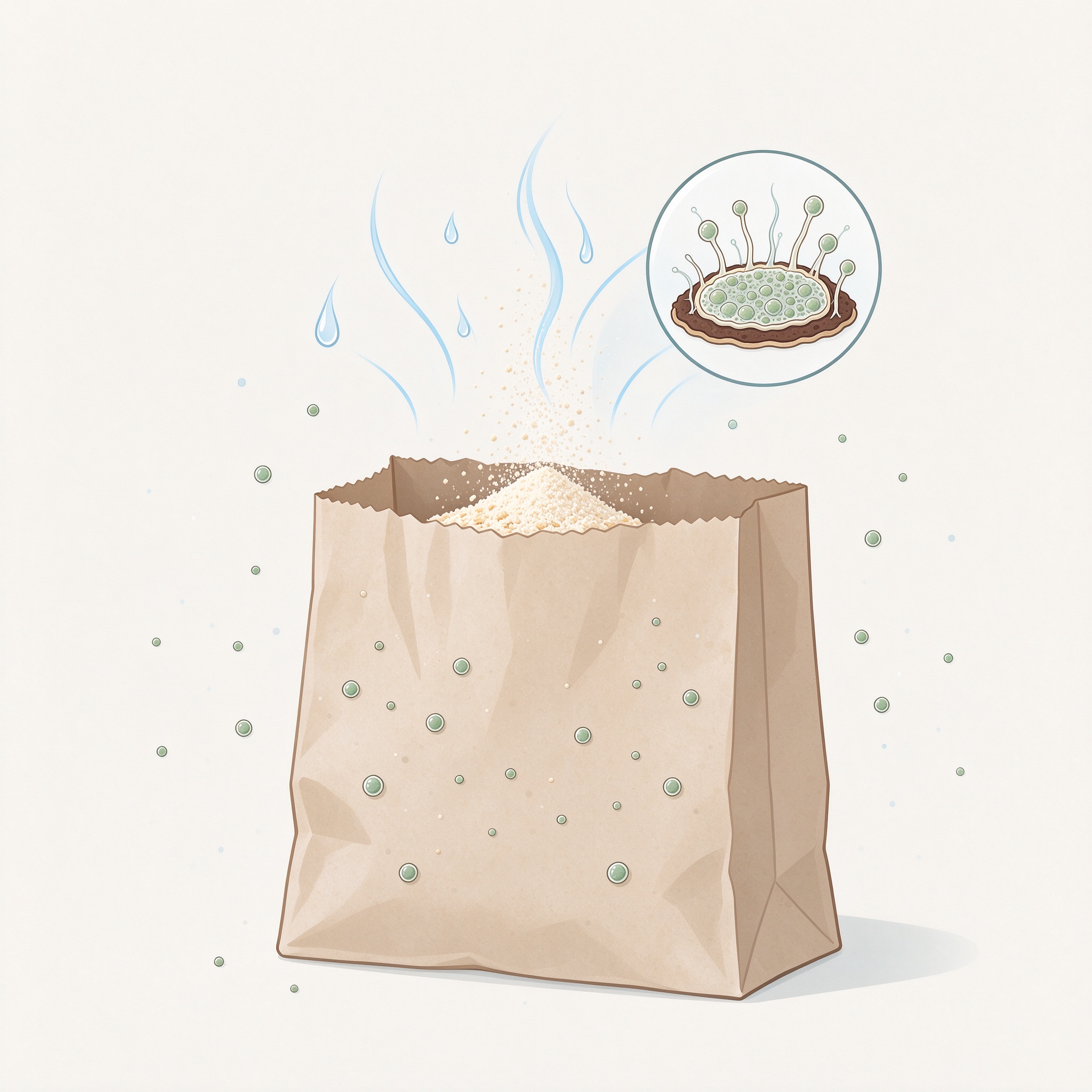
Mold is the everyday name for a large group of filamentous fungi — the same kingdom of life that includes mushrooms and yeast. A mold colony is built from hyphae: long, branching threads that weave together into a visible network called mycelium, the fuzzy growth you see on spoiled food. What you usually notice first, though, are the spores — tiny reproductive bodies, often just a few micrometers across, that form at the tips of stalks. They float in the air almost everywhere; given moisture, warmth, and food, a single spore can germinate and grow into a whole new colony.
Because spores are so small and so abundant, mold is something you rarely see in detail with the naked eye. Under a microscope, however, the structure is beautiful: radiating hyphae, spherical spore heads, and branching networks that look like miniature forests.

Why Powdered Foods Are a Mold's Paradise
Not all foods are equally vulnerable — and powdered mixes like black sesame paste are about as vulnerable as it gets, for three reasons:
Abundant nutrition. They are packed with starch and sugars, an ideal carbon source for fungal growth.
Huge surface area. A powder exposes far more surface per gram than a solid piece of food, giving spores more landing and germination sites.
Moisture attraction. Powders readily absorb humidity from the air. Once the surface moisture crosses a threshold (what food scientists call water activity), spores germinate quickly — and clumps inside a bag can create tiny damp micro-zones that keep the colony thriving.
That is why regulators treat mold as one of the core hygiene indicators for reconstituted cereal products: if a batch shows heavy mold growth, something in the process allowed moisture and contamination to meet.
What "27× the Limit" Actually Means
The unit CFU/g stands for colony-forming units per gram — a count of how many viable mold colonies can be cultured from each gram of the product. The legal limit of 100 CFU/g already assumes some background exposure is unavoidable in food. A reading of 2,800 CFU/g means the sample carried 28 times more culturable mold than the standard tolerates — not a minor blemish, but evidence of serious spoilage.
The detail that matters most is that all five samples from the batch exceeded the limit. Random, one-off contamination rarely hits every sample at once; when an entire batch fails, it points to a systemic breakdown somewhere in production, storage, or transport rather than an unlucky accident.
Why Mold Is the Core Indicator of Food Hygiene
Mold is a warning flag for two distinct kinds of risk:
The mold itself. Ingesting heavily spoiled food can cause acute gastrointestinal illness — abdominal pain, diarrhea, and vomiting — and mold spores are also common allergens and respiratory irritants.
The toxins it leaves behind. Far more dangerous are the mycotoxins some molds produce as metabolic byproducts, such as aflatoxins. Mycotoxins are largely heat-stable, so ordinary cooking does not destroy them, and chronic low-level exposure is associated with damage to the liver and kidneys. Health experts quoted in the report warn that long-term intake of mycotoxin-contaminated food can steadily harm these organs.
In short, mold is not just "something growing on the food" — it is a proxy for whether the whole chain, from raw material to your bowl, stayed clean and dry.
Where Did the Chain Go Wrong?
Reports point to a familiar set of suspects for powdered foods:
raw ingredients exposed to moisture during storage;
inadequate disinfection in the production workshop;
defects in packaging seals that let humidity back in; and
poor temperature and humidity control during warehousing and transport.
Any single one of these links can introduce spores or give them the moisture they need. For a product as moisture-sensitive as a powdered mix, the chain is only as strong as its weakest link.
The Lesson Beyond One Brand
The same bulletin tested 1,870 batches across 17 food categories and found only 7 non-compliant — a pass rate above 99%. Most producers do it right most of the time; the failures that slip through are the ones that teach the industry where vigilance must live: at the factory floor, not just in the boardroom.
The brand involved is a household name from the 1990s ("维维豆奶,欢乐开怀"), which has recently returned to its core business under a state-owned controlling shareholder. Governance reform, however, does not automatically upgrade the hygiene controls on a production line. As one economist put it, the lifeblood of a food company lies in frontline production management — and a single serious food-safety incident can erode decades of brand trust.
Explore the Moldy Micro-world with WWAI
Curious what a mold colony actually looks like under the microscope, or want to know how fungi reproduce in real time? WWAI is an AI-powered biology encyclopedia that answers your biology questions instantly — from fungus identification to food-safety science — and lets you observe real microscope slide specimens online. Just search "WWAI" in your app store and download it today.

References:
[1] Shanghai Municipal Market Supervision Administration, Food Safety Sampling Bulletin No. 25, 2026.
[2] GB 19640-2016, National Food Safety Standard for Reconstituted Cereal Products (冲调谷物制品).
[3] Jimu News (极目新闻) report, republished by Xinbeifang (新北方), September 24, 2026.
- Babies Age Too — and Monthly Cash Payments Seemed to Slow It Down
- Why Gout Is Surging in Young Men — and Its Link to Erectile Dysfunction
- Why a Batch of Black Sesame Paste Tested 27× the Mold Limit
- Why Are Beijing's Trees Suddenly Full of Fuzzy Caterpillars?
- DeepSeek Harness Desktop Preview Goes Live — Mac and Windows Downloads Available Now
- DeepSeek Harness Just Got a Desktop App — Before Any Official Announcement
- 双十一流量来了,智通SDK也更新了!
- After I Died, He Married My Face
- Palmbox Version 1.4.4 Released for a Better Browsing Experience
- Palmbox 1.4.4版本正式發布,帶來更流暢的追劇體驗
全部评论