A 3-Meter Fall Shattered His Kneecap. Physics, Not Age.
Zhou Hongyi, the 56-year-old founder of 360, posted a video on October 11: while bouldering the day before, he fell from about three meters and shattered his left kneecap. The internet had already written his diagnosis: "Bone density lower than 97% of men his age — shall we click 'one-tap bone-density reinforcement'?"
Jokes aside, landing on one leg from three meters is genuinely heavy for a knee.
Do the arithmetic. Assume an 80 kg body falls from three meters: impact speed before touchdown approaches 28 km/h, and the body has to absorb more than two thousand joules in the instant of landing. That number alone is not the scary part. The scary part is how much distance you give yourself to stop.
Land on two feet, and the ankles, knees, and hips all bend, then you sit back onto the pad — the body is a multi-stage shock absorber. Land on one leg with a relatively straight knee, and the body stops within a few centimeters. The impact force can jump by an order of magnitude.
| Step | Wrong: stiff single-leg landing | Right: multi-stage landing |
|---|---|---|
| 1 | Climb a line beyond your level | Same height; finish the move, then lose support |
| 2 | Hand slips, grip point missed | Let go in time, stay relaxed, don't fight it |
| 3 | Body loses support and drops fast | Both feet land at the same moment, knees bend |
| 4 | One foot lands; the knee takes the full impact | Roll forward, spreading the energy through the body |
| 5 | Possible comminuted knee fracture | Stand up, weight off, unhurt |
What "Shattered Kneecap" Actually Means
Many people hear "shattered knee" and imagine the kneecap — the patella — is the bone that broke. The patella is the bone you can feel at the front of the knee; on an X-ray it is the round bone sitting in front of the joint between the thigh bone and the shin bone.
But strictly, there is no standard diagnosis called "knee fracture." Around the knee sit the distal femur, the proximal tibia, the patella, and the fibula. From the public information so far, you cannot even determine the exact fracture type — the answer to "which part of the knee" is still open.
The Patella Is a Pulley
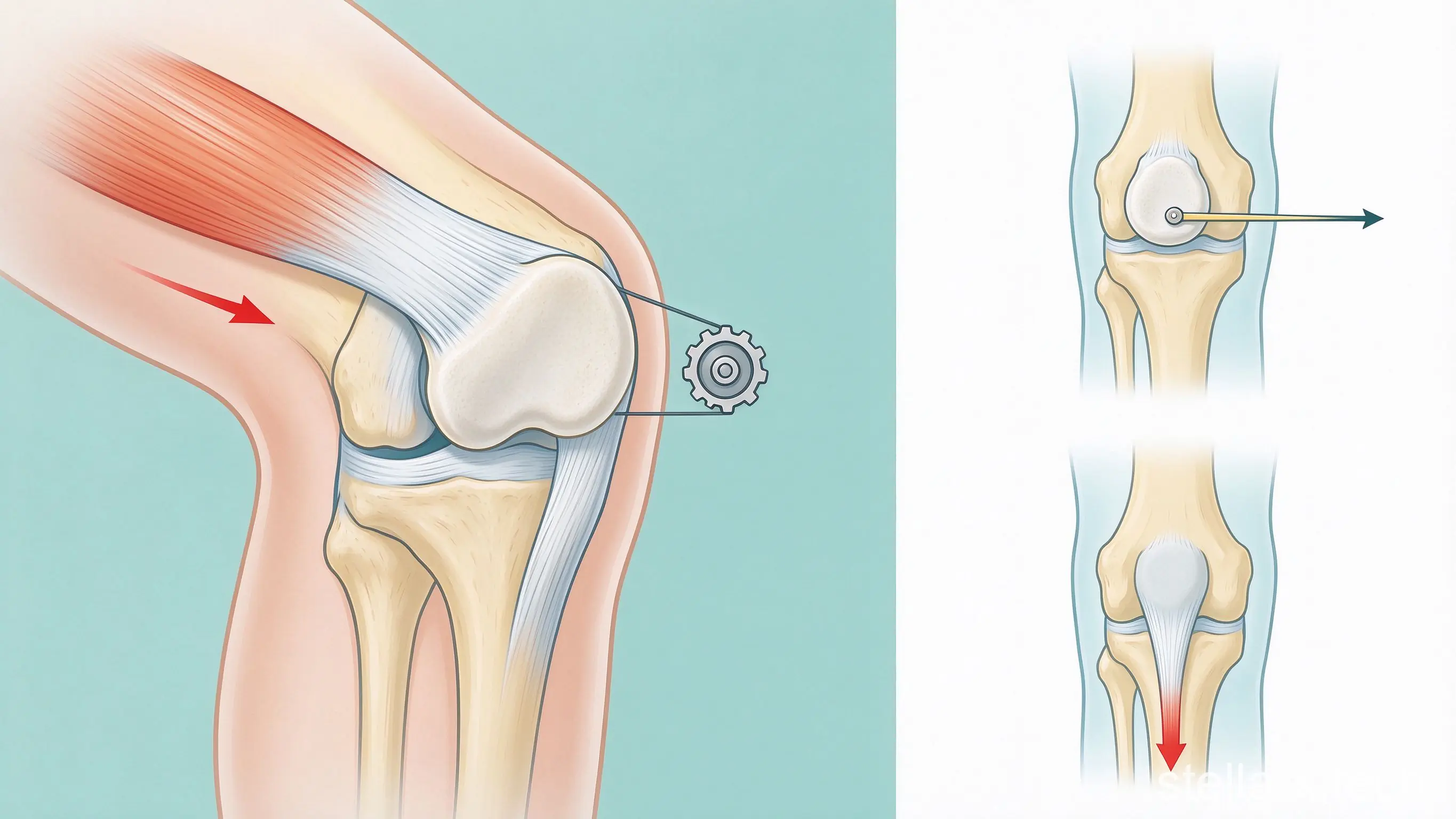
To straighten the leg — to lift the shin — the quadriceps muscle at the front of the thigh contracts. The quadriceps tendon runs over the front of the patella and attaches to the tibial tuberosity below, so the patella acts like a pulley: when the quadriceps contracts, the patella uses leverage to pull the shin up, and the leg straightens.
Put the fulcrum at the center of the distal femur, and the patella geometrically increases the lever arm of the quadriceps force. More lever arm means the quadriceps needs less force to extend the leg. Less muscle force means less stress transferred to the knee joint and minimum wear on the joint.
So for a load-bearing, high-mobility joint, adding this one bone buys you both economy and durability. A larger pulley radius means less force needed — the human knee is a genuinely clever piece of mechanical design. It also means the patella, precisely because it is a pulley, carries the quadriceps load in a concentrated way, and becomes a natural weak point when that load arrives as a sudden impact.
The Four Things an Orthopedic Surgeon Actually Checks
Orthopedic surgeons care about four questions after such a fall: Is the joint surface crushed? Is the leg's mechanical axis off? Are the ligaments and meniscus also injured? Are the nerves and blood vessels intact?
The tibial plateau deserves special attention. Think of it as the "tabletop" under the knee joint. When a high axial load lands on it — especially with a bit of varus, valgus, or rotation mixed in — the tabletop can split or collapse. How many fragments matter, but what matters more is how badly the articular surface is damaged. Bone usually heals; if the joint surface does not recover well, years later you may be left with post-traumatic arthritis.
Where Climbing Surprises People
This is the part of climbing that is easy to underestimate.
While you climb upward, everyone watches the fingers, the forearms, and the shoulders. When you actually fall, it is usually the ankles and knees that take the blame.
A bouldering pad only lengthens your deceleration distance. With the right body position, the pad saves you. Land stiff on one leg, and a few square meters of foam do not change Newtonian mechanics.
Age and Bone Density: Don't Run to the Other Extreme Either
A fully grown adult landing from three meters on one leg can fracture even with completely normal bone density.
Add a heavy body, weak quadriceps, poor hip control — and days full of deep squats, stair climbing, and running-jumping — and the patella easily becomes the Achilles' heel of the knee.

Does that mean climbing is off the table? Of course not. People in their fifties and sixties can still climb, ski, and run. It just means the playbook should upgrade with age: train enough strength, drill the landings, and stop early when you are tired.
When you are young, a wrong movement — the body often helps you round it out. When you are older, the body starts to strictly enforce the laws of physics.
Right now, the only three things you can "one-tap reinforce" are: muscle, technique, and not being too proud to quit.
Your knee's cartilage and the quadriceps muscle that protects it are built from the same cell-level machinery you can see under a microscope. WWAI gives you real microscopy specimens to explore at multiple magnifications — including a human hyaline cartilage specimen where the cartilage cells and matrix that cushion your knee joint are clearly visible — with AI answers about what you are seeing. Search "WWAI" in your app store and download it now.

Related reading

ACL Tear: Why Viral Dance Moves Injure Knees
Child Spine Curvature Signs Parents Should Check

Glutes and Aging: What 61,000 MRI Scans Show
References
Landing physics, patellar anatomy, and tibial-plateau biomechanics in this article follow a public explainer by a traditional Chinese medicine orthopedics PhD. All illustrations are AI-generated.
- Why Fish in a Plastic Bag Beat Fish in a Bucket
- 魚離開水能活多久?塑膠袋比水桶更保命
- Shamonda Virus: The First Human Case Ever Reported
- 沙蒙達病毒:全球首例人類感染病例
- Vegetable Nutrition: Why Lettuce Isn't the Healthiest Green
- 蔬菜營養排名:生菜墊底?真正的營養之王是這 5 種
- Metformin for Healthspan: Muscle, Bone, and a Tumor Switch
- 二甲雙胍延緩衰老?中年肌肉骨骼與膠質母細胞瘤的新證據
- 甜高粱會取代甘蔗與甜菜嗎?植物也會得「糖尿病」
- Why Sweet Sorghum Could Replace Sugar Cane and Beet
全部评论