Venomous Catfish: Fish That Fake Being Monsters
Something black and compact was walking across the seafloor toward him — a living shadow roughly the size of a truck, moving with a strange, unhurried flow. Anyone who escaped that would spend the night telling a monster story: a giant fish demon rising from the deep.
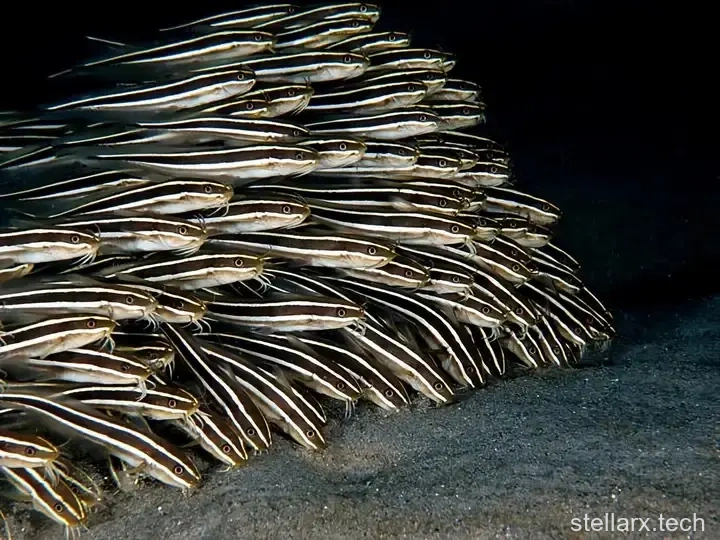
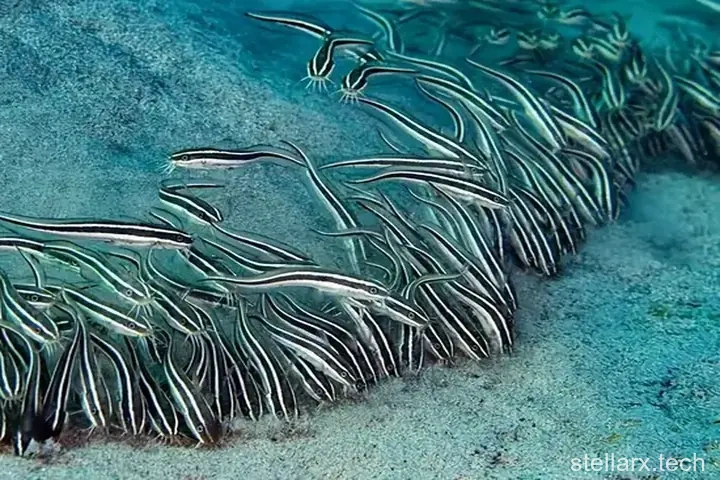
The truth is almost insultingly small. The "monster" was made of a few hundred juvenile striped eel catfish, swimming in such tight, coordinated ranks that they read as a single enormous animal.
The Fish That Is Already Armed
The adult version does not need theater. The striped eel catfish (Plotosus lineatus), also called the venomous catfish or "poison eel," carries venom glands at the base of the stiff spines on its dorsal and pectoral fins. The venom combines a neurotoxin with a hemotoxin. A sting means severe pain, swelling, and dizziness — and, in the worst cases, breathing failure, shock, and a real risk of death.
Laboratory toxicity tests on fish, crabs, and rodents confirmed the venom is lethal. A grown catfish, with that arsenal, is left alone by most of the reef.
Why the Young Ones Form a Monster
The juveniles have a problem: they are small, and their venom is comparatively weak. Being small and barely venomous makes them a target. So they stopped being one individual and became something else — hundreds of young catfish squeeze together into a single dark mass, and the mass itself does the scaring. Predators that would happily eat one small fish do not approach what looks like a large predator lying on the sand.
Watch the mass closely and the illusion starts to show its machinery. Each fish changes position as the group moves, in something like a conveyor belt. Fish at the bottom of the pile get a turn to dig through the sand and feed; when they are done, they quietly slip to the back and the inside of the crowd, and the next fish takes the bottom spot. The whole column glides over the seafloor with a fluid, almost hypnotic coordination — a monster that is actually a moving queue.
The Sea Serpent That Is a Million Mouths
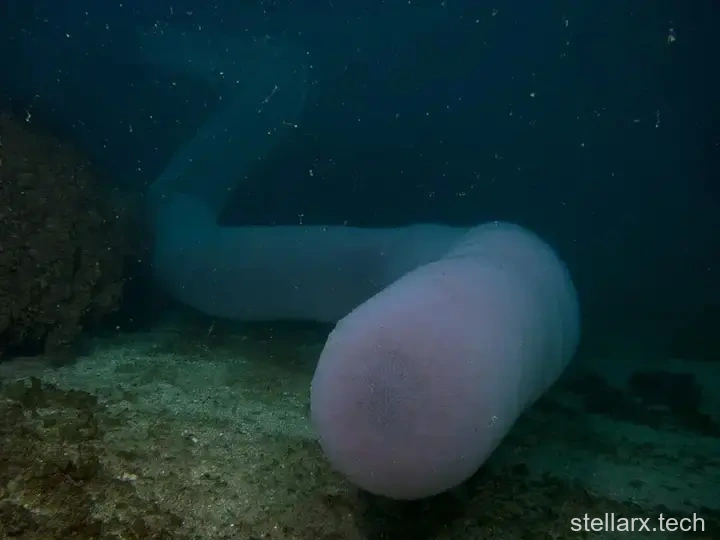
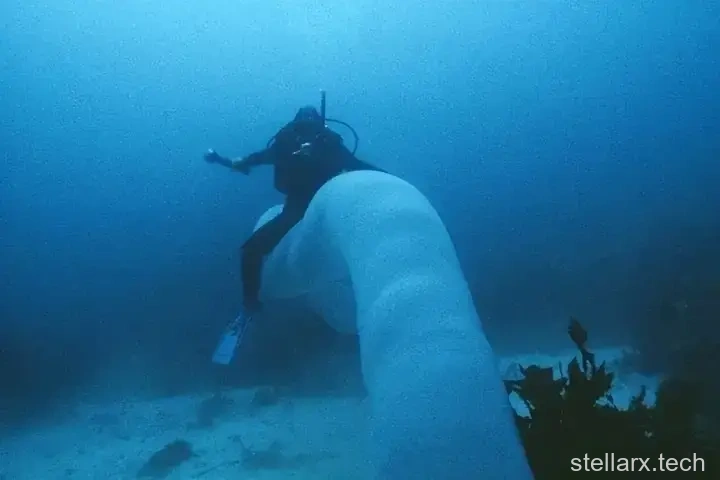
Deep water has the same trick on a larger scale. A diver meeting this one for the first time believes they have startled a giant sea snake: a soft, jelly-like cylinder ten-odd meters long and a meter wide, glowing with an eerie light, apparently without brain, spine, or guts — a hollow glowing pocket.
It is a pyrosome colony. Each individual is a few millimeters of translucent tunicate, a tiny open-ended sack that pumps seawater through itself to filter out plankton. Packed by the hundreds of thousands, the colony keeps its pocket shape and grows to whatever the math allows — colonies of Pyrostremma spinosum reach about 20 meters long and 1.8 meters in diameter, large enough for a diver to swim inside. The glow is bioluminescence, and together with sheer size it is the colony's defense.
Not every pyrosome is built to be a monster. The family has 3 genera and 8 species, and only two of them are the drift, translucent kind — the spiny and the delicate (Pyrostremma and related forms). The other six are the firm, compact type that look more like plastic than jelly and stay small. The Atlantic species (Pyrosoma atlanticum) that washes up on beaches is a few centimeters long, like a small sea cucumber, at most 60 centimeters — a transparent cucumber, not a sea serpent.
The Cheapest Survival Trick in the Ocean
Predators hunt by shape: big shapes are dangerous, small ones are food. The juveniles of a venomous catfish and the colonies of a glowing tunicate both exploit that assumption — the smallest animals in the ocean routinely dress up as the largest. No armor, no speed, no venom upgrade; just hundreds or millions of bodies agreeing to pretend together. When being small and poisonous is not enough, being a monster is the cheapest survival strategy there is. There is nothing supernatural under the sea — just very, very coordinated teamwork.
Want to see how a simple animal body works — no brain, no bones, just tissues doing their jobs? WWAI's virtual microscope includes a Hydra (longitudinal section) specimen where the body wall, tentacles, and digestive cavity are clearly visible, and next to it a fish-tail cross section shows how swimming builds muscle, bone, and scale in layers. Ask the AI what you are seeing, then open the specimen yourself — no microscope to order, no slide to prepare. Search for WWAI in your app store.

Related reading

Dolphin Makes Fish Vomit to Steal Food

Woodpecker Concussion Myth: Real Brain Damage

Dinoflagellate Genome: Largest on Earth
References
1. FishBase — Plotosus lineatus (striped eel catfish). https://www.fishbase.se/summary/Plotosus-lineatus.html
2. NOAA Ocean Exploration — What is a pyrosome? https://oceanexplorer.noaa.gov/facts/pyrosome.html
3. Wikipedia — Striped eel catfish. https://en.wikipedia.org/wiki/Striped_eel_catfish
4. Wikipedia — Pyrosoma atlanticum. https://en.wikipedia.org/wiki/Pyrosoma_atlanticum
- Ectopic Tooth in Eyelid: A World-First Superior Orbit Case
- 眼瞼長牙的真相:全球首例眶上異位牙
- What Is Lean Muscle? 4 Factors Behind 'Thin Muscle' Physique
- 薄肌理論是啥?4 個特徵決定你的肌肉線條
- 雙層保溫碗夾層長黴:60℃ 熱水殺不死的細菌
- Mold in a Double-Wall Baby Bowl: What 60°C Can't Kill
- Why Vacuum-Sealed Food Can Cause Botulism
- 肉毒桿菌中毒:真空包裝不是保鮮保險箱
- Why the Death's Head Hawkmoth Looks Like a Skull
- 鬼臉天蛾背上的骷髏,是人腦畫出來的

全部评论