The Chicken's Gizzard: A Dinosaur's Stone Crusher
What happens when a chicken swallows a leech? The leech's fans expect it to latch onto the stomach wall and drink blood for years. The chicken's body has a different plan — a chemical bath, a stone-lined grinder, and a one-way trip to becoming chicken dinner.
The chicken doesn't have a stomach like yours. It has a biological ball mill.
The chicken-shaped ball mill
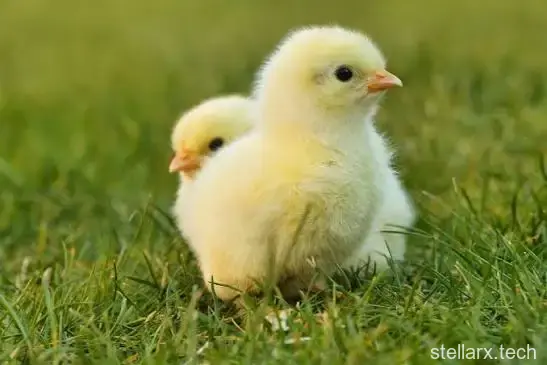
The gizzard — the muscle pouch Chinese cooks call "chicken gizzard" — is, to a biologist, a masterpiece of mechanical engineering. Its wall is powerful muscle, with a tough, keratin-like membrane inside that is highly mechanical and repairs itself quickly. Stones cannot scratch it. A leech is nothing to it.
Inside, the gizzard holds gastroliths — hard stones the chicken swallows on purpose.
Chickens are born without teeth. The gizzard, packed with stones, takes over the work of tearing and grinding.
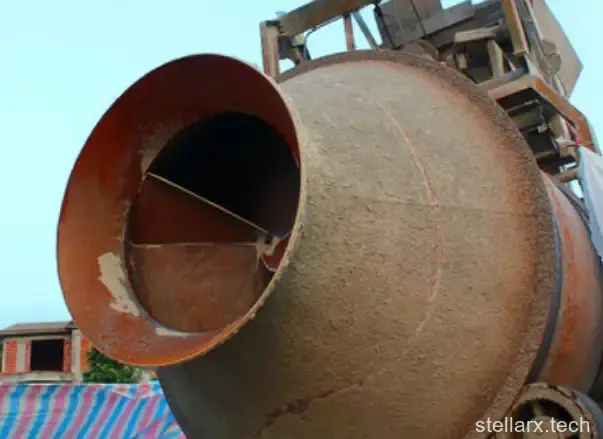
Call it the ball-mill gizzard: the muscle pouch squeezes, and the stones inside crush, rub and mill whatever comes in. For the leech, it is "falling into a stone-mill hell."
And a leech's suction needs one thing a chicken's gut refuses to provide: a continuous, smooth surface, like human skin. The chicken's digestive tract is rough — nothing for a leech to latch onto.
The leech's one-way journey
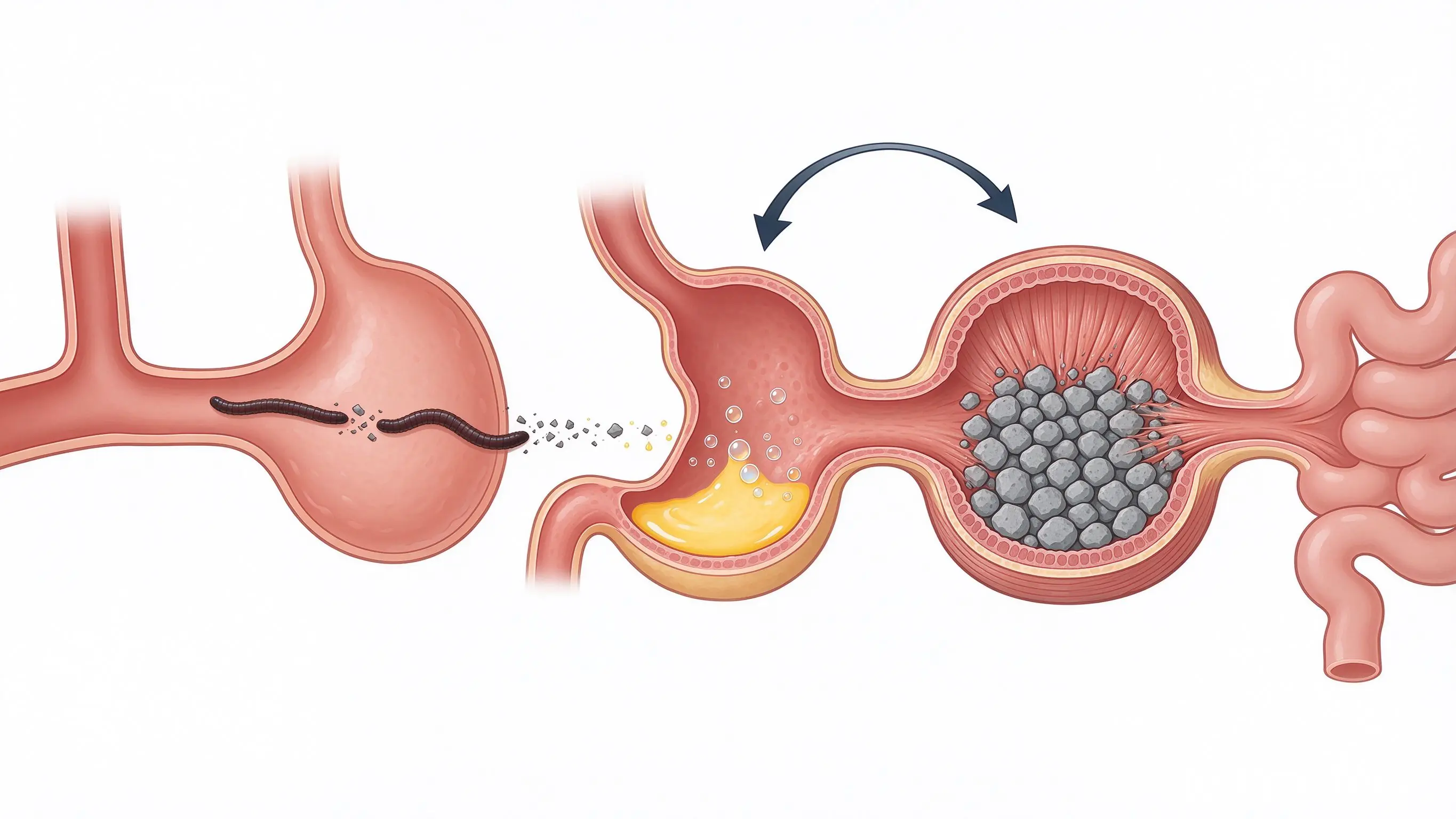
The leech enters through the esophagus. First stop: the crop. Not lethal, but hostile — secretions and microbial fermentation lower the pH and soften food, draining the leech's energy.
Then the proventriculus (glandular stomach). Here the chemical assault begins: chicken gastric acid can drop to pH 0.5–2.5. A leech's delicate skin takes a beating, while pepsin starts breaking down the proteins in its defenses. When the acid mixes with food the pH softens to about 2–4, giving the leech a brief gasp of relief.
Then the gizzard. Powerful contractions drive the swallowed stones in a relentless cycle of squeezing, friction and grinding against the leech's body. A leech is flexible — but it is still flesh and blood.
And the worst part: after the gizzard has pounded it soft and half-dead, antiperistalsis sends the mash back to the proventriculus for another round of acid and pepsin attack, then back to the stone grinder. Repeat. Around and around.
In the end, the leech is reduced to a slurry of chyme — then moves to the small intestine, the large intestine, is digested and absorbed, and becomes chicken nutrition.
For a chicken, a leech is the least challenging prey it will ever eat. Grains, nuts and beetles are ground the same way, all day.
The evolution runs backwards to your intuition
You'd assume the sequence is: ancestors lost their teeth → so they evolved stomach stones to help grind. Sounds logical. It's wrong.
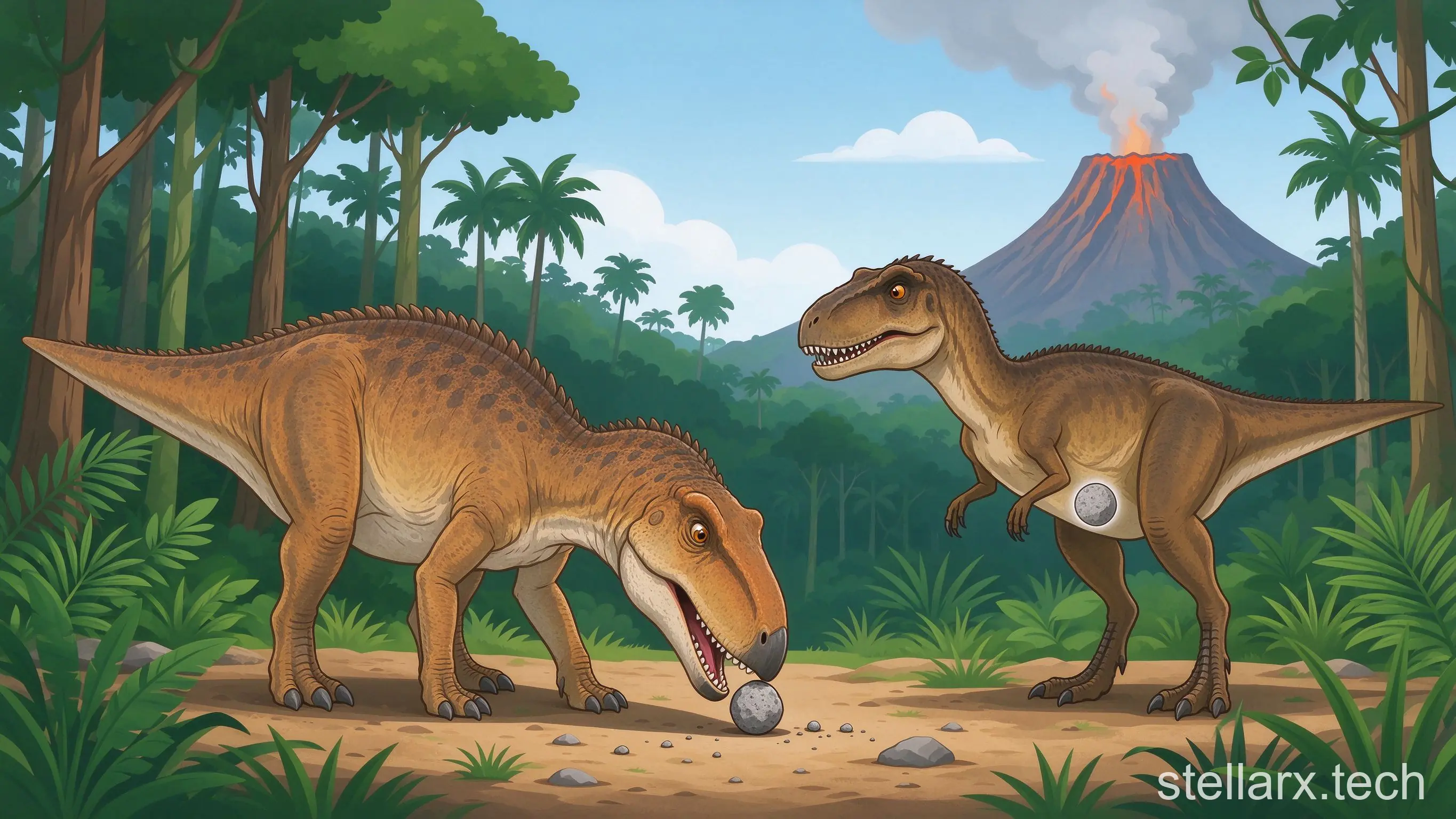
The ball-mill gizzard existed before the teeth disappeared. More than 100 million years ago, in the Cretaceous, multiple dinosaurs were already swallowing gastroliths to aid digestion — including the ornithischians Psittacosaurus (the parrot-beaked dinosaur) and Gasparinisaura, and the theropods Limusaurus (mud dragon), Sinornithomimus, Shenzhousaurus and Caudipteryx (the tail-feathered dinosaur).
Swallowing stones may have evolved independently several times across the dinosaur dynasty.
As for splitting the stomach into a glandular proventriculus plus a muscular gizzard — that may have begun in the coelurosaurian theropods. One lineage of small coelurosaurs that kept the gastroliths gave rise to the paravians, took to the air, and became birds. Within birds, one branch became the chicken-like lineage; within that, the pheasant family; and within the pheasant family, the red junglefowl was domesticated by humans — and became the chicken.
So it was the ball-mill gizzard that promoted tooth loss — not tooth loss that produced the gizzard. Once birds took to the skies, weight demands pushed the two in a mutual spiral: less teeth, more grinding.
The chicken's stone mill has survived a hundred million years of testing. A single leech melts on entry.
The leech-eaters' field notes
A cattle herder's childhood, told firsthand: when the buffalo waded into water, it walked straight in like a spell, lay down, and floated on its back. When it came out, the animal's belly hung with leeches the size of sweet potatoes. The chickens rushed over, stretched their necks, and chased and pecked under the buffalo's belly.
Pigs did the same — and a dozen chickens followed happily, clucking. Chickens can't swim, so these were about their only two chances to eat leeches.
The true professionals were the field ducks: they hunted leeches in shallow ditches. If a duck shook its tail joyfully, stretched its head up and down, opening and closing its beak — it had just eaten a leech or a river snail. Snails were swallowed whole and came out whole — empty shells, the meat gone.
When kids swam, leech bites were rare: leeches stay in shallow water. Deeper water has big fish that eat leeches, and no mosquito larvae either. The worst leech season was rice transplanting, and the mid-autumn month when everyone waded for river snails. A leech bite bleeds for several minutes. Don't yank it off — use fire, or tobacco smoke, or salt.
The same herder kept a secret: leeches are the best frog bait. Tied one on, and he could pull up several jin of frogs. The big frogs around the fish pond were wary — jump into the water at any footstep. So he'd circle the pond, scare the frogs in, then use a longer pole with a fishhook. The frog surfaced, its two big eyes obvious, off guard — it took the baited hook, flew over his head in an arc, and landed behind him with a croak. Into the bag.
His friends searched for the secret but never found it. They thought a fishhook could only catch fish — no one ever fished for frogs with one. "Connecting unrelated things — that's what imagination is," he concluded.
Even the eagle knows the rule: it raids chicken coops without a strong rooster. A coop with a red-combed, gold-clawed rooster in it? The eagle stays up in the sky unless starving.
A hundred million years of stone-mill evolution — and a leech enters, and is gone. Nature's oldest food processor was already crushing before birds even had beaks.
See the muscle that runs the mill. A smooth muscle specimen under the microscope shows long spindle-shaped fibers — the same tissue packed into the gizzard wall that drives the stones. Search "WWAI" in your app store and download it today.
Related reading

Is Honey Bee Vomit? The Secret Life of Honey


- Feeding Wildlife Can Get It Killed
- The Chicken's Gizzard: A Dinosaur's Stone Crusher
- Heart Attack at 49: Fit, Sober, Still Struck
- Stroke & Brain Hemorrhage: First Step Saves Life
- Firefly Glow: A Cold Light Humans Learned to Copy
- Heartburn or GERD: The Valve That Gives Up
- A Tiny Wound Nearly Killed Him: Tetanus Facts
- One Kidney vs a Regrowing Liver: Two Different Organs
- IBS and the Gut-Brain Axis: Why You Poop When You Leave Home
- Stomach Burst Risk: A 2-Hour Buffet Emergency | stellarx
全部评论