This Dolphin Makes Fish Vomit to Steal Their Food
Near the southern end of Australia's Great Barrier Reef sits Lady Elliot Island, a small coral cay. Just off its western shore, a bottlenose dolphin swims toward a school of bigeye trevally. Nothing looks unusual at first: the dolphin moves slowly, swinging its head side to side, sending out echolocation clicks. Then its attention sharpens. In the moving school, it seems to pick one fish.
The dolphin accelerates. The trevally flees, twisting and turning; the dolphin matches every change of direction, never losing the same target — even when it must surface to breathe, it dives again and keeps chasing the same fish.
Then the trevally does something strange. It vomits.
The dolphin stops chasing. It dives for what the fish brought up, swallows it, and lets the fish escape — then circles back to the school to begin the hunt again.
This is not a one-off caught on camera. Researchers have recorded the same behavior repeatedly over several years, always from the same male bottlenose dolphin. In a paper just published in Ecology and Evolution, they argue this may be the first confirmed case of a cetacean using kleptoparasitism — stealing food another animal has already obtained — as a foraging strategy.
Meet Bubbles
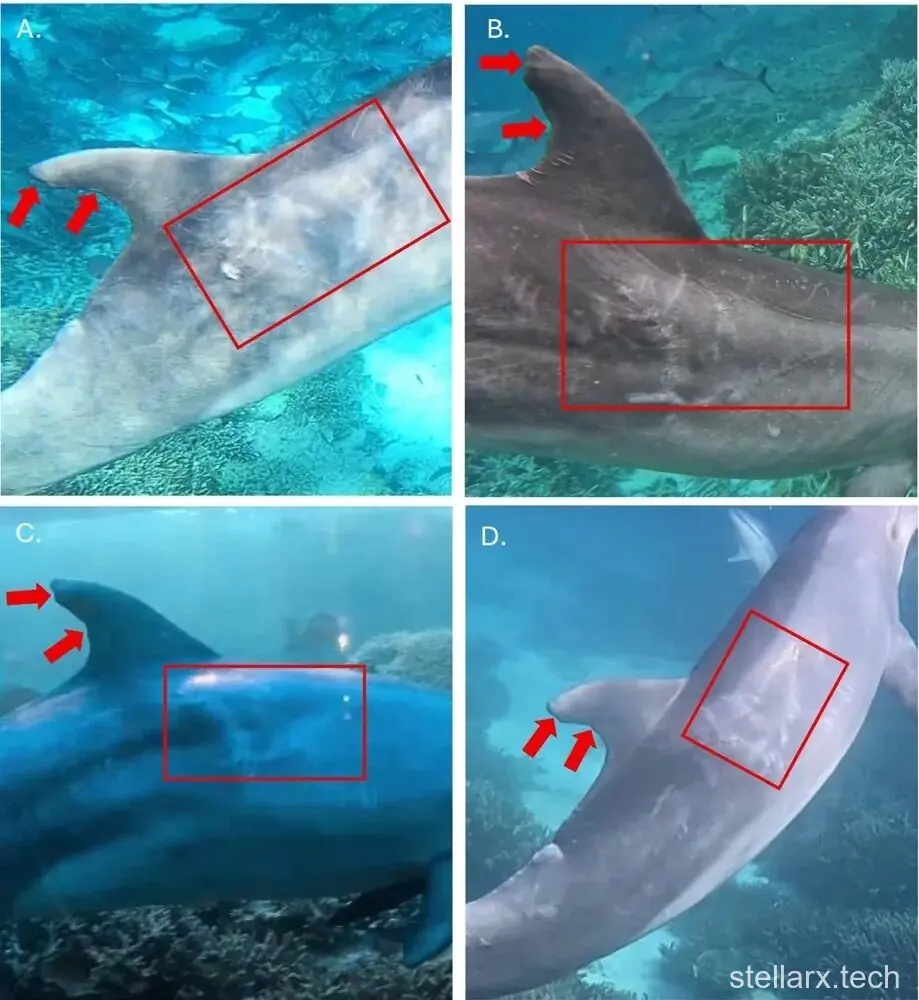
The dolphin appears around Lady Elliot Island often enough that resort staff gave it a name: Bubbles. Scientists recognize it by more reliable features — a set of permanent notches on the rear edge of its dorsal fin, and a distinct V-shaped scar on its right side. People have been spotting it off the island's western shore since at least 2017.
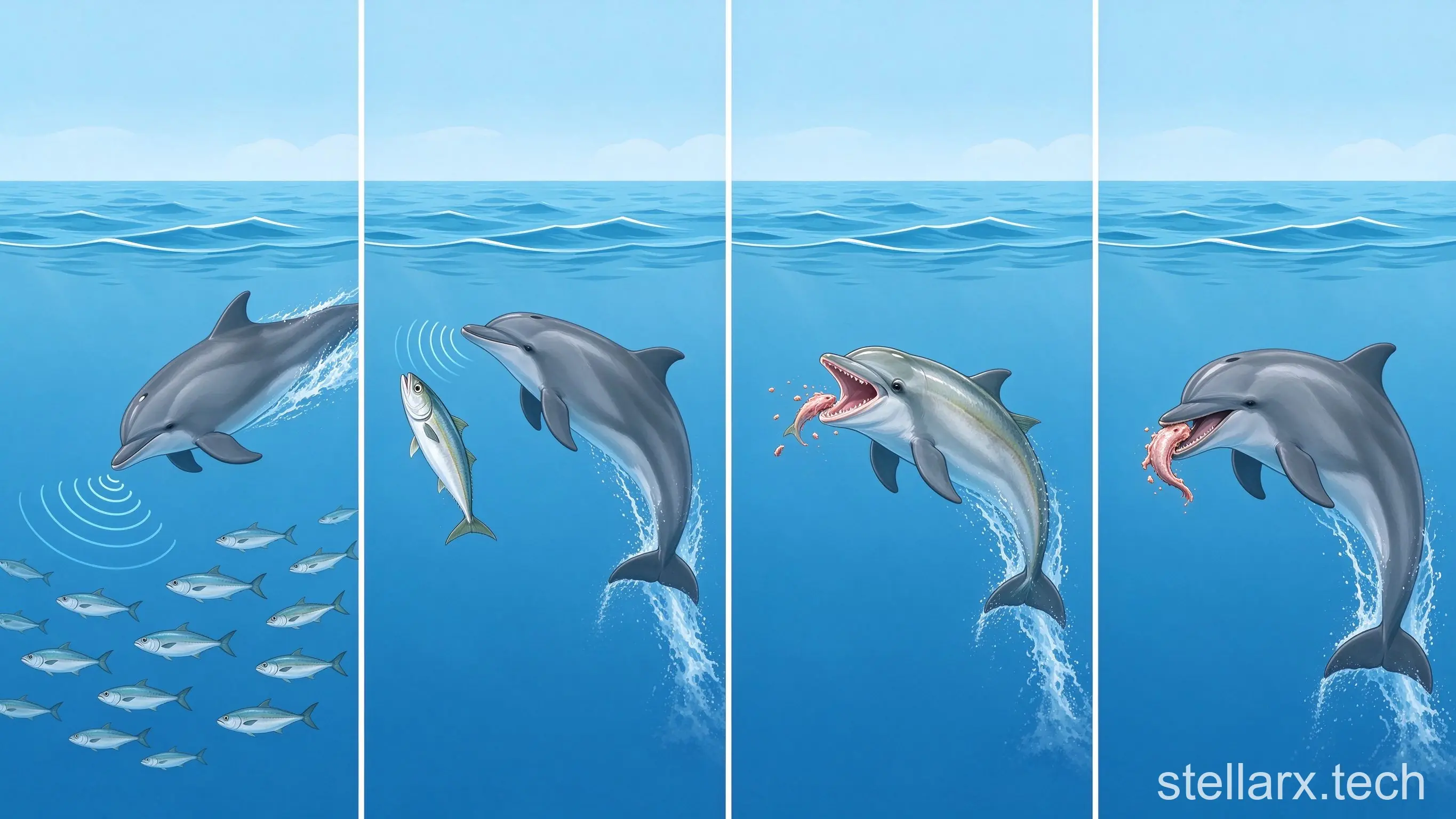
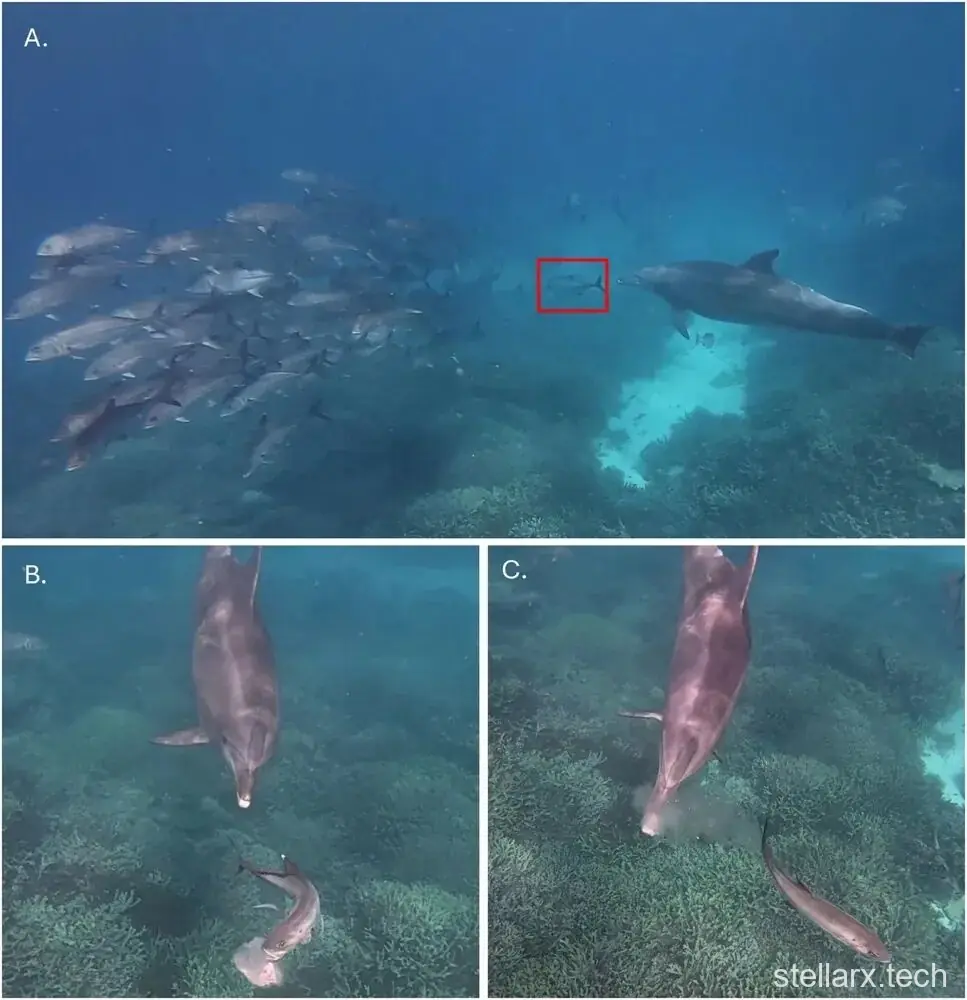
From 2021 to 2025, researchers collected 20 recorded interactions between Bubbles and schools of bigeye trevally. Eleven ended with the trevally vomiting and Bubbles eating the food. In one session the sequence repeated up to 10 times in half an hour. After each meal, Bubbles returned to the school to pick another target. In all these observations, researchers never saw it eat a trevally itself, and never saw it use the tactic on any other fish species.
The Fixed Robbery Sequence
Analyzing video, the researchers broke the behavior into recognizable stages.
First, scanning: Bubbles swims relatively slowly, making occasional sharp turns, swinging its head side to side, and producing distinctive sounds. Then targeting: the head-swinging stops, and it seems to focus on one fish, ignoring the others around it. Finally, chasing: sudden acceleration, staying glued to the chosen trevally and mirroring its direction changes. The chase typically ends when the trevally brings up food; Bubbles grabs it, stops pursuing, and eats.
Ecologically, this looks like classic kleptoparasitism. The strategy is common among birds: frigatebirds chase other seabirds that have caught prey until the victim drops or vomits it. Similar food-stealing exists among fish, sharks, and many invertebrates. The thief's advantage is obvious: most of the energy needed to find, chase, and capture food has already been paid by another animal.
The researchers suggest this is energetically attractive — especially for a dolphin foraging alone. Trevally are large; catching and eating one directly takes time and effort. Letting the trevally do the hunting, then taking the result, may save considerable energy. They have not yet measured how much energy Bubbles spends chasing, or how many calories it gains from the stolen food.
A Sonic Trick?
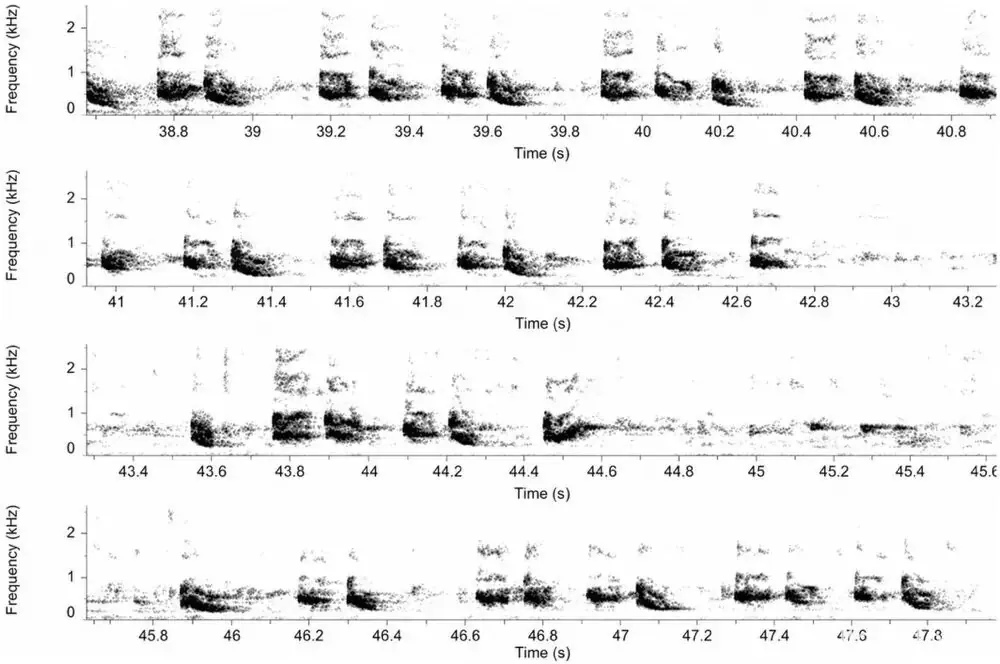
During scanning, Bubbles swings its head and makes distinctive sounds. The researchers suspect it is using sound to judge which fish has recently eaten — the right target to rob. Dolphin echolocation is extraordinarily sensitive: from returning echoes, they can distinguish differences in an object's size, shape, even internal structure. Fish produce different acoustic echoes, strongly influenced by structures like the swim bladder.
In one 75-second video suitable for acoustic analysis, researchers identified 200 vocalizations. Besides echolocation clicks, they detected many short, low-frequency sounds — possibly pressure applied to the chased trevally, nudging it to disgorge.
Is Bubbles Alone?
So far, only Bubbles has been observed doing this. Every confirmed case belongs to it. Sometimes Bubbles is seen with other dolphins — in 2018 it appeared near a trevally school with another adult and a calf — but no successful robbery was recorded that time.
Bottlenose dolphins are extremely flexible hunters. Different populations, and even individuals within a population, develop distinct foraging styles: some cooperatively herd schools of fish, some exploit fishing gear or human structures, some use objects in the environment as tools. Their powerful learning ability means a new behavior can appear in one individual first, then spread through social learning under the right conditions.
Bubbles may have discovered, in some chance encounter, that violently chased trevally sometimes throw up their stomach contents — then, through repetition, turned an accident into a stable strategy: find the right target, chase until it vomits, take the food.
Whether Bubbles learned this from other dolphins, or has taught it to others, remains unknown. From the current record, it appears to be the only dolphin that robs trevally.
What Comes Next
Before this study, scientists had recorded events that might involve cetacean food-stealing — sperm whales, for instance, have vomited when harassed by other whales. But in those observations, nobody actually saw the attacker eat the disgorged prey. In Bubbles' case, researchers witnessed the complete chain: choose a target, chase it, the victim vomits, and the thief eats.
That completeness is why the authors treat it as direct evidence of kleptoparasitism in cetaceans. Open questions remain: does Bubbles actually choose targets by whether they have food in their stomachs? Why exactly do the trevally vomit? Do the low-frequency sounds matter? And how much energy does this actually save?
There may be much more we don't know about how dolphins live. Most of their lives happen below the surface; even common behaviors can evade human attention for years. A scientist on a boat may only see a dolphin dive and surface again — never knowing that meters below, it just picked out another hunter's dinner and stole it. The researchers expect animal-borne cameras and drones to reveal more unseen foraging behaviors in the future.
Want to see the neural wiring that lets a dolphin turn echoes into a mental picture — the kind of processing that lets it pick one fish out of a school? WWAI includes a nerve cell specimen where branching nerve cells are clearly visible. Just search "WWAI" in your app store and download it today.
References:
[1] First evidence of a cetacean using kleptoparasitism as a foraging strategy. Ecology and Evolution 2025. https://onlinelibrary.wiley.com/doi/10.1002/ece3.74270
[2] Dolphin chased fish until it puked, then ate the vomit. Science. https://www.science.org/content/article/dolphin-chased-fish-until-it-puked-then-ate-vomit
[3] EurekAlert research release. https://www.eurekalert.org/news-releases/1144019
[4] Kleptoparasitism in animals. Encyclopedia of Animal Behavior. https://www.sciencedirect.com/science/chapter/edited-volume/abs/pii/B9780128006481000048
All illustrations are AI-generated.
Related reading
Centipede Leg Count: 21 to 191 Pairs
- Ancient Food Was Never Pure: Urine, Lye, and Fake Fish
- When Lockdown Laziness Grew Glowing Algae
- Why a Tick Bite Can Make You Allergic to Red Meat
- Who Has More Legs: House Centipede or Centipede?
- Vibrio vulnificus: Seafood Pricks That Can Turn Fatal
- This Dolphin Makes Fish Vomit to Steal Their Food
- Mercury in 'Baby Cod': A Toddler's Label Trap
- Male Lactation Is Real: Why Females Nurse
- Where the 1.6–2.2 g/kg Protein Rule Comes From
- Why Cockroaches Aren't as Tough as You Think
全部评论