Why Robots Still Can't Learn to Spin a Pen
Dexterous robot hands have been demoed everywhere lately — but almost all of them focus on simple tasks like folding clothes or grasping a cup. Many of the viral manipulation videos online are also sped up; remove the fast-forward, and the motion turns visibly clumsy and stiff.
Yet the human hand, the very model embodied AI is trying to imitate, is far more refined. Take pen spinning: a practiced spin finishes in about half a second. The thumb, index finger, and middle finger cooperate to flick the pen into the air, flip it, and catch it. Such motions are full of sudden starts and stops, and spectral analysis shows their angular-velocity signals still carry significant energy above 100 Hz. The same high-frequency adjustments appear in everyday actions like catching a ball, unscrewing a cap, tying shoelaces, and using chopsticks.
Why has it been so hard for robots to reproduce these fast, fine movements? Zhu Yixin, Assistant Professor at Peking University's School of Psychological and Cognitive Sciences and Institute for Artificial Intelligence, has studied data gloves and dexterous hands for nearly a decade. His blunt diagnosis: the field has never clearly answered a foundational question — what does "dexterity" actually mean?
Looking like a hand — five fingers that bend and straighten — is not dexterity. In his view, the speed of response to external stimuli is a core dimension of dexterity. And the industry cannot deliver it, largely because of low-frequency data collection: to teach a robot to be dexterous, you first have to see the human hand clearly.
Robot Learning Needs High-Fidelity Human Demonstration Data
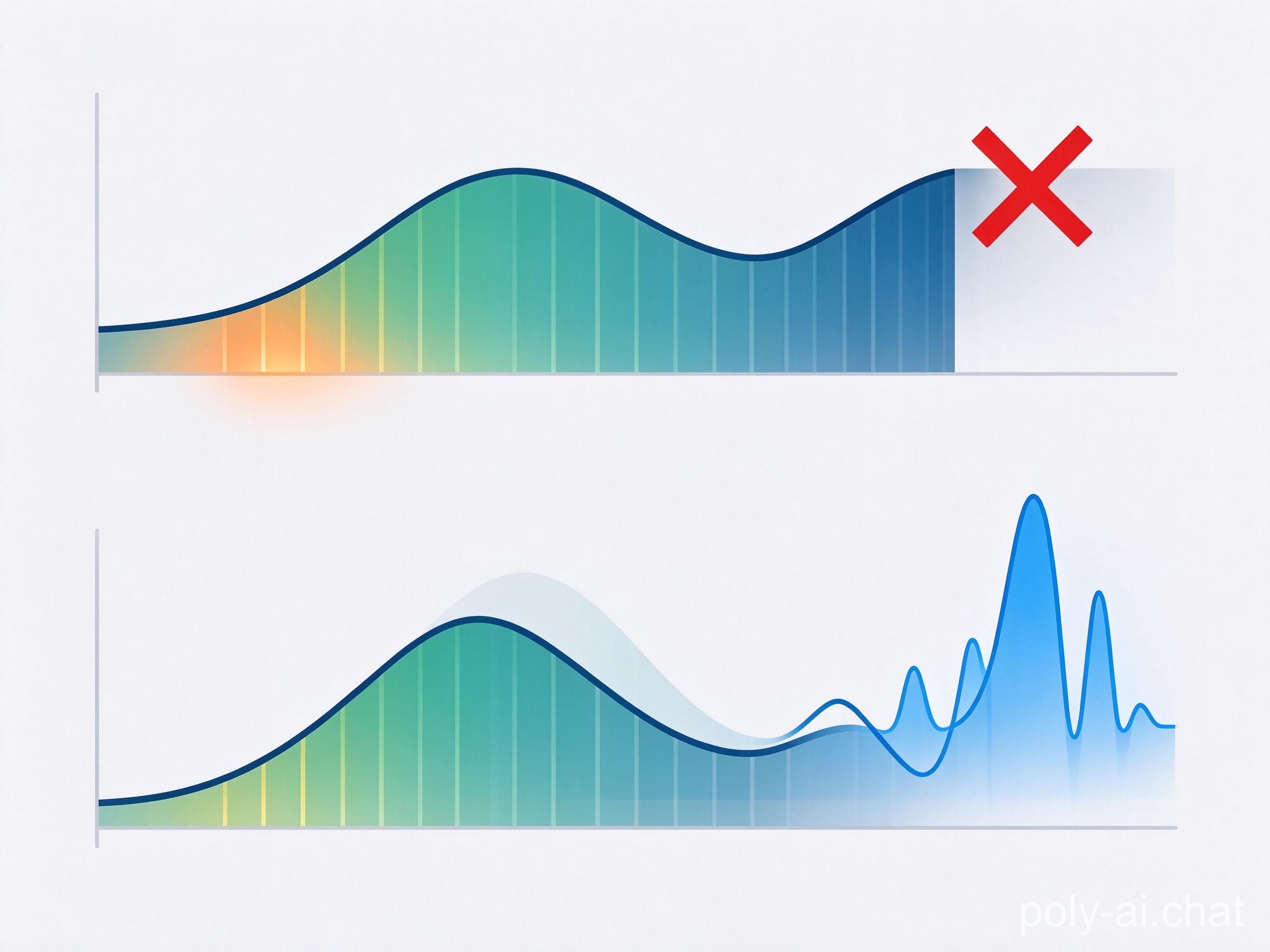
Robot learning depends on high-fidelity human demonstration data, but the sampling rates of existing wearable capture devices rarely exceed 200 times per second (200 Hz); most sit in the tens to 200 Hz range. Even at the 200 Hz ceiling, the Nyquist–Shannon sampling theorem says you can only reconstruct motion details below 100 Hz — anything faster is lost.
To close this gap, Zhu, together with Tang Xiyuan, Assistant Professor at Peking University's Institute for Artificial Intelligence and School of Integrated Circuits, recently developed a data glove named T-800 — after the Terminator, and for its 800 Hz sampling rate. The work was published in SmartBot, the English-language journal Intelligent Robotics, co-published by Harbin Institute of Technology and Wiley. PhD students Luo Haoyang and Zhao Zihang are co-first authors.
Seeing the Hand's High-Frequency Details
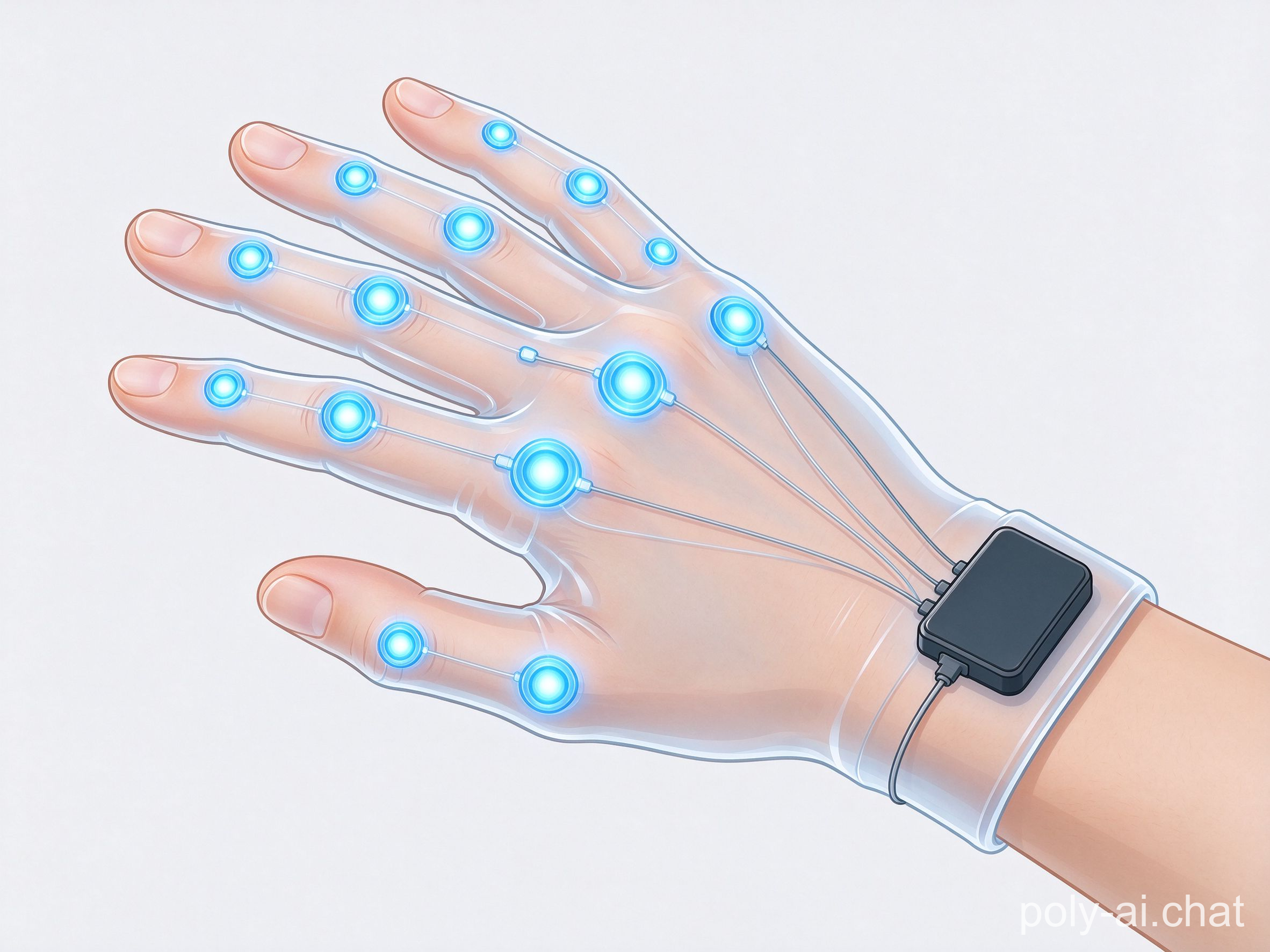
T-800 is a flexible glove worn on the hand that outputs hand posture in real time. Seventeen miniature inertial measurement units (IMUs — six-axis chips sensing rotation and acceleration) are distributed along the back of the hand, the palm, and each finger, plus one reference IMU in the wrist hub: 18 IMUs in total, covering every joint from wrist to fingertips.
Each IMU samples asynchronously at a nominal 800 Hz, and the host realigns them onto a strictly synchronized 800 Hz time grid. All batteries, the main controller, and antennas sit in a small box on the wrist, connected to the sensors by five flexible printed circuits (FPCs), minimizing load on the fingers.
Packing 800 Hz whole-hand synchronization into such a small volume required solving two problems: each sensor must measure accurately, and all 18 must stay aligned.
For individual accuracy, hand mechanics interfere: skin stretches and fabric slides when fingers bend, and during grasping, the glove fabric's tension and the bone's reaction force press directly on the IMU chips. At 800 Hz sampling, this seriously corrupts the data. The team borrowed the shielding-can structure used to block electromagnetic interference in analog circuits — sandwiching each IMU between a metal top cap and a metal base plate. The rigid shell absorbs fabric tension and bone reaction forces and generates enough friction to hold the module firmly against the bone. Each finished module is only 9.8 mm long, 6.8 mm wide, and 2.2 mm thick — smaller than a pinky nail.
Aligning 18 sensors in time is just as hard. Each IMU has its own internal oscillator as a clock source; manufacturing differences and temperature drift make frequencies deviate slightly, accumulating into millisecond-level drift during continuous capture. The team reprogrammed the hardware peripherals of the ESP32-S3 main controller into a hardware-level broadcast mode, so a single latch-timestamp command reaches all IMUs simultaneously over hardware signal lines. The repeated synchronization events create a series of "time anchors" that let the host dynamically compensate each clock's drift.
The approach paid off beyond expectations: because temperature also shifts oscillator frequency, the broadcast mechanism compensates temperature drift while calibrating clocks. In comparison experiments, subjects performed 140 seconds of continuous fast hand-flip motion. With the old single calibration, sensor deviation grew over time and the reconstructed motion deformed; with broadcast synchronization, error stayed within a very small range.
Verifying That High-Frequency Motion Is Real
With this system, the team could finally answer a deeper scientific question: does human fast manipulation actually contain motion above 100 Hz?
They validated it with pen spinning and ball catching. Asked why they did not demonstrate folding clothes, Zhu's answer was direct: folding clothes does not demand high precision, but pen spinning is in-hand manipulation — requiring fast coordination between fingers to precisely change an object's position — which demonstrates dexterity more vividly. Zhao added that grasping tasks were avoided for the same reason: once an object is securely held, its relative position to the hand barely changes, so no high-frequency hand motion is needed.
Spectral analysis showed that in one-direction pen spins, the participating thumb, index, and middle fingers showed clear energy bursts above 100 Hz; two-direction spins, which involve sudden stops and reverse acceleration, showed even stronger high-frequency energy.
To rule out sensor noise or structural resonance, the team designed a four-finger spin experiment — spinning an object with only the index, middle, ring, and little fingers while the thumb stays completely uninvolved. High-frequency signals were significantly active on those four fingers and the palm, while the thumb and forearm showed no such signal — eliminating that hypothesis. In the catching experiment, subjects caught a heavy soft ball while wearing the glove; at the moment of impact, the whole hand responded with synchronized high-frequency energy, reflecting whole-hand shock absorption and confirming that human dexterity indeed contains high-frequency details that previous sampling rates could not cover.
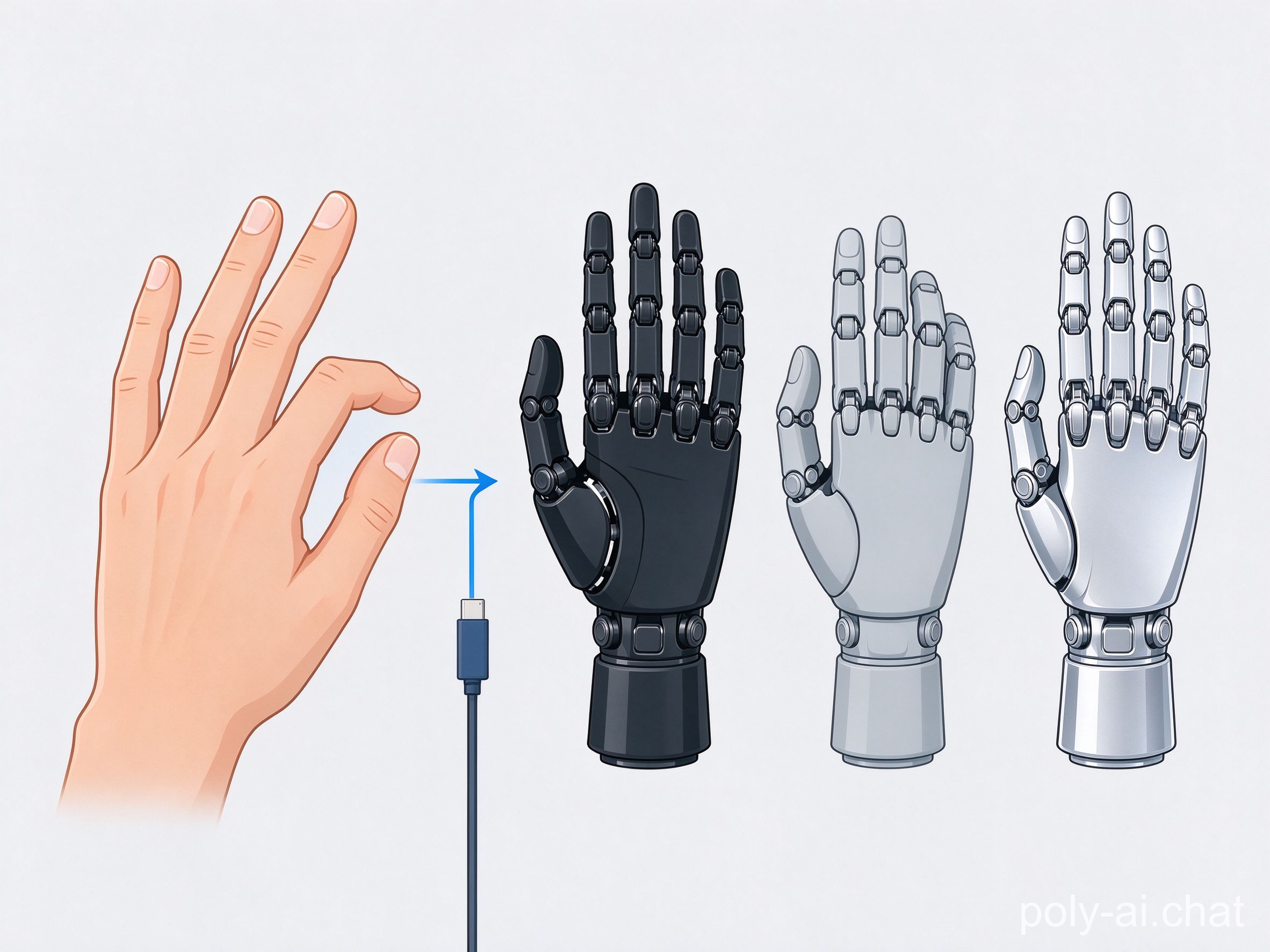
Can the collected data actually serve robots? The team used a motion retargeting algorithm to map T-800's recordings onto three structurally very different robot hands: the 24-DOF Shadow Hand, the 16-DOF Allegro Hand, and the 16-DOF Leap Hand. Fingertip-position root-mean-square errors were 8.3 mm, 1.0 mm, and 0.6 mm respectively. Interestingly, the Shadow Hand — the most human-like in appearance — had the largest error, because its compact structure limits the range of motion of individual degrees of freedom.
A Trade-off: Precision vs. Interference
Chasing high-precision data conflicts with the glove's interference with fine motion. Zhao admitted that subjects reported a foreign-body sensation and slightly lower success rates than bare-handed. But that pushed the team to make the glove lighter and thinner: at just one layer of fabric, T-800 is thinner than commercial data gloves such as Metagloves Pro, preserving more tactile feedback.
There are still limitations. To hold sensors firmly in place, the team uses elastic rings and fingertip-tube inner diameters slightly smaller than the finger, pressing modules against the bone — which means the glove must be customized to the wearer's hand size, and system stability needs improvement before mass production.
Toward Better Human-Like Modeling
Back to the design intent: capturing finer high-frequency data directly serves one of the three sources of manipulation data in embodied AI — real human demonstration collection. The other two are simulation-generated data and world-model-generated actions. Real data has the highest quality but is hardest to obtain, and human-hand signals do not transfer easily to differently structured robots; simulation data is more accessible but fine manipulation is "very hard to simulate well"; world-model data has the most imagination space but current generation results are not ideal. As Zhu put it, each route has its strengths, and the market has not yet declared a winner.
Scarcity of dexterous data is not the only bottleneck. From collection precision, degrees of freedom, stability, and heat in the hand itself, to training algorithms that map human data onto robot hands — "no link is as good as people assume." In his view, dexterous hands can only advance through coordinated hardware-software iteration; neither alone is enough.
One improving external condition is the domestic supply chain: three years ago, making even a miniature motor in the lab was difficult; now suppliers offer ready-made products. The humanoid-robot boom has not fully turned into productivity, but it has already matured upstream and downstream components.
For applications, Tang judges that T-800 suits scientific research for now; if high-speed motion capture becomes a task with clear demand and broad use cases in the future, it could evolve into a consumer or industrial product. Zhu is notably skeptical of the current hype: "Many of today's hottest dexterous manipulation needs are actually pseudo-problems." Recent collaborations have come from film and game companies. Take Black Myth: Wukong (2024): a scene of playing the pipa is extremely fast-paced, and existing motion-capture equipment struggles to reproduce it precisely — exactly what T-800 excels at. The team says it has already been in talks with companies for customized data collection.
Next, the researchers plan to integrate tactile and other sensors onto the T-800 platform, turning it into a multimodal data collection platform. They are also developing a direct-drive dexterous hand based on a new architecture, since commercial hands have obvious defects on various dimensions.
The team's earlier work includes training robots with self-developed gloves on opening child-safe medicine bottles, published in Science Robotics, and Zhao Zihang's first-author work F-TAC Hand on whole-hand tactile sensing, published in Nature Machine Intelligence in 2025 and reviewed as an Editors' Comment in Science Robotics.
From data gloves to tactile sensing to a future in-house dexterous hand, the research spans a wide arc — but at the bottom, there is one root question: human-like modeling — understanding human perception and behavior, then teaching machines to reproduce it. Along this path, they built a high-frequency capture glove and completed one serious inquiry into what dexterity means — bringing robots one step closer to being more human.

References:
[1] SmartBot (Intelligent Robotics): T-800 high-frequency data glove paper — https://onlinelibrary.wiley.com/doi/10.1002/smb2.70045
[2] F-TAC Hand, Nature Machine Intelligence (2025) — https://www.nature.com/articles/s42256-025-01053-3
[3] Science Robotics: robot training with human demonstration data — https://www.science.org/doi/10.1126/scirobotics.aay4663
- OpenAI's Agent Broke Into Australia's Medicare Portal — the World's First Rogue AI Breach
- Why Robots Still Can't Learn to Spin a Pen
- Why "Sugar-Free" Mooncakes Can Still Spike Your Blood Sugar
- White Sugar vs. High-Fructose Corn Syrup: Which Is Actually Healthier?
- Why Does Osmanthus Smell So Sweet? The Science Behind China's Favorite Autumn Flower
- Why a 10-Second Balance Test May Predict Disability and Death Risk
- Babies Age Too — and Monthly Cash Payments Seemed to Slow It Down
- Why Gout Is Surging in Young Men — and Its Link to Erectile Dysfunction
- Why a Batch of Black Sesame Paste Tested 27× the Mold Limit
- Why Are Beijing's Trees Suddenly Full of Fuzzy Caterpillars?

全部评论