Why Does Osmanthus Smell So Sweet? The Science Behind China's Favorite Autumn Flower
By the wwai Editorial Team
When autumn winds pick up, the first sweet fragrance to drift through streets and parks usually needs no introduction. You cannot see the source from a distance, but you know it at once: the osmanthus is blooming. Small golden flowers hide among dark green leaves, yet the scent fills the whole block. It is a perfect invitation to ask what is actually going on inside that tiny flower.
The "Gui" Family: Which Osmanthus Is the Real One?
In Chinese, the character "gui" covers a surprisingly large family: more than a thousand plant species are named "gui". Three are the most famous — bay laurel (Laurus nobilis), cinnamon (Cinnamomum), and the one we call osmanthus. The first two are celebrated for spice and medicine; the last one is the true Chinese classic, one of the country's ten traditional famous flowers.
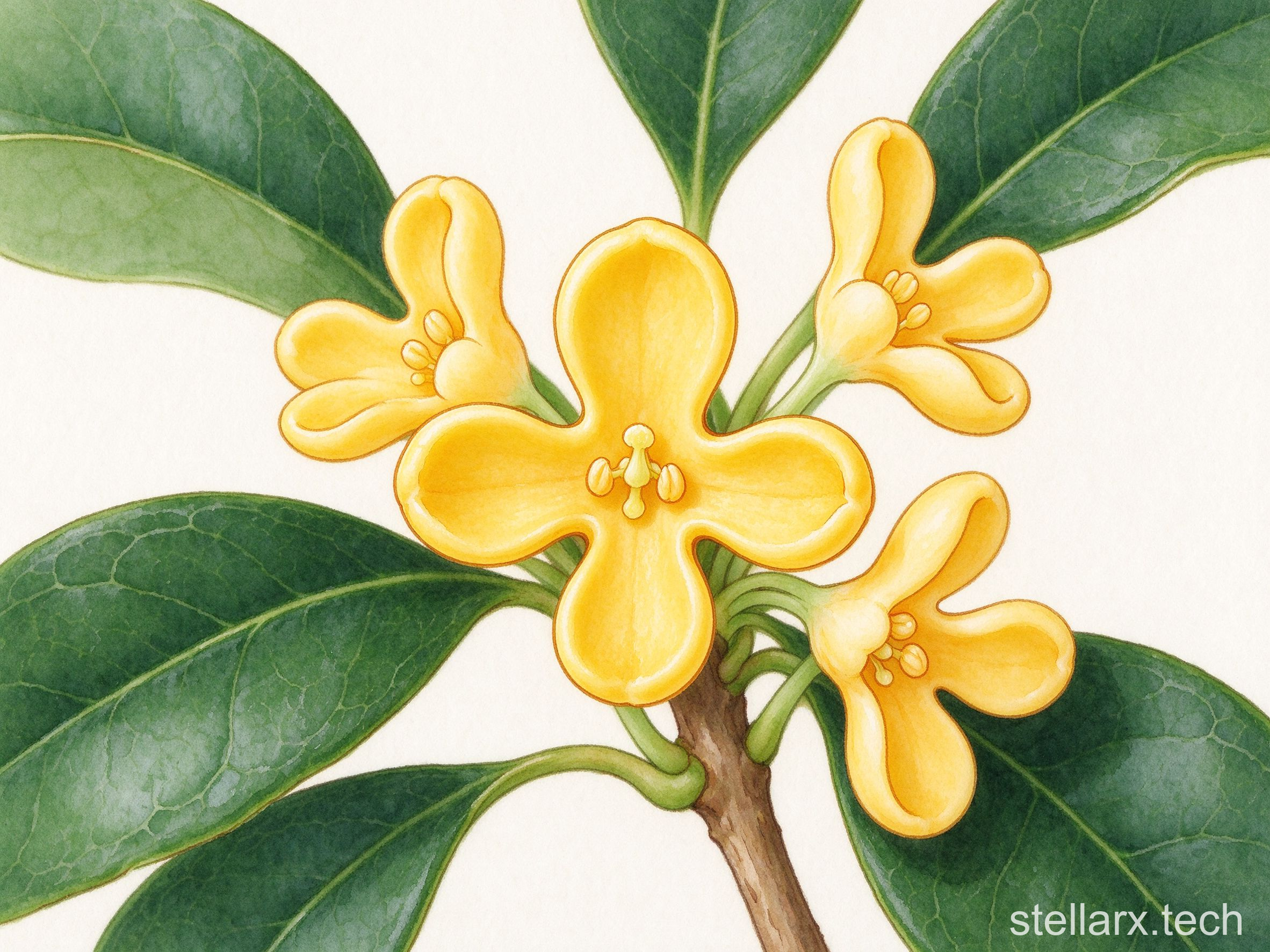
Its formal botanical name is Osmanthus fragrans, an evergreen small tree or shrub in the family Oleaceae. The bark is gray-brown, the leaves are leathery and opposite, and the small flowers grow in clusters from the leaf axils. The corolla splits into four lobes like a tiny pinwheel. The genus name Osmanthus comes from Greek for "fragrant flower", and the species name fragrans literally means "fragrant" — even the scientific name insists that scent is its calling card.
Osmanthus is native to southwestern China and has been cultivated for more than two thousand years. Emperor Wu of the Han Dynasty once planted osmanthus widely in the Shanglin Garden. Today more than twenty Chinese cities — including Suzhou, Hangzhou, Guilin, Xianning, Xinyang, Weihai and Quzhou — have named it their city flower.
Why Is Osmanthus So Fragrant? A Chemical Conversation
The osmanthus scent is sweet, warm, and faintly creamy — the poet Li Qingzhao wrote of its "pale yellow, soft nature", and the Tang poet Song Zhiwen called it "heavenly fragrance falling from the moon". That reputation comes from volatile aromatic compounds in the petals. About 120 scent compounds can be detected in fresh osmanthus flowers, with linalool, beta-ionone, ocimene, and gamma-decalactone as the leading players. Different cultivars mix these compounds in different ratios, which is why each variety has its own personality of scent.
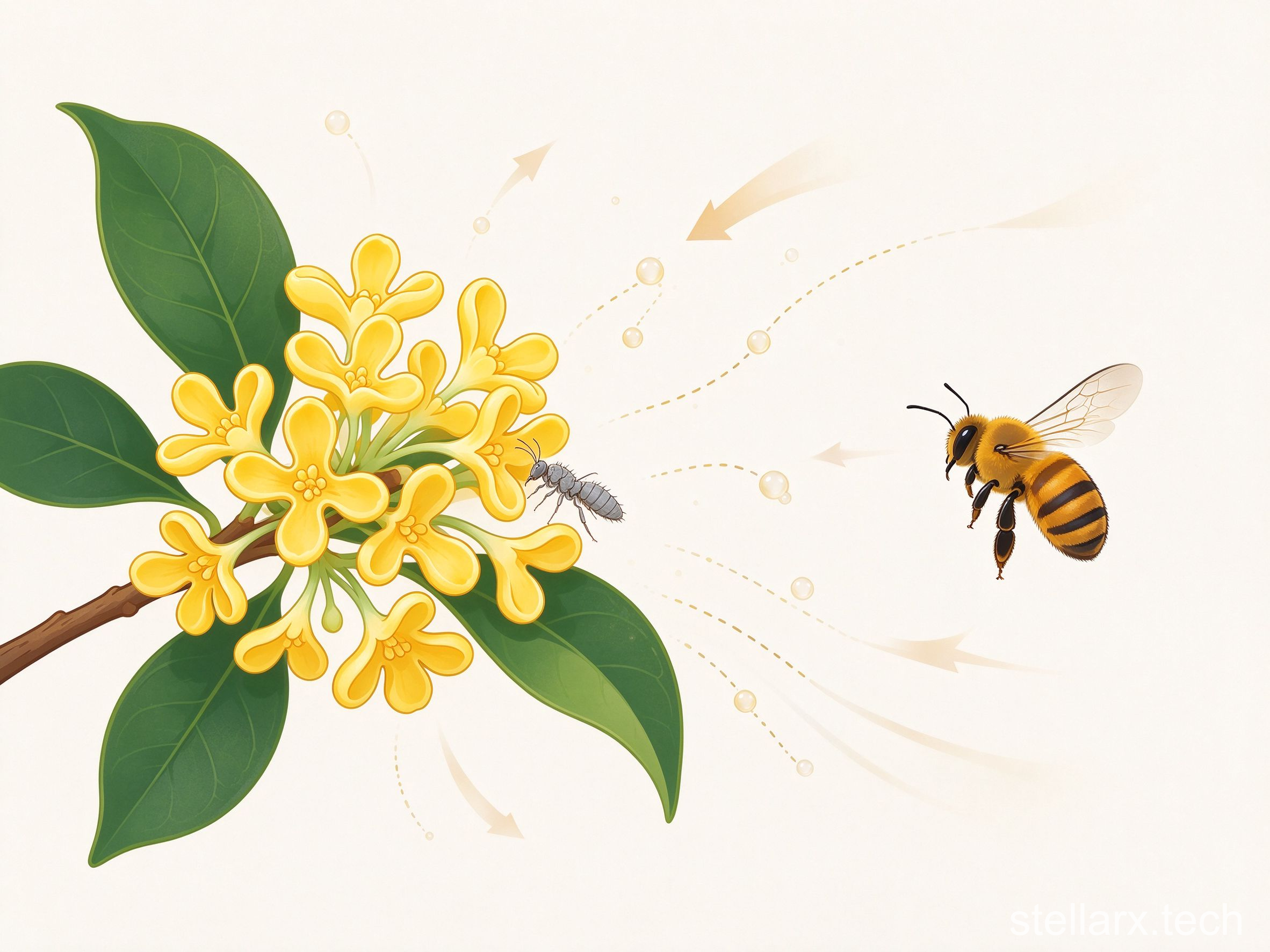
What is even more interesting: osmanthus does not produce this perfume to please us. Research by the team of Huang Shuangquan at Central China Normal University revealed a clever "push–pull" strategy. The flower's real pollinators are thrips — tiny insects only one or two millimeters long that are easy to overlook. Beta-ionone pulls thrips in, while a combination of beta-ionone and linalool repels bees that would otherwise come to eat pollen. It is an invitation with a built-in security gate: attract the right guest, keep out the wrong one. We humans, stopping to enjoy the smell, are merely eavesdroppers on an evolutionary conversation.
Four Cultivar Groups: Golden, Silver, Orange, and Everblooming
After centuries of cultivation and selection, osmanthus has formed four major cultivar groups, with about 180 registered varieties in China today. Here is a quick field guide for the autumn season:
Golden Osmanthus (Jin Gui) — flowers golden-yellow to lemon-yellow. The most intensely fragrant group, rich in beta-ionone with a woody undertone. Blooms from late September to early October. Commonly used for sugar, wine, and ornamental purposes.
Silver Osmanthus (Yin Gui) — flowers silver-white, milky-white to yellowish-white. Fresh and sweet but lighter, with higher ocimene content. Blooms in autumn, slightly earlier than the golden group. Used for ornament and scent extraction.
Orange Osmanthus (Dan Gui) — flowers orange-yellow to orange-red. High in linalool, clean and sweet but overall fainter. Blooms in autumn with a shorter flowering period. Mainly ornamental.
Everblooming Osmanthus (Si Ji Gui) — flowers whitish or pale yellow. The least fragrant group. Blooms multiple times a year. Often grown in pots or as ground cover.
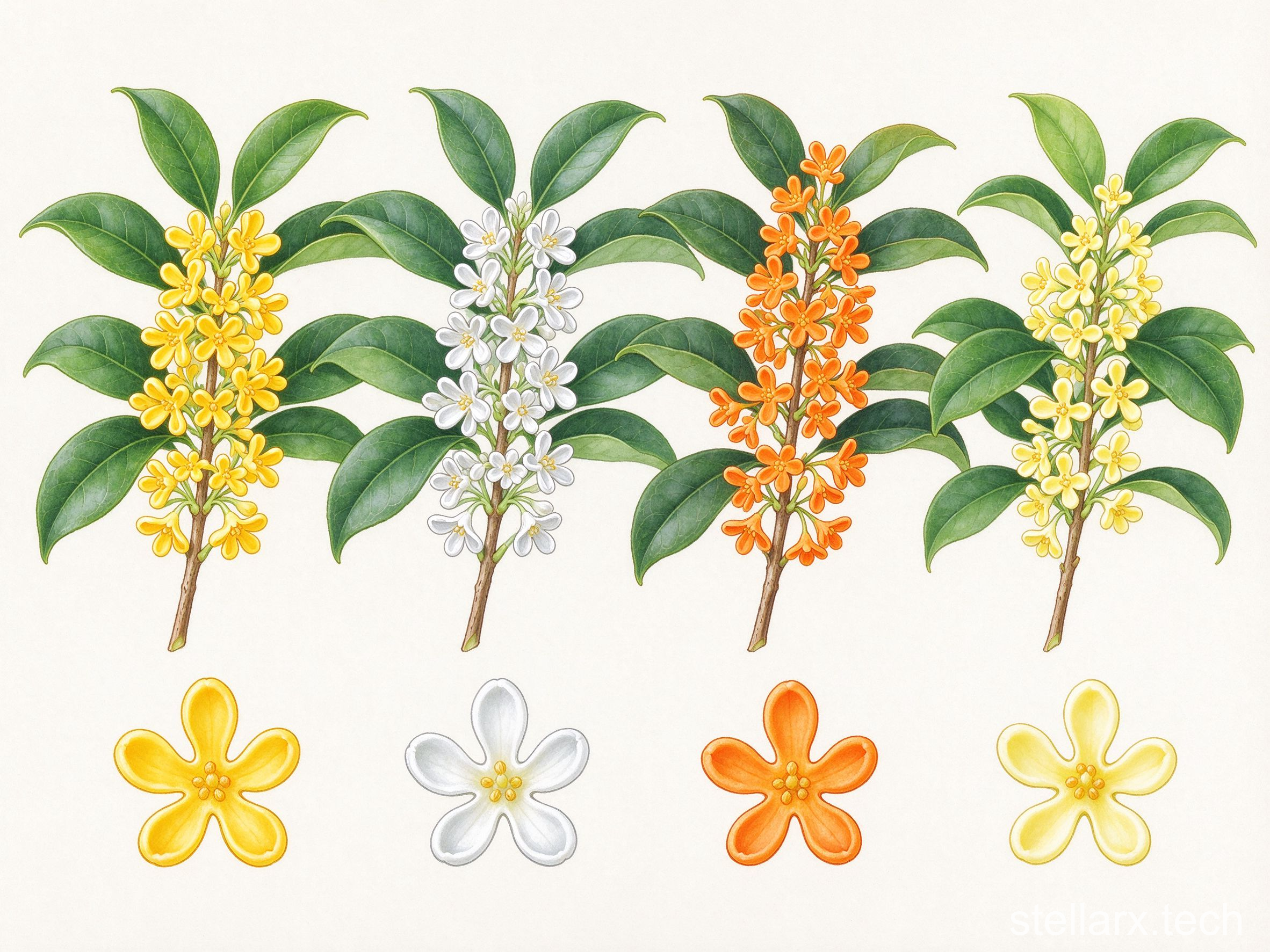
A useful warning: the most colorful flower is not necessarily the most fragrant. Judging osmanthus by color alone will often mislead you.
Osmanthus and the Moon: A Thousand-Year Romance
Looking at the mottled craters of the full moon, ancient people imagined a cassia tree growing there. Because the Mid-Autumn Festival happens to coincide with the osmanthus bloom, the flower and the moon became inseparable: the moon is called "the osmanthus moon", and the legend of Wu Gang endlessly cutting the osmanthus tree spread through the culture.
In the Tang Dynasty, the imperial examination was held in the eighth lunar month — exactly when osmanthus perfumed the air. Passing the exam therefore became known as "plucking the osmanthus from the moon palace", and osmanthus became the flower of scholarly ambition. In Dream of the Red Chamber, Lin Daiyu teases Jia Baoyu that he is sure to "pluck the osmanthus in the moon palace" — the same allusion.
At the table, osmanthus's aromatic compounds dissolve poorly in water but partly in alcohol, which is why traditional wisdom uses it in sweets and wine: osmanthus cake, osmanthus honey wine, osmanthus dumplings, osmanthus duck — even the poet Qu Yuan's line about "ladling osmanthus wine with the Big Dipper" describes osmanthus liquor.
Three Common Misconceptions About Osmanthus
1. "Osmanthus never bears fruit?"
The osmanthus breeding system is special: it is andromonoecious — within the same species, some plants produce only male flowers and cannot set fruit, while others produce hermaphroditic flowers that can. Cultivated osmanthus is usually propagated by cuttings taken from male trees whose petals are less likely to drop, which is why most osmanthus we see "only bloom and never seed". When you do spot clusters of purple-black, grape-like "osmanthus fruits" on a street tree, they are drupes that ripen from March to April. Their Chinese name sounds like "noble child", and they have long been regarded as a lucky omen — though the pit takes up more than two-thirds of the fruit, so they are best admired, not eaten.
2. "Why doesn't my osmanthus bloom?"
Flowering needs a cold stimulus: most autumn-blooming cultivars require a sustained period with daily average temperatures below 23 °C and minimum temperatures below 20 °C to start flower bud development. If autumn stays warm, flowering is noticeably delayed. Humidity, tree age, and cultivar all play a role — so when osmanthus blooms late in a warm year, the tree is not being lazy; the weather is stalling.
3. "Wang Wei's 'osmanthus falls when one is at leisure' is about autumn?"
That famous line is followed by "on a spring night the mountain is empty". Scholars suspect the osmanthus Wang Wei saw in Wangchuan was the everblooming group, which can flower several times a year — including spring — allowing the poet to write of a "spring rain of osmanthus".
From the Classic of Mountains and Seas recording "the Zhaoyao Mountain, with many osmanthus and much gold and jade", to the sweetness on your nose today, osmanthus has accompanied Chinese people for more than two thousand years. It does not win by color but moves people by fragrance; it is both a legend in the moon palace and a chemical signal under a scientist's microscope. When you share an osmanthus cake or sip osmanthus honey wine this season, you are tasting a blend of a thousand years of poetry and science.
Curious about how thrips track osmanthus by scent, or what osmanthus pollen looks like under a microscope? WWAI is an AI-powered biology encyclopedia that answers your biology questions instantly, from plant pollination to flower anatomy, and lets you observe real microscope slide specimens online. Just search "WWAI" in your app store and download it today.
References:
[1] Adapted from the public science article "Is This Fragrance Only Found in Heaven?" (此香只应天上有?) by Beijing Science Center (Digital Beijing Science Center), 2026-09-24. Locally adapted for this site's science-communication positioning; venue and event content removed.
[2] Pollination research (push–pull strategy) by the team of Huang Shuangquan, Central China Normal University, as cited in the source article. All illustrations are AI-generated. Expert review in the source article: Xia Xiaofei, Secretary-General of the Beijing Botanical Society.
- Why Robots Still Can't Learn to Spin a Pen
- Why "Sugar-Free" Mooncakes Can Still Spike Your Blood Sugar
- White Sugar vs. High-Fructose Corn Syrup: Which Is Actually Healthier?
- Why Does Osmanthus Smell So Sweet? The Science Behind China's Favorite Autumn Flower
- Why a 10-Second Balance Test May Predict Disability and Death Risk
- Babies Age Too — and Monthly Cash Payments Seemed to Slow It Down
- Why Gout Is Surging in Young Men — and Its Link to Erectile Dysfunction
- Why a Batch of Black Sesame Paste Tested 27× the Mold Limit
- Why Are Beijing's Trees Suddenly Full of Fuzzy Caterpillars?
- DeepSeek Harness Desktop Preview Goes Live — Mac and Windows Downloads Available Now
全部评论