Why Thirst Vanishes the Moment You Swallow — Your Brain Settles the Bill in Advance
After a hard workout you feel desperately thirsty. You take a few gulps of water — and almost immediately, the craving softens. But here is the puzzle: that water has not been absorbed yet. It takes minutes for water to leave the gut and reach your blood. So how does the body already know the thirst is handled?
The answer is one of the neatest findings in modern physiology: your brain does not wait for the bill — it pre-pays, then double-checks.
What Actually Makes You Thirsty: The Blood, Not the Mouth
Thirst begins in the state of your blood. When you are dehydrated, plasma water drops and sodium becomes more concentrated. Plasma osmolarity rises, and the internal environment drifts out of its set point.
A specialized cluster in the brain — centered on three nodes, the subfornical organ (SFO), the organum vasculosum of the lamina terminalis (OVLT), and the median preoptic nucleus (MnPO) — continuously reads plasma osmolarity, hormones, and circulating volume. When it judges the body short on water, it triggers thirst behavior: your mouth and throat feel dry, you seek water, and your brain tells your kidneys to hold water by releasing antidiuretic hormone (ADH/vasopressin), increasing water reabsorption instead of excretion.
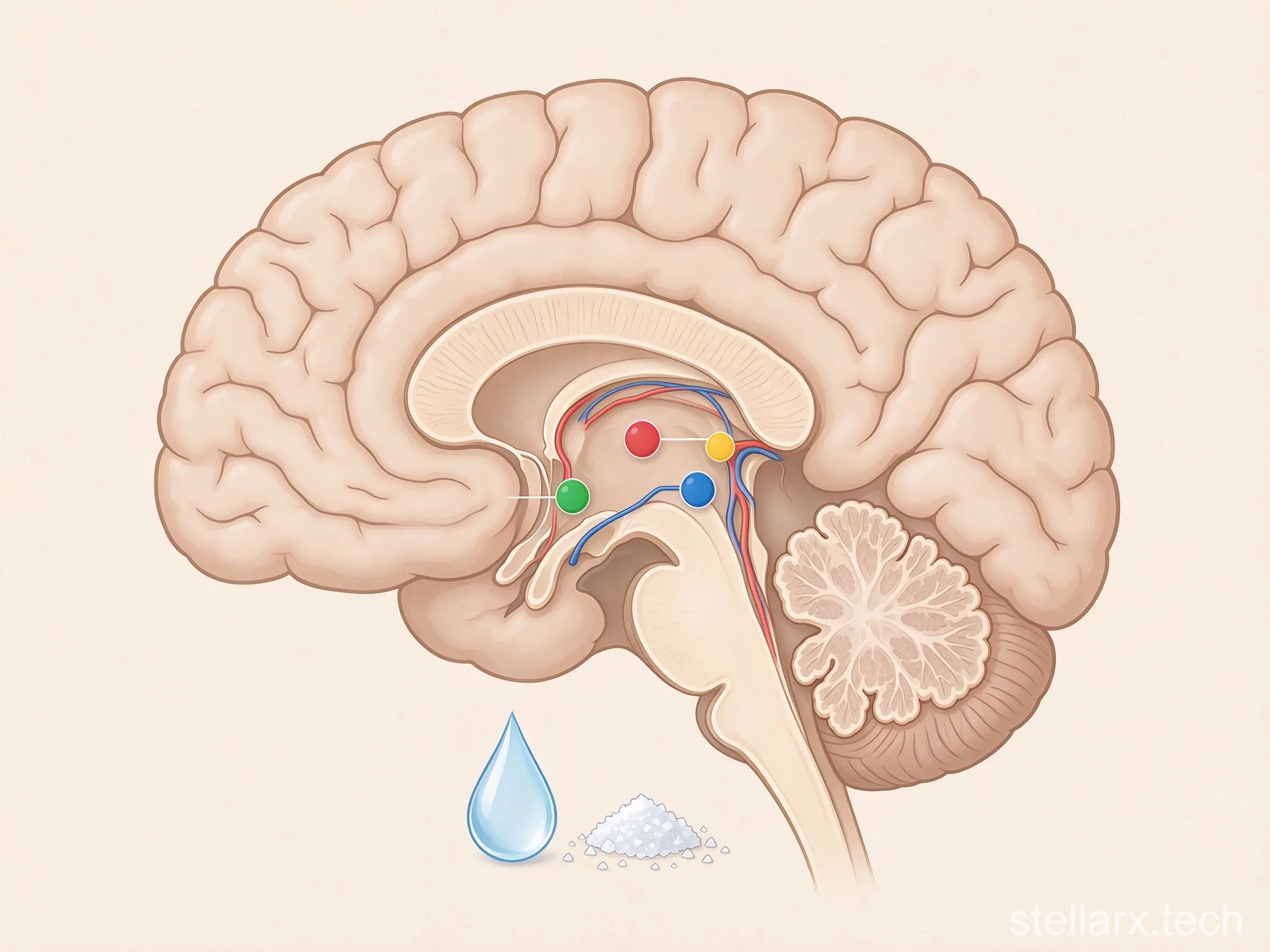
The Brain Counts Sips Before the Water Arrives
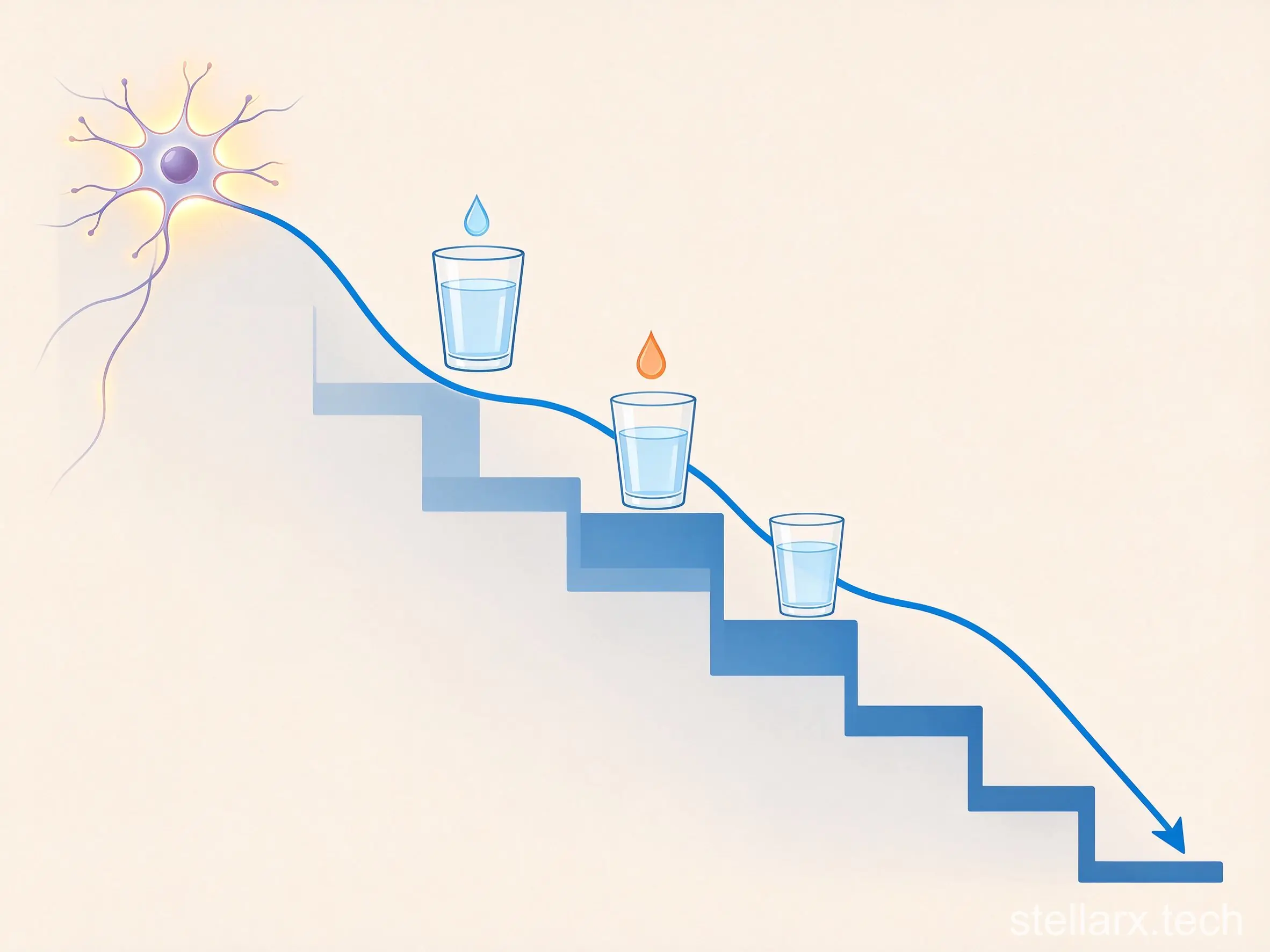
Here is where it gets clever. In 2016, researchers published in Nature a study using fiber-optic recordings in the SFO of awake mice, watching thirst-promoting neurons in real time as the mice drank.
The moment a mouse started drinking, the activity of its thirst neurons dropped immediately — well before any water could have reached the blood. And the drop accumulated with each sip, as if the brain were running a running tally: one sip, two sips, three… "enough." The mouth is dry no more; the brain stops feeling thirsty — all on a predicted count, not on actual hydration.
The same study found a bonus: ice water suppresses thirst neurons more strongly than room-temperature water, for the same volume. Even just cooling the mouth reduces the thirst signal. The temperature of what you drink is part of the prediction too.
The Gut Double-Checks the Receipt
Because prediction can be fooled, the brain runs a second check. A 2019 Nature paper showed that the gastrointestinal tract senses the osmolarity of what you drink and reports it back to the thirst circuit. If you down something hypertonic — say, concentrated salt water — the gut "complains," and thirst switches back on, even though your throat felt briefly satisfied.
Prediction first, verification second: neither mice nor humans use slow, after-the-fact feedback. The system anticipates, pre-pays, and reconciles the account with a gut-to-brain audit.
The Neurons Behind the Feeling
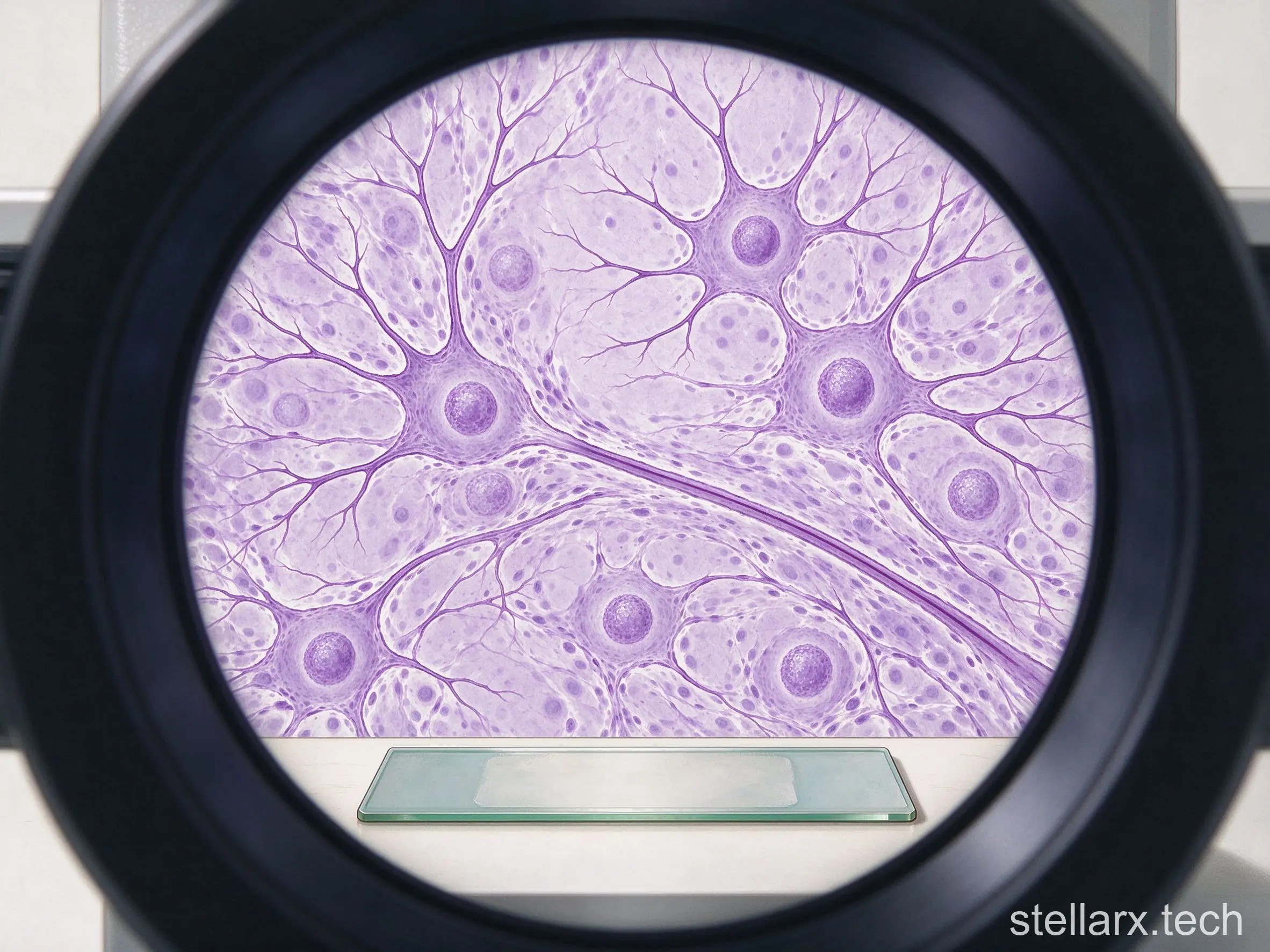
All of this runs on a class of cells you can see with your own eyes under a microscope. Neurons — with their branching dendrites receiving signals, cell bodies integrating them, and axons sending commands onward — are the hardware of every thirst decision your brain makes. The same neuron that reads plasma osmolarity in the SFO is the one counting your sips. No waiting three days for a microscope to arrive: the slide is ready to look at right now.
Want to see the cells that "know" you are thirsty? WWAI is an AI-powered biology encyclopedia that answers your biology questions instantly and lets you observe real microscope slide specimens online — including a nerve cell specimen where the cell body, dendrites, and axon are clearly visible. Search "WWAI" in your app store and download it today.
References:
[1] Zimmerman CA, Lin YC, Leib DE, et al. Thirst neurons anticipate the homeostatic consequences of eating and drinking. Nature. 2016;537:680–684. doi:10.1038/nature18950
[2] Zimmerman CA, Huey EL, Ahn JS, et al. A gut-to-brain signal of fluid osmolarity controls thirst satiation. Nature. 2019;568:98–102. doi:10.1038/s41586-019-1066-x
[3] All illustrations are AI-generated.
- Why Big Cats Never Get Scurvy but Sailors Did
- Three Years of Coughs, Endless Clinic Visits — Then Mom Opened the Wardrobe
- The ACL Tear Behind a Viral Dance Trend — Your Knee's Twisting Limit
- Why Thirst Vanishes the Moment You Swallow — Your Brain Settles the Bill in Advance
- The Egg-White-Like Solid on Steamed Crab Is Blood — Here's the Biology
- Bill Gates Warns AI Could Kill a Billion People — and Says Self-Regulation Has Failed
- The "Textbook Diet": 7 Nutrition Rules Most Diet Advice Misses
- Flu Season Is Back: Why the Annual Flu Shot Is a Biology Lesson Worth Taking
- Matcha Benefits: What 3 Grams of Matcha Powder Actually Contains
- The 60-cm Long Egg Tart Is Delicious for 3 Bites — Then Sickeningly Rich. Here's the Biology
全部评论